
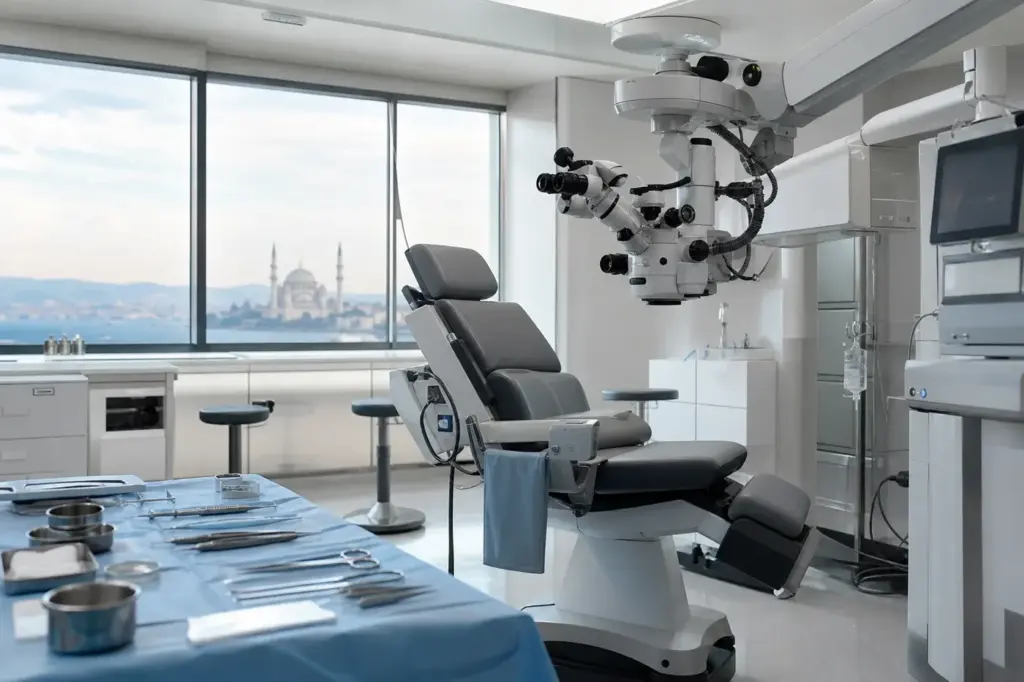
Information only. This article explains what a treatment is and how it is usually carried out. It is not medical advice, not an offer and not a recommendation to have any procedure. Whether it suits you can only be decided by a licensed doctor after an examination.
Smart lens surgery, also known as refractive lens exchange, is an elective procedure popular with international visitors seeking vision correction in Istanbul. Many clinics in the city offer this treatment, and understanding what it involves, its typical process and realistic expectations helps you make an informed decision before committing to treatment abroad.
This guide explains what the procedure is, how it works, what to prepare, typical recovery timelines, risks and complications, and important questions to ask your doctor. Remember: suitability for this procedure can only be decided by a licensed eye surgeon after a thorough examination in person.
Quick answer: Refractive lens exchange involves removing the natural lens of your eye and replacing it with a clear intraocular lens (IOL) with different lens power to correct your vision. The procedure is typically performed on an outpatient basis, meaning you can return home the same day. Initial recovery usually takes about a week.
At a Glance
| Total time | Procedure: 10–15 minutes per eye. Total visit: 4–5 days in Istanbul (allowing time for pre-op exams and initial post-op checks before travel). |
|---|---|
| Typical cost | ₺₺₺ |
What You Need Before You Start
- Full eye examination and measurements to determine IOL power and type suitable for your eyes
- Medical clearance and health history review, particularly for blood-thinning medications, diabetes, and eye conditions
- Current glasses and contact lens prescription records
- Pre-surgery measurements and imaging (keratometry, biometry)
- Ability to attend follow-up appointments during your stay and after returning home
- Written treatment plan outlining the procedure, expected outcomes, risks and post-operative care
Compare Your Options
| Option | Duration | Price | Notes |
|---|---|---|---|
| Multifocal (bifocal) IOL | Same procedure; different lens type | Allows vision at two focal distances (distance and near). Reduces but does not eliminate the need for reading glasses. May cause mild halos at night for some patients, which usually diminish over time. | |
| Trifocal IOL | Same procedure; different lens type | Provides vision at three distances: far, intermediate and near. Offers broader range of vision without glasses for most daily tasks. May have more pronounced night-time halos initially compared to bifocal lenses. | |
| Monofocal (single-focus) IOL | Same procedure; different lens type | Optimized for one focal distance (typically distance vision). Provides the clearest vision at your chosen distance but requires reading glasses for near tasks. Fewest optical side effects and halos. |
₺ budget · ₺₺ moderate · ₺₺₺ upscale · ₺₺₺₺ splurge. Price levels are estimates compared with typical prices for visitors.
Step-by-Step Instructions
Step 1: Consultation and eye examination
Before surgery, your eyes will be carefully examined and measurements will be taken to determine the appropriate power and type of IOL to be implanted. The surgeon will review your vision history, current prescriptions, and any eye conditions. Discuss your visual goals (distance vision, reading, driving) to help select the most suitable lens type. Ask for a written report of your eye measurements and the specific lens model recommended.
Tip: Bring your current glasses and contact lens prescriptions to the consultation, as these help the surgeon understand your vision history.
Step 2: Pre-operative preparation
The procedure is performed under local anesthesia to numb the eye area, ensuring your comfort throughout the process. The surgical site will be marked, and drops will be applied to dilate your pupil. Avoid eating and drinking for a few hours before surgery as directed. Arrange for someone to drive you home, as your vision will be blurred immediately after the procedure.
Tip: Follow all pre-operative instructions from your clinic exactly, including when to stop any blood-thinning medications or eye drops.
Step 3: Lens removal via phacoemulsification
The surgeon creates a small, self-sealing incision in the cornea and uses phacoemulsification—a technique using ultrasonic energy—to break up the natural lens and gently remove it. You may see light and feel slight pressure, but local anesthesia prevents pain. This step typically takes a few minutes per eye.
Tip: Stay as still as possible during this phase; the surgeon will guide you through what to expect.
Step 4: IOL implantation
An artificial IOL is carefully inserted into the lens capsule—the membrane that previously held your natural lens in place. The vision-correcting IOL is positioned through the same small incision, which typically heals naturally without the need for stitches. The type of IOL (monofocal, multifocal, or trifocal) determines how well you see at different distances.
Tip: Ask your surgeon to confirm which specific IOL model is being implanted and request a record card you can keep.
Step 5: Immediate post-operative care
Numbing anesthetic drops are used during the procedure, and most people report immediate vision improvement after surgery. You will wear a protective shield over your eye and receive prescription eye drops to prevent infection and reduce inflammation. Avoid rubbing your eye, water contact, and strenuous activity for the first few days. Pain, fever, sudden vision loss or heavy bleeding warrant immediate medical attention.
Tip: Keep your eye shield on as directed, even while sleeping, to protect the healing incision.
Step 6: Initial healing phase (week one)
Initial recovery—when you can resume normal everyday activities—usually takes about a week, and you should be able to return to work and resume driving within a week depending on your surgeon's instructions. You may notice vision disturbances such as blurry vision, halos and glare, or a scratchy sensation as your eyes heal. Attend all scheduled post-operative appointments before leaving Istanbul.
Tip: Do not drive or operate machinery until your surgeon confirms your vision is safe and stable.
Step 7: Ongoing recovery and follow-up
Most patients notice improved vision within a few days, with continued improvement over several weeks as the eyes heal and adjust to the new lenses. Initial activities can usually be resumed within a day or two, though you should avoid strenuous activities, swimming, and eye rubbing for several weeks. Arrange for follow-up exams with an eye doctor in your home country within 1–2 weeks of returning.
Tip: Wear sunglasses outdoors during the first few weeks to reduce glare sensitivity as your eyes adjust.
Common Mistakes to Avoid
- Not discussing your visual lifestyle and goals (driving, reading, computer work) with your surgeon before choosing a lens type. Different IOL types suit different needs, and selecting the wrong one can lead to disappointment.
- Underestimating recovery time and returning to strenuous activity, sports or heavy lifting too soon, which can compromise healing and increase risk of complications.
- Ignoring warning signs after surgery: sudden vision loss, severe pain, fever, or heavy bleeding should prompt immediate medical evaluation. Delaying treatment for serious complications can cause permanent vision loss.
- Failing to arrange follow-up care in your home country. Your local eye doctor needs to monitor your healing and manage any delayed complications after you return.
- Not obtaining a written copy of your surgical records, IOL model and serial number, and post-operative instructions. These are essential for future eye care and for any complications.
Tickets, Payment and Booking
Contact a licensed eye clinic or hospital in Istanbul directly. Many international health tourism facilitators and clinic websites provide contact forms. Verify that your chosen clinic holds a valid Health Tourism Authorization Certificate from the Turkish Ministry of Health and is staffed by licensed ophthalmologists. Request a written quote covering the procedure, IOL type, medications, pre- and post-operative exams, and any additional services. Payment methods vary; ask whether the clinic accepts international cards, bank transfers, or cryptocurrency, and clarify what is included in the quoted price. Avoid unofficial intermediaries and unsolicited offers; contact the clinic’s official website or phone number directly.
Good to know
- Have a comprehensive eye exam with your home country eye doctor before traveling for surgery. This establishes your baseline and helps your local doctor monitor any changes after the procedure. Bring a copy of that exam report to your Istanbul consultation.
- Do not make a final decision during your first consultation. Take time to review the written treatment plan, IOL options and risks, and discuss with your home country eye doctor via telehealth if possible. Reputable clinics will not rush you.
- Both eyes are usually done separately, about a week apart, to allow the first eye to stabilize before operating on the second. Budget enough time to remain in Istanbul for both procedures and initial healing before travel.
- Night-time halos and glare, especially with multifocal lenses, are common in the first weeks but typically improve as your brain adapts. Ask your surgeon whether your specific IOL and prescription choices are likely to cause these effects.
- Arrange for a local eye doctor in your home country to examine you within 1–2 weeks after your return. They can assess healing, check for delayed complications and provide continuity of care if issues arise.
- Keep your IOL card and surgical records safely and share them with any eye doctor you see in the future. Knowing your IOL model, power and serial number is essential for follow-up care and any future procedures.
Explore Nearby Smart Lens Surgery
Related guides
 Best Museums by Category: Ottoman Palaces to Contemporary Art
Main image: AI-generated illustration. It may not show the place exactly as it looks.
 Best Bars and Nightlife by Neighborhood: Where to Go Out in Istanbul
Main image: AI-generated illustration. It may not show the place exactly as it looks.
 Family-Friendly Things to Do: 10 Istanbul Activities for All Ages
Main image: AI-generated illustration. It may not show the place exactly as it looks.
 How to Visit a Hammam: Process, Etiquette and Where to Go in Istanbul
Main image: AI-generated illustration. It may not show the place exactly as it looks.
Browse more: All Other · All Treatments
FAQ
Is smart lens surgery the same as cataract surgery?
The surgical technique is identical: both remove the natural lens and implant an IOL. The difference is the reason: cataract surgery removes a clouded lens to restore vision; smart lens surgery removes a clear lens to correct refractive errors such as myopia, hyperopia, presbyopia or astigmatism. Suitability and long-term outcomes differ.
Can smart lens surgery be reversed?
The artificial lens implant is permanent and designed to last your lifetime. The natural lens cannot be restored. However, if the IOL power is incorrect, the lens can be exchanged for a different one, though this requires additional surgery.
Will I need glasses after smart lens surgery?
It depends on the IOL type chosen. Multifocal and trifocal lenses reduce or eliminate the need for glasses for most tasks, but some people still need reading glasses or glasses for certain distances. Monofocal lenses provide clear vision at one chosen distance; you will likely need reading glasses for near tasks.
How long does the procedure take?
The actual surgery takes about 10–15 minutes per eye. However, your total time at the clinic that day will be 1–2 hours, including pre-operative preparation, anesthesia and post-operative checks.
When can I travel home after smart lens surgery?
Most clinics recommend staying in Istanbul for 4–5 days after your first eye surgery to monitor healing and perform post-operative checks. If both eyes are done separately, allow at least 7–10 days total. Flying with a healing eye surgery is generally safe after the first week if cleared by your surgeon.
What if I get an infection after I return home?
Signs of infection include increasing pain, severe redness, discharge, fever or vision loss. Seek immediate medical attention from your local eye doctor or emergency room; do not wait. Provide your surgical records and IOL details. Most infections can be treated with antibiotics if caught early.
How do I verify that a clinic is legitimate and safe?
Check that the clinic holds a valid Health Tourism Authorization Certificate from the Turkish Ministry of Health, has licensed ophthalmologists on staff, and is accredited by international bodies such as JCI. Request references or before-and-after records (though you should not rely on these alone). Speak directly with the clinic, not intermediaries.
Is smart lens surgery suitable for younger people?
Smart lens surgery is most commonly performed on people aged 40 and above, when presbyopia (age-related near vision loss) becomes noticeable. Younger people with very high myopia or hyperopia unsuitable for LASIK may be candidates, but the decision must be made by a surgeon after examination. Youth alone is not a barrier, but long-term outcomes depend on individual eye health.
Not legal advice. This is general information for visitors. Rules on visas, entry, registration, customs and similar matters change often and can depend on your nationality. Check the official source and, if in doubt, ask your embassy or a qualified adviser.
Before you decide anything
Risks and possible complications
- Infection inside the eye (endophthalmitis), though rare; treated with antibiotics but requires urgent attention
- Retinal detachment, a more serious risk for people with high nearsightedness; may require surgery
- Temporary visual disturbances such as halos, glare around lights, or blurred vision, usually diminishing as healing progresses
- Posterior capsule opacification (thickening of the membrane behind the lens); can be managed by laser treatment if it affects vision
- Dry eye symptoms, temporary or persistent, managed with drops or other treatments
- IOL malposition or dislocation, requiring additional surgery; uncommon with modern techniques
- Inflammation and mild discomfort during healing; managed with prescribed drops
- Over- or under-correction of vision, requiring glasses or additional procedures in some cases
Alternatives to talk about with a doctor
- LASIK or PRK laser eye surgery (reshapes the cornea; best for moderate refractive errors; not suitable for high myopia or farsightedness)
- Phakic intraocular lenses (IOL implanted without removing the natural lens; considered when the natural lens is clear)
- Corneal inlays or rings (address presbyopia without lens removal; less invasive but shorter-lasting)
- Continuing to wear glasses or contact lenses (no surgical risk; reversible; requires ongoing maintenance and cost)
Questions to ask a licensed doctor
- Am I a suitable candidate for this procedure? What tests determine this?
- What is the specific IOL model you propose, and why is it suited to my vision goals and eye anatomy?
- What is your experience with this procedure? How many have you performed?
- What are the realistic outcomes for my vision after surgery, and how long do results last?
- What are the specific risks and complications for my eyes, given my medical history and eye condition?
- What is your post-operative protocol, and what signs warrant immediate medical attention?
- Will you provide a written treatment plan, surgical records and IOL details that I can show my home country eye doctor?
- Do you arrange or coordinate follow-up care with eye doctors in my home country?
- If complications occur after I return home, how will you support or help manage them?
- Is the fee all-inclusive, and what is not covered?
- This page is information. It is not medical advice and not a recommendation to have any treatment or to choose any clinic, doctor or country.
- Every medical procedure has risks, and results and healing differ from person to person. A licensed doctor who has examined you decides whether a treatment is suitable.
- Talk to a doctor in your home country before you decide, and plan follow-up care at home: problems can appear after you return.
- Check that the clinic and the doctor are licensed in the official register of the Türkiye Cumhuriyeti Sağlık Bakanlığı, and ask for a written treatment plan and a consent form you understand.
- After a procedure, get urgent medical help for severe pain, fever, heavy bleeding or breathing problems. In an emergency call the local emergency number.
Kontrendikasyonlar olabilir. Bir uzmana danışmak gerekir.

Take this guide with you
Get a free PDF of this guide to print or read offline: key facts, tips and a map link on a few clean pages.
Report an issue on this page
How we research and update our guides
About this page: AI assistance and accuracy
This page was prepared with the help of AI and checked by automatic rules. It is general information only, not medical advice and not a recommendation to have any treatment or to choose any clinic. Mistakes can still happen and details can change without notice. Please check important details with the official source and talk to a licensed doctor before you decide anything.
