
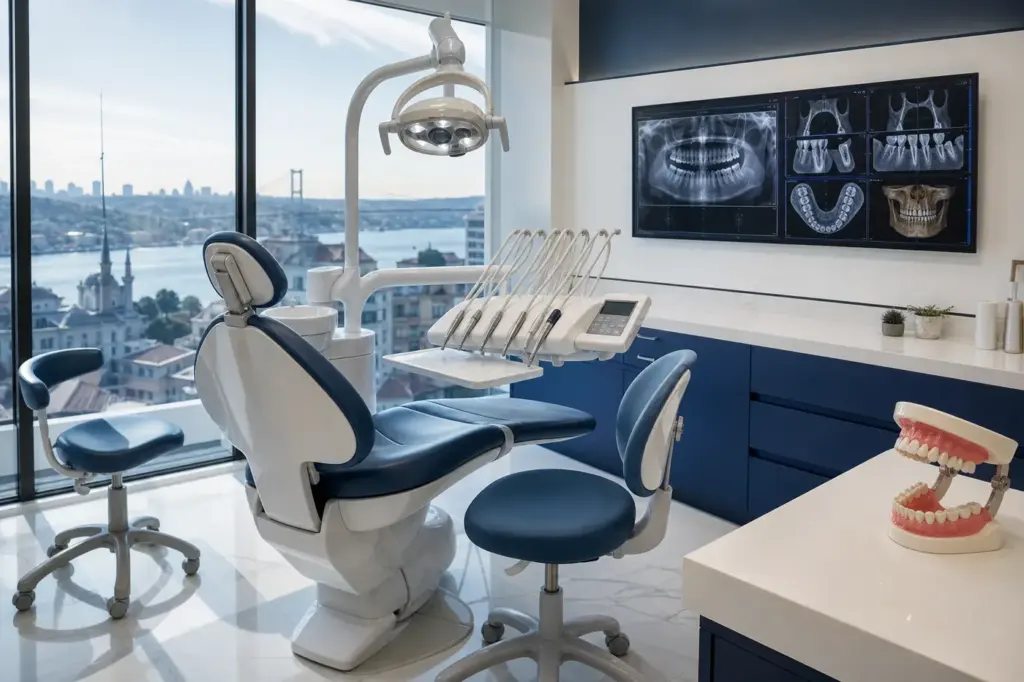
Information only. This article explains what a treatment is and how it is usually carried out. It is not medical advice, not an offer and not a recommendation to have any procedure. Whether it suits you can only be decided by a licensed doctor after an examination.
All-on-4 implants are a full-mouth restoration option for people with missing or failing teeth throughout one jaw. This article explains what the procedure involves, how it works, the typical phases from planning through recovery, and important considerations before deciding on treatment.
Many travellers from abroad consider dental procedures in Istanbul, where quality, regulation and advertising standards differ from their home countries. The Turkish Ministry of Health sets the rules for health services and for foreign patients; readers should verify the licence and credentials of any clinic and doctor through official registers before treatment.
Quick answer: All-on-4 replaces a full arch of missing or failing teeth with four titanium implants placed in the jaw, supporting a fixed prosthesis with 10 to 14 teeth attached typically within 24 hours of surgery. Two implants are placed straight near the front of the jaw where bone is thickest, and two more angle back at roughly 30 to 45 degrees to reach denser bone while avoiding vital structures. The implants then fuse with bone over 3 to 6 months; the full recovery and integration generally takes this period, during which the titanium implants fuse with bone and gum tissues heal.
At a Glance
| Total time | Surgery typically 30 minutes to 2 hours per jaw. Initial healing 1–2 weeks. Full bone integration 3–6 months. |
|---|---|
| Typical cost | ₺₺₺ |
What You Need Before You Start
- Sufficient jawbone density and height, especially in the front jaw area; assessed through 3D imaging
- Medical evaluation including health history and smoking status, as these affect healing
- Any missing or failing teeth removed before implant placement
- Ability to attend two visits typically 3–6 months apart: first for surgery and implant placement, second for final restoration
- Commitment to soft foods and careful oral hygiene during healing
- Follow-up care plan arranged with a dentist in your home country before returning
Compare Your Options
| Option | Duration | Price | Notes |
|---|---|---|---|
| All-on-4 (four implants per arch) | Same-day surgery; healing 3–6 months | The standard approach, using four angled implants to maximize available bone and avoid grafting in most cases. Temporary teeth can be attached the same day in many clinics. | |
| All-on-6 (six implants per arch) | Same-day surgery; healing 3–6 months | Uses six implants instead of four, offering more support points and potentially greater long-term stability. Typically recommended for patients with severe bone loss or who prefer additional support. | |
| Traditional full-mouth implants (one implant per tooth) | Multiple surgeries over 6–12 months; total healing 6–12 months or longer | Places a separate implant for each missing tooth, requiring more implants, more bone grafting and longer treatment. May be preferred for patients with minimal bone loss who want maximum customization per tooth. | |
| Removable dentures | Planning and fabrication 2–4 weeks | No surgery required; can be removed for cleaning. Lower upfront cost but requires daily removal, carries risk of slipping, and does not prevent jawbone loss. Comfort and fit may decrease over time as bone resorbs. | |
| Removable dentures on implants | Surgery 1–2 hours; healing 3–6 months | Two to four implants support a snap-on denture that is removable. Combines stability of implants with removability of dentures; simpler than fixed All-on-4 but requires daily maintenance. |
₺ budget · ₺₺ moderate · ₺₺₺ upscale · ₺₺₺₺ splurge. Price levels are estimates compared with typical prices for visitors.
Step-by-Step Instructions
Step 1: Initial consultation and imaging
Have a consultation with 3D imaging and health review to check bone, sinuses and nerves; your dentist or surgeon will plan implant positions using the scans. Bring medical records, medication list and details of any blood disorders or conditions that affect healing. The clinic will review your smoking status and general health, as these influence recovery.
Tip: 3D imaging (CBCT scans) is essential to map your jaw anatomy and avoid vital structures like nerve canals and sinuses.
Step 2: Tooth extraction if needed
Any failing teeth are removed and the four titanium implants are placed in the jaw. The surgeon typically performs this in a single session under local anaesthesia. A temporary fixed bridge may be attached the same day if implants achieve sufficient stability at placement.
Tip: If implants lack primary stability at placement, the surgeon will delay the temporary bridge until healing is further advanced.
Step 3: Immediate post-operative care (first 24–72 hours)
Numbness from anaesthetic wears off, and mild to moderate tenderness, swelling, oozing and bruising can occur. The dental team may recommend prescribed or over-the-counter pain relief, cold compresses during the first day and rest with the head elevated. Soft, cool foods and adequate fluids are usually most comfortable.
Tip: Swelling peaks within 48 to 72 hours and gradually improves over the following weeks. Avoid strenuous activity and hard foods.
Step 4: Healing period (one to four weeks)
Many patients return to non-strenuous work within several days, but physically demanding activities may need more time. Continue soft foods, gentle oral hygiene as instructed, and attend any follow-up appointments. If you received a temporary bridge, avoid chewing hard foods or putting excessive pressure on it.
Tip: Most surface healing of gums occurs within 2 to 4 weeks, but bone integration continues underneath.
Step 5: Bone integration phase (three to six months)
The implants are fusing with your bone, a process that may take 3–6 months. During this time it is essential to avoid putting pressure on the implants by avoiding hard foods. You will wear a temporary bridge during most or all of this period. Maintain excellent oral hygiene and avoid smoking, which delays healing.
Tip: Integration speed varies by individual health, bone quality and smoking status. Your dentist will monitor progress at check-ups.
Step 6: Final restoration
Once osseointegration is stable, your team fits a final custom prosthesis. This usually occurs after 3 to 6 months. The final prosthesis is fabricated to your bite and aesthetic preferences and is permanently attached to the implants.
Tip: Ask your dentist whether the final prosthesis can be removed for maintenance or is fully fixed.
Step 7: Lifelong maintenance
Brush and floss around the implants daily, avoid hard or sticky foods that can stress the bridge, and attend dental check-ups every 6 months to monitor implant health and prosthesis condition. Peri-implantitis (gum disease around implants) and prosthesis wear are the main long-term concerns.
Tip: Good daily oral hygiene is as important for implants as for natural teeth to prevent infection and bone loss.
Common Mistakes to Avoid
- Assuming that recovery has no downtime. The surgery is usually performed under local anaesthesia, with pressure but limited sharp sensation, and sensations differ from person to person. Swelling, tenderness and bruising for several days are common. Many people return to light activities within one to two weeks, while full recovery can take 3–6 months.
- Not arranging follow-up care at home before leaving Istanbul. Implant integration needs monitoring and adjustment as bone heals, so it helps to confirm that a home dentist can provide follow-up X-rays, adjustments and maintenance.
- Underestimating the need for adequate bone quality and density. If the jaw lacks sufficient bone, a bone graft may be needed, which can extend the timeline. Whether bone will support four implants is a question for the dentist.
- Choosing a clinic solely on price or marketing without verifying the dentist's licence. The register of the Turkish Ministry of Health can be used to check licences, and references and details of experience with this technique can be requested.
- Smoking or poor oral hygiene during healing. Both can slow bone integration and raise infection risk, which can lead to implant failure. Dentists usually advise stopping smoking before surgery and keeping up careful oral hygiene.
- Eating hard, sticky or crunchy foods during healing. Even with a temporary bridge, chewing forces can disturb bone healing around the implants. Dentists usually advise soft foods for the first months and say when normal foods can gradually return.
- Not discussing expectations for appearance and function. All-on-4 aims to restore function and appearance, but the final result depends on bone anatomy, gum contours and prosthetic design, and differs from person to person.
Tickets, Payment and Booking
All-on-4 treatment in Istanbul requires advance consultation and planning. Most clinics require an initial in-person or online assessment before surgery is scheduled. Contact clinics directly or through their official websites to request imaging, consultation and treatment quotes.
Payments and foreign visitors: Many Istanbul dental clinics accept international credit cards and bank transfers. Some offer payment plans. Foreign visitors should confirm in advance whether their home country’s banking or payment rules allow transactions with Turkish providers; sanctions regulations vary by nationality and may restrict certain payment methods. Verify this with your bank before committing to treatment.
Booking: Reputable clinics will provide a written treatment plan in English, detail all fees upfront, explain the phases of treatment, and arrange follow-up care. Be cautious of clinics that pressure you into same-day decisions or offer unusually low prices without clear explanation of what is included. Ask whether the quote covers imaging, surgery, temporary teeth, final prosthesis, and follow-up appointments.
Good to know
- Plan your trip for the first visit to allow 5–7 days in Istanbul: one day for consultation and imaging, one day for surgery, and 3–5 days of initial recovery before travelling. Many clinics arrange hotel and ground transport as part of packages, which simplifies logistics while you are uncomfortable.
- Arrange your follow-up dental care at home before surgery. Email your home dentist scans and treatment details in advance so they know what to expect and can coordinate monitoring. This is essential; your home dentist will manage X-rays and adjustments between your Istanbul visits and after the final restoration.
- Quit smoking for at least two weeks before surgery and ideally throughout healing. Smoking significantly delays bone integration, increases infection risk and can lead to implant failure. Many clinics may delay surgery if you are a current heavy smoker.
- Pack soft foods for your recovery period: yoghurt, soup, smoothies, mashed vegetables, scrambled eggs, pudding. Avoid hot foods for the first few days. Bring any medications you take regularly, as running out during recovery can complicate healing.
- The temporary bridge fitted after surgery is functional but not final. It may feel bulky or require bite adjustments over the first weeks. Eat carefully on it and report any looseness or discomfort to your clinic immediately; minor adjustments early prevent bigger problems later.
- If you receive implants in both jaws, one jaw is usually treated first; the second is planned 1–3 months later to allow the first to heal. This spreads treatment over two trips and reduces the intensity of recovery.
Explore Nearby All-on-4 Implants
Sights near All-on-4 Implants
 Basilica Cistern · typical visit: 1 hour4 min on foot from Gülhane metro, Open daily 09:00–18:30
Main image: AI-generated illustration. It may not show the place exactly as it looks.
 Blue Mosque · typical visit: 45–75 minutes3 min on foot from Gülhane metro
Main image: AI-generated illustration. It may not show the place exactly as it looks.
 Hagia Sophia · typical visit: 1–1.5 hours8 min on foot from Gülhane metro, Open daily 09:00–19:30
Main image: AI-generated illustration. It may not show the place exactly as it looks.
 Topkapi Palace · typical visit: 3–4 hours without Harem; 4–5 hours with Harem15 min on foot from Gülhane metro, Open 09:00–18:30, closed Tue
Main image: AI-generated illustration. It may not show the place exactly as it looks.
 Grand Bazaar · typical visit: 2–4 hours4 min on foot from Beyazıt-Kapalıçarşı metro, Open 08:30–19:00, closed Sun
Main image: AI-generated illustration. It may not show the place exactly as it looks.
Browse more: All Other · All Treatments
FAQ
How long does the entire All-on-4 process take from start to finish?
For All-on-4 or All-on-6, typical visits are 2 visits over months, with visit 1 lasting 5–7 days and visit 2 lasting 6–8 days. The first visit includes consultation, imaging, tooth extraction if needed, implant surgery and temporary bridge placement. The second visit, typically 3–6 months later, is for final prosthesis delivery and adjustments. Total time from first visit to fully functional teeth is usually 3–6 months.
Can I get temporary teeth the same day as surgery?
The four implants support a fixed prosthesis with 10 to 14 teeth, and it is placed immediately, typically within 24 hours of surgery. However, this depends on whether the implants achieve sufficient primary stability at placement. If stability is inadequate, your dentist will delay the temporary bridge until implants heal further, usually 1–2 weeks later.
Do I need to be asleep for the surgery?
Your specialist will place four or more implants per arch, typically under local anesthesia. Local anaesthesia numbs the jaw so you feel pressure but not sharp pain. You remain awake and aware. Some patients receive sedation to help them relax; ask your clinic if this is available.
Will I have pain during and after the surgery?
During surgery you should feel no sharp pain, only pressure and vibration, because local anaesthesia blocks sensation. After surgery, the numbness wears off over 4–5 hours and mild to moderate tenderness, swelling and bruising are normal. Your dentist will prescribe or recommend pain relief. Severe pain is unusual and should be reported immediately as it may signal infection or other complications.
How much time off work do I need?
Many patients return to non-strenuous work within several days, but physically demanding activities may need more time. Plan at least 1–2 weeks off for initial recovery. Avoid heavy lifting, strenuous exercise and intense physical activity for 2–4 weeks to allow bone healing to progress undisturbed.
Can I eat normally after All-on-4?
A soft-food diet and careful oral hygiene help protect the implants while bone healing takes place. For the first 3–6 months, stick to soft foods: soups, yoghurt, mashed vegetables, fish, eggs. Avoid hard, sticky, crunchy or hot foods. After 6 months, as bone integration completes, you can gradually return to harder foods, though very hard foods (nuts, hard candies, ice) should be chewed carefully to avoid stressing the prosthesis.
Is the procedure suitable if I have health conditions like diabetes or heart disease?
Many health conditions can affect implant healing or surgery safety. Diabetes, heart disease, blood disorders, immune conditions, and medications like blood thinners may complicate recovery or increase infection risk. Your dentist must evaluate your full medical history and may require clearance from your physician before proceeding. Be honest about all conditions and medications during your consultation.
How do I know if the clinic and dentist are properly licensed?
The Turkish Ministry of Health regulates dental clinics and practitioners. Ask the clinic for their registration number and verify it independently through the Turkish Ministry of Health database if possible. Request the dentist's credentials and experience. Ask for references or examples of previous work. Reputable clinics will provide this information willingly.
Before you decide anything
Risks and possible complications
- Infection at the implant site during surgery or early healing; signs include fever, excessive swelling, severe pain, or pus discharge within the first few weeks
- Implant failure to integrate with bone, typically occurring within 3–6 months; risk is higher in heavy smokers, patients with poor bone quality, and those with certain chronic conditions
- Nerve irritation or temporary numbness in the lower jaw or chin, usually resolving within weeks but occasionally persisting
- Sinus complications if implants placed in the upper jaw extend into or irritate sinus cavities, causing pain or sinus infection
- Peri-implantitis (gum and bone inflammation around the implant) from bacterial accumulation, similar to gum disease, occurring months or years after placement if oral hygiene is poor
- Fracture or loosening of the temporary or final bridge from chewing force or accident
- Allergic reaction to titanium or implant materials (very rare)
- Excessive bleeding or haematoma (blood collection) after surgery
- Prolonged swelling, bruising or pain lasting longer than expected
Alternatives to talk about with a doctor
- Traditional implant placement (one implant per missing tooth); more implants but may avoid grafting if bone is adequate
- Implant-supported removable denture (two to four implants with a snap-on denture); simpler surgery but requires daily removal and maintenance
- Fixed bridge supported by remaining natural teeth or single implants; option only if some natural teeth remain
- Conventional removable dentures; no surgery, lower cost, but do not prevent bone loss and may be uncomfortable or unstable
- Keeping remaining natural teeth with partial dentures or bridges; preserves natural tooth roots and bone stimulation
- Waiting and monitoring bone loss; if bone loss is severe, delaying treatment may increase need for grafting later
Questions to ask a licensed doctor
- Is my bone density and volume sufficient for All-on-4 without bone grafting? If grafting is needed, how will it affect cost and timeline?
- Do I have any conditions—such as diabetes, blood disorders, immune suppression, or medications like blood thinners—that affect implant healing?
- Am I a suitable candidate given my age, health, smoking status and oral hygiene habits?
- What is your experience with All-on-4? How many procedures have you completed? What are typical outcomes and complication rates in your practice?
- Will I receive a written treatment plan detailing the phases, timeline, costs, risks, and what is included or excluded?
- Will temporary teeth be attached the same day? If not, when will they be fitted?
- What are the warning signs of complications (infection, implant failure, nerve problems) that I should watch for and report immediately?
- How will follow-up care be handled after I return home? Do you have a relationship with dentists in my country, or will my home dentist need to manage my care?
- What is the longevity of the prosthesis? When will it typically need replacement?
- Are there restrictions on eating, drinking, smoking or exercise during healing? For how long?
- What happens if an implant fails to integrate or a complication occurs? What are my options and costs?
- This page is information. It is not medical advice and not a recommendation to have any treatment or to choose any clinic, doctor or country.
- Every medical procedure has risks, and results and healing differ from person to person. A licensed doctor who has examined you decides whether a treatment is suitable.
- Talk to a doctor in your home country before you decide, and plan follow-up care at home: problems can appear after you return.
- Check that the clinic and the doctor are licensed in the official register of the Türkiye Cumhuriyeti Sağlık Bakanlığı, and ask for a written treatment plan and a consent form you understand.
- After a procedure, get urgent medical help for severe pain, fever, heavy bleeding or breathing problems. In an emergency call the local emergency number.
Kontrendikasyonlar olabilir. Bir uzmana danışmak gerekir.

Take this guide with you
Get a free PDF of this guide to print or read offline: key facts, tips and a map link on a few clean pages.
Report an issue on this page
How we research and update our guides
About this page: AI assistance and accuracy
This page was prepared with the help of AI and checked by automatic rules. It is general information only, not medical advice and not a recommendation to have any treatment or to choose any clinic. Mistakes can still happen and details can change without notice. Please check important details with the official source and talk to a licensed doctor before you decide anything.
