
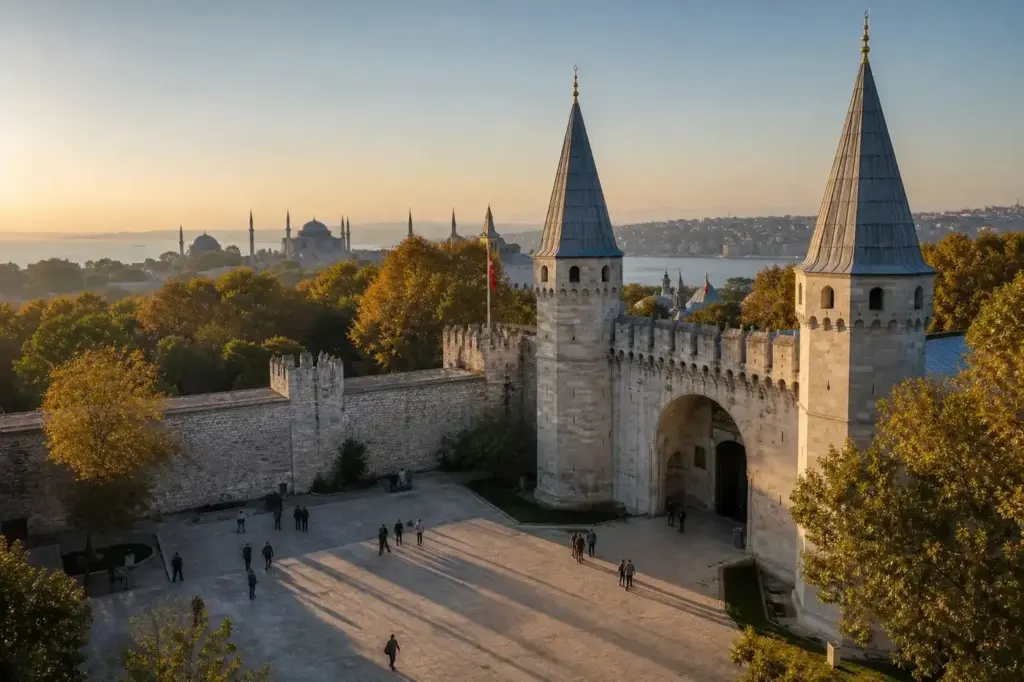
Topkapi Palace stands at the tip of the historic Sultanahmet peninsula, where the Bosphorus meets the Golden Horn. For 400 years it served as the working heart of the Ottoman Empire—the residence of sultans and the seat of imperial power that ruled an empire stretching across three continents. The massive complex, with its courtyards, pavilions and gardens covering over 700,000 square metres, reveals how the sultans lived, governed and accumulated the wealth that built Ottoman civilization.
What makes Topkapi different from a typical palace is its layout: a series of courtyards separated by walls and gates, designed so that each section had a specific function—administration, ceremony, the harem, the treasury. Walking through it today, you move between these distinct worlds, each with its own scale and intimacy.
Quick Facts
| Built / opened | 1459–1478 |
|---|---|
| Architect(s) | Mehmed II (patron); constructed under various imperial architects including Mimar Sinan |
| Address | Cankurtaran, 34122 Fatih, Istanbul, Turkey Google MapsApple MapsYandex Maps |
| District | Fatih |
| Metro | Sultanahmet (T1 Tram, Main entrance 5-minute walk from station) |
| Opening hours | Mon-Sun 09:00-18:30 (Apr–Oct); 09:00-17:30 (Nov–Mar) Closed Tuesdays Last entry 1 hour before closing Also closed first day of Ramadan Bayram and Kurban Bayramı |
| Admission | ₺₺ (combined ticket includes palace, Harem, and Hagia Irene Church) Free entry to First Courtyard only |
| Best time to visit | Topkapi is crowded, especially April to October, weekends, and midday (11:00 AM–3:00 PM). The best time to visit is weekday early morning, arriving within 15 minutes of opening (9:00 AM). Courtyards feel spacious and light is excellent. In spring (April–May) and autumn (September–October), weather is comfortable and crowds are manageable outside peak times.Summer (July–August) brings intense heat; the palace has limited shade in courtyards. Winter (November–February) is quiet and often clear, but can be rainy and the palace closes earlier (at 5:30 PM). Late afternoon light in autumn is particularly golden across the terraces and water.Avoid Fridays and weekends if possible, and avoid tour group hours (roughly 10:00 AM–2:00 PM). If you visit midday, the Harem and Treasury will be most crowded. Allow 1–1.5 hours extra if visiting at peak times. |
| Website | millisaraylar.gov.tr |
What Is (and Isn't) Part of a Visit to Topkapi Palace?
| Part | Status | Notes |
|---|---|---|
| Palace courtyards and galleries (Second, Third, Fourth) | Included in the standard ticket | Main palace admission covers courtyards, Council Chamber, Treasury, kitchens, and most interior galleries. |
| Harem (sultan's private quarters) | Included in the standard ticket | Harem is included in the combined ticket. It is accessible from within the palace and consists of approximately 400 rooms, with about 50 rooms open to visitors. |
| First Courtyard (outer court) | Included in the standard ticket | The First Courtyard is free to enter without purchasing a ticket. It is open to the public and contains the Imperial Gate, stables and outer buildings. |
| Hagia Irene Church (Aya Irini) | Included in the standard ticket | This Byzantine church inside the palace grounds is included in the combined ticket. It is accessed from the palace and hosts concerts and exhibitions. |
| Istanbul Archaeological Museum | Separate ticket or institution | The Museum is a separate institution located adjacent to the palace near Gülhane Park. It requires its own ticket and is not part of Topkapi Palace admission. |
| Gülhane Park | Outside / not part of it | The park is outside the palace walls but adjoins the side entrance. It is a public park, free to enter, with no palace ticket required. |
Why Visit Topkapi Palace?
This is Ottoman history in three dimensions. You see where imperial decisions were made, where the sultans’ families lived in elaborate seclusion, and where the empire’s greatest treasures—including the Spoonmaker’s Diamond and the Prophet’s cloak—are displayed. The Treasury alone contains thousands of objects: jade vessels, jeweled daggers, ornate robes and armor. The Harem section reveals the private world of royal women and children, with intricate tilework and intimate chambers. From the terraces, you look across the Golden Horn toward the mosques and tombs of centuries of Ottoman rule.
How Topkapi Palace Is Laid Out
The palace is arranged in four main courtyards, each entered through gates that control access and privacy. The First Courtyard is open to the public free of charge—this is the outer court where daily business and ceremonies took place. Beyond the Imperial Gate lies the Second Courtyard, the administrative heart, surrounded by the Imperial Council Chamber, kitchens and stables. The Third Courtyard is the palace proper, where the sultan lived and worked—smaller, more protected. The Fourth Courtyard and gardens sit at the highest point, with pavilions and terraces overlooking the water.
Most visitors start at the main entrance (Imperial Gate) on Soğuk Çeşme Street, opposite Hagia Sophia. There is also a side entrance via Gülhane Park, near the tram stop, which leads into the palace near the Archaeological Museum. The Harem requires a separate ticket and is accessed from within the palace. Allow time to move through security and understand the layout before heading to specific galleries—the palace is large and can feel confusing at first.
Highlights of Topkapi Palace
Imperial Gate (Bab-ı Hümayun)
The monumental main entrance, built in the 15th century as the symbol of imperial authority. Its fortress-like towers and inscriptions announce the power of the Ottoman state. You enter through this gate as sultans and their officials once did, and the First Courtyard beyond is the only section free to enter without a ticket. Look for the tower chambers above the gate and the scale of the walls—this was deliberate architecture designed to impress and intimidate.
Tip: Photograph the exterior of the gate from the side of Hagia Sophia for the best angle and least crowd in the early morning.
Treasury (Hazine)
The crown jewel of the palace, containing thousands of objects that reveal Ottoman craftsmanship and wealth. The Spoonmaker's Diamond—a 5-carat teardrop-shaped stone surrounded by smaller diamonds—is the most famous piece, but walk past cases of jade vessels carved in China, swords with gold and jeweled hilts, coral and pearl ornaments, and robes embroidered with real gold thread. Built in the 16th century, the Treasury is arranged in small rooms to control viewing and prevent theft.
Tip: Visit the Treasury early before midday tour groups arrive. Photography is not allowed inside, so take a moment to observe details rather than rush through.
Harem (Seraglio)
The private quarters of the sultan and his family, including approximately 400 rooms for wives, concubines, children and attendants. Only a portion is open to visitors, featuring richly tiled chambers with domed ceilings, intimate courtyards, and small gardens. Built and expanded over centuries, the Harem represents a hidden world within the palace—women and children rarely left these spaces. The tiling and carved marble work show extraordinary detail.
Tip: The Harem is accessed separately within the palace and requires a separate ticket (included in the combined admission). Visit this section mid-visit to break up time spent in galleries and courtyards.
Imperial Council Chamber (Divan)
The second-largest building in the Second Courtyard where the sultan's ministers gathered to hear imperial decisions and conduct state business. Built with an intricate domed roof and large windows overlooking the gardens, it conveys both power and order. The sultan would watch from a latticed window (the Window of Felicity) without being seen, allowing him to observe the divan's deliberations. Look for the calligraphy and the careful arrangement of benches.
Tip: The view from the Divan's window toward the Bosphorus makes this one of the most photographed interior spots. Visit before noon when light is clearer.
Kitchens and Pantries
A massive complex of kitchens lining one side of the Second Courtyard, with separate sections for the sultan, the harem, officials and the army. The sheer scale—enormous stone ovens, copper cauldrons and separate rooms for different functions—shows how many people the palace fed daily. Medieval and early modern palace kitchens rarely survive intact; these were restored to show how food was prepared and stored for imperial life.
Tip: The kitchen windows overlooking the courtyard provide excellent light for photography, especially mid-morning.
Spoonmaker's Diamond in the Treasury
Perhaps the world's most famous diamond in any museum, this 5-carat stone is set within a gold ring surrounded by smaller diamonds, creating a teardrop shape. The diamond arrived in Istanbul through various hands—possibly seized from a beggar who found it on a beach, though the story may be legend. It represents Ottoman wealth and the mystery of imperial treasures. The setting alone is a masterpiece of 18th-century jewel work.
Tip: The diamond is displayed in a small enclosed case within the Treasury. Go early to see it without a thick crowd blocking the view.
Third Courtyard and Pavilions
The innermost palace courtyard where the sultan held court and lived, surrounded by smaller, more intimate buildings than the outer courtyards. This is where the Topkapi Dagger is displayed in the Treasurey's third room, and where you can see the Library of Ahmed III, a small jeweled building from the 18th century with blue tilework and light-filled rooms designed for reading. The shift in scale from outer to inner courtyards shows the gradation of access and privacy.
Tip: The Library is often quieter than main galleries—this is a good place to pause and absorb detail.
Terrace Views of the Bosphorus and Golden Horn
The palace sits on the highest point of the Sarayburnu peninsula, and several terraces and gardens offer panoramic views toward the Bosphorus Strait, the Golden Horn waterway, and the European hills beyond. These views explain why the sultan chose this location—it was defensible, visible from the water, and allowed the ruler to overlook his city. In clear weather, you can see across to Asia and down toward the Marmara Sea.
Tip: Visit the terraces in late afternoon when the sun is lower and the light is softer. The view across the Golden Horn includes Galata Tower and the mosques of Sultanahmet.
Atmosphere
Topkapi is vast but surprisingly intimate in its details. The courtyards feel orderly and controlled—there are no crowds of people gathered in any single space, because the palace design separated functions and visitors. In the early morning, before tour groups arrive, you may have a courtyard largely to yourself, with only your footsteps echoing off stone. By midday, the palace fills with guided tours moving between galleries in tight groups, and courtyards become congested with bus-tour visitors.
The light changes dramatically as you move through courtyards and buildings—bright and open in the Second Courtyard overlooking the Sea of Marmara, then softer and more intimate in the Harem’s tiled rooms, then suddenly bright again on a terrace facing the water. The smell of water and salt air from the Golden Horn is constant. Ottoman music or Call to Prayer echoes from the surrounding city.
Architecturally, the palette is restrained: marble, tile, carved stone and wood rather than bright color. The Harem’s blues and greens in the tilework and the red of Turkish carpets are vivid against white walls, but the overall effect is of order and refinement rather than excess. You move through quiet galleries, then emerge into open courtyards that feel almost empty and very peaceful.
History of Topkapi Palace
Construction began in 1459, immediately after Mehmed II conquered Constantinople in 1453 and chose to make it the Ottoman capital. The palace was completed by 1478, though its layout would evolve for centuries. Mehmed II selected this promontory on the Sarayburnu (Seraglio Point) deliberately—it overlooked the harbor and the city, allowed the sultan to see and be seen, and was defensible. Early Ottoman palaces had followed the ruler on campaigns; this was the first true imperial seat designed to last.
For 400 years, thirty Ottoman sultans lived and governed from Topkapi. The palace grew in phases. In the 16th century under Süleyman the Magnificent, the Harem was expanded from a small section into the complex of 400 rooms that exists today, and the Treasury was formalized. The Imperial Council Chamber was rebuilt with its famous window overlooking proceedings. Under later sultans, pavilions were added—the Library of Ahmed III in the 18th century represented a calmer, more cultured vision of power, with emphasis on study and beauty rather than military might.
By the 19th century, Topkapi had grown cramped and old-fashioned. In 1856, the court moved to the newly built Dolmabahçe Palace on the Bosphorus, which had Western architecture and modern comforts. Topkapi Palace fell into slow decay. In 1924, after the fall of the Ottoman Empire and the founding of the Turkish Republic, the palace was declared a national museum. It has been gradually restored and expanded ever since, particularly in recent decades with new galleries and conservation work.
The palace was inscribed as a UNESCO World Heritage Site in 1985 as part of the Historic Areas of Istanbul. Today it remains one of the world’s most important documents of imperial life and Ottoman civilization, showing not just objects but the actual spatial arrangement of power, ceremony, family and daily life in a premodern empire.
Legends and Myths about Topkapi Palace
The Spoonmaker's Diamond
Legend – historically unreliable. Legend says a poor fisherman or street sweeper found this enormous diamond on a beach and sold it for three spoons—hence its name. The story claims he returned to find out what he had sold for, and the sultan rewarded him generously for his honesty. In truth, the diamond's origins are unclear; it likely came to Istanbul through imperial acquisition, seizure or trade. But the tale of humble discovery and unexpected fortune attached itself to the stone and endures in every guidebook and visitor story.
The Death of Ibrahim Pasha
Tickets and Booking for Topkapi Palace
| Ticket | Price | Includes |
|---|---|---|
| Combined Admission (Palace + Harem + Hagia Irene) | ₺₺ | Access to all courtyards, galleries, the Harem section, and Hagia Irene Church. Does not include audio guide (can be purchased separately). |
| First Courtyard Only | Free | Access to the outer courtyard, imperial gate, and stables. No access to paid galleries or the Harem. |
₺ budget · ₺₺ moderate · ₺₺₺ upscale · ₺₺₺₺ splurge. Price levels are estimates compared with typical prices for visitors.
Tickets are sold at the palace entrance (Imperial Gate on Soğuk Çeşme Street, near Hagia Sophia) and online through the official Milli Saraylar website (millisaraylar.gov.tr) and various ticket platforms. Online tickets are recommended to skip the ticket office queue, which can be 20–40 minutes during peak hours, especially midday and weekends.
Online sales typically open weeks in advance, though specific dates depend on the season. If a date shows as unavailable online, the palace may have reached capacity for that time slot (they manage visitor numbers). Same-day tickets are usually available if you arrive early (before 10:00 AM), but there is no guarantee. The palace is closed Tuesdays and the first day of major religious holidays (Ramadan Bayram and Kurban Bayramı).
At the gate, both individual and group tickets are available. You may need to show your passport or ID. Turkish citizens and students receive significant discounts (40–70% less); these rates are listed on the official site. Audio guides and guided tours can be added to admission. For all current rates, ticket types, and special discounts, consult the official Milli Saraylar website.
Suggested itineraries Topkapi Palace
2 hours
Enter via the Imperial Gate and walk through the First Courtyard free. Buy a ticket and visit the Second Courtyard, Treasury, and Imperial Council Chamber. Exit via the side gate near Gülhane Park. This covers the palace's most important and famous sections without the Harem.
3–4 hours
Start at the main entrance. Spend 45 minutes in the Second Courtyard and Treasury. Continue to the Third Courtyard and its pavilions (30 minutes). Then enter the Harem and spend 1.5 hours there, exploring the tiled rooms and courtyards. End on the terraces overlooking the water.
Half day (4–5 hours)
Complete visit: First Courtyard, Second Courtyard (Council, kitchens, stables), Treasury, Third Courtyard pavilions and gardens, Harem with all open sections, Hagia Irene Church. End at the terrace cafés for a break. This allows time to read plaques and absorb detail.
How to Get to Topkapi Palace
By tram: The T1 line runs along the Golden Horn directly to Sultanahmet station. Exit at Sultanahmet and walk uphill 5 minutes along Sultanahmet Square; follow the pedestrian pathway toward the palace. Signs point to the Imperial Gate entrance.
Walking from nearby sites: From Hagia Sophia: 2-minute walk. Cross Soğuk Çeşme Street to reach the Imperial Gate. From the Blue Mosque: 5-minute walk south via Sultanahmet Square. From Basilica Cistern: 10-minute walk.
Side entrance (via Gülhane Park): Exit the tram at Gülhane stop (same T1 line). Walk through Gülhane Park toward the palace—the entrance is adjacent to the Istanbul Archaeological Museum. This entrance is less crowded than the main gate.
By bus: Several buses serve the Sultanahmet area (routes 28, 30D, 46C, 99A); check current routes as they change. The stop is a short walk from the palace.
By car or taxi: A taxi from central Taksim takes 15–20 minutes. Street parking near the palace is limited; use a parking garage on the fringe of Sultanahmet. Uber and local taxi apps are available.
Accessibility
Topkapi Palace has a complex layout over hilly terrain with multiple levels, courtyards and stairs. Parts are wheelchair-accessible (main courtyards and some galleries on flat ground), but the Harem, some pavilions, and the upper terraces involve flights of stairs without elevators. The palace administration provides mobility information on its official website.There is disabled parking and accessible entrances from Gülhane Park side. Some sections have benches for resting. Staff can advise on accessible routes and which sections require steps. The overall experience is limited for those with mobility challenges, but the Second and Third Courtyards and some galleries can be seen on a flat, sloped walk.Weather: In summer, the palace has minimal shade in courtyards—bring sun protection. In winter, the stone can be slippery when wet. Comfortable walking shoes are essential.
Food Nearby
The palace itself has a small cafeteria in the Third Courtyard serving Turkish tea, coffee and basic snacks. This is the only food service within the palace grounds. For meals, Sultanahmet Square (5-minute walk) has numerous restaurants ranging from casual to upscale. Cankurtaran (the neighborhood directly south of the palace) has smaller kebab shops and local cafés. The waterfront promenade near Eminönü (15-minute walk north) has seafood restaurants with Golden Horn views. Avoid eating a heavy meal before visiting—you will want to move freely through courtyards.
What to Bring
Comfortable walking shoes (the palace involves continuous walking over stone and slight slopes). Sun protection and a hat (especially April–September; courtyards have little shade). Water bottle (refill stations exist but are not plentiful). Camera or phone for photos. Small backpack or crossbody bag (large bags are discouraged; security staff may ask you to check them). A light layer even in warm months, as stone buildings can be cool inside. No weapons, glass, or large luggage are permitted; security screening is standard.
Best Views and Photo Spots of Topkapi Palace
Imperial Gate from the courtyard of Hagia Sophia
The monumental gate framed by fortress towers, with crowds of visitors in the courtyard below. This perspective shows the architectural scale and the moment of entry that sultans and officials experienced. Hagia Sophia's dome is visible in the background, placing the palace within the Sultanahmet ensemble.
Best time: Early morning light (before 9:00 AM) to avoid crowds and get lower-angle light on the gate's towers.
Second Courtyard with the Imperial Council Chamber in the distance
The sweeping open courtyard surrounded by colonnades and low buildings, with the Divan's dome visible at the far end. This vista shows the palace's scale and order. Stone pathways and the symmetry convey the sense of administrative authority.
Best time: Mid-morning when light is clear but before heavy tour groups (10:00–11:00 AM). Shoot facing away from the sun to avoid glare off stone.
Bosphorus terrace view from the Third and Fourth Courtyards
The water vista framed by pavilions and gardens in the foreground, with the Asian shore and Bosphorus beyond. This is the view the sultan commanded—the entire waterway from his highest point. On clear days, you can see far into the Marmara.
Best time: Late afternoon (after 3:00 PM) when the sun is lower and light has a golden tone. Fewer crowds at this time as well.
Harem tilework and interior courtyards (Interior)
The blue and green tiles of the Harem's rooms and the light well courtyards within. Close-up details of Ottoman tilework are extraordinary—geometric patterns and calligraphy. The cramped, intimate scale contrasts sharply with the open Second Courtyard.
Best time: Mid-visit, around midday, when interior light is clearest. Use natural window light rather than flash.
Kitchens from the Second Courtyard
The row of kitchen buildings with their massive chimneys and domed roofs, lined along the courtyard's edge. This industrial architecture is often overlooked but shows the palace's working complexity. Copper cauldrons are visible through windows.
Best time: Morning light (9:30–11:00 AM) illuminates the façade well without casting harsh shadows.
Photography Rules
Photography is permitted throughout most of the palace courtyards and galleries. No flash or tripod photography allowed indoors. The Treasury galleries prohibit all photography to protect the objects and preserve visitors' experience. Some sections (like the Harem) allow photography but may be dim, limiting quality. Drones are not permitted anywhere in or around the palace grounds. Plan to photograph exteriors, courtyards and terraces; interiors will be mostly unavailable.
Family Suitability
Topkapi is a mixed experience for families. Young children (under 8) may find the scale overwhelming and the walking exhausting—the palace is vast and involves continuous walking with frequent stairs. However, the open courtyards and the adventure of exploring a real palace can fascinate older children (9+). Families with strollers should note that only the First Courtyard and parts of the Second Courtyard are flat; stairs and uneven stone paths prevent stroller use elsewhere.The Harem appeals to school-age children with its secret atmosphere and the story of how the sultan's family lived. The Treasury's jewels are visually striking. However, the lack of interactive displays means younger children may lose interest without a guide or structured narrative. Plan a shorter 2-hour visit focusing on courtyards and the Treasury rather than a full half-day. Visit early or late to avoid overwhelming crowds. Pack snacks and water, and take rest breaks on benches in the courtyards.
Istanbul Vibes Tips
- Arrive at 9:00 AM when gates open, or on a weekday after 4:00 PM. Courtyards are spacious and light is excellent. Midday is peak tour-group time and crowds become overwhelming.
- Buy tickets online before arriving to skip the 20–40-minute ticket office queue. The online platforms (Milli Saraylar, GetYourGuide, Tiqets) allow you to skip lines completely.
- Visit the Treasury and Harem early in your visit—these popular sections get extremely crowded by noon, and some galleries close before the palace itself.
- The First Courtyard is free. If you only have 30 minutes or the palace is at capacity, you can see the outer court, Imperial Gate and walls without paying. You can also access Hagia Irene Church and Gülhane Park from here without a ticket.
- Wear comfortable shoes with good support; the palace involves 2–3 hours of continuous walking on stone and slightly sloped terrain. In summer, bring sunscreen and a hat—shade is minimal.
- Do not expect to see all 400 rooms of the Harem or explore every pavilion—only about 50 rooms are open to visitors. Use the maps at entrances to prioritize what interests you most (private chambers, tilework, kitchens, etc.).
Explore Nearby Topkapi Palace
Sights near Topkapi Palace
 Hagia Sophia – about 450 m away (~7 min walk) · typical visit: 1–1.5 hours8 min on foot from Gülhane metro, Open daily 09:00–19:30
Main image: AI-generated illustration. It may not show the place exactly as it looks.
 Blue Mosque – about 900 m away (~14 min walk) · typical visit: 45–75 minutes3 min on foot from Gülhane metro
Main image: AI-generated illustration. It may not show the place exactly as it looks.
 Basilica Cistern – about 800 m away (~13 min walk) · typical visit: 1 hour4 min on foot from Gülhane metro, Open daily 09:00–18:30
Main image: AI-generated illustration. It may not show the place exactly as it looks.
 Gülhane Park – about 700 m away (~11 min walk) · typical visit: 1–2 hours7 min on foot from Gülhane metro, Open daily 06:00–22:30
Main image: AI-generated illustration. It may not show the place exactly as it looks.
 Istanbul Archaeological Museums – about 150 m away (~3 min walk) · typical visit: 2–3 hours13 min on foot from Gülhane metro, Open daily 09:00–18:30
Main image: AI-generated illustration. It may not show the place exactly as it looks.
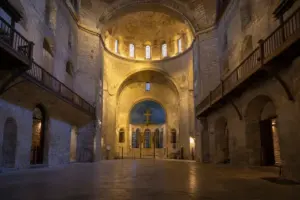 Hagia Irene – about 250 m away (~4 min walk) · typical visit: 45 minutes to 1 hour10 min on foot from Gülhane metro, Open 09:00–18:00, closed Tue
Main image: AI-generated illustration. It may not show the place exactly as it looks.
Metro stations near Topkapi Palace
 Gülhane – about 900 m away (~15 min walk)Open daily 06:00–00:00
Main image: AI-generated illustration. It may not show the place exactly as it looks.
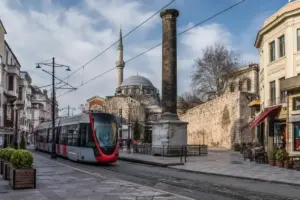 Çemberlitaşabout 1.1 km away (~17 min walk)
Main image: AI-generated illustration. It may not show the place exactly as it looks.
Restaurants and cafes near Topkapi Palace
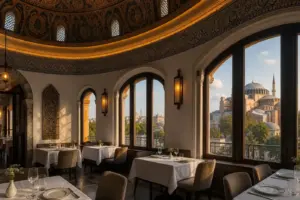 Matbah Restaurant – about 450 m away (~7 min walk)9 min on foot from Gülhane metro, Open daily 09:00–22:30
Main image: AI-generated illustration. It may not show the place exactly as it looks.
 Balık Ekmek at Eminönü – about 550 m away (~9 min walk)7 min on foot from Gülhane metro, Open daily 09:00–22:30
Main image: AI-generated illustration. It may not show the place exactly as it looks.
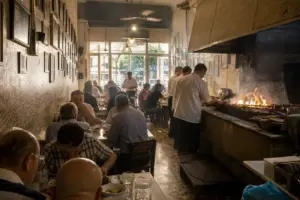 Tarihi Sultanahmet Koftecisi – about 650 m away (~10 min walk)7 min on foot from Gülhane metro, Open daily 11:00–23:00
Main image: AI-generated illustration. It may not show the place exactly as it looks.
 Hafız Mustafa 1864 – about 750 m away (~12 min walk)12 min on foot from Çemberlitaş metro, Open daily 12:00–23:59
Main image: AI-generated illustration. It may not show the place exactly as it looks.
Nightlife near Topkapi Palace
 Roxy – about 550 m away (~9 min walk)7 min on foot from Gülhane metro
Main image: AI-generated illustration. It may not show the place exactly as it looks.
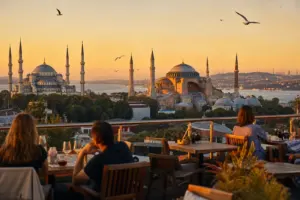 Seven Hills – about 650 m away (~11 min walk)4 min on foot from Gülhane metro, Open daily 08:00–23:00
Main image: AI-generated illustration. It may not show the place exactly as it looks.
Train stations and river piers near Topkapi Palace
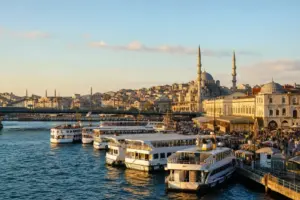 Eminönü Ferry Terminalabout 1.2 km away (~19 min walk)
Main image: AI-generated illustration. It may not show the place exactly as it looks.
 Karaköy Ferry Terminalabout 1.3 km away (~20 min walk)
Main image: AI-generated illustration. It may not show the place exactly as it looks.
Events and traditions near Topkapi Palace
 Istanbul Marathonabout 900 m away (~15 min walk)
Main image: AI-generated illustration. It may not show the place exactly as it looks.
Related guides
 Istanbul in December: Weather, Attractions and Winter Travel Tips
Main image: AI-generated illustration. It may not show the place exactly as it looks.
 Istanbul in April: Weather, Tulips, Events and Things to Do
Main image: AI-generated illustration. It may not show the place exactly as it looks.
 20 Mistakes First-Time Visitors Make in Istanbul and How to Avoid Them
Main image: AI-generated illustration. It may not show the place exactly as it looks.
 One Day in Istanbul: Sultanahmet, the Bosphorus and Kadıköy
Main image: AI-generated illustration. It may not show the place exactly as it looks.
 Binbirdirek Cistern: A Byzantine Underground Hall with 224 Marble Columns5 min on foot from Çemberlitaş metro, Open daily 10:00–17:00
Main image: AI-generated illustration. It may not show the place exactly as it looks.
Browse more: More in Fatih · All Landmarks · All Sightseeing
FAQ: Topkapi Palace
Is the First Courtyard really free?
Yes. The First Courtyard (the outermost court with the Imperial Gate and stables) is free to enter without a ticket. You can walk through the gate and see the outer palace, Hagia Irene Church entrance, and the Archaeological Museum from here. To enter the paid galleries, Treasury, Harem, and inner courtyards, you need a ticket.
What's included in the combined ticket?
The official combined ticket covers the palace courtyards and galleries, the Harem (about 50 open rooms), and Hagia Irene Church. There is no cheaper palace-only option for foreign visitors. The Istanbul Museum Pass is accepted at the palace and offers entry at the same rate.
Do I need a guide?
A guide is not required, but helpful. The palace has plaques in English explaining key sections, and maps are available. Many visitors use audio guides (available for rent) to understand the history and layout. Guided tours are also offered through the palace and third-party platforms.
Can I visit just the Harem or Treasury without the whole palace?
No. Foreigners must buy the combined ticket covering palace and Harem. Turkish citizens and students have separate pricing options. Once you buy a ticket, you can visit any section at any time—there is no required route.
How long should I spend here?
Plan 2–3 hours for the main palace without the Harem, or 4–5 hours if you want to see the Harem carefully. Most visitors spend 3–4 hours total. The pace depends on whether you linger in galleries or move quickly through courtyards.
Is the palace accessible with a wheelchair?
Partially. The main courtyards on flat or gently sloped ground are accessible, but the Harem, upper pavilions, and many galleries involve stairs. Mobility-impaired visitors should check the official website (millisaraylar.gov.tr) for detailed access information or call ahead.
What's the difference between Topkapi Palace and Dolmabahçe Palace?
Topkapi was the Ottoman sultans' main residence for 400 years (1478–1853) and represents medieval/early modern Ottoman power and design. Dolmabahçe is a 19th-century palace built in European style when the court moved there. Topkapi is more historically significant and widely visited; Dolmabahçe shows the empire's later Westernization.
When is the best time to visit to avoid crowds?
Weekdays before 10:00 AM or after 4:00 PM are best. Tuesdays it is closed. Avoid midday (11:00 AM–3:00 PM), weekends, and spring/summer peak season. Early autumn and late autumn (September, October, November) offer good weather with fewer crowds.
Istanbul Vibes is a one-person project. A coffee keeps it going
Hotels near Topkapi Palace
- The Empress Theodora (400 m) Check prices (affiliate link, opens in a new tab)
- Sirkeci Mansion Hotel (400 m) Check prices (affiliate link, opens in a new tab)
- The Constantine Hotel (400 m) Check prices (affiliate link, opens in a new tab)
- Merih Hotel (400 m) Check prices (affiliate link, opens in a new tab)
Affiliate link (opens the booking site): we may earn a commission at no extra cost to you.
Restaurants near Topkapi Palace
- Konyalı Restaurant (300 m) Google Maps
- Karakol Restaurant (300 m) Google Maps
- Cistern Restaurant (350 m) Google Maps
- Sarnic Restaurant (350 m) Google Maps
Distances are straight-line, from OpenStreetMap data.

Take this guide with you
Get a free PDF of this guide to print or read offline: key facts, tips and a map link on a few clean pages.
Report an issue on this page
How we research and update our guides
About this guide: AI assistance and accuracy
This guide is created with the help of AI and is based on official sources where available. Mistakes can still happen. Opening hours, prices, rules and other details are given to the best of our knowledge as of the date shown and can change without notice. It offers general recommendations only, not professional, legal or travel advice. Please confirm important details with the official source before you travel; you are responsible for your own plans and decisions.
* Affiliate link: as an Amazon Associate we earn from qualifying purchases at no extra cost to you.
