
Information only. This page is general information, not medical advice and not a recommendation to have any treatment. The order of a list is not a ranking. Whether a treatment suits you can only be decided by a licensed doctor after an examination.
This guide covers what international visitors need to know about traveling to Istanbul with prescription medications. Whether you are bringing medication from home, need to refill during your stay, or have questions about Turkish pharmacy rules, this article explains how the system works and what to prepare.
The guide covers five main areas: customs rules for entry, what documents to carry, how to find and use pharmacies in Istanbul, what happens if you run out of medication, and common misunderstandings about Turkish prescriptions.
At a Glance
| # | Place | Best for | Good to know |
|---|---|---|---|
| 1 | Customs entry rules for prescription medications | What Turkey allows at the border | All districts; apply at entry. Pack medications in hand luggage with documentation ready. |
| 2 | Documents to carry for prescription medications | Paperwork at customs and pharmacies | Prepare before departure. Generic names (active ingredients) matter more than brand names. |
| 3 | Finding and using pharmacies in Istanbul | How to recognize and access local pharmacies | All districts; standard hours Monday–Saturday, approximately 09:00–19:00; Sunday pharmacies rotate. Look for green cross sign. |
| 4 | Foreign prescriptions in Turkey | Why your home prescription does not work | All pharmacies in Istanbul. Cannot use home prescription; may buy over-the-counter equivalents instead. |
| 5 | Getting a Turkish prescription if yours runs out | How to obtain medication during your stay | Private clinics throughout Istanbul. Private consultations: ₺₺. Airport pharmacies: available 24/7 at terminals. |
| 6 | Over-the-counter medicines available in Istanbul | What you can buy without a prescription | All Istanbul pharmacies. Common painkillers, allergy medicines, stomach remedies freely available. |
| 7 | Packing medications for air travel to Istanbul | TSA and airline screening rules | At departure; hand luggage is safest for medications. Liquid and injectable medications need screening. |
| 8 | Controlled medications and special documentation | Strong painkillers, sedatives, psychiatric medicines, stimulants | Entry point at Istanbul. Hand luggage required. Confirmation with embassy advised before travel. |
How We Chose
This guide is based on Turkish Ministry of Foreign Affairs customs announcements, Turkish Medicines and Medical Devices Agency regulations, official travel advisories from the U.S. State Department, and practical guidance for international travelers. The information reflects the official regulations that apply when entering Turkey with medications; it is not ranked or rated, and does not recommend specific clinics or doctors.
The focus is on prescription medications, over-the-counter medicines that visitors can find in Istanbul pharmacies, and the procedures for obtaining medication if yours runs out. Important: this is general factual information. Your own rules may depend on your nationality, your home country’s regulations, and the specific medication you carry. Always verify current requirements with your government’s travel advice and the Turkish embassy or consulate before departure.
1. Customs entry rules for prescription medications – What Turkey allows at the border
Passengers entering Turkey may bring medications for personal treatment in quantities that match their length of stay. A document such as a medical report or doctor's prescription must be presented to customs to confirm medical necessity. Prescription medicines, including controlled ones, are allowed for personal use if prescribed to you and supported by your prescription and a doctor's letter.
Controlled substances, strong painkillers, sedatives, sleeping tablets, anti-anxiety medicines, stimulants for ADHD and certain psychiatric medicines are regulated more strictly in most countries.
Good to know: All districts; apply at entry. Pack medications in hand luggage with documentation ready.
Tip: If you are unsure whether a medicine is restricted, declare it. This signals transparency and puts your documents to work for you.
2. Documents to carry for prescription medications – Paperwork at customs and pharmacies
Carry three things: your original prescription, a recent signed doctor's letter explaining why you need the medicine, and the medicine in its original pharmacy packaging. Keep controlled medicines in your hand luggage, bring only a quantity that matches your stay, and confirm current Turkish rules with the Turkish embassy or consulate before you fly.
Turkish pharmacists and doctors are more likely to recognize international generic drug names than foreign brand names, and having this information in writing removes ambiguity in a stressful situation.
Good to know: Prepare before departure. Generic names (active ingredients) matter more than brand names.
Tip: Always bring your existing packaging rather than trying to describe the medication by memory. The active ingredient name (generic name) is what Turkish pharmacists and doctors will work from — brand names differ widely between countries.
3. Finding and using pharmacies in Istanbul – How to recognize and access local pharmacies
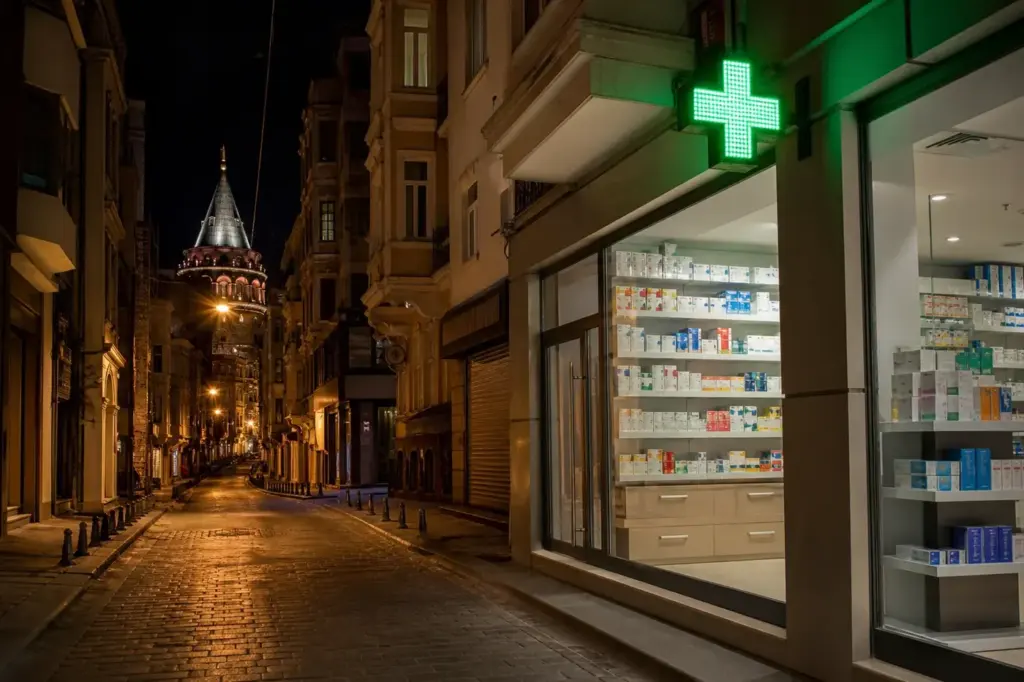
Turkey's pharmacy network is well-structured and widespread, with licensed pharmacies — known as eczane — located on virtually every street in urban and suburban areas. Pharmacies, known locally as "eczane," are widely available across Istanbul and are easily recognizable by the illuminated green cross sign displayed outside the store.
Outside regular hours, a rotating on-call system (nöbetçi eczane) ensures that at least one pharmacy in each district remains open overnight. The on-call pharmacy for any given night is displayed in the windows of closed pharmacies.
Good to know: All districts; standard hours Monday–Saturday, approximately 09:00–19:00; Sunday pharmacies rotate. Look for green cross sign.
Tip: Many pharmacists speak basic English. Bring your medication packaging and generic name written down if you need to communicate across a language barrier.
4. Foreign prescriptions in Turkey – Why your home prescription does not work
A prescription issued by your doctor at home — regardless of the country, regardless of whether it is translated into Turkish — is not legally recognised at Turkish pharmacies. Prescriptions issued abroad carry no legal weight in Turkey, meaning newly arrived visitors must obtain a locally issued prescription if they need a prescription-only medicine.
However, a wide range of medicines, including many that would require a prescription in other countries, can be purchased without one here.
Good to know: All pharmacies in Istanbul. Cannot use home prescription; may buy over-the-counter equivalents instead.
Tip: Simply showing the pharmacist your foreign prescription or telling them the name of the medicine may be sufficient, because many drugs that are prescription-only elsewhere can be obtained over the counter in Turkey.
5. Getting a Turkish prescription if yours runs out – How to obtain medication during your stay
Many private clinics in Istanbul offer consultations specifically for international patients. These clinics often have English-speaking doctors, making communication easier for visitors. During the consultation, the doctor can evaluate your symptoms, provide medical advice, issue a prescription if necessary, and recommend further tests or treatment.
Istanbul Airport has pharmacies on the departures floor and a complimentary medicine delivery service to gates for passengers who need medication after passport control.
Good to know: Private clinics throughout Istanbul. Private consultations: ₺₺. Airport pharmacies: available 24/7 at terminals.
Tip: Bring your original medication packaging (even if it is empty) when visiting a doctor so they can see the active ingredient name and dose.
6. Over-the-counter medicines available in Istanbul – What you can buy without a prescription
Turkish pharmacies sell most US/UK OTC equivalents without prescription: paracetamol (Parol), ibuprofen (Brufen, Nurofen), loperamide for traveler's diarrhea, oral rehydration salts, antihistamines (Aerius, Claritine), antacids, and topical antibiotics. Birth control pills are widely available in Turkish pharmacies, and you can generally purchase them without a prescription. Emergency contraception is also available over-the-counter.
Some US OTC drugs are prescription-only in Turkey — Sudafed, Benadryl-strength diphenhydramine, and melatonin.
Good to know: All Istanbul pharmacies. Common painkillers, allergy medicines, stomach remedies freely available.
Tip: Ask the pharmacist directly; do not assume that something available without prescription at home will be the same in Istanbul.
7. Packing medications for air travel to Istanbul – TSA and airline screening rules
Original pharmacy packaging with your name on the label, with essentials in your carry-on. Bring a prescription copy, doctor's letter and a full medication list with generic names. Medically necessary liquids above standard cabin limits are usually permitted, but keep them separate for screening and carry documentation. Needles, syringes and pens are allowed with evidence of medical need: your prescription or doctor's letter covers this.
Good to know: At departure; hand luggage is safest for medications. Liquid and injectable medications need screening.
Tip: Airline rules and customs rules are separate systems. Your airline may happily carry a medicine with documentation, while customs on arrival may still expect it to be declared. Check both.
8. Controlled medications and special documentation – Strong painkillers, sedatives, psychiatric medicines, stimulants
Medicines containing narcotic or psychotropic substances, certain strong pain medicines, some sedatives, some ADHD treatments, among others, are regulated under international conventions, and Turkey applies those rules as other countries do. These medicines can still travel with you, but they need proper documentation, and the definitions of what counts as controlled differ from country to country.
You must carry original pharmacy packaging with your name on the label, a prescription copy, doctor's letter and a full medication list with generic names. Confirm the current requirements before departure with the Turkish embassy or consulate in your country, because personal-use allowances and documentation rules for controlled drugs are set officially and can change.
Good to know: Entry point at Istanbul. Hand luggage required. Confirmation with embassy advised before travel.
Tip: Do not carry any controlled medication on behalf of someone else, even a family member: the medicine must be prescribed to the person carrying it.
Good to know
- Bring enough medication for the full trip plus a buffer of several days. Some formulations or doses may not match what you use at home.
- Before you leave home, check with your government's travel advisory for your country. When bringing medication into Turkey, carry a prescription and letter from your doctor. Some common US prescription and over-the-counter medicines widely available in the United States may be illegal in Turkey.
- Some medications available in your home country may not be stocked in Turkish pharmacies under the same brand, formulation, or dosage. Always bring the original packaging as a reference.
- If you transit through another country on your way to Istanbul, check that country's medication rules as well. A medicine that is routine in one jurisdiction can be strictly regulated in the next, and layovers sometimes mean passing through security again.
- Before travelling, contact the Turkish embassy or consulate in your home country, as they can supply specific guidance and, where necessary, help obtain any required approvals for the medications you plan to bring. Regulations can change, so always verify requirements directly with Turkish customs or the nearest Turkish diplomatic mission prior to departure.
Explore Nearby Traveling with Prescription Medications
Related guides
 Traveling with Chronic Conditions: Health Care Guide for Istanbul
Main image: AI-generated illustration. It may not show the place exactly as it looks.
 Questions to Ask Before Medical Treatment Abroad: A Patient Safety Guide
Main image: AI-generated illustration. It may not show the place exactly as it looks.
 A general finance overview for first-time visitors: Money, cards and ATMs in Istanbul
Main image: AI-generated illustration. It may not show the place exactly as it looks.
 ATMs and cash in Istanbul: How to withdraw money and exchange currency
Main image: AI-generated illustration. It may not show the place exactly as it looks.
Browse more: All Health & Beauty · All Health Guides
FAQ
Can I bring my home prescription to a Turkish pharmacy?
A prescription issued by your doctor at home — regardless of the country, regardless of whether it is translated into Turkish — is not legally recognised at Turkish pharmacies. However, many medicines that require a prescription at home can be bought over-the-counter in Istanbul. If you need a prescription-only medication, you will need to visit a private clinic or doctor in Istanbul to obtain a local prescription.
What happens if I declare my medication at customs?
Declaring is not an admission that something is wrong. It signals that you are travelling transparently, and it puts your documents to work for you. For routine prescription medicines, declaration is usually not required, but for controlled substances or if you are unsure, it is the safer approach.
How do I find a duty pharmacy open at night?
A rotating on-call system (nöbetçi eczane) ensures that at least one pharmacy in each district remains open overnight. The on-call pharmacy for any given night is displayed in the windows of closed pharmacies.
Do pharmacists in Istanbul speak English?
Many pharmacists speak basic English. It is helpful to carry written information about your medication (generic name, dose) and your original packaging as a reference.
What medicines can I buy over the counter in Istanbul pharmacies?
Turkish pharmacies sell most US/UK OTC equivalents without prescription: paracetamol (Parol), ibuprofen (Brufen, Nurofen), loperamide for traveler's diarrhea, oral rehydration salts, antihistamines (Aerius, Claritine), antacids, and topical antibiotics. Brand names may differ from your home country, so ask the pharmacist by generic name.
What should I do if my medication is not available in Istanbul?
Turkish pharmacies are generally well-stocked, and when a specific product is not immediately available, pharmacists can usually order it, including from international suppliers if necessary. Ask the pharmacist; they may be able to suggest a local equivalent or arrange delivery.
Can I order medications online and have them shipped to Turkey?
Turkish law prohibits residents from ordering pharmaceutical products from foreign-based websites that ship directly to consumers. Online sales of medications are illegal in Turkey — any website offering to mail prescription drugs is a black market operation. All medicines must be purchased in person at a licensed eczane.
Before you decide anything
- This page is information. It is not medical advice and not a recommendation to have any treatment or to choose any clinic, doctor or country.
- Every medical procedure has risks, and results and healing differ from person to person. A licensed doctor who has examined you decides whether a treatment is suitable.
- Talk to a doctor in your home country before you decide, and plan follow-up care at home: problems can appear after you return.
- Check that the clinic and the doctor are licensed in the official register of the Türkiye Cumhuriyeti Sağlık Bakanlığı, and ask for a written treatment plan and a consent form you understand.
- After a procedure, get urgent medical help for severe pain, fever, heavy bleeding or breathing problems. In an emergency call the local emergency number.
Kontrendikasyonlar olabilir. Bir uzmana danışmak gerekir.

Take this guide with you
Get a free PDF of this guide to print or read offline: key facts, tips and a map link on a few clean pages.
Report an issue on this page
How we research and update our guides
About this page: AI assistance and accuracy
This page was prepared with the help of AI and checked by automatic rules. It is general information only, not medical advice and not a recommendation to have any treatment or to choose any clinic. Mistakes can still happen and details can change without notice. Please check important details with the official source and talk to a licensed doctor before you decide anything.
