
Information only. This page is general information, not financial, investment, tax or legal advice and not a recommendation to use any bank, service or product. Rules, fees and availability change. The order of a list is not a ranking. Investments can lose value. For your own situation ask a licensed adviser or the provider.
This guide explains how money works in Istanbul for foreign visitors—from currency and payment methods to ATMs, fees, and practical financial decisions. Whether you’re arriving for a few days or planning a longer stay, understanding the financial landscape helps you avoid unnecessary costs and navigate transactions smoothly.
You’ll learn what payment methods work where, how to access cash safely, what fees to expect, and how Turkish banking and money transfer regulations affect visitors and newcomers.
At a Glance
| # | Place | Best for | Good to know |
|---|---|---|---|
| 1 | Turkish Lira and currency basics | Essential payment fact | Bring some cash or access ATMs immediately upon arrival; exchange at local döviz offices or bank ATMs, not at hotels or airport counters, for better rates. |
| 2 | Payment methods by transaction type | Cash vs. cards in practice | Combine cards and cash: use cards for larger purchases, cash for fares, street food, tips, and markets. |
| 3 | Istanbulkart for public transport | Cheapest transport option | Available at metro stations and newsstands; purchase and load credit before using public transport. |
| 4 | ATM withdrawals and fees | How to access cash safely | Use ATMs inside bank branches, shopping malls, or airports during daylight; avoid street-facing machines due to skimming risks. Major banks: Garanti BBVA, İş Bankası, Ziraat Bankası, Akbank, VakıfBank. |
| 5 | Currency exchange (döviz offices) | Local exchange rates | Located throughout central Istanbul; compare rates at a few offices before exchanging larger amounts. |
| 6 | Cash import and export rules | Customs declarations required | Keep receipts for large currency exchanges; fill out cash declaration forms if exporting above the declaration threshold. |
| 7 | Money transfers to and from Turkey | Sending and receiving money | Use banks or licensed payment institutions; have IBAN and SWIFT codes ready. Rules and fees vary by provider. |
| 8 | Opening a bank account as a visitor or resident | Accounts for longer stays | Visit a major bank branch with your passport and visa/residency documents; ask about English-language accounts and requirements. |
| 9 | Banking and sanctions: payment restrictions | What you need to check | Notify your home bank of travel dates; check with them on whether they service Turkey and whether Turkish transactions will work. |
| 10 | Common financial pitfalls to avoid | Mistakes that cost money | Always decline DCC; exchange at döviz offices; use major bank ATMs; decline ATM conversion offers. |
| 11 | Taxes and residence: the basics for longer stays | If you're considering staying longer | Consult the Turkish Revenue Administration (Gelir İdaresi Başkanlığı) and a licensed tax adviser for your specific situation. |
| 12 | Overview of investments and asset types | Understanding risks for those staying longer | Consult a licensed Turkish financial adviser and your home country's tax adviser before investing. |
How We Chose
This overview covers core financial topics that affect all first-time visitors and people considering a stay in Istanbul. Information is based on official sources including Turkish Central Bank (CBRT) regulations, bank websites, and current travel guides, verified as of October 2026. Facts about fees and regulations change; readers should check with their own bank before traveling and consult official Turkish financial authorities for current requirements that may depend on nationality and residency status.
1. Turkish Lira and currency basics – Essential payment fact
The Turkish Lira (₺, TRY) is the official currency and the best choice for daily transactions. Some tourist businesses accept euros or dollars, but you will receive change in Turkish Lira at rates set by the seller—usually unfavorable. Carrying Turkish Lira, whether cash or accessed via ATM, ensures transparency and avoids automatic currency markup fees at the point of sale.
Good to know: Bring some cash or access ATMs immediately upon arrival; exchange at local döviz offices or bank ATMs, not at hotels or airport counters, for better rates.
Tip: When paying by card at a terminal, the screen often asks whether to charge in your home currency or Turkish Lira. Always select Turkish Lira; choosing your home currency triggers hidden fees of 5–10%.
2. Payment methods by transaction type – Cash vs. cards in practice
Visa and Mastercard work in most hotels, restaurants, and shops, but cash remains essential for taxis, street vendors, public transport, and small neighborhood businesses. Many establishments have card minimums for small amounts. Digital wallets like Apple Pay and Google Pay are becoming available but adoption is uneven; always carry cash as backup.
Good to know: Combine cards and cash: use cards for larger purchases, cash for fares, street food, tips, and markets.
Tip: Ask for a cash discount when purchasing at local shops or markets—many offer 5–10% reductions for cash payment.
3. Istanbulkart for public transport – Cheapest transport option
A contactless smart card used for buses, trams, ferries, metro, and commuter rail across Istanbul. Contactless credit cards also work, but an Istanbulkart is the most economical. You can load cash onto it at metro stations, newsstands, or online. Fares are cheaper with the Istanbulkart than with a one-time card payment.
Good to know: Available at metro stations and newsstands; purchase and load credit before using public transport.
Tip: Buy the Istanbulkart on your first day if you plan to use public transport regularly—it pays for itself within a few journeys.
4. ATM withdrawals and fees – How to access cash safely
Major Turkish banks operate thousands of ATMs in Istanbul. Visa and Mastercard are widely accepted. Most Turkish bank ATMs now charge a foreign-card operator fee (typically a small fee per withdrawal, ₺). Your home bank may also charge an international withdrawal fee. Maximum withdrawal limits per transaction apply and differ between machines.
Good to know: Use ATMs inside bank branches, shopping malls, or airports during daylight; avoid street-facing machines due to skimming risks. Major banks: Garanti BBVA, İş Bankası, Ziraat Bankası, Akbank, VakıfBank.
Tip: Ask your home bank before traveling whether it charges a foreign ATM fee and whether it has partnerships with Turkish banks that might reduce fees.
5. Currency exchange (döviz offices) – Local exchange rates
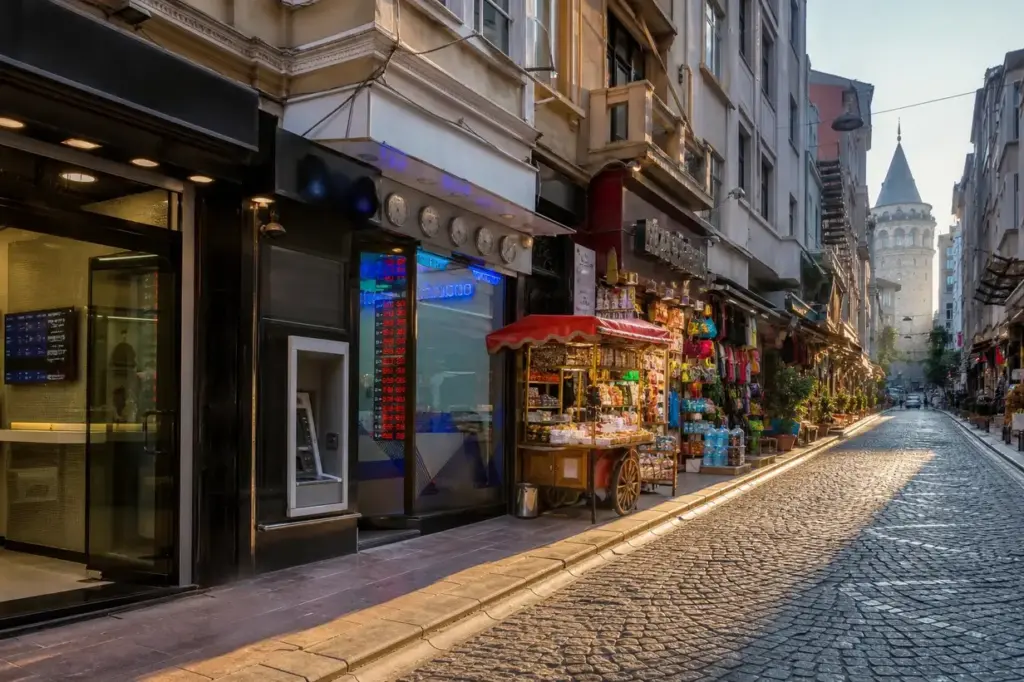
Exchange offices, known locally as döviz, are found throughout Istanbul in popular areas like Sultanahmet, Taksim, and near the Grand Bazaar. They typically offer better rates than airports or hotels. No commission claims at showy window displays usually indicate poor hidden rates; use established local offices instead. Exchange as you go rather than converting your entire budget at once.
Good to know: Located throughout central Istanbul; compare rates at a few offices before exchanging larger amounts.
Tip: Avoid high-traffic tourist zones with large neon signs offering no commission—their rates are often 10–20% worse than established local offices.
6. Cash import and export rules – Customs declarations required
You may bring any amount of foreign currency into Turkey, but must declare amounts above the official threshold when entering or leaving. Upon departure, declare Turkish Lira or foreign currency above the official thresholds. Rules depend on your nationality and residency; always declare at customs checkpoints.
Good to know: Keep receipts for large currency exchanges; fill out cash declaration forms if exporting above the declaration threshold.
Tip: If unsure whether your amount triggers a declaration, ask customs or your bank before traveling—the rules depend on your home country's reporting requirements and your residency status.
7. Money transfers to and from Turkey – Sending and receiving money
Bank transfers, payment institutions, and PTT (postal service) all offer money transfer services. Large transfers require documentation proving the source and purpose of funds. As of January 2026, any bank transfer of 200,000 Turkish Lira or above requires banks to record the source of funds and purpose. Transfers are permitted but not instant; expect several business days processing.
Good to know: Use banks or licensed payment institutions; have IBAN and SWIFT codes ready. Rules and fees vary by provider.
Tip: Personal remittances (family support, tuition, living expenses) typically face fewer restrictions than business transfers; check with your bank about the classification of your specific transfer.
8. Opening a bank account as a visitor or resident – Accounts for longer stays
Foreign visitors and residents can open bank accounts with Turkish banks. Requirements typically include a residence permit (for non-tourists), tax ID number (if resident), and identification. Many major banks offer accounts with English-language service. Rules depend on your visa status, residency permit, and nationality.
Good to know: Visit a major bank branch with your passport and visa/residency documents; ask about English-language accounts and requirements.
Tip: Rules for account opening depend entirely on your visa status and nationality—consult the bank directly and a licensed financial adviser, as requirements change frequently.
9. Banking and sanctions: payment restrictions – What you need to check
Payment services and access to Turkish banks can be restricted based on your country of residence and the sanctions rules of your home country. Some cards and payment providers do not serve foreign residents or may block transactions for compliance reasons. Rules change and vary by card network, bank, and country.
Good to know: Notify your home bank of travel dates; check with them on whether they service Turkey and whether Turkish transactions will work.
Tip: Do not rely on a single card or payment method; carry backup options (second card, cash, access to multiple ATMs) and contact your bank before traveling if you are from a country with payment restrictions on Turkey.
10. Common financial pitfalls to avoid – Mistakes that cost money
Dynamic Currency Conversion at card terminals adds hidden 5–10% fees. Exchanging large sums at the airport or hotel costs 10–20% more than local offices. ATMs at tourist sites or operated by non-bank providers charge excessive fees. Accepting ATM currency conversion (rather than declining it) costs extra. Many travelers regret these small decisions in hindsight.
Good to know: Always decline DCC; exchange at döviz offices; use major bank ATMs; decline ATM conversion offers.
Tip: Screenshot exchange rates from your bank's app when you leave home so you can spot bad rates immediately if offered anywhere in Istanbul.
11. Taxes and residence: the basics for longer stays – If you're considering staying longer
Tax residency in Turkey typically begins after 183 days in a calendar year or if you have a permanent home. Rules differ from immigration residency (visa status). Non-residents are taxed only on Turkish-source income; residents on worldwide income. Tax obligations depend on nationality, residency status, and the tax treaties your home country has with Turkey.
Good to know: Consult the Turkish Revenue Administration (Gelir İdaresi Başkanlığı) and a licensed tax adviser for your specific situation.
Tip: Rules depend entirely on your citizenship, residency status, and home country's tax laws—never assume based on visa status alone. Seek advice from a licensed Turkish accountant or tax lawyer before making plans for a long stay.
12. Overview of investments and asset types – Understanding risks for those staying longer
Financial asset types in Turkey include bank deposits, bonds, funds, shares, real estate, precious metals, and crypto-assets. Every investment can lose value. Regulation, taxation, and risk differ by asset type and by your country of residence. Bank deposits may have deposit protection; other assets have different protections and tax treatments. No asset is guaranteed or risk-free.
Good to know: Consult a licensed Turkish financial adviser and your home country's tax adviser before investing.
Tip: Never invest based on promised returns or someone's story; all investments carry risk, and returns are not guaranteed. Understand the regulatory status and taxation of any asset before committing money.
Good to know
- Bring some cash in small notes for tips, street food, and small vendors as a buffer. Many local neighborhood shops and street stalls do not accept cards and have no ATM nearby.
- Avoid exchanging money at tourist-heavy zones with neon signs and 'no commission' claims. Compare rates at 2–3 established döviz offices before making a large exchange. A 10–15% rate difference is typical.
- If your card is declined at an ATM or terminal, do not try the same machine repeatedly. Fraud alerts can lock your card. Move to a different ATM or call your bank immediately.
- Keep receipts for all large transactions and currency exchanges. If your bank questions a transaction or you need proof of funds, documentation is essential and may be required by Turkish customs or financial authorities.
- Download your bank's mobile app before traveling. You can freeze your card instantly if lost, check balances, and respond to fraud alerts in real time. Many Turkish ATMs and card terminals have English options, but if your card is blocked, you need contact information for your home bank in your home country.
- Before leaving Turkey, check whether you owe any tax filings or have any currency declaration requirements. Turkish banking regulations track large transfers, and leaving without clearing obligations can create problems for future visits or residency.
Explore Nearby A general finance overview for first-time visitors
Related guides
 Spice Bazaar and Grand Bazaar Route: Two Markets, Six Centuries
Main image: AI-generated illustration. It may not show the place exactly as it looks.
 Istanbul in Autumn: Golden Light, Festivals and Fewer Crowds
Main image: AI-generated illustration. It may not show the place exactly as it looks.
 Istanbul Markets and Bazaars: A Three-Day Shopping and Exploration Itinerary
Main image: AI-generated illustration. It may not show the place exactly as it looks.
 HSBC Turkey: Banking in Istanbul for International Visitors
Main image: AI-generated illustration. It may not show the place exactly as it looks.
 How to Find a Pharmacy in Istanbul: Signs, Hours and Night Pharmacies
Main image: AI-generated illustration. It may not show the place exactly as it looks.
Browse more: All Finance Guides · All Free and Budget
FAQ
Do I need to bring cash or can I use cards for everything?
No, cash is still essential in Istanbul. Taxis, street vendors, local markets, and small neighborhood restaurants do not accept cards. Most hotels, restaurants in tourist areas, and shops accept Visa and Mastercard. Carry a mix: cards for large purchases and ATM for frequent cash withdrawals.
What is the best way to exchange money?
Use local döviz (exchange offices) in established areas like Sultanahmet, Taksim, or near the Grand Bazaar—they offer better rates than airports or hotels. Avoid high-traffic zones with neon 'no commission' signs. ATMs operated by major banks (Garanti BBVA, İş Bankası, Ziraat Bankası) also offer interbank rates, though you may pay a foreign-card fee.
Do I need an Istanbulkart or can I just pay for each trip?
You can pay for each trip with a contactless card, but an Istanbulkart is cheaper. Buy one at any metro station or newsstand, load cash onto it, and fares cost significantly less per journey. If using public transport more than a few times, the card pays for itself immediately.
Will my credit card work in Turkey, and what fees should I expect?
Visa and Mastercard work in most businesses, but ask your home bank before traveling. They may charge a foreign transaction fee; some cards do not. When paying by card, always select Turkish Lira (not your home currency) to avoid hidden 5–10% conversion fees. Check your card statement after travel; fees appear as currency conversion charges.
Are ATMs in Turkey safe, and which ones should I use?
ATMs are generally safe if you follow basic precautions: use machines inside bank branches, shopping malls, or airports; avoid street-facing machines; withdraw during daylight; check that your card ejects properly. Major banks (Garanti BBVA, İş Bankası, Ziraat, Akbank, VakıfBank) are reliable. Most now charge a foreign-card operator fee (₺), so plan larger withdrawals to spread the fee.
Can I send money to Turkey or receive money while I'm visiting?
Yes, through banks or licensed payment institutions. Large transfers (200,000+ Turkish Lira) require documentation of source and purpose as of January 2026. Processing takes several business days. Rules depend on your residency status and nationality. Check with your bank on fees and processing times in advance.
Do I need to declare cash when entering or leaving Turkey?
You may bring any amount into Turkey, but must declare amounts above the official threshold at customs. When leaving, declare Turkish Lira or foreign currency above the official thresholds. Requirements vary by nationality; check with your country's customs before traveling and keep currency exchange receipts.
What happens if I want to stay longer or open a bank account?
Bank account requirements depend on your visa status, residence permit, and nationality. Many major banks serve foreign residents and offer English-language accounts. Tax residency rules differ from visa status; consult a licensed Turkish tax adviser and the Turkish Revenue Administration (Gelir İdaresi Başkanlığı) for obligations that apply to your situation.
Before you decide anything
- This page is information. It is not financial, investment, tax or legal advice, and not a recommendation to use or buy any product, or to choose any bank, service or country.
- Fees, rates, limits and rules change often and depend on your nationality, residence and the product. Ask the provider for its current written conditions.
- Investments can lose value, and you can lose money. Past results say nothing about the future.
- Check that a provider is licensed in the official register of the BDDK, SPK, TCMB, SEDDK.
- Payment limits can affect which services work for visitors from your country. Check with your own bank before you travel or send money.

Take this guide with you
Get a free PDF of this guide to print or read offline: key facts, tips and a map link on a few clean pages.
Report an issue on this page
How we research and update our guides
About this page: AI assistance and accuracy
This page was prepared with the help of AI and checked by automatic rules. It is general information only, not financial, investment, tax or legal advice and not a recommendation to use any bank, service or product. Mistakes can still happen, and fees, rules and availability change without notice. Please check important details with the provider, the competent regulator and a licensed adviser before you decide anything.
