
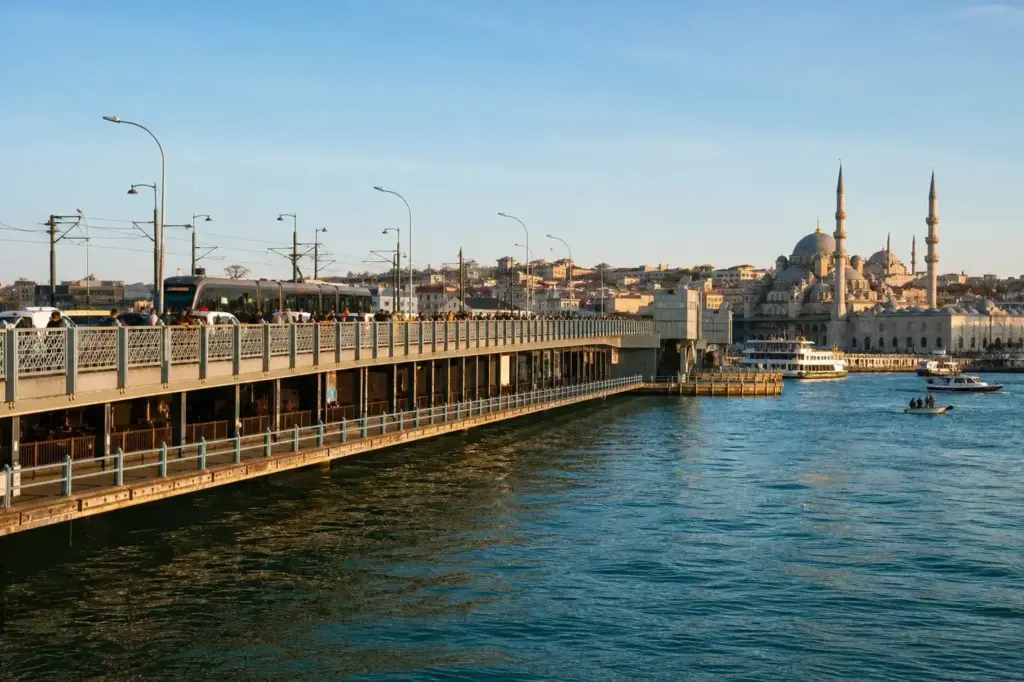
The Galata Bridge (Galata Köprüsü) is Istanbul’s most iconic crossing, a 490-metre landmark spanning the Golden Horn and joining the old city with the modern districts beyond. Built in 1994 as a reinforced concrete bascule bridge, it is the fifth structure on this site—a succession that stretches back to the early 19th century.
The bridge carries cars, trams, and pedestrians across the strait in a single stream of motion; it opens at night to allow tall ships through. Unlike most tourist attractions, there is no entrance fee or designated visiting hours. It is public infrastructure and a place where Istanbul lives itself: fishermen casting rods, vendors selling balık ekmek (fish sandwiches), diners seated at tables below, and thousands crossing on foot to reach the other shore.
Quick Facts
| Built / opened | 1994 |
|---|---|
| Architect(s) | Göncer Ayalp Engineering Company (designer); STFA Construction Company (engineering design and construction) |
| Address | Kemankeş Karamustafa Paşa, Galata Köprüsü, 34425 Beyoğlu, Istanbul Google MapsApple MapsYandex Maps |
| District | Beyoğlu |
| Metro | Eminönü (T1 tram, direct tram stop at southern end) Karaköy (T1 tram, direct tram stop at northern end) |
| Admission | Free |
| Best time to visit | The bridge is accessible and worthwhile at all hours. Early morning (6–8 am) offers soft light, fewer crowds, and active fishermen. Mid-morning to early afternoon (9 am–3 pm) brings steady tourist and local traffic; it is lively but crowded. Late afternoon into dusk (4–7 pm, depending on season) combines clear light, moderate crowds, and the best photography conditions for the Yeni Mosque and water. Evening (7 pm–midnight) brings restaurant activity, illuminated surroundings, and a different social atmosphere but darker photography. Avoid the bridge during the brief opening hours at night (1–4 am) unless you specifically plan to observe the bascule mechanism opening for ships—a rare sight. |
| Website | galatakoprusu.com/en |
What Is (and Isn't) Part of a Visit to Galata Bridge?
| Part | Status | Notes |
|---|---|---|
| The bridge deck and crossing | Included in the standard ticket | The upper roadway, tram line, and pedestrian walkways are free and accessible 24/7 as public infrastructure. |
| The lower deck (restaurants and shops) | Separate ticket or institution | Dining and shopping on the lower deck requires paying at individual establishments; walking through the lower deck on the public passage is free. |
| Galata Tower | Separate ticket or institution | The tower is visible from the bridge but is a separate ticketed attraction across the water in Karaköy; it requires its own ticket and is not part of the bridge. |
| Yeni Mosque (New Mosque) | Separate ticket or institution | The mosque is visible from the bridge across the water but is a separate venue requiring its own ticket; it is not part of the bridge. |
| Spice Bazaar (Egyptian Bazaar) | Outside / not part of it | The bazaar is on land near the southern end of the bridge, a few minutes' walk away; it is a separate attraction with its own entrance and shopping. |
| Eminönü ferry terminals | Outside / not part of it | The ferries depart from the waterfront near the southern end of the bridge but are separate services; ferry tickets are purchased separately. |
Why Visit Galata Bridge?
The Galata Bridge offers something rare: a working landmark where the cityscape and the rhythm of daily life are part of the experience. The span itself frames views of the Yeni Mosque, the Golden Horn’s waterfront, and the Galata Tower rising on the far bank. At dusk, when light reflects off the water and crowds thicken, the atmosphere becomes particularly vivid.
The bridge also serves a practical purpose: it is the fastest pedestrian crossing between Sultanahmet and Beyoğlu, and the point where many visitors first grasp that Istanbul straddles two distinct worlds, geographically and culturally. Walking it is a necessary rite for understanding the city’s geography and mood.
How Galata Bridge Is Laid Out
The bridge is simple in layout but layered in use. The upper deck, at street level, carries two lanes of traffic in each direction, the T1 tram line down the centre, and pedestrian walkways on both sides roughly 2–3 metres wide. The middle section holds the 80-metre bascule span, which lifts hydraulically to allow shipping.
Below the main deck lies a second level, a semi-enclosed gallery around 5 metres deep that runs nearly the full length. This lower deck houses restaurants, cafés, and small fish vendors. Most visitors walk the upper deck and may peer down into the restaurant level; entry to the lower restaurants is separate from crossing the bridge.
The southern end opens onto Eminönü, near the Spice Bazaar and ferry terminals. The northern end opens onto Karaköy, with the Galata Tower visible on a hill to the east. Both ends are accessible on foot; the bridge connects seamlessly to city pavements.
Highlights of Galata Bridge
The Upper Deck Crossing
The main platform where 490 metres of urban life unfolds underfoot. As you cross, you see the Yeni Mosque (Yeni Cami) with its distinctive silhouette to the south, the Galata Tower rising on the north shore, and the narrower waterway of the Golden Horn stretching away to the west. The width and height of the deck (42 metres wide, roughly 12 metres above water) make the crossing feel open and exposed. Most visitors cross in 5–10 minutes; stopping to look around adds another 10–15. Best views of the mosques are from the southern half; best views of the tower are from the northern.
Tip: Walk slowly or stand against the railing rather than stopping in the middle—traffic and tram movements are constant. Early morning and late afternoon light are sharpest for photographs of the mosques and water.
The Fishermen
Rods line the railings, particularly on the southern and western sides. Local and visiting fishermen stand patiently for hours, casting into the Golden Horn for small sea fish. The practice is traditional and remains visible most days and seasons. Fishermen are typically concentrated in early morning (before 10 am) and evening (after 4 pm). You can watch them work or ask respectfully to photograph their catch. This is one of Istanbul's working scenes that visitors rarely find elsewhere in the city.
Tip: If you plan to photograph fishermen, arrive early morning when light is softer and crowds are thinner. Bring a long lens if you want detail without standing directly beside someone.
The Lower Deck and Restaurants
Below the main roadway, a continuous gallery of seafood restaurants and cafés occupies the 5-metre-deep space sheltered by the upper deck. The décor ranges from casual to upscale; most serve fish, meze, and tea. The lower deck is accessed from ramps and stairs at each end; it is open to pedestrians whether or not you dine. Walking through feels like being inside a busy street market indoors, with the Golden Horn visible through the railing gaps. The restaurants operate during daylight and evening hours; most close late at night.
Tip: Reserve ahead at established restaurants if dining during peak hours (noon to 2 pm, 7 pm to 10 pm). Otherwise, casual vendors sell prepared snacks (balık ekmek, börek, drinks) without reservation. Budget restaurants ₺ to ₺₺; upscale fish restaurants ₺₺₺.
The Bascule Mechanism and Engineering
The bridge is a modern bascule (drawbridge) type, meaning its 80-metre central span opens vertically to allow ships with tall masts to pass. The opening uses four steel leaves, each roughly 1,500 tonnes. The mechanism raises the deck in about 3.5 minutes. Unlike the pontoon bridges of the past, this is anchored firmly to bedrock. The opening happens in the early morning hours (1–4 am), typically once a week in summer and twice weekly in winter, when ship traffic is heaviest. You will not see it during a normal daytime visit.
Tip: If you stay overnight near the bridge and wish to see the opening, ask your hotel staff which nights to expect it. The bridge is otherwise solid to walk across; no opening is visible or felt during the day.
The Yeni Mosque (Yeni Cami)
The mosque visible across the water from the bridge's south side is the Yeni Mosque (New Mosque, built 1597–1663). Its cascading domes and pencil minarets are among the most photogenic views from Istanbul. The mosque itself is a separate venue requiring its own ticket; it is not part of the bridge visit. From the bridge, the exterior architecture and setting are clearly visible. Early morning and late afternoon light illuminates the mosque's stonework dramatically.
Tip: Photograph the Yeni Mosque from the southern half of the bridge at sunrise (6–7 am) or sunset (5–7 pm, depending on season) for the best light. The mosque is closed during the five daily prayer times; consult a local prayer schedule if you plan to enter it separately.
The Galata Tower View
From the northern end of the bridge, the Galata Tower rises on the hillside above Karaköy, roughly 400 metres away. This medieval stone tower (built 1348, rebuilt 1440s) is visible throughout the crossing but becomes the focal point as you approach the Karaköy side. The tower is a separate ticketed attraction with observation decks. From the bridge, it forms one of Istanbul's classic skyline photographs, especially when lit at dusk or silhouetted against sunrise.
Tip: For the classic 'tower above bridge' shot, photograph from the bridge's northern quarter-span, looking north-northeast. Alternatively, cross to Karaköy and photograph the bridge with the tower in the background from the waterside promenade.
The Passage Between Worlds
The bridge is more than transport; it is the physical and symbolic boundary between Istanbul's two historic halves. The south side represents the old Ottoman city (Sultanahmet, Fatih district), marked by imperial mosques and bazaars. The north side represents Pera and Beyoğlu, the Westernised districts that grew during the Ottoman decline and early republican period. Simply crossing the bridge makes this boundary tangible. As you walk, the architecture, street layout, and even the pace of daily life shift noticeably.
Tip: Spend 15 minutes standing mid-bridge and observe the water, architecture, and people on each side. This pause helps consolidate the geographical and cultural split that defines Istanbul. It is a lesson in urban topology that no guidebook replaces.
Atmosphere
The bridge is a study in layered noise and motion. Above, traffic hums constantly: cars accelerating, the tram’s bell ringing three or four times per hour, motorcycle engines. Pedestrian footsteps echo on the pavement. Below, kitchen sounds carry from restaurants—sizzling oil, chopping, calls between staff. Water laps against the bridge pilings.
The crowd is mixed. Mornings see workers and school-bound passengers in steady flow. Mid-morning to mid-afternoon: tourists, local shoppers, people meeting friends. Evening rush hours (5–7 pm) turn the bridge into a stream of hurried motion. Dusk brings a theatrical shift—the water flattens into a mirror, restaurant lights come on, fishermen intensify their efforts, and a lounging mood replaces the earlier transit rush.
The smell is salt water, diesel exhaust, and fish. In warm months, it is often the smell of grilled meat and seafood wafting from restaurants. There is no unpleasant industrial odour; the water is clean enough for fishing. Visually, the bridge is stark: concrete railings, metalwork, asphalt—functional rather than decorated. The beauty comes from the setting: the water, the mosques, the light, the humanity, not from the bridge itself.
History of Galata Bridge
The first known crossing of the Golden Horn was a temporary bridge built in 1453 during Mehmed II’s conquest of Constantinople, assembled from ships lashed together to allow troops to cross. A permanent bridge did not exist for another 350 years.
In 1502–1503, Sultan Bayezid II commissioned Leonardo da Vinci to design a permanent bridge. Leonardo proposed a single-arch span 240 metres long and 24 metres wide, supported by double pillars—revolutionary for its time and unrealised because the Sultan rejected the design. The concept was revived in 2001 when a scaled-down timber version was built in Norway, the first bridge ever constructed from a Leonardo sketch.
The first permanent bridge at the Golden Horn’s mouth was built much further upstream in 1836: the Hayratiye Bridge, commissioned by Sultan Mahmud II, linking Azapkapı and Unkapanı. This pontoon structure stood until 1912.
The first Galata Bridge at the current mouth-of-the-Horn location was completed in 1845. It was a wooden structure commissioned by Valide Sultan, the mother of Sultan Abdülmecid I. Called Cisr-i Cedid (New Bridge) to distinguish it from the earlier Cisr-i Atik (Old Bridge), it cost 105,000 gold lira. For the first three days, crossing was free; afterwards, a toll was collected by the Naval Ministry. The toll system lasted until 1930 and was levied on pedestrians, luggage carriers, horses, carriages, and small animals at graduated rates.
In 1863, a second wooden bridge replaced the first, commissioned by Sultan Abdülaziz in preparation for a visit by Napoleon III. It was built by Ethem Pertev Pasha. This bridge stood for 12 years.
The third bridge was completed in 1875 by British firm G. Wells, following a complex international negotiation. Originally, a French company had won the contract in 1870, but the Franco-Prussian War delayed the project. The British took over in 1872. This bridge lasted 37 years until 1912.
The fourth bridge was built in 1912 by German firm Hüttenwerk Oberhausen AG. It was a floating pontoon bridge, 466 metres long and 25 metres wide, made of 12 interlocking steel sections that could be separated for maintenance. This bridge became an integral part of Istanbul’s cultural life, housing bars and restaurants underneath that became known as venues for early modern Turkish rock music. The toll was abolished. This bridge operated until 1992, when it was severely damaged by fire and towed away.
The current fifth bridge was built between 1992 and 1994. Designed by Göncer Ayalp Engineering Company and constructed by Turkish firm STFA, it is a reinforced concrete structure 490 metres long and 42 metres wide, anchored to bedrock rather than floating. It is a bascule bridge, with an 80-metre central span that opens hydraulically for maritime traffic. The upper deck carries vehicular and tram traffic plus pedestrian walkways; the lower deck houses restaurants and shops. The bridge opened in December 1994 and has remained in continuous use since.
Legends and Myths about Galata Bridge
Leonardo's Unrealised Bridge
Disputed by historians. Sultan Bayezid II asked Leonardo da Vinci to design a bridge in 1502–1503. Leonardo drew a remarkable single-arch span 240 metres long—longer than any bridge built at the time—with double support pillars beneath. The design was visionary but technically audacious. The Sultan rejected it, reportedly because it seemed too ambitious or impractical. The bridge was never built, but Leonardo's sketch survives in historical records and became a symbol of Renaissance ambition meeting Ottoman pragmatism. In 2001, a scaled-down timber footbridge modelled on Leonardo's design was constructed near Oslo, Norway.
The Bridge That Swayed and Rolled
Legend – historically unreliable. The fourth bridge (1912–1992) was a floating pontoon structure that rose and fell with the tides and water currents of the Golden Horn. Eyewitnesses reported that crossing the bridge could feel like walking on a gently rocking ship—the entire structure would sway and pitch with the sea. This pontoon design allowed the bridge to expand and contract without stress and made it easier to move sections for maintenance. For 80 years, Istanbulites crossed a living, breathing structure; when strong currents ran during winter, the motion was pronounced enough to notice. The experience became embedded in Istanbul folklore and was mourned when the bridge was destroyed by fire in 1992.
The Toll Collectors in White Uniforms
Legend – historically unreliable. From 1845 until 1930—85 years—crossing the first Galata Bridge cost money. Officials in white uniforms stood at each end collecting tolls. The rates varied by category: pedestrians, people carrying luggage, horses, horse-drawn carriages, and small animals each paid different amounts. During the 1870s and 1880s, this toll system was a fixture of daily urban life and a source of civic revenue. The practice ended in 1930, marking a symbolic shift toward free public passage. Old photographs and Ottoman records confirm this system; the white uniforms and the collected amounts are well-documented.
Tickets and Booking for Galata Bridge
The Galata Bridge is free and requires no advance booking or tickets. It is open 24 hours as a public transportation route.
Accessing the bridge: Simply walk onto the bridge from either end (Eminönü to the south, Karaköy to the north). Pedestrians, cyclists, and taxis can use the walkways; cars and trams use the roadway. No passes, vouchers, or ID are required.
Lower-deck restaurants: If you plan to dine at a restaurant on the lower deck, booking in advance is recommended during peak hours (noon–2 pm, 7–10 pm), especially on weekends. Most restaurants accept walk-ins during quieter times. Each restaurant sets its own prices independently; ₺ budget cafés to ₺₺₺ upscale fish establishments.
The bridge carries no entrance restrictions. Turkish citizens and concessions are not applicable. Facilities and hours for individual restaurants on the lower deck vary; consult the official website galatakoprusu.com for current vendor information and hours.
Suggested itineraries Galata Bridge
30 minutes
Walk from Eminönü across the bridge to Karaköy, stopping briefly to view the Yeni Mosque and Galata Tower. Observe fishermen and street life. Cross at a moderate pace and pause at the midpoint for orientation. This covers the essential crossing and snapshot of Istanbul's geography.
1 hour
Walk from Eminönü to Karaköy, pause mid-bridge to absorb the views and atmosphere for 10–15 minutes. Descend to the lower deck (via stairs at either end) and walk through the restaurant level, observing the vendors and dining spaces. Re-ascend and complete the crossing to Karaköy.
2–3 hours
Cross the bridge, exploring both decks. Walk into Karaköy and visit the Galata Tower (separate ticket). Return to the bridge for evening light, then dine at a lower-deck restaurant as dusk falls. This combines the bridge crossing with related attractions and captures the changing atmosphere across the day.
How to Get to Galata Bridge
By tram (T1): Take the T1 tram to Eminönü stop (southern end of bridge) or Karaköy stop (northern end). The tram stops are directly at each end; exit and walk onto the bridge.
On foot from Sultanahmet: From the Blue Mosque or Hagia Sophia, walk north-northwest toward the waterfront (approximately 1–1.5 km, 15–20 minutes). Pass the Spice Bazaar on your left and continue to Eminönü. The bridge entrance is clearly visible at the waterfront.
By taxi or shared minibus (dolmuş): Ask the driver to take you to Eminönü (southern end) or Karaköy (northern end). Both are major transport hubs and well known. Taxis are readily available; expect light to moderate traffic depending on time of day.
From Taksim Square or Beyoğlu: Take the T2 tram line toward Eminönü, or the M2 metro to Karaköy station, then walk downhill to the bridge entrance (approximately 400 metres, 5–7 minutes).
Accessibility
The bridge has been designed for accessibility. Ramps and lifts serve both the upper and lower decks, allowing wheelchair users to navigate the full crossing. The pedestrian walkways are roughly 2–3 metres wide with metal railings on the outer edge. There are no stairs on the main upper deck; all level changes are served by ramps or lifts. The lower deck is accessed via ramps and stairs at the ends. Benches are available on the upper deck for resting. No free companion ticket is provided for wheelchair users; companions pay normal rates for dining if they eat on the lower deck.
Food Nearby
The lower deck of the bridge itself is lined with seafood restaurants and cafés, ranging from budget to upscale (₺ to ₺₺₺). For casual eating, vendors on the upper deck and waterfront sell balık ekmek (fish sandwiches), börek (pastries), and drinks (₺). Near the southern end (Eminönü), the Spice Bazaar and surrounding streets have numerous casual eateries, kebab shops, and tea gardens. Near the northern end (Karaköy), the narrow streets of the Galata neighbourhood host restaurants, meyhanes (taverns), and contemporary cafés. Most establishments are within a 2–5 minute walk from either bridge end.
What to Bring
Comfortable walking shoes (the bridge is 490 metres and flat, but you may walk longer if exploring the surrounding neighbourhoods). In summer, bring water and sunscreen; the bridge offers little shade. In winter, bring layers; wind across the water can be sharp. A camera or phone for photography; the views reward it. A light bag is fine; security staff may do a cursory check but the bridge has no X-ray or bag restriction. Avoid large luggage or backpacks if possible—they impede movement in crowded times.
Best Views and Photo Spots of Galata Bridge
Mid-bridge, southern railing, facing northwest
The Yeni Mosque's cascading domes and minarets fill the frame against the sky, with the Golden Horn's waterfront and Galata Tower on the far bank. This is the classic postcard view of Istanbul's religious and residential skyline. The framing works from sunrise to mid-morning.
Best time: Sunrise to 9 am for soft, angled light that illuminates the mosque's stonework. Avoid shooting into the sun directly.
Northern quarter-span, facing north-northeast
The Galata Tower rises above the Karaköy roofline, with the bridge's own roadway and railing in the foreground. This shot captures the tower as a sentinel overlooking the crossing—an iconic Istanbul composition.
Best time: Late afternoon (4–6 pm) for angled light that gives the tower dimension. Evening (after 7 pm) when the tower is lit; this requires slower shutter speed or higher ISO.
Upper deck, western side, middle section
Looking west down the Golden Horn toward the Süleymaniye Mosque and the urban shoreline beyond. The water, small boats, and layered cityscape create compositional depth. This view is less iconic than the Yeni Mosque shot but more intimate.
Best time: Late afternoon when the low sun glints off the water. Avoid harsh midday overhead light.
Fishermen on the railing, southern half
A candid shot of locals casting fishing rods, silhouetted against the water and the opposite shore. This captures the bridge's working-life atmosphere and human element. Permission from fishermen is courteous.
Best time: Early morning (6–7 am) when fishermen are most numerous and light is soft. Avoid mid-day when crowds block access and shadows are harsh.
Lower deck interior, looking out through the railing
The sheltered restaurant-lined interior with diners and vendors, framed by the bridge's supporting structure and water visible beyond. This captures the bustling social atmosphere and the bridge's double-layer design.
Best time: Late afternoon or early evening (5–7 pm) when restaurants are active and light is warm. Avoid shooting other diners' faces without permission.
Karaköy end, facing back toward Eminönü
A reverse shot of the bridge's full span receding toward the southern shore, with the Golden Horn beyond. This shows the bridge's length and the scale of the Golden Horn as a waterway dividing the city.
Best time: Early morning or late afternoon for angled light. Cloudy days reduce glare on the water.
Photography Rules
Photography is permitted on the bridge. No permit is required for hand-held cameras, phones, or standard lenses. Tripods are not explicitly forbidden but are discouraged during peak traffic hours (8–10 am, noon–2 pm, 5–7 pm) as they obstruct pedestrian and tram flow. Drones are not permitted. Flash is not restricted but is unnecessary outdoors. Indoor photos at lower-deck restaurants respect standard private business rules—ask permission if photographing other diners.
Family Suitability
The Galata Bridge is family-friendly for most ages. The crossing itself is flat, easy, and takes 5–15 minutes depending on pace and stops. Young children (3+) can manage the walk; strollers are permitted on the wide pedestrian walkways but may feel crowded during peak hours (9–11 am, noon–2 pm, 5–7 pm). Older children and teens enjoy exploring the lower deck restaurants, watching fishermen, and observing urban life. The bridge is not a play area; supervision is needed in crowds. Restaurants on the lower deck typically accommodate children and high chairs are available. The main risk is traffic noise and the proximity of moving vehicles; children should stay on the pedestrian walkways away from the roadway.
Istanbul Vibes Tips
- Visit early morning (before 9 am) if you want to photograph or experience the bridge with fewer crowds. The light is also soft and flattering, fishermen are active, and the atmosphere feels less touristy. Restaurants are quieter but not all are fully open.
- The bridge is a transport route for thousands of commuters, particularly at 8–9 am and 5–7 pm. If you prefer a slower pace, avoid these hours or stay mid-crossing rather than at the edges where foot traffic is heaviest.
- Don't miss the lower deck. Most visitors walk only the upper deck and believe the bridge ends there. The lower deck's restaurants, vendors, and atmosphere add a full dimension to the experience and reveal how the bridge functions socially.
- The best light for photographing the Yeni Mosque is before 10 am and after 4 pm, when the sun is angled across the water. At midday, the overhead light flattens the image and creates harsh shadows.
- If you plan to eat at a lower-deck restaurant, arrive during off-peak hours (3–5 pm or 10–11 am) to secure a waterfront table without booking. Peak meal times require advance reservation or a long wait.
- Stand still for 10 minutes at mid-bridge facing south. Observe how the light, crowd, and soundscape change with time of day. This pause alone teaches more about Istanbul's rhythm than many hours of guidebook reading.
Explore Nearby Galata Bridge
Sights near Galata Bridge
 Blue Mosque – about 1.7 km away (~27 min walk) · typical visit: 45–75 minutes3 min on foot from Gülhane metro
Main image: AI-generated illustration. It may not show the place exactly as it looks.
 Hagia Sophia – about 1.4 km away (~23 min walk) · typical visit: 1–1.5 hours8 min on foot from Gülhane metro, Open daily 09:00–19:30
Main image: AI-generated illustration. It may not show the place exactly as it looks.
 Spice Bazaar – about 450 m away (~7 min walk) · typical visit: 1–2 hours13 min on foot from Haliç metro, Open daily 08:00–19:30
Main image: AI-generated illustration. It may not show the place exactly as it looks.
 Galata Tower – about 650 m away (~10 min walk) · typical visit: 1–2 hours4 min on foot from Şişhane metro, Open daily 08:30–23:00
Main image: AI-generated illustration. It may not show the place exactly as it looks.
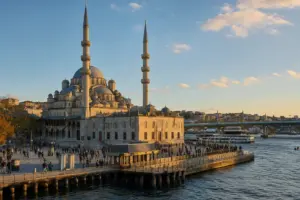 New Mosque – about 350 m away (~6 min walk) · typical visit: 30–45 min12 min on foot from Haliç metro
Main image: AI-generated illustration. It may not show the place exactly as it looks.
 Kara Mustafa Mosque – about 350 m away (~6 min walk) · typical visit: 30 minutes10 min on foot from Şişhane metro
Main image: AI-generated illustration. It may not show the place exactly as it looks.
Metro stations near Galata Bridge
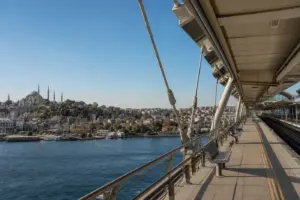 Haliç – about 600 m away (~10 min walk)Open daily 06:06–00:06
Main image: AI-generated illustration. It may not show the place exactly as it looks.
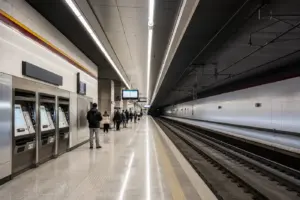 Şişhane – about 850 m away (~14 min walk)Open daily 06:09–00:09
Main image: AI-generated illustration. It may not show the place exactly as it looks.
 Tünelabout 950 m away (~15 min walk)
Main image: AI-generated illustration. It may not show the place exactly as it looks.
Restaurants and cafes near Galata Bridge
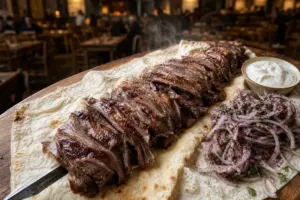 Şehzade Cağ Kebap – about 100 m away (~2 min walk)11 min on foot from Haliç metro
Main image: AI-generated illustration. It may not show the place exactly as it looks.
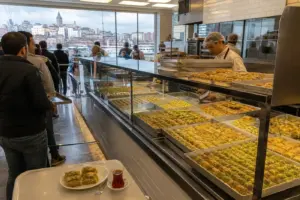 Karaköy Güllüoğlu – about 250 m away (~4 min walk)12 min on foot from Şişhane metro, Open daily 07:00–23:00
Main image: AI-generated illustration. It may not show the place exactly as it looks.
 Ali Ocakbaşı Karaköy – about 300 m away (~5 min walk)8 min on foot from Haliç metro, Open daily 12:00–23:00
Main image: AI-generated illustration. It may not show the place exactly as it looks.
 Pandeli – about 350 m away (~6 min walk)12 min on foot from Haliç metro, Open 11:30–19:00, closed Sun
Main image: AI-generated illustration. It may not show the place exactly as it looks.
Nightlife near Galata Bridge
 Cheers Karaköy – about 150 m away (~3 min walk)9 min on foot from Haliç metro, Open daily 08:30–02:00
Main image: AI-generated illustration. It may not show the place exactly as it looks.
 The Bank Roof Bar – about 400 m away (~7 min walk)8 min on foot from Şişhane metro, Open daily 12:00–02:00
Main image: AI-generated illustration. It may not show the place exactly as it looks.
Train stations and river piers near Galata Bridge
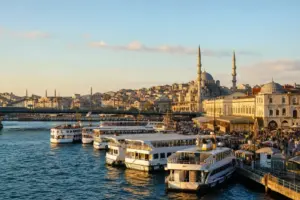 Eminönü Ferry Terminalabout 350 m away (~6 min walk)
Main image: AI-generated illustration. It may not show the place exactly as it looks.
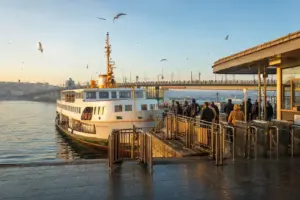 Karaköy Ferry Terminalabout 350 m away (~6 min walk)
Main image: AI-generated illustration. It may not show the place exactly as it looks.
Events and traditions near Galata Bridge
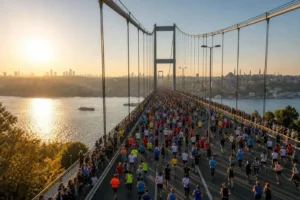 Istanbul Marathonabout 1.7 km away (~27 min walk)
Main image: AI-generated illustration. It may not show the place exactly as it looks.
Related guides
 Best Baklava Shops in Istanbul: Where and What to Order
Main image: AI-generated illustration. It may not show the place exactly as it looks.
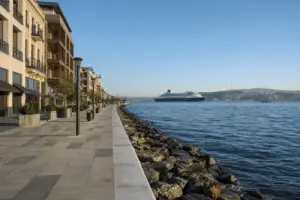 Istanbul Cruise Port Guide: Galataport to the Old City in One Day
Main image: AI-generated illustration. It may not show the place exactly as it looks.
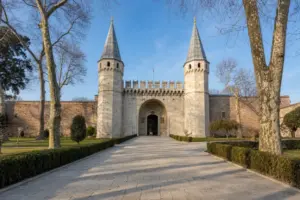 Istanbul Attractions Opening Hours and Restoration Closures 2027
Main image: AI-generated illustration. It may not show the place exactly as it looks.
 Best Bosphorus Dinner Cruises: Prices, Food and Experiences Compared
Main image: AI-generated illustration. It may not show the place exactly as it looks.
 Galataport: Istanbul’s Waterfront Promenade in Karaköy
Main image: AI-generated illustration. It may not show the place exactly as it looks.
Browse more: More in Beyoğlu · All Landmarks · All Sightseeing
FAQ: Galata Bridge
Is there an entrance fee to cross the Galata Bridge?
No. The Galata Bridge is free and open 24 hours as public infrastructure. No ticket or advance booking is required. You simply walk onto it from either end (Eminönü or Karaköy). Dining at restaurants on the lower deck costs extra and is optional.
How long does it take to cross the bridge?
A simple crossing from one end to the other takes 5–10 minutes at a normal pace. If you pause to view the surroundings, photograph, or visit the lower deck, plan 30–60 minutes. Many visitors spend 1–2 hours if they dine.
Can I use the bridge to get from Sultanahmet to Taksim?
Yes, partly. The bridge crosses from Eminönü (near Sultanahmet) to Karaköy (south of Beyoğlu). To reach Taksim Square from Karaköy, you would need to walk uphill through Galata (20–30 minutes) or take the M2 metro (2 minutes from Karaköy station). The bridge is the crossing; it does not lead directly to Taksim.
Does the bridge open for ships?
Yes. The 80-metre central span is a bascule bridge that opens hydraulically to allow ships with tall masts to pass through the Golden Horn. The opening takes about 3.5 minutes. It typically happens in the early morning hours (1–4 am), once weekly in summer and twice weekly in winter. You will not see it during a typical daytime visit.
Is the bridge accessible for people in wheelchairs?
Yes. The bridge has ramps and lifts serving both the upper deck and the lower deck. The pedestrian walkways are 2–3 metres wide with railings. Wheelchairs can navigate the full crossing, though peak-hour crowds may feel tight. The lower deck is also accessible.
What is the best time to photograph the Yeni Mosque from the bridge?
Early morning (6–8 am) or late afternoon (4–6:30 pm), when the sun is angled across the water and illuminates the mosque's domes and minarets. Avoid midday overhead light, which flattens the image. The best weather is clear sky with some clouds for texture.
Can I fish from the bridge like the locals?
Technically, yes—the bridge is open to the public. However, fishing requires a licence in Turkey. Local fishermen have licenses or operate in a grey area of informal tolerance. As a visitor, bring no equipment and observe only, unless you plan to obtain a Turkish fishing permit in advance.
Where should I eat on the bridge?
The lower deck (reached via stairs or lifts at either end) is lined with restaurants and casual vendors. For budget-friendly balık ekmek (fish sandwiches) and drinks, look for street vendors on the upper deck or waterfront near Eminönü. For sit-down meals with a water view, any lower-deck restaurant works; prices range from ₺ cafés to ₺₺₺ upscale fish establishments.
Istanbul Vibes is a one-person project. A coffee keeps it going
Hotels near Galata Bridge
- Hotel Nordstern Galata (300 m) Check prices (affiliate link, opens in a new tab)
- Ferman Port Hotel (400 m) Check prices (affiliate link, opens in a new tab)
- Azzap Hotel (400 m) Check prices (affiliate link, opens in a new tab)
- The Hezar (400 m) Check prices (affiliate link, opens in a new tab)
Affiliate link (opens the booking site): we may earn a commission at no extra cost to you.
Restaurants near Galata Bridge
- Aruna Cafe & Restaurant (100 m) Google Maps
- Ab-i Hayat (100 m) Google Maps
- Zeno (100 m) Google Maps
- Saray (100 m) Google Maps
Distances are straight-line, from OpenStreetMap data.

Take this guide with you
Get a free PDF of this guide to print or read offline: key facts, tips and a map link on a few clean pages.
Report an issue on this page
How we research and update our guides
About this guide: AI assistance and accuracy
This guide is created with the help of AI and is based on official sources where available. Mistakes can still happen. Opening hours, prices, rules and other details are given to the best of our knowledge as of the date shown and can change without notice. It offers general recommendations only, not professional, legal or travel advice. Please confirm important details with the official source before you travel; you are responsible for your own plans and decisions.
* Affiliate link: as an Amazon Associate we earn from qualifying purchases at no extra cost to you.
