

The New Mosque (Yeni Cami) is one of Istanbul’s most recognizable Ottoman landmarks, anchoring the waterfront at Eminönü square where the Golden Horn meets the old city. Despite its name, the structure is 360 years old—a joke that works because when it was completed in 1665, it really was the newest of the great imperial mosques, newer than the Blue Mosque and Suleymaniye.
Quick Facts
| Built / opened | 1665 |
|---|---|
| Architect(s) | Davud Ağa (initial design), Mustafa Ağa (completion) |
| Address | Rüstem Paşa, Yeni Cami Cd. No:3, 34116 Fatih/İstanbul Google MapsApple MapsYandex Maps |
| District | Fatih |
| Metro | Eminönü (T1, On the square) Sirkeci (Marmaray, 5 min walk northwest) |
| Admission | free |
| Best time to visit | Visit outside prayer times to avoid closures. Prayer times shift throughout the year; download a prayer-times app to check the current schedule for the day. Prayer is most disruptive at midday Friday (the entire day is typically closed to tourists).Crowds: Eminönü is busy all day, but the mosque interior itself is often quiet and nearly empty, especially on weekday afternoons. Weekend mornings tend to be more crowded.Light: Visit in the morning or early afternoon when daylight streams through the dome's openings and illuminates the Iznik tiles. Late afternoon light can wash out the blue and turquoise tones.Season: Open year-round. Winter is typically quieter; summer brings heavy tourist crowds to Eminönü square, though the mosque interior remains peaceful. |
What Is (and Isn't) Part of a Visit to New Mosque?
| Part | Status | Notes |
|---|---|---|
| Prayer hall and interior | Included in the standard ticket | Main mosque interior with domes, tiles, and calligraphy. Closed to visitors during the five daily prayer times. |
| Courtyard | Included in the standard ticket | Open courtyard area south of the prayer hall, facing Eminönü square. Usually accessible. |
| Royal Pavilion (Hünkar Kasrı) | Separate ticket or institution | Separate tiled suite with mother-of-pearl inlay. Free entry; Tuesday–Sunday 10:00–19:00, closed Monday. Operated by Istanbul Chamber of Commerce. |
| Valide Sultan Tomb (Türbe) | Separate ticket or institution | Family tomb with 82 sarcophagi, reopened 2019. Free entry; hours vary seasonally. Check ahead. |
| Spice Bazaar (Mısır Çarşısı) | Outside / not part of it | Attached commercial market on the northeast side of the complex. Operates independently with separate vendors. Not part of the mosque visit. |
| Qur'an school and primary school | Not open to visitors | Part of the original 17th-century complex but not open to visitors. |
| Public fountains (sebil) | Included in the standard ticket | Original charitable water fountains visible on the square side of the complex. Part of the complex's public welfare function but no drinking water for visitors. |
Why Visit New Mosque?
The New Mosque delivers several reasons to visit: its dramatic architectural setting between the Galata Bridge and Golden Horn makes it instantly recognizable from across the water; the layered dome interior with Iznik tile work is quiet and contemplative even as thousands of people mill about outside; and it sits steps from the Spice Bazaar and ferry docks, so it fits easily into any Eminönü itinerary.
The hidden royal pavilion—a tiled suite with mother-of-pearl inlay where the sultan would watch prayer without being seen—is open separately and offers the best free interior view in Eminönü. Visiting costs nothing and typically takes 30–45 minutes with the pavilion.
How New Mosque Is Laid Out
The New Mosque complex sits on a waterfront platform overlooking the Golden Horn. The main prayer hall dominates, with the courtyard opening toward Eminönü square (the south side). The royal pavilion is tucked to one side with its own ramp entrance, originally allowing the sultan private access to prayer. The attached Spice Bazaar (Egyptian Bazaar) occupies separate buildings on the east side and operates independently.
On arrival, you enter from the square side either through the main portico or, if you find it, the pavilion entrance. The prayer hall interior rises with a central dome of 17.5 meters diameter, surrounded by semi-domes in a cascading pattern—step inside and look up to see how the geometry works.
Highlights of New Mosque
Central Dome and Interior
A pyramidal arrangement of semi-domes ascends to the central dome, creating the defining Ottoman geometry. The 17.5-meter-diameter central dome (outer height 36 meters) casts light through multiple openings, and the lower walls are clad in 17th-century Iznik tilework in cobalt blue and turquoise. Look up as you enter to see the full cascading effect and notice the intricate calligraphy on the walls. The tiles date from when the Iznik ceramic tradition was in decline, making them historically significant as well as visually striking.
Tip: Go early in the day when light streams through the dome's openings and clouds the interior. Afternoon light can be harsh and washes out the tile colors.
Royal Pavilion (Hünkar Kasrı)
The sultan's private suite attached to the mosque features three interconnected rooms with intricate Iznik tiles, wood and mother-of-pearl inlay, and a ramped entrance that allowed the sultan to enter unseen by the congregation. Restored in 2004 and opened as a museum in 2010, it remains little-known despite being one of Istanbul's best-preserved royal interiors. The L-shaped sofa and the main chamber show luxury detailing that contrasts sharply with the prayer hall's austere geometry. Entry is free; hours are Tuesday–Sunday 10:00–19:00 (closed Monday).
Tip: Many visitors miss it entirely because it is not signposted prominently from the main prayer hall. Ask mosque staff or look for the separate entrance and ramp on the eastern side.
Twin Minarets
Two 52-meter minarets frame the dome and are visible from across the Golden Horn and from the Galata Bridge. Built by the same architect who completed the mosque (Mustafa Ağa, 1661–1663), they use cut stone and marble and follow classical Ottoman proportions with one balcony each. The minarets call to prayer five times daily and their sound carries across the water, making them as much an auditory landmark as a visual one.
Tip: Photograph them at sunset from the Galata Bridge or the waterfront pier to the north; the light hits them directly and the water creates a mirror effect.
Valide Sultan Tomb (Türbe)
Turhan Hatice Sultan, the queen mother who completed the mosque in 1663, is buried in a connected tomb that holds 82 sarcophagi of dynastic family members. The tomb was reopened in 2019 after restoration. It is visually less grand than the prayer hall but historically essential—this was the woman whose determination revived a stalled imperial project and made the mosque possible. Hours vary by season; check ahead.
Tip: The tomb is attached to the eastern side of the mosque complex. Entry is typically free but hours are less regular than the main prayer hall.
The Waterfront Setting
The mosque sits on wooden pilings driven into the waterfront (a technique also used for Büyükçekmece Bridge in the 1600s), making it vulnerable to erosion and requiring regular restoration work. This precarious setting is part of the story—Safiye Sultan chose the location deliberately for its proximity to Istanbul's trade routes, envisioning it as both a religious and commercial landmark. The result is a building that seems to hover between land and sea, with the bustle of ferries, trams, and market commerce surrounding it on all sides.
Tip: Walk around the south and east sides to see the substructure and understand why the mosque has required so much restoration work over four centuries.
Spice Bazaar Connection
The New Mosque complex included an attached closed spice market (known as the Egyptian Bazaar, Mısır Çarşısı) built at the same time in the 1660s. The bazaar operates as a separate commercial space but was always intended as part of the same development, creating a physical and functional link between prayer and commerce. When the precinct walls came down with the building of the Galata Bridge in 1845, the bazaar opened directly onto the street, transforming Eminönü square into the vibrant commercial hub it remains today.
Tip: Enter the Spice Bazaar from the New Mosque side (northeastern corner) to see the original connection and find the less-crowded sections of the market.
Atmosphere
The mosque interior is cool, echoing, and deliberately calm—a stark contrast to the chaos outside. During non-prayer hours it is often quiet and nearly empty, a genuine refuge rather than a tourist spectacle. The Iznik tiles glow with cobalt blue in the daylight, and the overall effect is contemplative rather than ornate.
Outside, Eminönü square is one of Istanbul’s most intense sensory environments: pigeons, ferry horns, tram bells, vendors, and thousands of people moving between the Spice Bazaar, ferries, and the bridge. The mosque sits in the middle of this frenzy, which makes stepping inside feel like entering a different city. The contrast between the noise outside and the tranquility inside is one reason local people recommend it—not as a sightseeing box to tick, but as a place to recover from overwhelming crowds.
History of New Mosque
The 66-year construction saga
Construction of the New Mosque began in 1597 under Safiye Sultan, the wife of Sultan Murad III and mother of Sultan Mehmed III. She ordered it built in a waterfront neighborhood that locals occupied as a slum; inhabitants were paid to relocate. The original architect was Davud Ağa, a student of the legendary Mimar Sinan. Work progressed fitfully, hampered by water seepage, funding problems, and embezzlement. Davud Ağa died in 1599 and was replaced by Dalgıç Ahmed Çavuş, but progress remained slow.
The 57-year abandonment (1603–1660)
Completion under Turhan Hatice Sultan (1660–1663)
In late 1660, imperial architect Mustafa Ağa proposed to Turhan Hatice Sultan—mother of the young Sultan Mehmed IV and acting regent—that she complete the project as a work of piety. She agreed. Work resumed in the last months of 1660, and the mosque was completed in 1663. The full complex, including the royal pavilion, tomb, Qur’an school, primary school, public fountains, and the attached spice bazaar, was inaugurated on 30 October 1665.
The “new” mosque that wasn’t new
When finished, the mosque was genuinely new—the newest of the great imperial Ottoman mosques. It became known formally as Yeni Valide Camii (New Valide Sultan Mosque), after its two queen mothers. Over time, the name simplified to Yeni Cami (New Mosque), and that name stuck for 360 years, becoming one of Istanbul’s driest jokes. It remains the last great imperial mosque of the classical Ottoman tradition, marking the end of an architectural era even as the Ottoman Empire continued for another 250 years.
Legends and Myths about New Mosque
The Hidden Royal Pavilion
Legend – historically unreliable. Ottoman protocol required that the sultan watch prayer without being seen by the congregation. The royal pavilion was built with a ramped entrance, allowing the sultan to enter privately and observe from behind a screened window (a jali). Most visitors never find it because it is not advertised and the entrance is easy to miss. The pavilion remained in use into the 20th century and was eventually given to the Istanbul Chamber of Commerce, who restored it and opened it as a museum in 2010. Locals still know it as a secret because few tourists venture to look for it.
The Fire That Saved the Mosque
Disputed by historians. The great fire of July 1660 destroyed much of the surrounding neighborhood but paradoxically enabled the mosque's completion. The fire provided Turhan Hatice Sultan with both the moral justification (piety as a response to disaster) and the practical opportunity (cleared ground to restart work) to resume a project that had been abandoned for 57 years. Without the fire, the mosque might have remained a ruin for decades longer. Local tradition holds that the fire was a turning point that brought the mosque back from the dead.
The Waterfront Pilings
Legend – historically unreliable. The mosque stands on wooden pilings driven into the waterfront mud, a risky engineering choice that has caused centuries of water damage and required repeated restoration. The technique was borrowed from earlier Ottoman bridge engineering (Büyükçekmece Bridge used the same method). Some accounts suggest that Safiye Sultan chose the waterfront location so deliberately and was so determined to build there that engineers were forced to devise the pilings to make it work, prioritizing the symbolic power of a mosque at the water's edge over practical construction stability. The cost has been paid ever since in restoration bills.
Tickets and Booking for New Mosque
The mosque is free to enter. There is no ticket to purchase or booking required—simply arrive during daylight hours outside prayer times.
Prayer times shift with the calendar throughout the year. Check a prayer-times app (many are available for free on iOS and Android) rather than relying on posted times, as the mosque will close to general visitors for around 30 minutes at each of the five daily prayer times, and all day Friday at midday prayer.
The royal pavilion (attached) is free but has separate hours: Tuesday–Sunday 10:00–19:00, closed Monday. The Valide Sultan tomb is also free; hours vary seasonally so check at the door or with mosque staff.
This is a working mosque serving a Muslim congregation. Donations to the mosque’s ongoing maintenance are welcome but not expected. Dress code: shoulders and knees must be covered; head scarves are provided at the entrance if needed. Shoes must be removed before entering the prayer hall.
Suggested itineraries New Mosque
30 min
Quick visit: arrive outside prayer times, enter the prayer hall, spend 10 minutes looking up at the domes and tile work, walk around the courtyard, and exit. Ideal if you are passing through Eminönü on the way to the Spice Bazaar or ferry.
45 min to 1 hour
Standard visit: enter the prayer hall, explore the dome and tiles, walk the courtyard, then ask staff for the royal pavilion entrance or find the ramp on the eastern side. View the pavilion's three rooms and mother-of-pearl inlay, which adds context to the mosque as a symbol of royal power.
1.5 to 2 hours
Extended visit: explore the prayer hall and courtyard, visit the royal pavilion, locate the tomb entrance and view the family sarcophagi, then spend 30 minutes sitting quietly inside the prayer hall or in the courtyard before heading to the Spice Bazaar or Galata Bridge. This gives time to absorb the atmosphere and the 66-year building story.
Half day
Deep dive: start at the New Mosque, explore the pavilion and tomb thoroughly, then spend time in the Spice Bazaar on the northeast side, walk the Eminönü waterfront from the mosque to the Galata Bridge, visit Galata Tower or cross the bridge to Karaköy, and return to the mosque for an afternoon or evening visit when crowds thin. This frames the mosque in its broader Eminönü context.
How to Get to New Mosque
By tram (T1 line): Get off at Eminönü. You will see the mosque immediately across the road on the waterfront. Walk straight from the tram stop—the mosque’s minarets and dome are unmissable. Walk time: under 1 minute.
By Marmaray (commuter rail): Get off at Sirkeci and walk northwest along the Golden Horn waterfront toward the bridge. The mosque comes into view as you approach. Walk time: 5 minutes.
On foot from Sultanahmet: Head northwest downhill toward the water; the walk is 10–15 minutes and leads directly to Eminönü square. The mosque is on the waterfront side.
By ferry: If arriving by ferry from Üsküdar or Kadıköy, you dock at Eminönü Pier. The mosque is 2 minutes’ walk north along the shore.
Entry: The main entrance is from Eminönü square on the south side. The royal pavilion has a separate ramped entrance on the east side (less obvious but ask staff inside the prayer hall).
Accessibility
The prayer hall is on ground level with step-free access from the courtyard. However, the main entrance involves a short series of steps down from Eminönü square. Wheelchair access may be possible through alternative entrances; ask at the main gate.The royal pavilion has a ramped entrance, making it wheelchair-accessible. The tomb involves stairs.Benches are not available inside the prayer hall (visitors typically sit or kneel on the carpet), but the courtyard offers benches for rest.There are no accessible toilets specifically marked for visitors, though mosque facilities may be available; ask staff. The Spice Bazaar on the adjacent northeast side has cafés with toilet facilities.
Food Nearby
The Spice Bazaar (Egyptian Bazaar, Mısır Çarşısı) is directly attached to the northeast corner of the mosque complex. It has dozens of food stalls selling dried spices, nuts, dried fruit, lokum (Turkish delight), and tea. Many stalls offer samples. Small independent shops and cafés within and around the bazaar serve tea, coffee, and light snacks.On the waterfront around Eminönü square are numerous casual restaurants and kebab stands. The area is a working food market, not a tourist dining destination, so prices are reasonable and portions generous. Ferry terminals and the Galata Bridge area also have snack vendors and simple restaurants within a 2–5-minute walk.
What to Bring
Comfortable, quiet shoes that are easy to remove (you will take them off to enter the prayer hall). Socks recommended. Bring a head scarf if you prefer your own rather than using the ones provided at the entrance; many visitors bring a lightweight one they can wrap around shoulders or head as needed. A light layer (cardigan or shawl) is useful because the interior can feel cool in summer and the wind off the water is constant.Bags and backpacks are allowed but will be scanned at the entrance. No tripods, drones, or flash photography inside.
Best Views and Photo Spots of New Mosque
Interior dome from the center of the prayer hall
Look up from the center of the prayer hall and frame the central dome with the semi-domes cascading down. The effect captures the Ottoman geometric design and the Iznik tile work on the walls. Light from the dome's openings creates soft illumination on the tiles.
Best time: Mid-morning (9:00–11:00) when light streams from the dome openings without harsh shadows. Avoid noon when shadows are directly below.
Minarets from the Galata Bridge
Frame both minarets with the dome between them. The bridge offers a side-angle view that shows their height and proportion against the dome. Water and the bridge structure provide visual depth.
Best time: Late afternoon (16:00–18:00), shooting from north to south. The setting sun illuminates the minarets and dome directly, and the Golden Horn water below reflects the light.
Waterfront platform from Eminönü square
Shoot the mosque's south face from the square, with pigeons, ferries, and people in the foreground. This captures the mosque's setting in urban chaos and shows the architectural relationship to the waterfront platform.
Best time: Early morning (before 9:00) or late afternoon (after 17:00) when the square is less congested and light is softer. Avoid midday crowds and harsh overhead sun.
Royal pavilion entrance and ramp
If you access the pavilion, frame the ramped entrance with the attached tiled rooms visible through the doorway. This shows the practical and decorative detail of the royal private access.
Best time: Tuesday–Sunday (pavilion is open). Early afternoon provides good light inside the pavilion without reflection glare on the tile work.
Courtyard looking toward the prayer hall interior
From the courtyard, frame the main prayer hall entrance with the doorway opening into the interior dome. The contrast of outdoor courtyard light and interior cool shadow creates visual drama.
Best time: Mid-morning when light fills the courtyard and the interior dome is backlit from windows, creating silhouette contrast.
Tiles and calligraphy detail (interior)
Close-up shots of the Iznik tile patterns and Arabic calligraphy on the walls. These show the decorative craftsmanship and the geometric floral designs in cobalt blue and turquoise.
Best time: Morning light at a side angle shows texture in the tiles. Early afternoon also works if direct sun is not washing them out.
Photography Rules
Photography (without flash or tripod) is allowed inside the prayer hall and throughout the complex during visiting hours. Respect ongoing prayer and worshippers if prayer times overlap with your visit. Drones are not permitted. Tripods should not be used inside; handheld or supported shots only. The Iznik tiles photograph well in natural morning light; avoid harsh afternoon sun which washes out the blue tones.
Family Suitability
The New Mosque is suitable for families and children of all ages. The prayer hall is spacious and calm, and young children find the interior peaceful. The climb is minimal—ground-level access from the courtyard. The courtyard itself is open and safe for children to walk around.Stroller access: the courtyard is paved and stroller-friendly. However, the main entrance from Eminönü square involves a few steps down, and the prayer hall itself has steps down into the interior. Strollers can be left in the courtyard or at the entrance during prayer hall visits.Duration: most children are happy spending 15–20 minutes inside the prayer hall, with another 10–15 minutes in the courtyard. Older children interested in history or architecture may spend longer. The attached royal pavilion is small but interesting for children old enough to understand the concept of a private royal suite.Dress code reminder: modest dress (shoulders and knees covered) is required, which most families already follow for mosque visits. Shoes are removed at the entrance, so slip-ons are practical.
Istanbul Vibes Tips
- Avoid Friday midday (roughly 12:00–14:00). Friday is the main weekly prayer time in Islam, and the mosque typically closes all day to general visitors. If you want to visit during the week, Wednesday or Thursday afternoons are quietest.
- Download a prayer-times app (e.g., Prayer Times, Muslim Pro, or Hisnul Muslim) before you arrive. Prayer hours shift daily with the calendar, and posted times are not always current. The mosque closes to visitors for 20–30 minutes at each prayer time; knowing the schedule lets you plan your visit without surprise closures.
- Find the royal pavilion. Most visitors miss it because it is not prominently signposted, but it is free and adds significant context to the mosque as a symbol of royal power. Ask mosque staff for the entrance on the eastern side; there is a ramped entry and three beautifully tiled rooms inside.
- Visit in the early morning (9:00–10:00) if you want solitude. Eminönü square itself is busy all day, but the mosque interior is often nearly empty on weekday mornings and you can hear the echoes and atmosphere clearly.
- Do not confuse the New Mosque with the Blue Mosque. They are both in Eminönü, but the Blue Mosque is across the water in Sultanahmet (about 1 km away). If you want to visit both in one day, allow at least 30 minutes to walk between them or take a tram; they are not next door to each other.
- Walk around the east and south sides of the mosque to see the waterfront platform and the wooden piling substructure. This is not obvious from the main entrance and explains why the mosque has required so much restoration work for 350+ years—it sits on precarious waterfront pilings that need constant maintenance against erosion.
Explore Nearby New Mosque
Sights near New Mosque
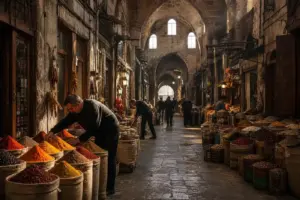 Spice Bazaar – about 100 m away (~2 min walk) · typical visit: 1–2 hours13 min on foot from Haliç metro, Open daily 08:00–19:30
Main image: AI-generated illustration. It may not show the place exactly as it looks.
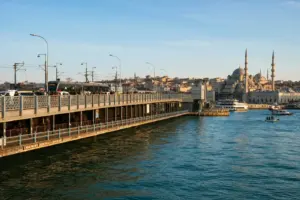 Galata Bridge – about 350 m away (~6 min walk) · typical visit: 30 minutes to 1 hour10 min on foot from Haliç metro, Open 24 hours
Main image: AI-generated illustration. It may not show the place exactly as it looks.
 Fener and Balat Districtsabout 2.1 km away · typical visit: 3–5 hours
Main image: AI-generated illustration. It may not show the place exactly as it looks.
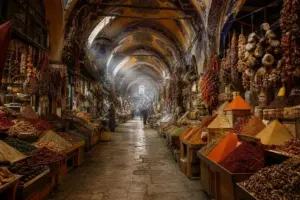 Egyptian Bazaar – about 100 m away (~2 min walk) · typical visit: 30 minutes to 1 hour13 min on foot from Haliç metro, Open daily 08:00–19:30
Main image: AI-generated illustration. It may not show the place exactly as it looks.
 Rüstem Pasha Mosque – about 250 m away (~4 min walk) · typical visit: 45 minutes to 1 hour10 min on foot from Haliç metro, Open daily 09:00–18:00
Main image: AI-generated illustration. It may not show the place exactly as it looks.
 Büyük Valide Han – about 450 m away (~7 min walk) · typical visit: 1–2 hours9 min on foot from Beyazıt-Kapalıçarşı metro, Open daily 06:00–20:00
Main image: AI-generated illustration. It may not show the place exactly as it looks.
Metro stations near New Mosque
 Haliç – about 750 m away (~12 min walk)Open daily 06:06–00:06
Main image: AI-generated illustration. It may not show the place exactly as it looks.
 Çemberlitaşabout 950 m away (~15 min walk)
Main image: AI-generated illustration. It may not show the place exactly as it looks.
 Beyazıt-Kapalıçarşı – about 1000 m away (~16 min walk)Open daily 06:00–00:00
Main image: AI-generated illustration. It may not show the place exactly as it looks.
Restaurants and cafes near New Mosque
 Pandeli – about 50 m away (~1 min walk)12 min on foot from Haliç metro, Open 11:30–19:00, closed Sun
Main image: AI-generated illustration. It may not show the place exactly as it looks.
 Hamdi Restaurant – about 200 m away (~4 min walk)12 min on foot from Çemberlitaş metro, Open daily 12:00–00:00
Main image: AI-generated illustration. It may not show the place exactly as it looks.
 Şehzade Cağ Kebap – about 450 m away (~7 min walk)11 min on foot from Haliç metro
Main image: AI-generated illustration. It may not show the place exactly as it looks.
 Hafız Mustafa 1864 – about 450 m away (~7 min walk)12 min on foot from Çemberlitaş metro, Open daily 12:00–23:59
Main image: AI-generated illustration. It may not show the place exactly as it looks.
Nightlife near New Mosque
 Cheers Karaköy – about 500 m away (~9 min walk)9 min on foot from Haliç metro, Open daily 08:30–02:00
Main image: AI-generated illustration. It may not show the place exactly as it looks.
 The Bank Roof Bar – about 750 m away (~12 min walk)8 min on foot from Şişhane metro, Open daily 12:00–02:00
Main image: AI-generated illustration. It may not show the place exactly as it looks.
Train stations and river piers near New Mosque
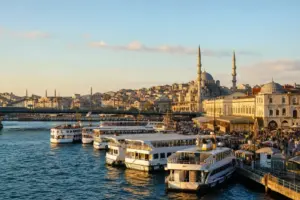 Eminönü Ferry Terminalabout 50 m away (~1 min walk)
Main image: AI-generated illustration. It may not show the place exactly as it looks.
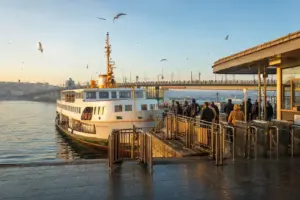 Karaköy Ferry Terminalabout 700 m away (~11 min walk)
Main image: AI-generated illustration. It may not show the place exactly as it looks.
Events and traditions near New Mosque
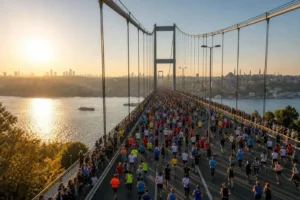 Istanbul Marathonabout 1.4 km away (~22 min walk)
Main image: AI-generated illustration. It may not show the place exactly as it looks.
Related guides
 Best Underground Cisterns in Istanbul: Three Sites Compared
Main image: AI-generated illustration. It may not show the place exactly as it looks.
 The Red School in Fener: A Castle above the Golden Horn
Main image: AI-generated illustration. It may not show the place exactly as it looks.
 Orient Occident Hotel: Green and Brass in Sirkeci
Main image: AI-generated illustration. It may not show the place exactly as it looks.
 AJWA Sultanahmet: Ottoman Luxury Near the Blue Mosque
Main image: AI-generated illustration. It may not show the place exactly as it looks.
 My Terrace: Rooftop Breakfast by Little Hagia Sophia
Main image: AI-generated illustration. It may not show the place exactly as it looks.
Browse more: More in Fatih · All Landmarks · All Sightseeing
FAQ: New Mosque
Is entry to the New Mosque really free?
Yes, entry is completely free. It is a working mosque, not a museum. Donations to the mosque's maintenance are welcome but not required or expected. There is no ticket booth and no one will charge you at the door.
When can I visit? Is it open all day?
The mosque is open daily during daylight hours but closed to general visitors during the five daily prayer times. Prayer times shift throughout the year. Download a prayer-times app to check the current schedule for your visit day. It is typically closed for 20–30 minutes at each prayer time and all day Friday at midday prayer.
What do I need to wear to enter?
Dress modestly: shoulders and knees must be covered. Long trousers and a sleeved top are standard. Head scarves are provided free at the entrance if you need one; many visitors bring their own. Remove your shoes before entering the prayer hall—wear slip-ons for easy removal. Socks are recommended.
Is the royal pavilion part of the main mosque ticket?
The royal pavilion is attached to the mosque but has separate hours and operates independently (run by the Istanbul Chamber of Commerce). Entry is free but hours are Tuesday–Sunday 10:00–19:00, closed Monday. Ask mosque staff inside the prayer hall for the pavilion entrance on the eastern side; it is not obvious from outside.
Can I visit the Spice Bazaar at the same time as the New Mosque?
Yes. The Spice Bazaar (Egyptian Bazaar, Mısır Çarşısı) is physically attached to the northeast corner of the mosque complex. Both are free to enter, operate independently, and can be visited in any order. The bazaar is commercial; the mosque is religious. They are separate experiences.
How long does a visit take?
A quick visit to the prayer hall and courtyard takes 20–30 minutes. With the royal pavilion, add another 15–20 minutes. If you also visit the tomb (Valide Sultan türbe), add 10 minutes. Most people spend 30–45 minutes total. You can go faster or slower depending on interest in history and architecture.
Is the New Mosque the same as the Blue Mosque?
No, they are different mosques. The Blue Mosque (Sultanahmet Camii) is in the Sultanahmet district, about 1 km away. The New Mosque (Yeni Cami) is at Eminönü waterfront. Both are Ottoman imperial mosques built in different eras and locations. Allow 30 minutes to walk between them or take the tram.
Why does a new mosque built in 1665 still exist?
It is called the New Mosque because when it was completed in 1665, it really was the newest of the great imperial mosques. That name stuck for 360 years, becoming one of Istanbul's jokes. It has survived because it is an iconic structure and Ottoman heritage site; it has undergone regular restoration to combat waterfront erosion damage. It reopened fully restored in 2023.
Istanbul Vibes is a one-person project. A coffee keeps it going
Hotels near New Mosque
- Şirin Han Hotel (200 m) Check prices (affiliate link, opens in a new tab)
- Cronton (200 m) Check prices (affiliate link, opens in a new tab)
- Orientbank Hotel Istanbul (200 m) Check prices (affiliate link, opens in a new tab)
- Legacy Ottoman (250 m) Check prices (affiliate link, opens in a new tab)
Affiliate link (opens the booking site): we may earn a commission at no extra cost to you.
Restaurants near New Mosque
- Pandeli (50 m) Google Maps
- Resturant (50 m) Google Maps
- 2K Chicken (100 m) Google Maps
- Dilek Züccaciye Eminönü (150 m) Google Maps
Distances are straight-line, from OpenStreetMap data.

Take this guide with you
Get a free PDF of this guide to print or read offline: key facts, tips and a map link on a few clean pages.
Report an issue on this page
How we research and update our guides
About this guide: AI assistance and accuracy
This guide is created with the help of AI and is based on official sources where available. Mistakes can still happen. Opening hours, prices, rules and other details are given to the best of our knowledge as of the date shown and can change without notice. It offers general recommendations only, not professional, legal or travel advice. Please confirm important details with the official source before you travel; you are responsible for your own plans and decisions.
* Affiliate link: as an Amazon Associate we earn from qualifying purchases at no extra cost to you.
