
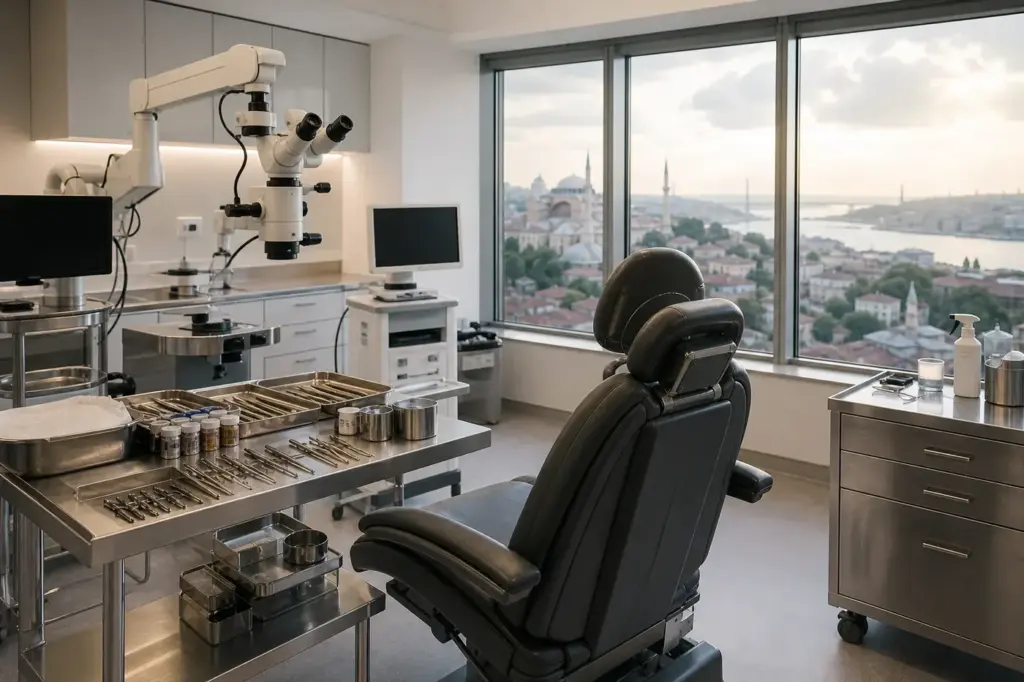
Information only. This article explains what a treatment is and how it is usually carried out. It is not medical advice, not an offer and not a recommendation to have any procedure. Whether it suits you can only be decided by a licensed doctor after an examination.
Beard transplant is a surgical option for men seeking to restore facial hair density or coverage. If you have patchy, thin, or completely absent beard growth, this article explains how the procedure works in Istanbul, what to expect during and after, and what matters before deciding whether it suits you.
Many international patients consider treatment abroad, and quality, regulation and advertising rules differ by country and by provider. Before deciding, talk to a licensed doctor in your home country about whether the procedure is suitable for you, and check the licence of any clinic and doctor in the official register of the Turkish health authority.
Quick answer: A beard transplant involves taking a person's own hair roots from an area where they grow densely, usually the donor zone at the back of the scalp, and relocating them one by one to facial areas where the beard is thin or absent. The procedure uses the minimally invasive Follicular Unit Extraction (FUE) method to harvest hair, then grafts it into sparse beard areas. Results and recovery differ from person to person; visible growth typically appears 6–12 months after the procedure.
Because the relocated roots come from the scalp, they behave like scalp hair at first, growing in fine and soft. Over time, and with the help of regular shaving, most patients find that the hair tends to thicken and coarsen until it approaches the texture of natural beard hair.
At a Glance
| Total time | Procedure: 4–8 hours. Initial healing: 1–2 weeks. Full results: 6–12 months. |
|---|---|
| Typical cost | ₺₺₺ |
What You Need Before You Start
- Health assessment by a licensed doctor to confirm suitability (no active infection, reasonable scalp donor density)
- Realistic expectations: results take 6–12 months to fully appear; early months show temporary shedding
- Time off work: 7–14 days minimum for initial healing, though some can return within 2–3 days
- Post-operative care commitment: follow all aftercare instructions, attend follow-up appointments
- Stable medical history: certain chronic conditions, blood-thinning medications, or pregnancy may require medical advice against the procedure
- Willingness to avoid smoking and alcohol for at least 2 weeks post-procedure
Compare Your Options
| Option | Duration | Price | Notes |
|---|---|---|---|
| FUE (Follicular Unit Extraction) | 4–8 hours for procedure; 6–12 months for full results | FUE and DHI are not two rival operations. FUE is a method of harvesting grafts; DHI is essentially a method of placing them. Both extract grafts one by one from the donor with a micromotor; where they part ways is in how the graft is placed on the face. FUE is the most common technique used in Istanbul clinics. Individual follicles are extracted with a small punch (0.7–1.25 mm), leaving tiny circular marks rather than a linear scar. Grafts are held in solution and placed into prepared channels in the beard area. | |
| DHI (Direct Hair Implantation) | 4–8 hours for procedure; 6–12 months for full results | The DHI method is considered less traumatic for the facial skin. Hair is extracted from the donor area, then directly transplanted into the beard area using a special implanter pen. This method allows you not to damage the hair roots growing nearby. DHI reduces the time grafts spend outside the body and may offer slightly better control of angle and depth, but requires more technical precision and often takes longer. | |
| FUT (Follicular Unit Transplantation, 'strip' method) | Procedure varies; longer recovery than FUE | Also known as the 'strip' technique, FUT involves the surgeon removing a strip of skin from the back of the head where the hair is at its thickest and closing the incision before transplanting the hair follicles. The stitches used to close the incision are removed about 10 days later. The Strip method is not used in medical institutions in Istanbul, since it leaves noticeable scars. FUT is now rarely chosen for beard work. |
₺ budget · ₺₺ moderate · ₺₺₺ upscale · ₺₺₺₺ splurge. Price levels are estimates compared with typical prices for visitors.
Step-by-Step Instructions
Step 1: Consultation and design
The surgeon examines your facial structure and donor area to design a beard line that suits your face. This step determines the number of grafts needed for your desired density. The doctor marks the planned beard outline and discusses the design with you. This happens either in person at the clinic or, in some cases, via video beforehand. The consultation also includes blood tests.
Tip: Be clear about your goal: partial fill-in, goatee, or full beard. The design directly affects the final look.
Step 2: Donor area assessment
The donor area is examined with dermoscopy; the true density at the back of the scalp, the thickness of the hairs and the health of the scalp are assessed to determine how many grafts can be safely taken. This determines the feasibility of the procedure for your hair type and density.
Step 3: Local anaesthesia
Under local anesthesia, follicles are extracted from the back of the head (FUE) and implanted into the beard area. You remain awake throughout and feel numbing sensations but no pain during the extraction and implantation.
Tip: The procedure is performed with local anaesthetic only; general anaesthesia is not used.
Step 4: Extraction of follicles
In FUE the roots are collected one by one from the back of the scalp with a micromotor carrying fine cylindrical punches. There are no incisions and no stitches. The harvested grafts are held in solution, then fine instruments are used to open channels in the beard area and the grafts are set into those channels. The entire extraction phase typically takes 2–3 hours depending on graft count.
Tip: FUE leaves small, nearly invisible circular marks on the scalp rather than a linear scar, so you can wear short hair after.
Step 5: Implantation of grafts
Because opening the channels determines the exit angle and direction of the hair, it is one of the most critical steps in the naturalness of the beard. Each graft is placed at a precise angle to match natural facial hair growth. Surgeons create fuller, natural-looking beard density by transferring 2,500–4,500 scalp follicular units from the donor area and placing them at precise angles of 30–35 degrees to mimic natural facial hair growth. This phase takes 2–3 hours.
Tip: The angle and direction of each graft are crucial; this is where surgeon skill makes the most difference to the final appearance.
Step 6: First wash and initial care
You return to your accommodation the same day. On day 3 (first wash in Istanbul), the clinic provides a guided foam wash (no rubbing); laser therapy may be offered to accelerate healing. Scabs form around the grafts over the first few days and will gradually fall off naturally.
Tip: Do not wash your face yourself or allow water pressure on the transplant area until the clinic gives permission. Use only the techniques shown by the clinic.
Step 7: Scab phase and early healing
Beard transplant recovery follows a predictable timeline, starting with an initial healing phase of about 7 to 10 days. During recovery, small scabs form around the grafts and gradually fall off as the skin heals, while redness and sensitivity decrease. Patients can expect redness across the transplanted zone, minor swelling (particularly around the jaw and chin), and small pinpoint scabs forming at each graft site. Swelling typically peaks at 48–72 hours and begins subsiding by days three to four.
Tip: Do not pick, scratch, or rub the transplant area. Scabs protect the grafts while they anchor; dislodging them reduces graft survival.
Step 8: Temporary shedding phase
A temporary shedding phase usually occurs between weeks 3 and 4, where transplanted hairs fall out before new growth begins. This is normal and does not mean the procedure failed. The transplanted hairs shed, but the important part, the follicle, remains safely beneath the skin. This shedding phase makes way for new, stronger hairs to grow in their place.
Tip: This shedding phase (called "shock loss") is expected. Do not panic; the follicles are still active beneath the skin.
Step 9: Months 3–6: Visible regrowth
Visible results typically appear around 6 to 9 months, with full density developing between 12 and 18 months. As new hairs push through the skin during months three to four, some patients experience folliculitis—small pimples or ingrown hairs in the transplanted area. Other potential complications include graft pitting, cobblestoning (small bumps at implanted roots, more common with coarse dark hair), and rare temporary facial nerve numbness. These are typically mild and resolve naturally.
Tip: Be patient; the full picture of your beard takes 12 months or longer to develop. Early appearance is often sparse.
Step 10: Return to normal activities
You can return to work 2 to 3 days after a beard transplant. Although, usually, patients are advised a week's rest. Most patients can return to normal routines shortly after the initial 7–10 day phase. Weight training can typically resume after three to four weeks, while contact sports require a minimum of four to six weeks.
Tip: Even if you feel ready earlier, avoid strenuous exercise and activities that cause sweating for at least 3 weeks to protect the grafts.
Common Mistakes to Avoid
- Not verifying the doctor's credentials in the official Turkish health register. Before booking, check that your chosen surgeon holds a valid licence registered with the Turkish Ministry of Health.
- Underestimating the commitment to aftercare. Infection risk, graft loss, and poor results are often caused by not following post-operative instructions (especially avoiding touching the transplant area, water pressure, sweating, and smoking).
- Expecting results too soon. Many patients become discouraged during the temporary shedding phase (weeks 3–4) and think the procedure failed. Full density takes 6–12 months; judging results before month 3 is misleading.
- Confusing the early texture with the final texture. Transplanted hair from the scalp grows in fine and soft at first; it typically thickens over several months with regular shaving. This is normal, not a sign of failure.
- Booking a return flight too soon. While you can leave Istanbul after 3–4 days for basic care, initial swelling and scabs are still visible. Plan to stay 7 days if possible, or accept that you may look noticeably different during travel.
- Ignoring signs of infection. Fever, severe pain beyond mild discomfort, spreading redness, pus, or excessive bleeding after day 2–3 require immediate medical attention. Do not wait; contact your surgeon or seek local medical help.
Tickets, Payment and Booking
Beard transplant is performed at private aesthetic and hair transplant clinics throughout Istanbul. There is no single official booking system; each clinic manages its own reservations.
- How to book: Contact the clinic directly by phone, email, or WhatsApp (preferred by most Turkish clinics). Provide photos of your beard area and ask about available dates.
- Consultation: Most clinics offer a free initial consultation, either in person or via video call. Some charge a small fee that is credited toward the procedure if you proceed.
- Payment: Clinics accept Turkish lira, euros, and dollars; many also accept international credit cards and bank transfers. Check whether your home country’s banking or payment restrictions affect transfers to Turkish accounts.
- Booking in advance: Popular clinics may have waiting lists of 2–4 weeks, especially in summer. Book as early as possible if you have a specific date in mind.
- Avoid unauthorised agents: Book directly with the clinic, not through third-party websites that take commissions. Verify the clinic’s official phone number and website independently before contacting them.
Good to know
- Plan your timing around work and social commitments. You can return to work after 3 days, but visible scabs and redness persist for 7–10 days. If your job involves close customer interaction or is appearance-sensitive, take a full week off.
- Bring copies of any recent blood tests or medical records to your first consultation. Turkish clinics do their own blood tests pre-procedure, but having your history helps them assess your suitability and any medication interactions.
- Avoid alcohol and smoking completely for at least 2 weeks post-procedure. Both restrict blood flow to healing tissue and increase infection risk. Many clinics recommend avoiding them for 4 weeks for optimal results.
- Do not expect to see results before month 3. The temporary shedding phase (weeks 2–4) is disheartening but normal. Take progress photos starting month 3, not month 1.
- Sleep with your head elevated on 2–3 pillows for the first week to reduce swelling. Lying flat increases fluid accumulation in the face and delays healing.
- Ask the clinic whether your follow-up is included in the quoted price or charged separately. Some clinics offer free follow-ups for 12 months; others charge per visit. Clarify before paying.
Explore Nearby Beard Transplant
Sights near Beard Transplant
 Galata Tower · typical visit: 1–2 hours4 min on foot from Şişhane metro, Open daily 08:30–23:00
Main image: AI-generated illustration. It may not show the place exactly as it looks.
 Topkapi Palace · typical visit: 3–4 hours without Harem; 4–5 hours with Harem15 min on foot from Gülhane metro, Open 09:00–18:30, closed Tue
Main image: AI-generated illustration. It may not show the place exactly as it looks.
 Hagia Sophia · typical visit: 1–1.5 hours8 min on foot from Gülhane metro, Open daily 09:00–19:30
Main image: AI-generated illustration. It may not show the place exactly as it looks.
 Blue Mosque · typical visit: 45–75 minutes3 min on foot from Gülhane metro
Main image: AI-generated illustration. It may not show the place exactly as it looks.
Browse more: All Other · All Treatments
FAQ
How long does the procedure take?
The process takes 2–5 hours depending on the graft count. Most beard transplants require 2,500–4,500 grafts, which typically takes 4–8 hours total, including consultation, design, extraction, and implantation.
How long do I need to stay in Istanbul?
Plan for at least 3–4 days. Day 1: arrival and pre-operative assessment; Day 2: procedure; Day 3: first wash at the clinic and aftercare instructions; Day 4: optional follow-up or departure. Many patients stay 5–7 days to ensure initial healing is progressing well.
Will the transplanted hair look natural?
Because opening the channels determines the exit angle and direction of the hair, it is one of the most critical steps in the naturalness of the beard. When performed by an experienced surgeon, the grafts blend with existing beard and scalp hair. However, results differ person to person; some have fuller results than others.
When can I start shaving the transplant area?
Most doctors recommend waiting at least ten to fourteen days before shaving the transplanted area. As the skin and follicles need time to recover, shaving too early can interfere with the healing process. After 2 weeks, when scabs have naturally fallen off, shaving is safe.
How much time off work do I need?
You can return to desk work after 2–3 days. However, usually, patients are advised a week's rest. If your job involves manual labour, heat exposure, or heavy sweating, wait at least 3–4 weeks before resuming full duties.
Is this permanent?
A beard transplant involves relocating healthy hair roots to facial areas. Existing, shedding-resistant roots are moved to the face. Transplanted follicles are genetically resistant to hair loss and should continue growing for life, provided the donor area follicles are stable.
What if the transplant does not work?
Graft survival and results vary. If grafts fail to take root or density is unsatisfactory after 12 months, revision or additional procedures are possible, but come with additional cost. Ask your surgeon about their policy on revisions and whether they offer touch-ups at reduced cost.
Can I use my own donor area if I have patchy facial hair?
A beard-to-scalp transplant involves extracting facial hair from the beard area and implanting it into thinning or balding areas on the scalp. This technique is suited to patients with insufficient scalp donor supply but dense, healthy beard growth that can be repurposed for restoration. If you have dense facial hair elsewhere (goatee, sideburns), a surgeon may be able to harvest and redistribute it; discuss this during consultation.
Before you decide anything
Risks and possible complications
- Temporary redness, swelling, and mild discomfort in the transplant and donor areas, usually subsiding within 1–2 weeks.
- Scabbing around the grafts for 7–10 days; scabs fall off naturally and should not be picked.
- Temporary numbness or tingling in the face, usually lasting a few weeks.
- Temporary shedding of transplanted hair (shock loss) between weeks 2–4; this is normal and does not mean failure.
- Folliculitis: small pimples or ingrown-hair bumps as new hair emerges (months 3–4), usually mild and self-resolving.
- Graft pitting or cobblestoning: small bumps or indentations at implant sites, more common in coarse dark hair; usually fades over time.
- Infection: rare if aftercare instructions are followed, but possible if the transplant area is exposed to contaminated water, touched with unwashed hands, or subjected to pressure.
- Rare complications: severe bleeding, skin necrosis (tissue death), facial nerve damage, or total graft failure are uncommon when performed by an experienced surgeon, but have been documented.
- Results vary from person to person: graft survival rates, hair density, texture change, and growth timeline differ. A doctor cannot predict your individual outcome in advance.
Alternatives to talk about with a doctor
- Minoxidil (topical medication): may slow hair loss or stimulate some growth in existing hair, but does not create new density and requires ongoing use.
- Finasteride (oral medication): may slow male-pattern hair loss in some men, but does not restore lost facial hair and has side effects.
- Beard dyes or fillers: temporary cosmetic products that darken existing hair or fill gaps, but do not add actual hair or density.
- Growing existing beard longer: allows existing hair to cover sparse areas, but does not address complete absence or very low density.
- Acceptance and styling: working with existing beard shape through careful grooming and barber work; this option requires no procedure but has natural limits.
Questions to ask a licensed doctor
- Am I a suitable candidate? A doctor should examine your scalp donor density, existing facial hair pattern, and overall health.
- Which technique (FUE or DHI) is best for my hair type and density goals?
- How many grafts will I need, and what density should I expect?
- What is your graft survival rate, and how do you measure it?
- What is the total cost and what is included (procedure, follow-up visits, aftercare products)?
- What is your aftercare protocol, and how often will I have follow-up appointments?
- If complications occur (infection, poor growth, unsatisfactory density), what follow-up or revision options exist, and are they included or additional cost?
- Will you provide a written treatment plan and detailed aftercare instructions before the procedure?
- Can I arrange follow-up care with a doctor in my home country, and will you provide records and images?
- What signs or symptoms require me to seek urgent medical attention?
- This page is information. It is not medical advice and not a recommendation to have any treatment or to choose any clinic, doctor or country.
- Every medical procedure has risks, and results and healing differ from person to person. A licensed doctor who has examined you decides whether a treatment is suitable.
- Talk to a doctor in your home country before you decide, and plan follow-up care at home: problems can appear after you return.
- Check that the clinic and the doctor are licensed in the official register of the Türkiye Cumhuriyeti Sağlık Bakanlığı, and ask for a written treatment plan and a consent form you understand.
- After a procedure, get urgent medical help for severe pain, fever, heavy bleeding or breathing problems. In an emergency call the local emergency number.
Kontrendikasyonlar olabilir. Bir uzmana danışmak gerekir.

Take this guide with you
Get a free PDF of this guide to print or read offline: key facts, tips and a map link on a few clean pages.
Report an issue on this page
How we research and update our guides
About this page: AI assistance and accuracy
This page was prepared with the help of AI and checked by automatic rules. It is general information only, not medical advice and not a recommendation to have any treatment or to choose any clinic. Mistakes can still happen and details can change without notice. Please check important details with the official source and talk to a licensed doctor before you decide anything.
