
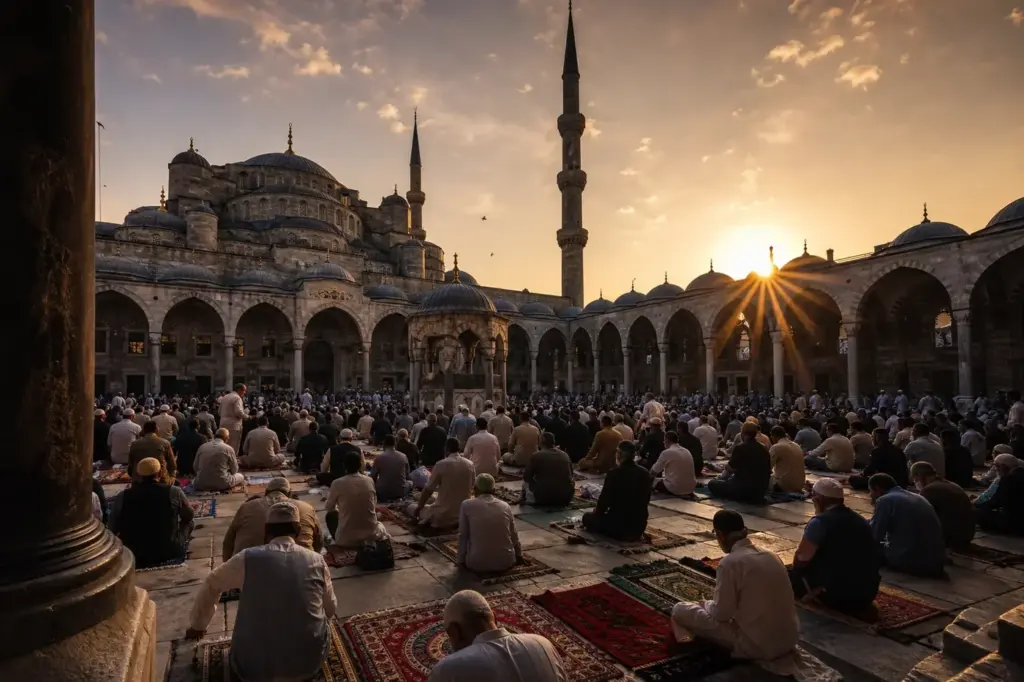
Eid al-Adha, also known as the Festival of Sacrifice, is one of the two major Islamic holidays celebrated by Muslims worldwide. In Istanbul, this significant religious observance transforms the city into a place of spiritual reflection and family gathering. The holiday marks the end of the annual Hajj pilgrimage and holds immense religious importance, second only to Eid al-Fitr.
In 2026, Eid al-Adha will be on 27 May. Turkey has announced that the Eid al-Adha holiday for public employees will run from 23 May to 31 May 2026. The celebration is known in Turkey as Kurban Bayramı. Visitors timing their trip to Istanbul during this period will encounter a city where traditional customs blend with modern celebrations, from dawn prayers at historic mosques to family gatherings and community charity.
Quick Facts
| Type | Holiday / observance |
|---|---|
| When | Every year on the 10th of Dhu al-Hijjah (Islamic lunar calendar), falling roughly 10–11 days earlier in the Gregorian calendar each year |
| Next occurrence | May 27 (same date every year) |
| Typical duration | 4 days |
| Public holiday | Yes, a non-working day in Turkey |
| Best time to visit | Eid al-Adha falls in late May, when Istanbul has warm, pleasant spring weather. The holiday weekend itself is the primary time for celebrations and family gatherings. The morning of the first day is busiest with congregational prayers. Be aware that public spaces, mosques and traditional markets may be crowded during prayer times. |
Dates, programs and prices change from year to year. Always check the official website for the current edition.
Tickets and Booking for Eid al-Adha
Eid al-Adha is not a ticketed event. There is no charge to participate in prayers at mosques or to experience the holiday celebrations in Istanbul. The exact dates depend on the sighting of the moon, so they may vary slightly from country to country. For 2026, check the official Turkish government announcements closer to the date for any updates to the holiday schedule. Details about specific mosque services and public celebrations change by year; consult local Istanbul tourism information or mosque websites for the current edition’s program.
Why Visit Eid al-Adha?
Eid al-Adha offers a unique opportunity to experience one of Turkey’s most magnificent cultural and religious celebrations. Cities, markets, and villages enter an exceptional atmosphere in which religious spirit blends with social traditions that date back to the Ottoman era. Visitors will witness communities gathering in mosques and town squares across cities and villages to perform the special Eid prayer side by side. After the sermons, Muslims warmly embrace each other, exchange greetings and engage in gift-giving while visiting their relatives. The holiday showcases Turkish hospitality, charitable practices, and the importance families place on reunion and social solidarity.
How Eid al-Adha Is Celebrated
On the first day, men go to local mosques for a special early morning Eid prayer, with mosques overflowing into the courtyards, creating a beautiful, communal atmosphere. A key aspect of Eid al-Adha is the religious slaughter of sheep and cattle, symbolizing Prophet Ibrahim’s willingness to sacrifice his son as an act of obedience to God, with the meat from these sacrifices shared among family members and distributed to the less fortunate.
Livestock markets across the country become increasingly active, with special and temporary livestock markets set up on the outskirts of major cities such as Istanbul and Ankara, where buyers carefully inspect the animals and negotiate with sellers. Younger family members pay their respects to elders by kissing their hands and then lifting them to their foreheads, signifying reverence and receiving blessings in return. Families and neighbors visit each other during the holiday, elders are shown respect, children receive holiday money and sweets are offered, strengthening family and community ties.
What It Means for Your Visit
The Eid al-Adha holiday for public employees runs from 23 May to 31 May 2026. It is a nationwide public holiday with heavy traffic expected before and after the holiday, and the Grand Bazaar and Spice Market in Istanbul are usually closed for the first few days. Some individuals take advantage of the extended Eid holidays and head to summer resorts, with millions of people hitting the road and flocking to coastal provinces. Museums, shops and restaurants may have irregular hours during the holiday period. Public transport will be busier than usual as people travel to family gatherings. Check ahead with individual venues for their specific holiday hours.
History of Eid al-Adha
Eid al-Adha is celebrated on the tenth day of Dhu al-Hijjah, when the Hajj pilgrimage takes place and lasts for four days, with Muslims performing an act of zakat and friendship by slaughtering a sheep and distributing the meat to family, friends, and to the poor, and are encouraged to be especially friendly and reach out to one another during this period.
The holiday goes back to the religious story of Ibrahim, who was ordered by Allah to sacrifice his son as a test of faith; after Ibrahim and his son had submitted to Allah, he was rewarded and told to sacrifice a sheep instead. In reminiscence of the Ottoman period, preparations for the holiday used to begin weeks in advance, with livestock markets becoming an essential part of the cities’ social and economic life, and families regarding the purchase of the sacrificial animal as an event in itself involving all family members.
How to Get to Eid al-Adha
Eid al-Adha celebrations take place throughout Istanbul, with the main focus on mosques across all districts. Major congregational prayers occur at iconic mosques including the Blue Mosque and Sultanahmet Mosque in the European side’s historic district. Access by metro to Beyazıt-Kapalıçarşı (lines M1A, M2) or Tünel (lines M1A, F1) stations places you near key religious sites. Most neighborhoods will have local mosques hosting prayers; check ahead for prayer times. Family gatherings and market visits happen in residential areas throughout the city.
Food Nearby
Traditional Turkish breakfast consists of various components such as bread, cheese, olives, eggs, tomatoes, cucumbers, jams, honey, pastries, tea, yogurt, and fresh herbs; Istanbul boasts numerous cafes and restaurants serving delectable Turkish delicacies including kebabs, lahmacun, börek, baklava, künefe, and Güllaç, a special dessert during Eid. Family meals and restaurant gatherings are common during the holiday. Many venues may have modified hours; call ahead to confirm.
What to Bring
Wear respectful, modest clothing, particularly when visiting mosques. Closed shoes are recommended. Women should bring a headscarf to cover their heads when entering prayer spaces. Bring cash, as some traditional shops may be closed and ATM access might be limited during the holiday period.
Photography Rules
Photography is generally permitted in outdoor areas and public spaces during Eid celebrations. Inside mosques, photography is typically restricted or prohibited, especially during prayer times. Check with individual mosques or religious sites for their specific policies before taking photos.
Family Suitability
Holiday money given to children increases their joy and teaches the value of sharing, while offering sweets and treats makes the holiday fun and memorable for children. Eid is fundamentally a family-centered celebration, welcoming visitors of all ages. Young children will enjoy the festive atmosphere, gift-giving traditions, and special foods. Teenagers may appreciate the cultural and spiritual significance of the prayer services and community gatherings. The holiday emphasizes family reunion and intergenerational connection.
Istanbul Vibes Tips
- Plan your visit around mosque prayer times. Early morning congregational prayers on the first day are the most significant; arrive early for popular mosques as they fill quickly.
- Book accommodations and transport well in advance. The extended holiday period means increased travel demand across Turkey; prices rise and availability becomes limited closer to the date.
- Prepare for closures and changes. The Grand Bazaar, Spice Market, and many shops close for the first few days of Eid. Major restaurants may have limited availability or modified hours.
- Expect heavy traffic on roads leaving Istanbul, especially before and after the holiday. Use public transport when possible; taxis and ride services will be busier and more expensive than usual.
- Respect local customs: dress modestly, avoid eating or drinking in public during daylight in religiously observant areas, and be mindful during prayer times when noise should be minimized.
- Street livestock markets appear temporarily on the outskirts of Istanbul for several weeks before Eid. These offer a glimpse into preparations but can be crowded and emotionally intense for some visitors.
Explore Nearby Eid al-Adha
Sights near Eid al-Adha
 Blue Mosque · typical visit: 45–75 minutes3 min on foot from Gülhane metro
Main image: AI-generated illustration. It may not show the place exactly as it looks.
 Topkapi Palace · typical visit: 3–4 hours without Harem; 4–5 hours with Harem15 min on foot from Gülhane metro, Open 09:00–18:30, closed Tue
Main image: AI-generated illustration. It may not show the place exactly as it looks.
 Hagia Sophia · typical visit: 1–1.5 hours8 min on foot from Gülhane metro, Open daily 09:00–19:30
Main image: AI-generated illustration. It may not show the place exactly as it looks.
Related guides
 Spice Bazaar and Grand Bazaar Route: Two Markets, Six Centuries
Main image: AI-generated illustration. It may not show the place exactly as it looks.
 Christian and Jewish Religious Sites and Pilgrimage Locations: Where to Visit and How
Main image: AI-generated illustration. It may not show the place exactly as it looks.
Browse more: All Events & Holidays · All Holiday
FAQ: Eid al-Adha
Is Eid al-Adha a public holiday in Turkey?
Eid al-Adha is a public holiday for a total of 4.5 days. For public employees, the holiday runs from 23 May to 31 May 2026. The private sector operates normally, though many businesses close or reduce hours.
Can I visit mosques during Eid prayers?
Visitors of all faiths are generally welcome to observe prayers in mosques, though participating in prayer itself is reserved for Muslims. Arrive early, dress modestly with covered shoulders and knees, and women should bring a headscarf. Remove your shoes before entering the prayer hall.
What will be open and closed during Eid?
The Grand Bazaar and Spice Market in Istanbul are usually closed for the first few days. Many shops, restaurants and offices close during the first 2–3 days. Museums and major tourist attractions typically remain open but may have modified hours. Check individual venues ahead of time.
Why is meat sacrifice important during Eid al-Adha?
The religious slaughter of sheep and cattle symbolizes Prophet Ibrahim's willingness to sacrifice his son as an act of obedience to God, with the meat from these sacrifices shared among family members and distributed to the less fortunate.
Is the date of Eid al-Adha fixed every year?
The exact dates depend on the sighting of the moon, so they may vary slightly from country to country. The holiday falls on the 10th of the Islamic month Dhu al-Hijjah, which moves forward by roughly 10 days each year in the Gregorian calendar.
What's the difference between Eid al-Adha and Eid al-Fitr?
Eid al-Fitr is the first of the two main festivals in Islam, the other being Eid al-Adha. Eid al-Fitr marks the end of Ramadan fasting month, while Eid al-Adha commemorates Prophet Ibrahim's willingness to sacrifice his son and marks the conclusion of Hajj pilgrimage.
Where will I see livestock markets?
Special and temporary livestock markets are set up on the outskirts of major cities such as Istanbul and Ankara, where buyers carefully inspect the animals and negotiate with sellers. These markets operate for several weeks before Eid.
What should I expect in terms of crowds and traffic?
Expect heavy traffic before and after the holiday. Istanbul's streets, mosques, and markets become crowded during prayer times and gatherings. Public transport is busier than usual as residents travel to family destinations outside the city.
Istanbul Vibes is a one-person project. A coffee keeps it going

Take this guide with you
Get a free PDF of this guide to print or read offline: key facts, tips and a map link on a few clean pages.
Report an issue on this page
How we research and update our guides
About this guide: AI assistance and accuracy
This guide is created with the help of AI and is based on official sources where available. Mistakes can still happen. Opening hours, prices, rules and other details are given to the best of our knowledge as of the date shown and can change without notice. It offers general recommendations only, not professional, legal or travel advice. Please confirm important details with the official source before you travel; you are responsible for your own plans and decisions.
* Affiliate link: as an Amazon Associate we earn from qualifying purchases at no extra cost to you.
