
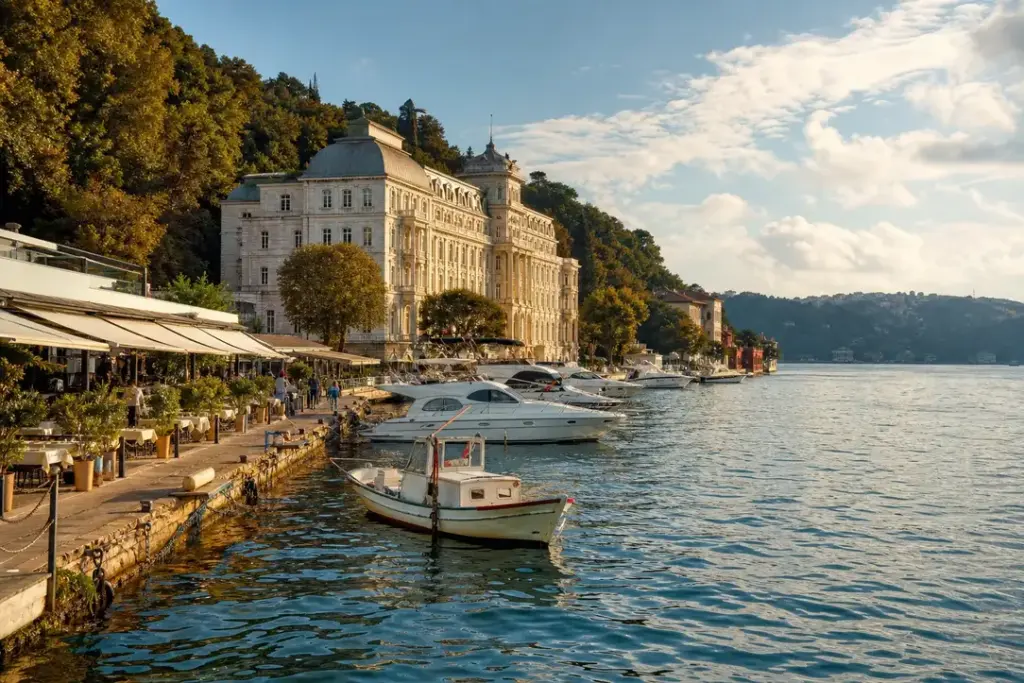
Tarabya is a scenic neighborhood on the European side of the Bosphorus in Istanbul, Turkey. This waterfront quarter draws visitors seeking a quieter, more residential experience than central Istanbul offers. The waterfront area has a rich history, having originated as a health resort in the 18th century.
It is famous for its coastal fish restaurants. With its greenery, the Huber Mansion and a marina which houses tens of boats and yachts, it is one of the most famous neighborhoods in Istanbul. The neighborhood attracts photographers, couples, and those interested in Ottoman heritage and diplomatic history.
Quick Facts
| Address | Tarabya, 34457 Sarıyer, İstanbul, Turkey Google MapsApple MapsYandex Maps |
|---|---|
| District | Sarıyer |
| Metro | Hacıosman (M2, approximately 3 km from the waterfront; take bus 25A or 25Y toward the coast) |
| Best time to visit | Spring (April–May) and autumn (September–October) offer the most pleasant weather for waterfront walks and outdoor dining. Summer (June–August) is warm but crowded with weekend visitors; the waterfront becomes congested on Friday and Saturday evenings. Winter (November–February) is cooler and less crowded, but some restaurant terraces close or reduce hours; the bay can appear grey on overcast days.Visit on weekday mornings or early afternoons for the quietest experience. Fish restaurants are busiest from Thursday evening through Sunday. Early-season autumn (September) combines warm weather with fewer crowds than summer. |
| Recommended duration | 2–3 hours |
What Is (and Isn't) Part of a Visit to Tarabya?
| Part | Status | Notes |
|---|---|---|
| Tarabya waterfront and marina | Included in the standard ticket | Public promenade and bay area accessible year-round; restaurants, cafes and shops open seasonally. |
| Grand Tarabya Hotel | Separate ticket or institution | Luxury hotel property; public can visit the lobby bar and restaurant or book rooms; access is not free. |
| Residential villa streets and mansions | Included in the standard ticket | Exterior views from public streets are free; most villas are private property behind walls. |
| Belgrad Forest | Separate ticket or institution | Adjacent forested area north of Tarabya; separate hiking destination accessed via bus 42 from Hacıosman metro or driving. |
| International schools | Not open to visitors | Lycée Français and Tarabya British Schools are private institutions; not open to casual visitors. |
| Tarabya British Schools campus | Not open to visitors | Private school; not a tourist venue. |
Why Visit Tarabya?
Tarabya offers one of Istanbul’s best-preserved waterfront experiences. Tarabya is surrounded by natural greenery, such as the Belgrad Forest, and it is blessed with a unique natural setting. Nestled along the Bosphorus Strait, it offers panoramic views of the waterway, creating an idyllic backdrop for walking, dining, and living.
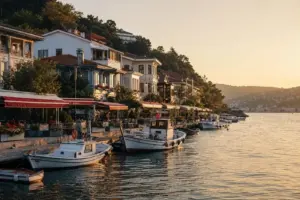
It has a lovely setting on the Bosphorus and plenty of impressive mansions to admire. One of the key attractions is the Tarabya Bay, known for its picturesque marina that showcases an array of yachts and boats. Along the waterfront, several seafood restaurants offer fresh culinary delights, capitalizing on the area’s maritime heritage.
Highlights of Tarabya
Tarabya Bay and Marina
Tarabya Bay is known for its picturesque marina that showcases an array of yachts and boats. The waterfront promenade offers the primary entry point to the neighborhood and draws walkers and photographers. Views stretch across the water toward the Asian shore. Walk along the quay in the late afternoon when light is golden and the restaurants are preparing for dinner service.
Tip: Visit on a weekday morning to avoid weekend crowds; the waterfront is quieter before noon.
Grand Tarabya Hotel
The most prominent landmark in the neighborhood is the Grand Tarabya, which stands proudly on the northeast corner of the harbor. Its history begins in 1909 when Ottoman Armenian businessman Mıgırdiç Tokatlıyan built the Tokatlıyan Hotel, which was designed by Ottoman French architect Alexandre Vallaury (1850-1921). Ravaged by a fire in 1954, the hotel was reconstructed in the mid-1960s and named the Grand Tarabya Hotel. The neoclassical waterfront building is a key visual landmark even if you do not enter.
Tip: Photograph the hotel from the marina promenade at sunset for the best light on its façade.
Fish Restaurants Along the Shore
Today, Tarabya is a popular destination for fish restaurants, especially on weekends and holidays. These casual establishments operate mostly in the evening and offer fresh seafood caught locally or brought daily. Most are family-run and have operated for decades. Menus typically feature grilled fish, octopus, and meze plates.
Tip: Arrive before 20:00 on weekdays to find a table without a reservation; weekends fill quickly.
Ottoman Diplomatic Villas
During the 18th and 19th centuries, many wealthy members of the Phanariots (a famous group of wealthy Greek families) built summer houses (yalılar) here to escape overpopulation and the plague, which at that time was ravaging the city. Many of these families held high positions as Ottoman ambassadors, or worked within the empire's Supreme Council. These homes were then transferred into the hands of ambassadors to be used as summer embassies. Many are still visible from the waterfront.
Tip: Walk the residential streets (Haydar Aliyev Caddesi and side lanes) in late afternoon to see architectural details of these mansions; many are set back from the street behind walls.
Belgrad Forest Access
Tarabya is surrounded by natural greenery, such as the Belgrad Forest. This ancient pine and oak woodland sits above the neighborhood and offers hiking trails, picnic areas, and relief from city heat. Bus 42 from near Hacıosman metro connects to the forest entrance within 20 minutes.
Tip: Pack water; shade is plentiful but the forest has limited commercial facilities. Go early or on weekdays to avoid weekend crowds.
International Schools and Communities
Lycée Français Pierre Loti d'Istanbul and Tarabya British Schools both have high school campuses in Tarabya. These institutions mark the neighborhood's role as a residential hub for international families. The presence of foreign embassies and expat communities has shaped Tarabya's character since Ottoman times.
Tip: The neighborhood is family-friendly and safe, with good infrastructure. International markets and imported goods shops operate near the schools.
Atmosphere
Tarabya feels like a privileged enclave by the water—quieter and greener than central Istanbul, yet connected by metro. Weekday mornings bring elderly walkers and delivery trucks along residential streets. By evening, families emerge for waterside strolls, and restaurants fill with dinner crowds. Weekends see traffic and leisure boats in the bay. The sound of water is constant; the smell of charcoal and fish rises from cooking grills at dusk.
Architecture ranges from grand Ottoman villas behind walls to modern apartment blocks and the monumental Grand Tarabya Hotel. Trees—pines from the forest above, planted along streets—give the place a leafy, privileged air. Language heard includes Turkish, English, French, and Greek. The atmosphere is prosperous and orderly, without the frenetic energy of historic districts.
History of Tarabya
Tarabya was originally a Byzantine village known as Pharmakía (Φαρμακία) which means poison. According to tradition, the name changed to Therapiá (Θεραπειά) in the 12th century because Ecumenical Patriarch Cosmas II Atticus of Constantinople (d. 425) was uncomfortable with the settlement being associated with poison. The name comes from Therapia, was well known in Byzantine and early Ottoman times for its therapeutic hot springs, which unfortunately dried up or cooled down after an earthquake.
A small Byzantine castle was located there. It was conquered in 1453 by the Ottomans and 40 soldiers were executed. During the 16th century, Sultan Selim II is said to have travelled to Tarabya for hunting and fishing. He was apparently so delighted with the area that he brought gardeners to tend a royal garden and settle the area.
In his expeditions around Constantinople in 1630, famed traveler Evliya Çelebi documented that Tarabya was a small village whose inhabitants were both Muslims and Greek Orthodox Christians. The village became the centre of the Terkos Metropolis in 1655, which transformed the village. Thanks to its new religious position and relative proximity to Constantinople, it became one of the most important settlements on the European side of the Bosphorus.
During the 18th and 19th centuries, many wealthy members of the Phanariots (a famous group of wealthy Greek families) built summer houses (yalılar) here to escape overpopulation and the plague, which at that time was ravaging the city. Many of these families held high positions as Ottoman ambassadors, or worked within the empire’s Supreme Council. These homes were then transferred into the hands of ambassadors to be used as summer embassies. By the 17th century, the village was almost completely populated by Greeks with small Armenian and Muslim minorities. It became popular with the diplomatic community and wealthy merchants began to build mansion there in the 18th and 19th centuries.
Its history begins in 1909 when Ottoman Armenian businessman Mıgırdiç Tokatlıyan built the Tokatlıyan Hotel, which was designed by Ottoman French architect Alexandre Vallaury (1850-1921). The hotel burned down on April 19, 1954, with many believing Gültan deliberately set the fire. In 1964 the hotel was reconstructed and its name changed to the Büyük Tarabya (Grand Tarabya) Hotel. Most Greeks left in the mid-20th century as relations between Greece and Turkey changed. The Church of St. George was damaged by fire in the mid-20th century and the Greek school closed down in 1985.
Legends and Myths about Tarabya
The Healing Springs
Legend – historically unreliable. During the term of Attikos as Archbishop of Constantinople from 405 to 425 CE, the name of the neighborhood changed to Therapeia, meaning "cure" or "healing" in ancient Greek due to the hot springs in the region. These sacred springs represent St. John the Baptist, St. Fotini, St. Paraskevi, St. Marina, St. Kyriaki, and St. Constantine and Helen.
Sultan Selim II's Summer Retreat
Legend – historically unreliable. During the 16th century, Sultan Selim II is said to have travelled to Tarabya for hunting and fishing. He was apparently so delighted with the area that he brought gardeners to tend a royal garden and settle the area.
Tickets and Booking for Tarabya
Tarabya is a free-to-access neighborhood. The waterfront promenade, marina area, and residential streets are open to the public at all times. Fish restaurants and cafes operate on typical commercial hours. The Grand Tarabya Hotel welcomes visitors to its public lobby and bar (beverage and food purchases required); overnight stays or restaurant reservations may be made via the hotel’s official site.
No tickets or advance booking are required to walk through the neighborhood or photograph the waterfront. Visit the official Istanbul tourism site for restaurant directories and current business listings.
Suggested itineraries Tarabya
2–3 hours
Start at Hacıosman metro station (M2 line). Take bus 25A or 25Y (10–15 minutes) to the waterfront. Walk the marina promenade, photograph the Grand Tarabya Hotel from the bay side, and explore residential streets inland. Stop for tea or coffee at a waterfront café. End with a walk among the Ottoman villas on Haydar Aliyev Caddesi and side streets.
Half day (4–5 hours)
Follow the 2–3 hour itinerary. Add lunch or early dinner at a fish restaurant (book ahead on weekends). After eating, take a walk through the upper residential area to spot the Huber Mansion and other heritage properties. If time permits, return to Hacıosman and take bus 42 toward Belgrad Forest for a brief woodland walk.
Evening walk (1–2 hours)
Arrive at waterfront after 17:00. Stroll the promenade as light becomes golden. Watch boats in the bay and sketch the Grand Tarabya Hotel. Move to a restaurant by 19:00–20:00 for dinner. This visit captures Tarabya's best light and most relaxed atmosphere.
How to Get to Tarabya
By Metro and Bus (recommended): Take Istanbul Metro line M2 to Hacıosman station (the northern terminus). The journey from central Istanbul (e.g., Beyazıt area) takes approximately 30–35 minutes. Exit toward Tarabya Bayırı Avenue. From the station entrance, walk uphill briefly or wait for bus 25A or 25Y, which run regularly to the waterfront (10–15 minutes). Both buses pass directly through Tarabya and stop near the marina and restaurants.
Alternative buses: From Taksim Square or Beşiktaş, you can take bus 40 or 40B directly to Tarabya (40–50 minutes), though this is slower and more crowded than the metro–bus combination.
By taxi or car: A taxi from central Istanbul takes 25–40 minutes depending on traffic. Parking is available along the waterfront and near the marina, though spaces fill on weekends. The neighborhood is hilly and best explored on foot once you arrive.
Accessibility
Tarabya is moderately accessible. Hacıosman metro station is wheelchair-accessible; the station has lifts. The waterfront promenade is flat and paved, suitable for wheelchairs and strollers. However, many residential streets are steep and hilly, with older properties built on sloped terrain. Not all restaurants have ramped entrances; call ahead to confirm accessibility. The Grand Tarabya Hotel is fully accessible with modern facilities.Public restrooms are limited; the hotel and restaurants offer facilities to customers. Benches and shaded seating are available along the marina promenade.
Food Nearby
The neighborhood is famous for its coastal fish restaurants. Most operate in the evening along the waterfront, offering grilled fish, octopus, mussels, and traditional meze. Casual tavern-style establishments dominate; fine dining is limited to the Grand Tarabya Hotel and a few upscale spots. Bakeries and small grocers serve residents on side streets. International market shops and cafes cater to the expat community. Few chains operate here; independent, family-run venues are the norm. Tea gardens (çay bahçesi) and kiosks operate near the marina.
What to Bring
Comfortable walking shoes (streets are hilly and uneven in places). Sunscreen and a hat for waterfront time. A light jacket or sweater for evening, especially in spring and autumn. A camera or phone for waterfront and villa photography. Water or a refillable bottle. Modest dress is recommended for entering religious sites if any are open. Secure any bags; petty theft is rare but possible in crowded areas.
Best Views and Photo Spots of Tarabya
Tarabya Bay from the marina promenade
Wide angle view of the Bosphorus, the far shore (Asian side), and boats anchored in the bay. The Grand Tarabya Hotel dominates the right frame. Water reflects evening light beautifully.
Best time: 16:00–18:30, any season; best in clear weather. Weekday mornings offer fewer people in the frame.
Grand Tarabya Hotel from the waterfront
Three-quarter view of the hotel's neoclassical façade rising above the marina. The building's pale stone glows against the blue water and sky. Yachts in the foreground add scale.
Best time: Late afternoon (16:30–18:00) for warm, directional light on the façade. Spring and autumn skies are clearest.
Residential streets with Ottoman villas (Haydar Aliyev Caddesi and side streets)
Tree-lined street with glimpses of grand old properties behind walls, gates, and greenery. Architectural details visible on visible portions of facades. Peaceful, leafy setting.
Best time: Morning or late afternoon for gentle side-lighting. Avoid harsh midday sun. Weekday afternoons have minimal foot traffic.
Marina quay looking toward the hotels and buildings
Close-up of moored boats and yachts with waterfront buildings and restaurants behind. The mix of traditional and modern architecture frames the working harbor.
Best time: Early evening (17:00–19:00) when boats have returned and light is gold. The area is quieter before dinner service.
Photography Rules
Photography is free and unrestricted on public streets and the waterfront. Photograph the Grand Tarabya Hotel from the marina side for best light (late afternoon). Ottoman villas are private; photograph from public streets only. Drones are not permitted without official authorization. Waterfront photos are best taken from 16:00–18:00 when the western light is warm. Flash is not needed in daylight; respect privacy and do not photograph people without permission.
Family Suitability
Tarabya is family-friendly, though it is primarily an adult neighborhood focused on dining and leisure. The waterfront promenade is safe and suitable for stroller walks and young children. Fish restaurants welcome families; eating on terraces allows children to move freely. The hilly residential streets may challenge stroller pushing in some areas. There are no playgrounds or child-specific attractions; families seeking entertainment venues should visit other neighborhoods. Older children (8+) enjoy exploring the architectural heritage and waterfront. The Belgrad Forest, accessible via bus 42, offers hiking suitable for families with older children.
Istanbul Vibes Tips
- Book a fish restaurant table before 18:30 on Friday or Saturday; otherwise arrive after 21:00 or visit midweek. Weekday lunch is also quieter.
- The 25A bus from Hacıosman is faster and more reliable than walking; it passes through the neighborhood and drops you at the waterfront in 10–12 minutes.
- Walk the upper residential streets in late afternoon to see architectural details of Ottoman villas; many are invisible or plain from the street-level view.
- Bring a sweater or light jacket even in summer; the waterfront can be breezy in the evening, and many restaurant terraces lack heating.
- Avoid visiting on public holidays (especially Turkish national holidays) when the neighborhood is congested with weekend crowds and parking is impossible.
- Check bus schedules online (moovit.app or metro.istanbul) as evening frequencies drop after 21:00; plan your return journey to the metro accordingly.
Explore Nearby Tarabya
Sights near Tarabya
 Belgrad Forestabout 10.7 km away · typical visit: 2–4 hours
Main image: AI-generated illustration. It may not show the place exactly as it looks.
 Ural Ataman Classic Car Museumabout 600 m away (~10 min walk) · typical visit: 1–2 hours
Main image: AI-generated illustration. It may not show the place exactly as it looks.
 Maslak Pavilions – about 2.6 km away · typical visit: 2–3 hoursOpen 09:00–17:00, closed Mon
Main image: AI-generated illustration. It may not show the place exactly as it looks.
 Emirgan Park – about 2.8 km away · typical visit: 2–3 hoursOpen daily 07:00–22:00
Main image: AI-generated illustration. It may not show the place exactly as it looks.
Metro stations near Tarabya
 Hacıosman – about 1.8 km away (~29 min walk)Open daily 06:42–00:42
Main image: AI-generated illustration. It may not show the place exactly as it looks.
Related guides
 Sarıyer: Bosphorus villages, seafood and green escapes north of Istanbul
Main image: AI-generated illustration. It may not show the place exactly as it looks.
 Best Seafood Restaurants in Istanbul: Bosphorus Fish Dining Guide
Main image: AI-generated illustration. It may not show the place exactly as it looks.
 Six Senses Kocataş Mansions: A Bosphorus Spa Retreat
Main image: AI-generated illustration. It may not show the place exactly as it looks.
 Rumeli Kale Cafe: Breakfast on the Bosphorus Shore
Main image: AI-generated illustration. It may not show the place exactly as it looks.
 Lokma: A Bosphorus Breakfast at Rumeli Hisarı
Main image: AI-generated illustration. It may not show the place exactly as it looks.
Browse more: More in Sarıyer · All Neighborhoods
FAQ: Tarabya
How do I get to Tarabya from Sultanahmet or Beyazıt?
The easiest way to get to Tarabya is to take the Metro on line M2 to the Hacıosman stop and hop on the 25A or 25Y bus, which both pass through the neighborhood. The journey takes about 40–45 minutes total.
Is entry to Tarabya free?
Yes. The waterfront, marina, and public streets are free to access at all times. Restaurants, cafes, and the Grand Tarabya Hotel charge for food and drinks or room bookings.
Can I photograph the Ottoman villas?
Yes, you can photograph villas from public streets and the waterfront. Do not trespass onto private property or photograph people without permission. The best exterior views are from Haydar Aliyev Caddesi and the marina promenade.
What are the best fish restaurants in Tarabya?
Most waterfront establishments are independently run and well-known locally. Ask your hotel concierge for current recommendations, as menus and quality vary. Book ahead on weekends. Consider arriving after 20:30 for table availability without a reservation.
How far is Tarabya from the Belgrad Forest?
Tarabya is surrounded by natural greenery, such as the Belgrad Forest. The forest entrance is accessible via bus 42 from near Hacıosman metro (approximately 20 minutes). Walking uphill from the waterfront to the forest takes 1–1.5 hours.
Is the neighborhood safe for solo travelers?
Yes, Tarabya is a safe, upscale neighborhood with good lighting and regular police presence. The waterfront and main streets are secure even in the evening. Solo travelers should observe typical city caution (avoid displaying valuables, stay aware of surroundings).
What is the Grand Tarabya Hotel?
The most prominent landmark in the neighborhood is the Grand Tarabya, which stands proudly on the northeast corner of the harbor. Its history begins in 1909 when Ottoman Armenian businessman Mıgırdiç Tokatlıyan built the Tokatlıyan Hotel, which was designed by Ottoman French architect Alexandre Vallaury (1850-1921). Today it is a luxury hotel; the lobby and restaurant are open to the public.
When is the best time to visit Tarabya?
Spring (April–May) and autumn (September–October) offer ideal weather and smaller crowds. Summer weekends are busy. Weekday mornings are quieter year-round. Evening visits (after 16:00) capture the best light and atmosphere.
Istanbul Vibes is a one-person project. A coffee keeps it going

Take this guide with you
Get a free PDF of this guide to print or read offline: key facts, tips and a map link on a few clean pages.
Report an issue on this page
How we research and update our guides
About this guide: AI assistance and accuracy
This guide is created with the help of AI and is based on official sources where available. Mistakes can still happen. Opening hours, prices, rules and other details are given to the best of our knowledge as of the date shown and can change without notice. It offers general recommendations only, not professional, legal or travel advice. Please confirm important details with the official source before you travel; you are responsible for your own plans and decisions.
* Affiliate link: as an Amazon Associate we earn from qualifying purchases at no extra cost to you.
