
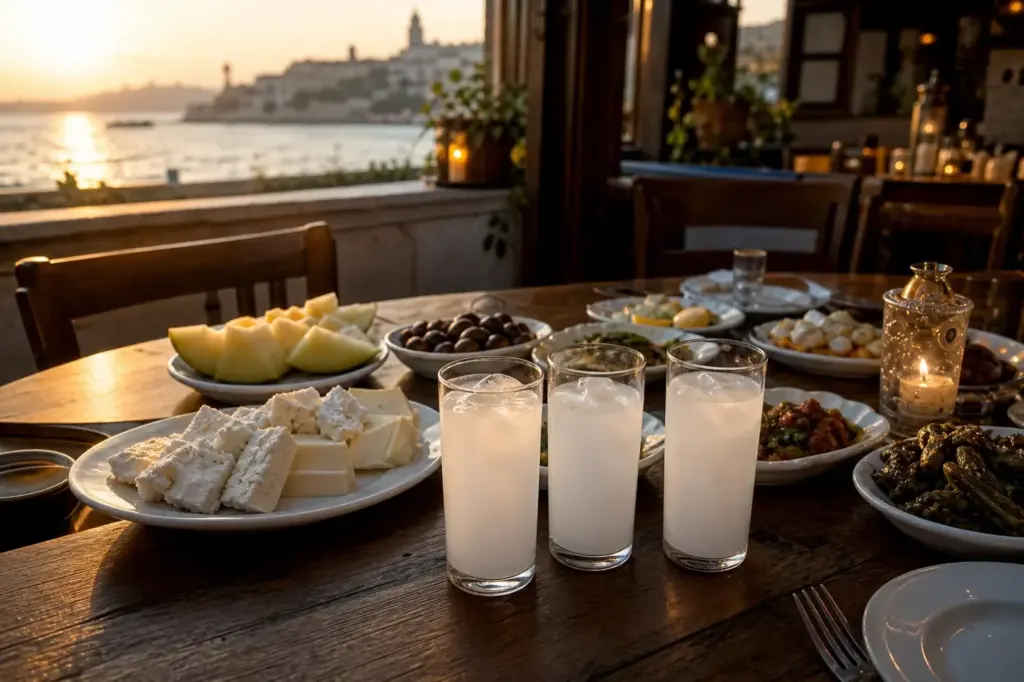
Rakı is not just a drink to order; it’s a ritual central to Turkish social life. This guide teaches visitors to Istanbul how to drink rakı properly—a skill that goes far beyond pouring and sipping.
The recommended way is to order a single kadeh (glass) at a traditional meyhane (tavern), dilute it with water to turn it milky white, and sip slowly alongside meze while in good company. This how to drink rakı Turkish spirit guide walks through the ceremony, the etiquette, and what to expect at the table.
Quick answer: Rakı is a twice-distilled grape and anise alcoholic beverage and the national drink of Turkey. Order it diluted 1:1 or 1:2 with water, never as a shot. Expect to spend 2–3 hours at table with friends and food. Cost is moderate for a single glass; more for a bottle.
At a Glance
| Type | Alcoholic drinks |
|---|---|
| Origin | Rakı originates from the Ottoman Empire, where distillation spread via Mediterranean and Middle Eastern trade routes. Production dates back to the 17th century and became integral to Turkish culture, especially during the 19th century Tanzimat reform period when it began large-scale production. |
| Servings | 1 person per kadeh; typically shared among 2–4 people at a table |
| Total time | 2–3 hours minimum for a proper rakı sofrası |
| Difficulty | Easy |
History and Story of Rakı
The history of rakı as we know it today dates back to the 16th century, the Ottoman Period. The art of distilling ended up in Istanbul (former Constantinople) and here emerged several producers creating higher alcoholic spirits using wine. ‘Wine Rakı’ is mentioned in Evliya Çelebi’s famous work, ‘Seyahâtnâme’ (The Travelogue) in 1630. Over time, it became integral to Turkish culture, especially during the 19th century Tanzimat reform period, when it began to be produced on a larger scale. Rakı began to be consumed as a popular drink in Istanbul’s taverns in the mid-19th century. At that time, taverns were not just places for drinking but also venues where artists, writers, and friendships were shared. As rakı became the centerpiece of this culture, it turned into not just a drink but a social element.
Ingredients
- Cash or payment card accepted at most meyhanes
- Comfortable clothing for a long evening
- Empty stomach or light meal before (the meze is the meal)
- Company—rakı is never drunk alone
- Basic Turkish phrases: 'bir kadeh rakı' (one glass of rakı), 'Tamam!' (enough water/ice)
- Tolerance for strong licorice flavor; it is an acquired taste
How Rakı Is Made
Step 1: Arrive at a meyhane
In Istanbul, traditional meyhanes (taverns) are found on Nevizade Sokak off İstiklal, Çiçek Pasajı, Kumkapı, and Kadife Sokak in Kadıköy on the Asian side. Look for establishments with long wooden tables, older patrons, and warm lighting. Evening (after 8 pm) is the traditional time. Meyhanes often serve fish and seafood alongside meze.
Tip: Go with a friend or join locals at a shared table—solitary rakı drinking is not the custom.
Step 2: Order rakı and meze
Ask for 'bir kadeh rakı' (one glass) if alone or lightly drinking with one or two friends, or 'bir otuzbeşlik rakı' (a 35-cl half-bottle) for a longer evening. Simultaneously order meze (appetizers). A traditional rakı table bears dozens of hot and cold meze, salads and cheeses, but the two essentials are salty white sheep's-milk cheese (beyaz peynir) and sweet yellow melon (kavun).
Tip: Do not order everything at once; meze arrive in waves throughout the evening. Tell the server to bring them slowly.
Step 3: Prepare your glass correctly
Pour the rakı first, then the water, then ice. If you add ice first, it chills the spirit enough that the louche effect is uneven and the aroma closes up. The traditional drinking style is to add equal amounts of water and rakı. Say 'Tamam!' (enough) when you want the server to stop pouring water or ice. The drink turns milky white, earning its nickname aslan sütü (lion's milk).
Tip: Keep a glass of plain water at your side to sip between rakı sips and to cleanse your palate.
Step 4: Toast before drinking
Clink your fellow drinkers with the bottom of the glass—never the top. This is a sign that you consider everyone at the table your equals. Say 'Şerefe!' (to your honour) or 'Afiyet olsun!' (enjoy the meal). It is considered disrespectful to drink quickly like you're racing everyone else at the table.
Tip: Rakı is for sipping over 2–3 hours of conversation, not for speed drinking.
Step 5: Eat meze with each sip
Rakı is traditionally served with meze—a selection of small dishes almost always seasonal. Beyaz peynir (feta) is a must, and melon in summer is a personal favorite pairing. A rakı sofrası includes dishes of salads, cheeses, fruits, and kebap. Take small bites between sips; food is essential to pace your drinking and prevent the alcohol from hitting too hard.
Tip: Hot meze (cooked appetizers) usually arrive after cold ones. Fish or grilled meat comes later in the evening, not at the start.
Step 6: Avoid common mistakes
Do not drink your glass of rakı like a shot, and especially do not drink it straight. You shouldn't do this mainly because it will hit you like a ton of bricks, and because it is meant to act as a digestif or aperitif. Refrain from chasing rakı with anything but beer or coffee, and you must dilute the beverage due to its potency. Never order rakı alone unless you are at a table with others.
Tip: If rakı's licorice taste is too intense, add more water. There is no shame in diluting further.
Step 7: End the evening gracefully
After 2–3 hours of meze, the server may bring a main course (fish or kebap) if you order it, or fruit to signal the meal is winding down. Turkish coffee may follow. Settle the bill and thank your companions. No one leaves early at a proper rakı table.
Tip: Rakı sofrası is a social ritual, not a race to intoxication. Pace yourself and enjoy the company and conversation above all.
Variants
- Fresh-grape rakı, the most popular throughout Turkey, made from recently harvested grapes.
- Grape suma and fresh-grape (yaş üzüm) styles—two main production styles.
- Rakı cocktails—modern variations mixed with citrus or other spirits, served in upscale bars rather than traditional meyhanes.
- Homemade village rakı (köy rakısı)—informally produced in rural areas; quality and safety vary considerably.
Common Mistakes to Avoid
- Drinking rakı like a shot instead of sipping slowly. This overwhelms your palate and is considered disrespectful. Rakı must be diluted and consumed over hours with food.
- Adding ice before water. Ice diminishes or affects the flavor of rakı, and for novice drinkers the alcohol becomes too intense. Always pour rakı, then water, then ice.
- Drinking rakı alone. Rakı is never drunk alone or quickly. The ritual requires company, meze, and conversation. Ordering a bottle to yourself at a table signals either celebration or distress, neither casual.
- Skipping meze or eating too much at the start. If you're having rakı with a meal, it will always start with meze, and they're likely to appear all throughout the night—somewhere in the middle many choose to eat shared meat or fish. Let food arrive naturally with the rhythm of the evening.
- Chasing rakı with the wrong drink. You should refrain from chasing rakı with anything but beer or coffee. Mixing with sugary soft drinks or wine disrupts the experience.
- Ordering expensive spirits at a meyhane. Most meyhanes serve simple, reliable rakı (like Yeni Rakı or Efe) at standard prices. Seeking rare or premium brands there misses the point of casual tradition.
How to Order and Eat It
Rakı is served in a tall narrow glass, diluted with cold water—which turns it milky white, hence the nickname aslan sütü, lion’s milk—and drunk slowly across a long meal of meze, never as a shot. First, pour the rakı into a rakı bardağı (rakı glass), or if you don’t have one, a çay bardağı (tea glass) will do. Then add water. The drink turns milky white, earning its nickname aslan sütü (lion’s milk). The rakı sofrası is a table structure: cold meze arrive first—white cheese and melon are almost obligatory—then hot meze, then grilled fish, then fruit. Conversation is the point, and the table is expected to last two to three hours. Sip between bites of meze; never rush.
To order: Bir kadeh rakı, lütfen. [Beer kah-DEH rah-KUH, LOO-tefen.] (One glass of rakı, please.)
Diet and Allergens
- Contains alcohol (40–50% ABV)
- Gluten-free
- Vegan
Contains alcohol. Please drink responsibly and follow local rules.
Where to Try Rakı
 Boncuk Turkish and Armenian meyhane cooking
Main image: AI-generated illustration. It may not show the place exactly as it looks.
 Giritli Restaurant Cretan and Mediterranean
Main image: AI-generated illustration. It may not show the place exactly as it looks.
 Ritim12 min on foot from Tünel metro, Open daily 10:00–04:30
Main image: AI-generated illustration. It may not show the place exactly as it looks.
Istanbul Vibes Tips
- Visit a meyhane in Beyoğlu or on the Asian side (Kadıköy) for the most authentic atmosphere. Nevizade Sokak behind İstiklal Avenue is crowded but genuinely traditional; Çiçek Pasajı (Flower Passage) is more touristy but still lively. Kumkapı on the waterfront specializes in fish and offers a relaxed vibe.
- Go in the evening after 8 pm or after dinner. Rakı is a night ritual. Midday rakı drinking exists but is rare and signals either celebration or unofficial business.
- If you do not like anise (licorice taste), order more water or skip rakı entirely and order beer or wine instead. There is no obligation to drink something you dislike for cultural reasons.
- Rakı turns opaque white in the glass because of the chemistry of anise dissolving in diluted alcohol—this is normal and expected. The color is part of the appeal.
- Bring cash; many traditional meyhanes do not accept cards. Modern bars in tourist areas do accept cards. Prices for a single glass are budget-level; a bottle is moderate.
- Eating before drinking is optional, but eating meze while drinking is mandatory. The food is not a side; it is the main focus of the gathering.
Explore Nearby Rakı
Related guides
 Beyoğlu and Galata Walk: Modern Istanbul from Taksim to the Tower
Main image: AI-generated illustration. It may not show the place exactly as it looks.
 Pickle Juice (Turşu Suyu): Recipe, Taste and Where to Try It
Main image: AI-generated illustration. It may not show the place exactly as it looks.
 Stuffed Eggplant (Karnıyarık): How to Make the Turkish Classic
Main image: AI-generated illustration. It may not show the place exactly as it looks.
Browse more: All Etiquette and Safety · All Food & Drink
FAQ
Is rakı a spirit or a liqueur?
Rakı is an alcoholic beverage made of twice-distilled grape pomace and flavored with aniseed. It is classified as a spirit (not a liqueur) because it contains no added sugar and is produced solely by distillation. It is similar to Greek ouzo, French pastis, or Italian sambuca, but rakı is made exclusively from grapes and Turkish anise.
Can I drink rakı at a restaurant, or only at a meyhane?
Rakı is available at most traditional Turkish restaurants, fish restaurants, and casual taverns. However, the ritual experience—the rakı sofrası with hours of meze and company—is most authentic at a meyhane. Modern bars may serve rakı cocktails but this is not the traditional way.
What if I do not like the taste of anise?
Rakı's licorice flavor is distinct and acquired. If you dislike anise after trying diluted rakı with water, do not force yourself to drink it. Order beer, wine, or Turkish coffee instead. No visitor should feel obligated to drink something distasteful.
How much rakı should I drink in an evening?
First-time rakı drinkers should only ask for one shot and dilute it with cold water. One diluted glass (kadeh) over 2–3 hours with food is the standard. A half-bottle (35 cl) shared among 2–3 people is moderate. Never drink a full bottle alone.
Is rakı safe to drink, and are there any health concerns?
Rakı contains between 40–50 percent alcohol. It is safe if consumed responsibly with food and water in a social setting. Never drink it quickly, straight, or on an empty stomach. Hangover risk is real if you drink too much.
Can visitors find rakı easily in Istanbul?
Yes, rakı is widely available at meyhanes, traditional restaurants, fish restaurants, and most bars. The most common brand is Yeni Rakı. Expect to pay moderate prices for a glass; higher prices at upscale establishments. Order by the glass if you are trying it for the first time.
What is the difference between rakı and arak?
Rakı is made specifically from grapes and Turkish anise; it is protected as a product of Turkey since 2009. Arak is a similar spirit made across the Middle East and Levant, often from other fruits or grains. They are related but distinct spirits with different production regulations.
Why does rakı turn white when you add water?
Anethole, the aromatic compound in aniseed, dissolves in alcohol but not in water. When you add water the alcohol concentration drops and the anethole comes out of solution as microscopic droplets that scatter light—the louche effect, the same chemistry that clouds ouzo, pastis and absinthe.
Istanbul Vibes is a one-person project. A coffee keeps it going

Take this guide with you
Get a free PDF of this guide to print or read offline: key facts, tips and a map link on a few clean pages.
Report an issue on this page
How we research and update our guides
About this guide: AI assistance and accuracy
This guide is created with the help of AI and is based on official sources where available. Mistakes can still happen. Opening hours, prices, rules and other details are given to the best of our knowledge as of the date shown and can change without notice. It offers general recommendations only, not professional, legal or travel advice. Please confirm important details with the official source before you travel; you are responsible for your own plans and decisions.
* Affiliate link: as an Amazon Associate we earn from qualifying purchases at no extra cost to you.
