
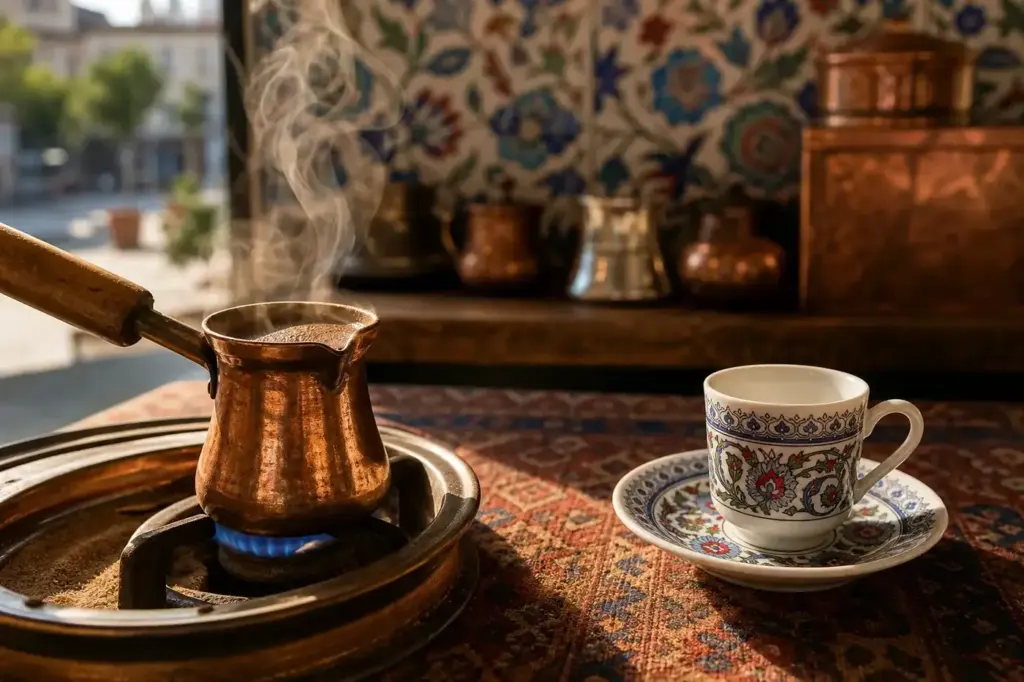
Turkish coffee is more than a morning drink; it is a cultural ceremony that has defined social life in Istanbul and across Turkey for nearly 500 years. If you want to experience it the way locals do—or learn to make it at home—this guide shows you the exact technique, the history behind it, and how to avoid the common mistakes that result in flat, bitter results.
The recommended approach: buy finely ground Turkish coffee from a market or shop, use a cezve (the traditional small pot), measure carefully, and learn the foam technique that gives authentic Turkish coffee its signature character.
Quick answer: It takes about two minutes to prepare Turkish coffee. The method requires very finely ground beans, cold water, optional sugar added before heating, and careful attention to remove the pot from heat just as foam forms on top. The result is a strong, unfiltered coffee served in small cups with grounds settling at the bottom.
At a Glance
| Type | Drinks |
|---|---|
| Origin | Coffee entered Turkey in the mid-16th century, and the preparation method was developed by the Turks and became known worldwide as "Turkish Coffee." Istanbul was introduced to coffee in 1543 by Özdemir Pasha, the Ottoman Governor of Yemen, who had grown to love the drink while stationed in that country. The first coffeehouse opened in the district of Tahtakale in 1554. |
| Servings | 2–4 servings (recipe scales proportionally) |
| Total time | 2–3 minutes |
| Difficulty | Easy |
History and Story of Turkish Coffee
The history of Turkish coffee dates back to the 16th century and the reign of the Ottoman Sultan Suleiman the Magnificent. Legend tells us that an Ottoman governor who was posted in Yemen became fond of the coffee and introduced it to the palace’s cuisine. Initially reserved for the Ottoman Palace, Turkish coffee was brewed using copper pots over slow embers. This method produced a rich, frothy beverage that soon became a symbol of hospitality and refinement. The first coffeehouse opened in the district of Tahtakale in 1554 and others rapidly cropped up all over the city. Coffeehouses and coffee culture soon became an integral part of Istanbul social culture; people came here throughout the day to read books and beautiful texts, play chess and backgammon and discuss poetry and literature. During the 1683 Siege of Vienna, the Ottoman troops abandoned coffee sacks after failing to capture the city, thus introducing coffee to Europe. Its popularity has rapidly spread to other countries since then. Turkish coffee is one of the oldest known coffee preparation and cooking methods, from the Ottoman Empire to the beginning, which has an important place in Turkish history.
Ingredients
- 200 ml cold water (for 2 servings)
- 2 heaping teaspoons (about 7–8 grams each) finely ground Turkish coffee
- Sugar (optional: 2–4 teaspoons depending on sweetness preference)
- Cezve (small long-handled pot, traditionally copper)
- Small coffee cups (fincan) and saucers
How Turkish Coffee Is Made
Step 1: Measure cold water into the cezve
Using your Turkish coffee cup (fincan) as the measure, pour cold water into the cezve. One cup-measure per serving. Do not heat the water first.
Tip: Traditionally, the fincan itself serves as the measuring cup—one cup of water per person.
Step 2: Add finely ground coffee and sugar
Add 1 heaping teaspoon of finely ground Turkish coffee per cup directly to the cold water. When ordering you need to indicate your preferred sweetness: sade (without sugar), az şekerli (little sweet, ½ tsp/cup), orta şekerli (medium sweet, 1 tsp/cup), şekerli or çok şekerli (sweet or very sweet, 2 or more tsp/cup). Add sugar now, before any heat is applied.
Tip: Sugar must be added to the cold mixture before heating, never after. Adjust sweetness to taste.
Step 3: Stir gently to combine
Give the mixture a gentle stir with a small spoon until the coffee and sugar are incorporated into the water. This is the only time you stir.
Tip: Do not over-stir or you will reduce the foam. One or two gentle stirs are enough.
Step 4: Place on low heat and watch carefully
Place the cezve on the stove over low heat. Heat the pot as slowly as possible. The slower the heat the better it is. Do not walk away, make sure you watch it to prevent any overflowing when the coffee starts to foam.
Tip: Low heat is essential. If the heat is too high, the foam will collapse and you will lose the characteristic texture.
Step 5: Remove when foam rises
The coffee will be done within two to three minutes. Look for the moment when the island of foam starts to collapse in on itself, or the foam begins to rise rapidly. If you see bubbles starting to form, remove the cezve from the heat immediately.
Tip: Listen for a subtle hissing sound as foam rises. This signals it is time to lift the pot.
Step 6: Distribute the foam to cups
When the foam rises turn off the heat. Scoop away the foam with a spoon and place an even amount of foam in each cup. This ensures everyone receives foam, which is a mark of quality.
Tip: Use a small spoon to gently portion the foam. Save the best foam for the first distribution.
Step 7: Return to heat and finish pouring
Return the cezve to the heat. Let the coffee heat up again until a new layer of froth forms. Then, pour the rest of the coffee into the cups. Don't pour out the dregs into the cups.
Tip: Leave a small amount of grounds at the bottom of the cezve; they are bitter and should not be poured.
Variants
- Sade (unsweetened Turkish coffee)
- Az şekerli (lightly sweetened with ½ teaspoon sugar per cup)
- Orta şekerli (medium sweetness with 1 teaspoon sugar per cup)
- Şekerli or çok şekerli (sweet or very sweet with 2+ teaspoons sugar per cup)
- Salted coffee, which occurs during a pre-marriage ceremony called "isteme" where a bride-to-be serves the groom coffee with salt instead of sugar.
Common Mistakes to Avoid
- Make sure not to bring it to a boil. A longer brew time will result in over-extraction (bitter taste). Watch for foam rising, not a rolling boil.
- Too much stirring leads to less foam. Stir only once at the beginning to dissolve coffee and sugar.
- Pouring the entire contents of the cezve, including the thick grounds at the bottom, makes the coffee gritty and unpleasant. Leave a small residue behind.
- Using coffee that is not finely ground enough. Turkish coffee beans are ground to a powder finer than any other coffee preparation—almost like cocoa powder. Pre-ground Turkish coffee from a market is best.
- The coffee grounds are simmered (not boiled!) in this pot, usually with sugar, until a frothy layer forms on top. The coffee is not filtered; hence, the coffee powder needs to be ground to a very fine, powdery consistency. Do not attempt to filter or strain it.
- Using water that is too warm or hot when starting. Always begin with cold water and add coffee to it.
How to Order and Eat It
The coffee is served unfiltered in small cups, often accompanied by a glass of water and a piece of Turkish delight or chocolate. Drink slowly and do not stir the cup after serving. Do not drink the grounds at the bottom. If properly prepared there should always be a thick residue at the bottom of your cup when you have finished drinking. It is believed that shapes of coffee grounds left in the cup provides insights into the future. When the cup is empty, it’s time for the ritual of tasseography, or coffee-cup reading. The cup is inverted onto its saucer, left to cool and then shapes and symbols perceived in the leftover grounds are “read” for meaning.
To order: Bir fincan Türk kahvesi, lütfen [Bir fincan Turkish coffee, please]
Where to Try Turkish Coffee
 Rumeli Kale Cafe & Restaurant Turkish breakfast and grill
Main image: AI-generated illustration. It may not show the place exactly as it looks.
 Gallant Galata Cafe, coffee and desserts
Main image: AI-generated illustration. It may not show the place exactly as it looks.
 Kahve 6 Turkish breakfast with İzmir and regional dishes, vegan options
Main image: AI-generated illustration. It may not show the place exactly as it looks.
 Cafe Privato Turkish village breakfast, home-style dishes and a few Georgian specialties
Main image: AI-generated illustration. It may not show the place exactly as it looks.
 Baylan Pastanesi French Patisserie, Desserts, Café
Main image: AI-generated illustration. It may not show the place exactly as it looks.
 Susam Cafe International, Turkish, Breakfast
Main image: AI-generated illustration. It may not show the place exactly as it looks.
 Almira Turkish, Pastries, Cafe
Main image: AI-generated illustration. It may not show the place exactly as it looks.
 Yigit Sofram Turkish Breakfast
Main image: AI-generated illustration. It may not show the place exactly as it looks.
Istanbul Vibes Tips
- Unlike Arabic coffee, Turkish coffee isn't made with added spices such as cardamom. Traditional Turkish coffee is simple: coffee, water, and sugar. Avoid any recipe that adds cardamom, mastic, or other flavorings unless you specifically want a regional variation.
- Compared to a cup of filtered coffee, Turkish coffee has a stronger, more aromatic kick, as well as a lot more body thanks to the fact that it's served along with the grounds without filtering. First-time visitors often expect it to taste like espresso or filtered coffee; it is heavier and more intense.
- The foam is not optional or decorative—it is the hallmark of proper brewing. Visitors can judge a cafe or someone's skill by whether the coffee arrives with a thick, even foam layer. This is why the double-heating technique (raising and lowering the pot twice) is worth mastering.
- Buying pre-ground Turkish coffee from a market or grocer is practical if you are making it at home. Most visitors do not own a traditional Turkish grinder or burr grinder fine enough. Look for bags labeled "Türk kahvesi" or "Turkish coffee grind."
- Turkish coffee represents hospitality, conversation, patience, and social connection. Its preparation and presentation follow a ritual that has been passed down through generations. Accepting a cup of Turkish coffee offered by a host or cafe owner is a gesture of respect and cultural participation, not merely a transaction.
- You don't put milk in Turkish coffee. It is always served black. Water on the side helps cool the palate between sips and aids digestion.
Explore Nearby Turkish Coffee
Events and traditions near Turkish Coffee
 Istanbul Coffee Festival
Main image: AI-generated illustration. It may not show the place exactly as it looks.
Related guides
 Spice Bazaar and Grand Bazaar Route: Two Markets, Six Centuries
Main image: AI-generated illustration. It may not show the place exactly as it looks.
 Pickle Juice (Turşu Suyu): Recipe, Taste and Where to Try It
Main image: AI-generated illustration. It may not show the place exactly as it looks.
 Güllaç: Recipe, History and How to Make This Turkish Dessert
Main image: AI-generated illustration. It may not show the place exactly as it looks.
 Grape Juice (Şıra): Recipe and How to Make Turkish Fermented Grape Juice
Main image: AI-generated illustration. It may not show the place exactly as it looks.
 Caramelised Milk Pudding (Kazandibi): Recipe and Technique
Main image: AI-generated illustration. It may not show the place exactly as it looks.
Browse more: All Food & Drink · All Other
FAQ
What is the difference between Turkish coffee and espresso?
Turkish coffee is a traditional immersion brewing method that uses very finely ground beans simmered unfiltered in a cezve over low heat. Espresso is pressure-brewed and filtered. Turkish coffee is never boiled, uses no pressure, and the grounds remain in the cup. The result is heavier, more sediment-rich, and requires longer sipping.
Do I need a real cezve, or can I use a regular pot?
A traditional cezve (a small pot with a long handle, typically copper or brass) is designed to create the proper foam. While it is technically possible to make Turkish coffee in a regular saucepan, a Moka Pot's filter stops the possibility of this traditional foam forming on the coffee, so it can brew the coffee but stops short of a true Turkish coffee experience. For the authentic experience, a cezve is worth buying; they are inexpensive and widely available in Istanbul markets.
Can I make Turkish coffee without sugar?
Yes. When ordering you need to indicate your preferred sweetness: sade (without sugar). Sugar is optional and should be added to the cold water before heating, not after. Adjust the amount or omit it entirely based on taste.
Why is there sediment at the bottom of my cup?
Turkish coffee is not filtered. The fine grounds are simmered with water and sugar and served directly, allowing the sediment to settle at the bottom of the cup. This sediment is key to the fortune-telling tradition that often follows. Do not drink it; leave it in the cup.
Is Turkish coffee UNESCO recognized?
Turkish coffee culture and tradition was inscribed as an intangible cultural heritage element in 2013. This recognition reflects its deep historical and social importance to Turkish society.
How much ground coffee do I use?
The traditional ratio is 1 heaping teaspoon (about 7 grams) of finely ground coffee per Turkish coffee cup of water (65–75 ml). This produces a rich, full-bodied cup with good foam. Adjust slightly to taste, but this is the standard starting point.
What does it mean when someone reads coffee grounds?
When the cup is empty, it's time for the ritual of tasseography, or coffee-cup reading. The cup is inverted onto its saucer, left to cool and then shapes and symbols perceived in the leftover grounds are "read" for meaning. This is a traditional practice, part of Turkish coffee culture, though not a scientific practice.
What is the salted coffee tradition?
When the groom's family visits the bride's house before the wedding, the bride is expected to prepare a perfect Turkish coffee. If the bride was fond of the groom-to-be, she would prepare coffee with sugar, but if she didn't like the candidate, she would put salt in his coffee instead. This is a historical wedding ritual with symbolic meaning about the bride's feelings.
Istanbul Vibes is a one-person project. A coffee keeps it going

Take this guide with you
Get a free PDF of this guide to print or read offline: key facts, tips and a map link on a few clean pages.
Report an issue on this page
How we research and update our guides
About this guide: AI assistance and accuracy
This guide is created with the help of AI and is based on official sources where available. Mistakes can still happen. Opening hours, prices, rules and other details are given to the best of our knowledge as of the date shown and can change without notice. It offers general recommendations only, not professional, legal or travel advice. Please confirm important details with the official source before you travel; you are responsible for your own plans and decisions.
* Affiliate link: as an Amazon Associate we earn from qualifying purchases at no extra cost to you.
