
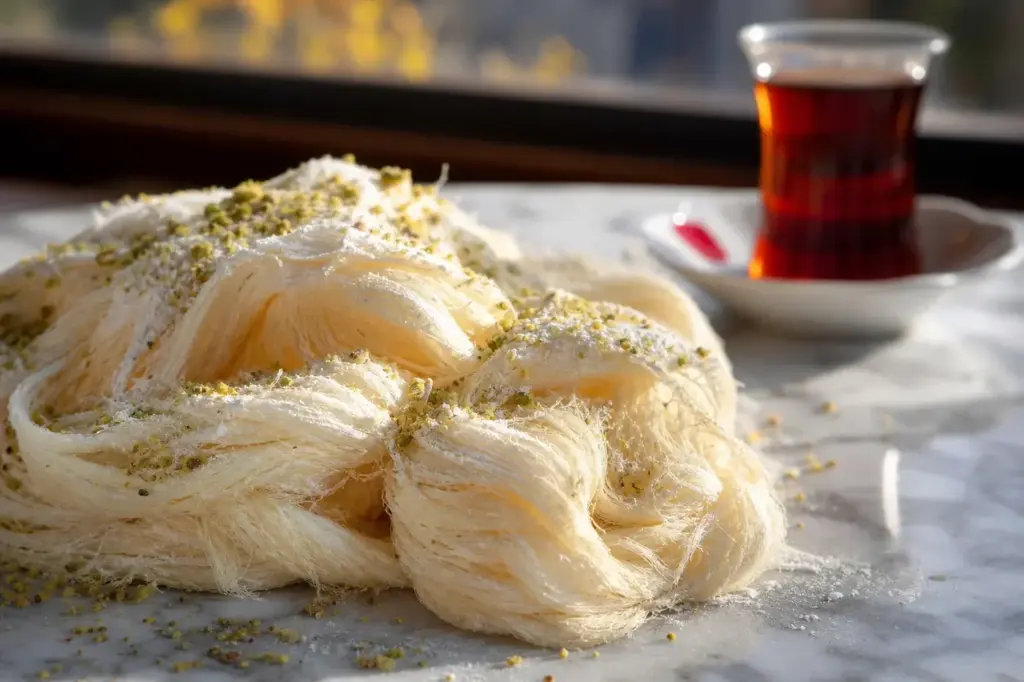
Pişmaniye, known in Turkish as “Turkish cotton candy,” is more than just a sweet—it’s a traditional dessert with roots stretching back centuries. If you’re planning to try authentic Turkish sweets in Istanbul or want to recreate this delicacy at home, understanding how to make pişmaniye reveals why locals have a saying: “Eat pişmaniye and regret it once; don’t eat it and regret it a thousand times.”
This guide takes you through the complete process—from the precise cooking of sugar syrup to the labor-intensive folding and pulling technique that transforms simple ingredients into feathery strands. You’ll discover what makes pişmaniye fundamentally different from Western cotton candy and master the skill yourself.
Quick answer: Pişmaniye requires patience and physical coordination. Cook sugar syrup to the soft-ball stage, cool it into a ring shape, then fold and pull it repeatedly with roasted flour and butter coating until fine strands form. Total time: 45–60 minutes of active work (plus cooling). Cost level: ₺
At a Glance
| Type | Desserts & sweets |
|---|---|
| Local name | пишманiye |
| Origin | The earliest Turkish reference to pişmaniye is a recipe by Şirvani, a physician writing during the 1430s. The Persian form pashmak, related to paşmīna and paşm, the origin of the Turkish name pişmaniye, occurs in the poetry of the Iranian poet Ebu Ishak (d. 1423 or 1427). "Pashm" in Persian means wool, and "Pashmak" means wool-like. Although pişmaniye is known and found throughout Turkey, the Turkish sweet dish is particularly rooted in the Kocaeli/Izmit region. |
| Servings | 2–4 servings (makes approximately 8–10 portions) |
| Total time | 45–60 minutes active preparation, plus 20–30 minutes cooling |
| Difficulty | Medium |
History and Story of Pişmaniye
The true origin of pişmaniye lies in 15th-century Iran. Because the Turkish cotton candy resembles sheep’s wool, the Persians named the dessert “peşmek,” which means “wool” in Persian. Initially, pişmaniye spread through ordinary Turkish households before eventually making its way into the palace. According to legend, the first person to produce pişmaniye in Koaceli was a confectioner named Hayrettiin Usta from the town of Kandıra. From Hayrettiin Usta’s apprentice came an apprentice named Ethem Efendi, who established the first pişmaniye confectionery production in Kapanönü/Izmit and began the industrial production of pişmaniye.
Ingredients
- 500 g granulated white sugar
- 200 ml water
- 200 g all-purpose flour
- 100 g butter
- 1 teaspoon lemon juice
- 5 g vanilla powder or extract
- Cornstarch or powdered sugar for dusting (optional)
How Pişmaniye Is Made
Step 1: Roast the flour and butter together
In a large, dry pan over medium heat, roast the flour slowly until lightly golden and fragrant, stirring constantly to prevent burning (about 10–15 minutes). Remove from heat, add the melted butter, and stir until fully combined. The flour should smell nutty and toasted. Set aside on a work surface or large tray.
Tip: Toast the flour gently—too much heat will darken it and create a bitter taste. Aim for a pale golden color.
Step 2: Prepare the sugar syrup
In a heavy-bottomed pan, combine the sugar, water, and lemon juice. Stir over medium heat until the sugar dissolves completely. Stop stirring once boiling begins and use a candy thermometer to monitor temperature. Cook until the syrup reaches 115–120°C (soft-ball stage). This takes 10–15 minutes.
Tip: Lemon juice prevents crystallization and keeps the syrup smooth. Have everything ready before cooking—sugar cooks quickly once it reaches temperature.
Step 3: Cool and shape the sugar
Pour the hot syrup onto a buttered or oiled marble surface or baking sheet and let it cool for 10–15 minutes until it's warm to the touch but still pliable. Using buttered hands or an oiled spatula, gather the sugar mass and form it into a large ring or rope shape.
Tip: The sugar must cool enough to handle without burning you, but stay warm enough to stretch without breaking.
Step 4: Begin the pulling and folding process
Place the sugar ring on the tray of roasted flour and butter. Using buttered hands, stretch the ring outward, then fold it back onto itself. Dust with more of the flour-butter mixture as you work. With each fold, the sugar absorbs more flour and the mixture becomes lighter in color and finer in texture.
Tip: Work quickly but steadily. The sugar cools as you work, making it firmer and easier to handle. If it becomes too stiff, warm it gently near (not over) heat.
Step 5: Continue folding until strands form
Repeat the pulling, folding, and dusting process at least 10–15 times (some sources recommend up to 40 folds for very fine strands). With each fold, the sugar mass becomes paler and begins to break into fine, hair-like strands. Stop when the mixture resembles shaggy wool.
Tip: This is the most labor-intensive step. Many families traditionally gather around a low table to pull together, passing the bundle and folding in rhythm.
Step 6: Shape and finish
Once the strands are fine and woolly, gently gather the bundle and divide it into small portions. Press each portion into a small cup-shaped mold or simply bundle it loosely with your hands. Dust with powdered sugar, cornstarch, or crushed pistachios if desired.
Tip: Pistachios or chocolate coating are traditional finishes. Keep finished pişmaniye in an airtight container to maintain texture.
Variants
- Pistachio-dusted: The most traditional presentation, with crushed pistachios coating the strands
- Chocolate-covered: A modern variation with cocoa powder or chocolate coating
- Vanilla-flavored: Vanilla extract or powder stirred into the sugar syrup before pulling
- Cocoa variety: Cocoa powder mixed with the flour-butter base for a chocolate flavor throughout
- Walnut-topped: Crushed walnuts used instead of pistachios for garnish
Common Mistakes to Avoid
- Overcooking the sugar syrup: If sugar temperature exceeds 120°C, it becomes too hard and brittle. Use a candy thermometer for precision, not guesswork.
- Not toasting the flour: Raw or barely warmed flour won't have the nutty flavor or structural role needed. Toasting is essential, not optional.
- Rushing the folding process: Each fold must be methodical, coating the sugar evenly with the flour-butter mix. Hurrying results in clumpy, uneven strands instead of fine, delicate ones.
- Working with cold sugar: If the sugar cools too much, it becomes impossible to fold without shattering. Keep it warm but handle-able, warming gently if needed.
- Skipping the lemon juice: This ingredient prevents grainy crystallization. Omitting it often leads to a rough, sugary texture rather than smooth strands.
- Using the wrong flour: Whole wheat or cake flour behaves differently. Use all-purpose flour for authentic texture and results.
How to Order and Eat It
Pişmaniye is traditionally eaten with hands. Pull small strands or bundles apart and place them directly in your mouth—the delicate fibers dissolve instantly, releasing the buttery, nutty flavor. Unlike ordinary cotton candy, pişmaniye’s ingredients and method of preparation are significantly different, giving it structure and a distinct taste that allows you to hold and pull it apart without it collapsing. The dessert is often enjoyed with Turkish tea or coffee, where the sweetness balances the bitterness of the drink. Pişmaniye does not go off but “melts” into bigger lumps of sugar over time if left uncovered, so store it in an airtight container.
To order: Pişmaniye lütfen [Pişmaniye lütfen]
Diet and Allergens
- vegetarian
- dairy
Istanbul Vibes Tips
- Timing matters: Make pişmaniye on a cool, dry day. High humidity can cause the sugar to absorb moisture and become sticky, making the pulling process frustrating.
- Recruit help: The traditional method involves multiple people working together around a low table. Having extra hands makes the folding faster and the result finer. If working alone, pause occasionally to let the sugar rest and cool slightly.
- Temperature precision: Keep your candy thermometer clean and calibrate it in boiling water before use. A difference of 2–3°C changes the final texture dramatically—too soft or too brittle.
- Butter your hands generously: Underestimate how much you'll need. Cold, oiled hands make handling the hot sugar much safer and prevent sticking. Refresh butter or oil between folds.
- Storage extends shelf life: Once made, store pişmaniye in an airtight container with parchment paper between layers. It lasts weeks without refrigeration but gradually hardens and consolidates. Use it for gift-giving within a few days for the best texture.
- Buy it from specialist shops: If making pişmaniye sounds too demanding, pişmaniye is found in shops where they sell Turkish delights. You won't find it in supermarkets like Migros, but if you come to the Egyptian or Grand Bazaar you will find it for sure.
Explore Nearby Pişmaniye
Browse more: All Food & Drink · All Other
FAQ
Why is pişmaniye called "regret"?
The Turkish word pişmaniye resembles the word pişman meaning regret. The saying goes "eat pişmaniye and you will regret it once, don't eat pişmaniye and regret it a thousand times." This playful saying references both the supreme taste and the labor required to make it.
How is pişmaniye different from regular cotton candy?
Pişmaniye is made by blending flour roasted in butter into pulled sugar and then forming it into fine strands. Although it is sometimes compared to cotton candy, both the ingredients and method of preparation are significantly different. Unlike ordinary cotton candy, it contains roasted flour and butter. This gives it a nutty aroma and fibrous texture.
Can I make pişmaniye at home without special equipment?
Yes. You need a candy thermometer, a heavy-bottomed pan, and buttered hands or oiled spatulas. A marble surface or baking sheet for cooling helps but is not essential. The main ingredient is patience and coordination rather than fancy tools. The traditional method relies on hand-folding, which families have done for centuries.
How long does homemade pişmaniye keep?
Pişmaniye keeps for weeks in an airtight container without refrigeration. Over time it hardens and the strands consolidate into larger clumps, but it remains edible and safe. For the best feathery texture, consume within 2–3 days. Storage in paper between layers prevents layers from sticking together.
What allergens does pişmaniye contain?
Pişmaniye typically contains gluten (from wheat flour), dairy (butter), and tree nuts if topped with pistachios or walnuts. Some varieties include vanilla or cocoa. Always check the ingredient list on packaged versions, as additives vary by brand.
Where is the best place to buy pişmaniye in Istanbul?
Pişmaniye is found in shops where they sell Turkish delights. You won't find it in supermarkets, but if you visit the Egyptian or Grand Bazaar you will find it for sure. It is commonly sold as a packaged souvenir at bus stations and airports throughout Turkey.
Is pişmaniye vegan?
Traditional pişmaniye contains butter, making it vegetarian but not vegan. Some modern recipes use oil or clarified butter, but dairy remains standard. Check packaged labels to confirm, as some brands may use margarine or other fats.
Can I flavor pişmaniye differently?
The three basic ingredients for pişmaniye are flour, butter, and sugar, but you can find different varieties in different parts of the country. The most popular toppings are walnuts and pistachios and the most popular flavorings are chocolate and vanilla. Vanilla, cocoa, or other extracts can be stirred into the sugar syrup before pulling.
Istanbul Vibes is a one-person project. A coffee keeps it going

Take this guide with you
Get a free PDF of this guide to print or read offline: key facts, tips and a map link on a few clean pages.
Report an issue on this page
How we research and update our guides
About this guide: AI assistance and accuracy
This guide is created with the help of AI and is based on official sources where available. Mistakes can still happen. Opening hours, prices, rules and other details are given to the best of our knowledge as of the date shown and can change without notice. It offers general recommendations only, not professional, legal or travel advice. Please confirm important details with the official source before you travel; you are responsible for your own plans and decisions.
* Affiliate link: as an Amazon Associate we earn from qualifying purchases at no extra cost to you.
