
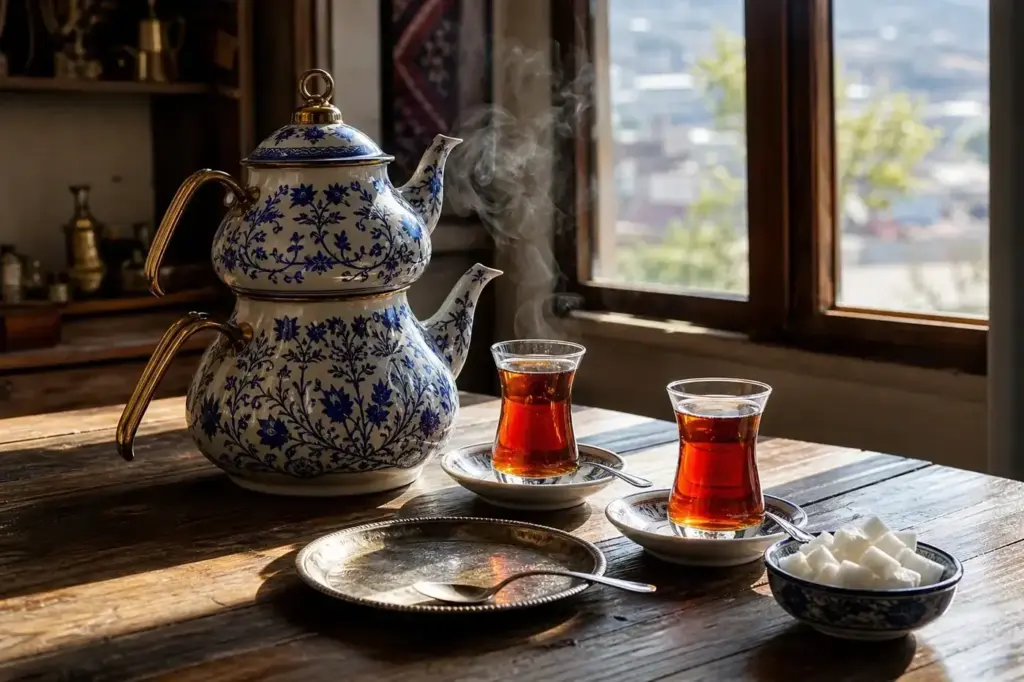
Turkish tea, or çay, is more than a beverage—it’s a cultural ritual woven into Istanbul daily life. Visitors encounter it everywhere: on ferries, in bazaars, in shops offered freely as a gesture of welcome. Learning how to make authentic Turkish tea at home lets you recreate this experience and understand the tradition behind it.
This guide teaches you the traditional double-pot brewing method that produces the smooth, strong amber tea Turks have drunk for over a century. The recommended option uses a çaydanlık (stacked teapot), loose black tea, and fresh water—nothing else. Once you master the technique, you can adjust strength to preference and serve it as Turks do: without milk, in small glasses, with sugar on the side.
Quick answer: Brew loose black tea in the upper pot of a double teapot (çaydanlık) while boiling water in the lower pot. Steep for 10–15 minutes, then pour concentrate into a glass and dilute with hot water to your preferred strength. Total time: about 30 minutes.
At a Glance
| Type | Drinks |
|---|---|
| Origin | Turkish tea comes from the Rize region on the Black Sea coast of Turkey. The first tea harvest in Rize occurred in 1938. Coffee was once the main hot drink in the Ottoman era, but supply problems in the early twentieth century pushed Turkey to look for alternatives. The Black Sea coast, especially Rize province, was found to have the perfect climate for tea, with rain, humidity, and rich soil ideal for growing tea bushes. By the 1950s, tea had become a national habit. State support and Black Sea rainfall turned tea into an everyday staple, and Turks now drink more tea per person than any other country, averaging well over three kilograms annually. |
| Servings | 4–6 servings |
| Total time | 30 minutes (including 10–15 minutes steeping) |
| Difficulty | Easy |
History and Story of Turkish Tea
Turkish tea has a fairly recent history. Coffee was once the main hot drink in the Ottoman era, but supply problems in the early twentieth century pushed the country to look for alternatives. In 1924, a law was passed that encouraged cultivating tea in the east of the Black Sea region. This was the start of Turkish tea culture as we know it today. The first tea harvest in Rize was in 1938, and today people in Turkey drink more tea per person than any other country. UNESCO describes tea culture in Turkey and Azerbaijan as a social practice connected with hospitality, identity and maintaining social relationships.
Ingredients
- 500 ml fresh water for lower pot
- 250 ml water for upper pot
- 15 grams (about 3 tablespoons) loose black tea leaves
- Double teapot (çaydanlık) with stacked upper and lower pots
- Tulip-shaped glass (ince belli bardağı)
- Sugar cubes or honey (optional)
- Small spoon for stirring
How Turkish Tea Is Made
Step 1: Fill and boil the lower pot
Fill the lower kettle with fresh water and bring it to a boil. Use about 500 ml of water; fill the pot up to the level where the spout meets the body. Once it reaches a rolling boil, turn off the heat.
Tip: Use fresh, cold water rather than reheated or stale water, which can flatten the flavor.
Step 2: Rinse the upper pot and add tea
Rinse the top pot with a splash of hot water from the lower pot, then throw it out, just enough to wake the leaves. Place loose black tea in the upper pot, using enough for the number of glasses. For this quantity, use about 15 grams or 3 tablespoons of loose black tea leaves.
Tip: Rinsing warms the pot and prevents the leaves from sticking.
Step 3: Pour boiling water over the leaves
Pour some boiled water over the leaves, then return the upper pot to the lower kettle. Cover the upper pot with its lid. You should see steam rising immediately as the upper pot sits on top of the lower one.
Tip: Do not put the upper pot directly on the stove heat—it must sit on top of the lower pot so steam does the work.
Step 4: Keep the lower pot hot
Keep the lower water hot while the tea steeps gently until the leaves settle and flavor develops. The bottom pot is topped off with fresh water to re-boil while the steeping happens on the top (this water will be needed for serving later). Refill the lower pot with fresh water and return it to the stove to keep the water hot.
Tip: A gentle simmer in the lower pot is sufficient; avoid a hard rolling boil, which can make the final tea taste harsh.
Step 5: Steep the tea
The tea should steep for 10–15 minutes. The tea leaves will settle at the bottom by the end of this period. As the tea brews, it will become very dark and concentrated—this is correct.
Tip: Do not stir the upper pot while brewing. The concentrate should look nearly black or deep mahogany in color.
Step 6: Pour and dilute to strength
Pour concentrate into each glass, then add hot water for the desired strength. Half of a glass is considered very strong (koyu or demli), a quarter of a glass is considered normal, and less is light (açık). Then you add water to fill the rest of the glass.
Tip: Each person can dilute their own glass—this is the beauty of the method. Offer sugar cubes on the side for those who want sweetness.
Step 7: Serve and enjoy
Serve in tulip-shaped glass teacups with saucers. Turkish tea never has milk. The tea will keep hot in the upper pot for an hour or more as long as the lower pot stays warm.
Tip: The tulip shape is not just decorative—it shows off the deep amber color and fits easily in a saucer.
Variants
- Strong tea (koyu or demli)—made with more concentrate and less hot water, often darkened to nearly black
- Light tea (açık)—made with less concentrate and more hot water, pale amber in color
- Turkish apple tea (elma çayı)—made by adding dried apples and spices to the brew
- Herbal teas—rose hip (kuşburnu çayı), linden flower (ıhlamur çayı), and other regional varieties, often consumed for their properties rather than as a daily beverage
Common Mistakes to Avoid
- Using a tea bag instead of loose leaves. Turkish tea depends on loose black tea leaves for proper flavor development; tea bags will not produce the same result and may taste flat or bitter.
- Placing the upper pot directly on the stove heat. The upper pot must sit on top of the lower pot and be heated by steam only. Direct heat will scorch the leaves and ruin the taste.
- Boiling the leaves violently instead of steeping gently. Once the tea is in the upper pot, avoid a hard rolling boil after the tea is combined with water, which can create a harsh taste.
- Using old or reheated water. Stale water, a weak ratio, or boiling the leaves directly can flatten the aroma or make the concentrate harsh.
- Adding milk. Turkish tea never has milk. Milk dilutes the flavor and breaks with tradition.
- Mixing the concentrate and hot water too early. Always pour the concentrate into the glass first, then add hot water to your preference. If the concentrate becomes too strong, adjust it in the glass rather than flooding the upper pot.
How to Order and Eat It
Turks use special curved, see-through tea glasses and a small plate underneath for making it easier to carry and serve. Turkish tea is strong, deep red, served without milk in a small tulip-shaped glass, and it is the everyday drink of Turkey from breakfast to late evening. Tea is traditionally served strong and hot, often with sugar cubes or honey to add sweetness. In bazaars and back-street workshops, a deal is never final until sugar cubes hit the saucer. In Istanbul, you will see tea offered everywhere: on ferries in the morning, shared between shopkeepers and customers, served at the Grand Bazaar during negotiations, and sipped on sidewalks late into the evening. Accepting a cup offered in a shop is a gesture of hospitality and does not obligate you to purchase anything.
To order: Çay lütfen [Chai lutfen]
Where to Try Turkish Tea
 Rumeli Kale Cafe & Restaurant Turkish breakfast and grill
Main image: AI-generated illustration. It may not show the place exactly as it looks.
 My Terrace Cafe & Restaurant Traditional Turkish breakfast and grill
Main image: AI-generated illustration. It may not show the place exactly as it looks.
 Barnathan İstanbul Turkish breakfast and brasserie
Main image: AI-generated illustration. It may not show the place exactly as it looks.
 Çakmak Kahvaltı Salonu Turkish Breakfast
Main image: AI-generated illustration. It may not show the place exactly as it looks.
 Karaköy Güllüoğlu Turkish Desserts & Baklava
Main image: AI-generated illustration. It may not show the place exactly as it looks.
 Van Kahvalti Evi Turkish breakfast, Van-style
Main image: AI-generated illustration. It may not show the place exactly as it looks.
 Yigit Sofram Turkish Breakfast
Main image: AI-generated illustration. It may not show the place exactly as it looks.
 Seven Hills4 min on foot from Gülhane metro, Open daily 08:00–23:00
Main image: AI-generated illustration. It may not show the place exactly as it looks.
Istanbul Vibes Tips
- If you don't have a çaydanlık, improvise with a regular teapot sitting inside a kettle or pot of hot water. The principle remains: the tea steeps in the upper vessel while heat comes from below, not direct flame.
- In Istanbul, tea is often served free in shops and bazaars to visitors as part of the hospitality tradition. Don't assume you're obligated to buy; it is a simple traditional gesture of hospitality. At first, you might suspiciously think they are trying to trick you into buying something, but there are no expectations of purchasing from them.
- The strength of tea in Turkey varies by region and preference. Ask for açık çay (light tea) if you want less intensity, or koyu çay (strong tea) if you prefer a darker, more concentrated brew. In Istanbul's commercial areas, the default is usually medium strength.
- Tea stays warm in the çaydanlık for over an hour if you keep the lower pot on low heat. This is why Turkish families can serve tea throughout the morning or afternoon without rebrewing.
- The color of the brewed concentrate matters. If it's nearly black or mahogany-dark, your tea is properly brewed. If it's pale or muddy, either the tea is weak, the steeping time was too short, or your leaves are of poor quality.
- When visiting a Turkish tea garden (çay bahçesi), tea is ordered by the glass, and refills are unlimited for a single price. You're welcome to linger for hours with just one or two glasses.
Explore Nearby Turkish Tea
Related guides
 Lamb Stew (Tas Kebabı): Recipe, History and How to Cook It
Main image: AI-generated illustration. It may not show the place exactly as it looks.
 Pickle Juice (Turşu Suyu): Recipe, Taste and Where to Try It
Main image: AI-generated illustration. It may not show the place exactly as it looks.
 Ottoman Sherbet (Şerbet): How to Make Traditional Turkish Şerbet
Main image: AI-generated illustration. It may not show the place exactly as it looks.
 Stuffed Eggplant (Karnıyarık): How to Make the Turkish Classic
Main image: AI-generated illustration. It may not show the place exactly as it looks.
 Güllaç: Recipe, History and How to Make This Turkish Dessert
Main image: AI-generated illustration. It may not show the place exactly as it looks.
Browse more: All Food & Drink · All Other
FAQ
What is Turkish tea made of?
Turkish tea is black tea grown around Rize, on the Black Sea coast of Turkey. It's made with only tea leaves and water. No milk, no additives—just strong black tea brewed strong and diluted to preference.
Is Turkish tea different from regular black tea?
Yes. Rize tea is a form of black tea and produces a crystal clear liquid that is mahogany in color. The difference is in how it is prepared: Turkish tea is brewed in a stacked double teapot called a çaydanlık—water boils in the bottom kettle while loose black tea steeps slowly in the top pot, and you pour the two together to the strength you like. This method creates a unique smooth, strong flavor without bitterness.
Can I use a regular teapot instead of a çaydanlık?
Yes, though the result will differ slightly. You can use a regular teapot and a kettle or saucepan instead. You can still make it without a double teapot, using an ordinary teapot and a saucepan. Brew the tea in the teapot while keeping hot water in the other vessel for dilution.
Do you add milk to Turkish tea?
Turkish tea never has milk. This is fundamental to the tradition and the taste. Sugar cubes or honey may be added, but milk is not used.
How long does Turkish tea stay hot in the çaydanlık?
If you keep the lower pot on low heat (a gentle simmer), the tea will remain hot for an hour or more. This is why Turkish families can brew once in the morning and serve tea throughout the day.
What does 'çay' actually mean, and how is it pronounced?
Çay (pronounced 'chai' but not at all related to chai tea) is Turkish black tea. The word 'çay' refers to the tea itself, the çaydanlık is the pot, and a çay bahçesi is a tea garden or tea house.
Why is tea offered free in Turkish shops?
UNESCO describes tea culture in Turkey and Azerbaijan as a social practice connected with hospitality, identity and maintaining social relationships. Unlike a formal afternoon-tea ceremony, Turkish tea is normally flexible and accessible. Offering tea is a gesture of warmth and welcome, not a sales tactic.
How much tea should I use per serving?
Turkish black tea calls for 15 grams as the documented reference amount for 500 ml of water. This quantity serves 4–6 glasses, depending on how much you dilute. Loose tea amounts vary by density, so weighing the leaves is more reliable than measuring by volume.
Istanbul Vibes is a one-person project. A coffee keeps it going

Take this guide with you
Get a free PDF of this guide to print or read offline: key facts, tips and a map link on a few clean pages.
Report an issue on this page
How we research and update our guides
About this guide: AI assistance and accuracy
This guide is created with the help of AI and is based on official sources where available. Mistakes can still happen. Opening hours, prices, rules and other details are given to the best of our knowledge as of the date shown and can change without notice. It offers general recommendations only, not professional, legal or travel advice. Please confirm important details with the official source before you travel; you are responsible for your own plans and decisions.
* Affiliate link: as an Amazon Associate we earn from qualifying purchases at no extra cost to you.
