
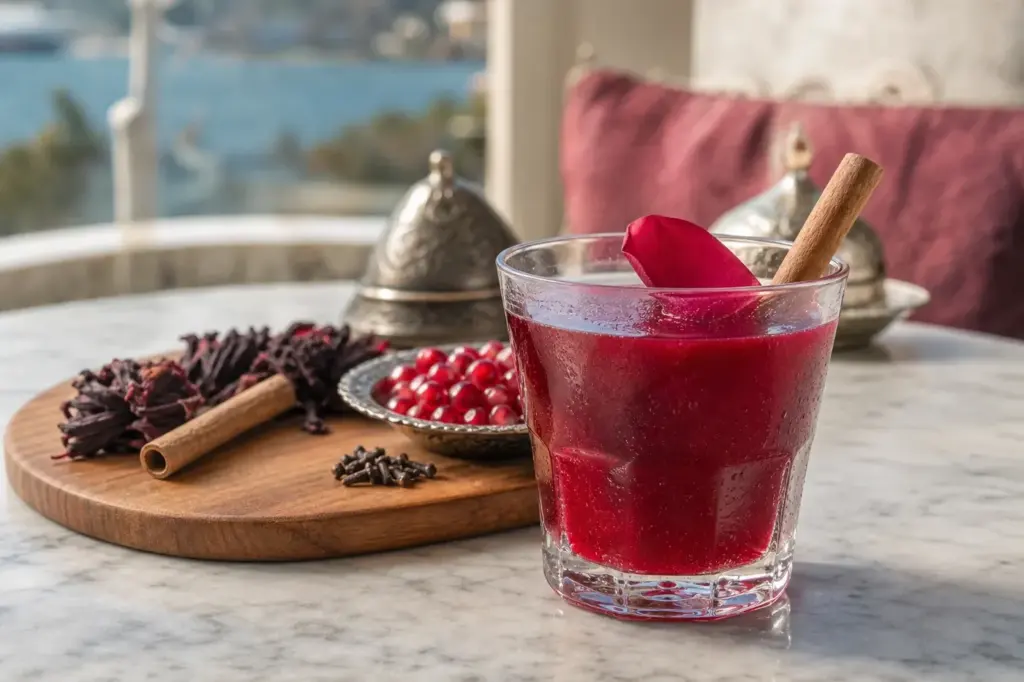
As the Ottoman capital, Istanbul was the stage for the most sophisticated expression of sherbet, with palace cooks blending local fruits and flower essences with rare spices brought from across the empire. Yet this refreshment was not confined to the court—it was equally a drink of the people, stirred in homes, shared with neighbors, and served at weddings and religious festivals.
This guide shows you how to prepare authentic Ottoman sherbet şerbet at home, from simple fruit versions to floral variations. Learn the traditional method, understand the key flavors, and discover why this chilled drink remains central to Turkish hospitality and Ramadan tables. The recommended starting point is a balanced fruit and spice version that comes together in under an hour.
Quick answer: Traditional şerbet is made by boiling or steeping fruit, flowers, herbs, or honey and vinegar with water, then sweetening and chilling the mixture before serving over ice. Preparation time is 35–50 minutes (including cooling). Most ingredients cost very little.
At a Glance
| Type | Drinks |
|---|---|
| Origin | Ottoman sherbet is a traditional beverage widely consumed in Anatolia and the Middle East. The term "sherbet" originates from the Arabic word "shariba," meaning "to drink." Over time, it spread from royal courts to everyday households, becoming a nostalgic part of local culinary culture. |
| Servings | 2–4 servings |
| Total time | 50 minutes, plus cooling time |
| Difficulty | Easy |
History and Story of Ottoman Sherbet (Şerbet)
Ottoman sherbet played a significant role in the Ottoman palace cuisine. The Ottoman palace had şerbet—chilled, fragrant drinks made from fruit, flowers, herbs, and honey that were served to sultans, guests, and the sick alike. Şerbet wasn’t just a refreshment; it was considered a remedy, prepared by dedicated palace şerbetçi (sherbet makers) for weddings, Ramadan, and royal banquets. Tamarind sherbet was one of the most popular şerbets during the Ottoman period, traditionally said to be Sultan Süleyman the Magnificent’s favorite. In the 19th century, English-born Sephardic scholar Isaac Edrehi recalled a popular Istanbul shop serving cold lemon, cherry, and mulberry syrups to a mixed crowd of foreign visitors and local elites. These accounts make it clear: şerbet was a universal language of hospitality across the city.
Ingredients
- 250 g sour cherries, fresh or frozen
- 150 ml pomegranate juice
- 2 tablespoons dried hibiscus flowers
- 1 litre water
- 1 cinnamon stick
- 4 whole cloves
- Peel of ½ lemon
- 120–180 g sugar or honey
How Ottoman Sherbet (Şerbet) Is Made
Step 1: Combine fruit and spices
Add the water, sour cherries, hibiscus, cinnamon, cloves, ginger, and lemon peel to a saucepan. Bring the mixture just to a boil.
Step 2: Simmer gently
Reduce the heat and simmer for about 15 to 20 minutes. The liquid should take on a deep red color and become noticeably aromatic. Do not boil aggressively.
Step 3: Add sweetener
Stir in the sugar while the liquid is still hot. Start with the lower amount and taste before adding more.
Step 4: Strain and cool
Pour the mixture through a fine strainer into a clean container, pressing gently on the fruit and spices to extract all liquid. Let it cool to room temperature, about 20 minutes.
Step 5: Add lemon juice and chill
Add a splash of lemon juice to balance the sweetness. Transfer to the refrigerator and chill for at least 2 hours until completely cold.
Step 6: Serve
Pour into small glasses. Ice should never be added to sherbets. If the sherbet is too concentrated, dilute with cold water to taste before serving.
Variants
- Rose sherbet, one of the most elegant traditional versions, is made with rose petals or rose water and has a light floral aroma.
- Sour cherry sherbet is bright, tart, and refreshing, especially appealing in warm weather because the acidity balances the sugar.
- Pomegranate creates a deeper, more intense flavor, with natural tartness giving the drink a rich sweet-sour character.
- Tamarind sherbet has a darker, tangier profile and may also include spices such as cinnamon and cloves.
- Cranberry sherbet, prepared from cranberry pulp, water, and sugar.
- Purple basil sherbet is a fragrant, floral şerbet made by steeping purple basil like tea—if you can't find purple basil, dried purple basil (sometimes sold as reyhan) works too.
Common Mistakes to Avoid
- Boiling too vigorously: Aggressive boiling flattens delicate fruit and spice flavors. Keep the heat at a gentle simmer.
- Over-sweetening: Traditional sherbet can be very sweet, but balance it with enough acidity (lemon juice) to keep the drink lively and refreshing.
- Skipping the cooling step: Sherbet must be completely cold before serving. It tastes flat at room temperature.
- Forgetting to strain completely: Bits of fruit and hibiscus particles left in the drink create an unpleasant texture. Use a fine strainer.
- Adding ice: Ice should never be added to sherbets—it melts and dilutes the drink. Keep the concentrate cold instead.
- Using overripe fruit: Choose firm, fresh cherries and undamaged pomegranate. Overripe fruit makes the sherbet cloudy and muddy-tasting.
How to Order and Eat It
It is a sweet, spiced, and often floral drink crafted from ingredients like rose petals, sour cherries, or tamarind. Served ice-cold, it is light, fragrant, and truly revitalizing. Pour a small amount into a traditional glass and sip slowly. Today, sherbet is mostly served in crystal bowls for ceremonial occasions across Turkey, such as the holy month of Ramadan. Sherbet can be enjoyed on its own as a refreshment, served at the beginning or end of a meal as a palate cleanser, or offered to guests as a gesture of hospitality.
To order: Bir bardak şerbet lütfen [Bir bardak şerbet lütfen]
Diet and Allergens
- dairy-free
- caffeine-free
- naturally vegan
Where to Try Ottoman Sherbet (Şerbet)
 Matbah Restaurant Ottoman Turkish
Main image: AI-generated illustration. It may not show the place exactly as it looks.
Istanbul Vibes Tips
- Start with a concentrate: The sherbet is concentrated so when serving you can add more cold water and ice cubes. This lets you adjust sweetness and flavor strength to your taste and makes the sherbet last longer.
- Choose quality fruit: The ingredients in Ottoman sherbet reflect the diverse flora of the region. Common choices include rose petals, tamarind, pomegranate, grapes, cloves, cinnamon, ginger, fennel, hibiscus, and sage. Fresh or frozen sour cherries work well if you can't find them fresh.
- The most popular is tamarind sherbet, which is called the "sultan of Ottoman sherbets." If you want to try the classic version, tamarind is readily available in markets across Istanbul and online.
- Timing matters: In the modern days of Turkey, it is most popular in the month of Ramadan, but nowadays Ottoman Sherbet begin to get more attention in other times too. Make sherbet during hot weather when it's most refreshing.
- Store the concentrate in glass bottles in the refrigerator for up to two weeks. When you're ready to serve, dilute with cold water to your preferred strength—you control the flavor intensity each time.
- Experiment with substitutions: You can substitute or combine ingredients such as pomegranate, quince, apple, grapes, tamarind, rose, and hibiscus. The important thing is to balance sweetness with enough acidity or spice to keep the drink lively.
Where to Find Ottoman Sherbet (Şerbet) in Istanbul
Related guides
 Turkish Delight: How to Make Lokum at Home
Main image: AI-generated illustration. It may not show the place exactly as it looks.
 Turkish Tea: How to Brew and Serve It Like Istanbul Locals
Main image: AI-generated illustration. It may not show the place exactly as it looks.
 Sahlep: Turkish Orchid Drink Recipe and What to Expect
Main image: AI-generated illustration. It may not show the place exactly as it looks.
 Ayran: How to make Turkish yogurt drink at home
Main image: AI-generated illustration. It may not show the place exactly as it looks.
Browse more: All Food & Drink · All Other
FAQ
Is Ottoman sherbet the same as Western sorbet or sherbet ice cream?
Unlike modern sorbet, Ottoman sherbet is a drink, not a frozen dessert. The English word "sherbet" for ice cream comes from this Turkish drink, but they are completely different.
Can I make sherbet without sour cherries?
Sherbet is highly adaptable. You can substitute or combine ingredients such as pomegranate, quince, apple, grapes, tamarind, rose, or hibiscus. Each base produces a different flavor profile.
What does Ottoman sherbet taste like?
The taste depends entirely on the ingredients. A fruit-based sherbet may be sweet and tart, while a rose sherbet can be floral and delicate. Spiced versions can taste warm and aromatic even when served cold. Common flavor notes include sweet, sour, floral, fruity, spicy, and slightly herbal.
Should I add ice to sherbet?
Ice should never be added to sherbets. Instead, chill the concentrate thoroughly in the refrigerator and dilute it with cold water just before serving.
Is sherbet alcoholic?
Ottoman sherbet is a non-alcoholic drink traditionally prepared by combining water with sugar and flavoring ingredients such as fruit, flowers, herbs, or spices.
Can I make sherbet ahead of time?
Yes. Keep the concentrate in a glass bottle in the refrigerator for up to two weeks. Dilute with water to your preferred strength and chill again just before serving.
What spices go best with fruit in sherbet?
Common choices include rose petals, tamarind, pomegranate, grapes, cloves, cinnamon, ginger, fennel, hibiscus, and sage. Cinnamon and cloves are the most traditional pairing with fruit.
Where can I find edible rose petals or dried hibiscus in Istanbul?
Spice markets (such as the Egyptian Spice Market in the Grand Bazaar area) carry dried hibiscus, rose petals, and whole spices. Supermarkets also stock these ingredients. Check that flowers are labeled as edible and unsprayed.
Istanbul Vibes is a one-person project. A coffee keeps it going

Take this guide with you
Get a free PDF of this guide to print or read offline: key facts, tips and a map link on a few clean pages.
Report an issue on this page
How we research and update our guides
About this guide: AI assistance and accuracy
This guide is created with the help of AI and is based on official sources where available. Mistakes can still happen. Opening hours, prices, rules and other details are given to the best of our knowledge as of the date shown and can change without notice. It offers general recommendations only, not professional, legal or travel advice. Please confirm important details with the official source before you travel; you are responsible for your own plans and decisions.
* Affiliate link: as an Amazon Associate we earn from qualifying purchases at no extra cost to you.
