

The Atatürk Airport National Garden is a vast new urban green space in Bakırköy, reclaiming the former site of Istanbul’s busiest international airport. Since Atatürk Airport closed to commercial flights in 2019 after Istanbul Airport opened, this 1.2 million square metre park has become Türkiye’s largest city park and one of the world’s biggest urban green spaces.
The garden is part of the nationwide “Nation’s Gardens” initiative to expand public green space in Turkish cities. Rather than leaving a large central area unused, the government transformed it into a destination for families, athletes, and anyone seeking peaceful outdoor time within the city. The park combines recreation with disaster preparedness: it can accommodate over 165,000 people simultaneously for emergency gathering.
Current access notice: As of October 2026: The Atatürk Airport National Garden is fully open and accessible. The park is under ongoing management and minor improvements, but this does not affect visitor access.
Quick Facts
| Turkish name | Национальный сад аэропорта Ататюрка |
|---|---|
| Built / opened | 2025 |
| Address | Yeşilköy Mahallesi, Bakırköy, Istanbul Google MapsApple MapsYandex Maps |
| District | Bakırköy |
| Metro | Atatürk Havalimanı (M1A, Main exit towards park) |
| Admission | free |
| Best time to visit | Spring (April–May) and autumn (September–October) offer pleasant temperatures and clear light without summer heat. Summer (June–August) is very hot, though the open space and water features provide some relief; visit early morning or late afternoon. Winter is mild in Istanbul but overcast; the park's mixed deciduous and evergreen trees mean it is still green. Avoid peak weekend mid-morning hours if you prefer quieter space. Weekday mornings are the most peaceful. After dark (after 23:00), the park closes. |
What Is (and Isn't) Part of a Visit to Atatürk Airport National Garden?
| Part | Status | Notes |
|---|---|---|
| Green space with walking and cycling paths | Included in the standard ticket | The entire 1.2 million square metre park with all paths and open areas is included in free entry. |
| Sports facilities (tennis courts, basketball courts, etc.) | Included in the standard ticket | Courts and outdoor sports areas are free to use; availability and booking procedures may apply. |
| Libraries, exhibition halls, and workshops | Included in the standard ticket | These facilities inside the two külliye buildings are free to visit and use. |
| Restaurants and cafés | Separate ticket or institution | Food and beverage services operate independently; cost depends on what you order. |
| Atatürk Airport (former airport terminal buildings) | Outside / not part of it | The old airport terminal and certain structures are not part of the garden area and not accessible as a visitor attraction. |
| Parking | Included in the standard ticket | Parking at the main entrances is free, with capacity for 4,000 vehicles. |
Why Visit Atatürk Airport National Garden?
This is an exceptional find for visitors seeking authentic Istanbul experiences away from tourist crowds. The sheer scale gives you room to breathe—something rare in a dense city. The site tells Istanbul’s recent history: you walk where international travellers once departed for flights. Walking the paths and sitting by the artificial watercourse or pond, you see trees planted specifically to stay green year-round. The themed hills mirroring Istanbul landmarks (including Sarayburnu, Süleymaniye, and Çemberlitaş) connect the space to the city’s heritage without overwhelming it with tourist attractions. Bring a picnic, rest on the grass, or use the freely available facilities: libraries, exhibition spaces, restaurants, and workshops designed for community use.
How Atatürk Airport National Garden Is Laid Out
The garden follows the former airport’s runway alignment, running north-south across the former airfield. Nine entrances are distributed around the perimeter, so approach from whichever side is convenient. Once inside, the space is organized into several zones: the main green areas with walking and cycling paths, recreational zones with sports courts (tennis, basketball, football, volleyball), themed landscaped hills throughout, and dedicated facilities areas (libraries, exhibition halls, restaurants) clustered in two main structures in the north and south.
The Ab-ı Hayat (“Water of Life”) stream runs approximately 2.5 kilometres along the centre, with walking paths alongside. Ponds and sitting areas dot the landscape. The park is flat and accessible from multiple directions, so you can shape your own route. Parking is available at the main entrances, with capacity for 4,000 vehicles. First-time visitors often underestimate the scale—it’s genuinely large—so plan your time accordingly.
Highlights of Atatürk Airport National Garden
The Seven Symbolic Hills
Seven landscaped hills rise throughout the park, each representing a historic Istanbul district: Sarayburnu (the peninsula's point), Süleymaniye (the imperial mosque), Fatih (the conqueror's neighbourhood), Yavuz Selim, Edirnekapı, Kocamustafapaşa, and Çemberlitaş. These are not dramatic elevations but gentle mounds that offer slightly elevated views of the surrounding greenery. Walking to and around them reveals how the designers used modest topography to structure the vast flat space and create visual variety.
Tip: Climb the hills in late afternoon when light is softer and fewer people are around. Each hill overlooks different sections of the garden.
Ab-ı Hayat Stream and Waterside Paths
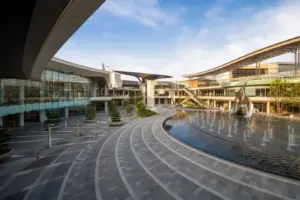
An artificial watercourse named "Ab-ı Hayat" (Water of Life) runs for 2.5 kilometres north-south through the garden's centre. Lined with walking paths and sitting areas, it creates a linear focal point through the vast space and provides the sound and sight of water—a cooling presence on hot days. The stream includes small ponds where visitors stop to rest and watch birds.
Tip: Walk the stream in late afternoon or early evening to avoid midday heat. The best sitting spots are where the stream widens into small pools.
Sports and Recreation Zones
The former airport runways have been converted into recreational facilities: twelve tennis courts, eleven basketball courts, six football fields, six volleyball courts, plus skateboarding areas and cycling tracks totalling over 10 kilometres. Walking paths crisscross the entire park, extending nearly 85 square kilometres in total. Children's play areas, each with different themes, occupy seven separate zones throughout the garden.
Tip: If you plan to use courts or equipment, arrive early on weekends. Weekday mornings are quieter.
The Two Külliye Buildings
Two main buildings (called "külliye" complexes, after the Ottoman architectural term for a group of buildings around a central institution) house social facilities. Inside are exhibition halls, libraries, public reading rooms, workshops, soup kitchens, restaurants, and traditional Turkish coffeehouse spaces. These indoor areas provide shelter from weather and are used by locals as community gathering places.
Tip: Visit the exhibition halls and libraries to see what temporary exhibitions or community programs are running. The traditional coffeehouse is a quiet, authentic spot for tea.
20,000 Trees and Year-Round Greenery
Over 20,000 trees were planted across the park, chosen to ensure it stays green through all four seasons. This includes centuries-old olive trees (some 350 years old), linden trees (50–60 years old), and mixed conifers and deciduous trees. The variety means the garden changes appearance subtly with the seasons while never looking bare.
Tip: Return in different seasons to appreciate the changing light and colours. Spring and autumn offer the most dramatic shifts in appearance.
Disaster Preparedness Infrastructure
The park serves a dual purpose: recreation during normal times, but also designed as an emergency gathering site for up to 165,000 people during earthquakes or disasters. This is reflected in the wide, clear open spaces (avoiding dense trees or structures that could block movement) and infrastructure including water reservoirs, medical spaces, and mobile unit parking. It is a sobering reminder of Istanbul's vulnerability to seismic activity.
Tip: Understanding this dual function adds context to why the design is so open and uncluttered—it's intentional planning for safety.
Atmosphere
The garden has a quiet, civic quality unlike typical tourist parks. On weekends, thousands of Istanbul residents arrive with families, carrying picnic baskets, kilims (traditional rugs) and foldable chairs, settling in for the day. Children play in designated areas while adults sit in groups, talking and watching the landscape. On weekday mornings, the park is largely yours—joggers use the paths, groups do tai chi or yoga on open lawns, elderly couples walk slowly together.
The light here has a different quality than in the dense city: you feel space and sky. The sound is mostly wind through leaves, the gentle water of the stream, and distant voices. The air is noticeably fresher than central Istanbul. Visitors include families, elderly couples, young people on dates, exercise groups, and people who simply want to sit in silence. There is little artificial energy or merchandise—no souvenir stands, no loud speakers. It feels like a genuinely public space still discovering its rhythm.
History of Atatürk Airport National Garden
Atatürk Airport, named after Turkey’s founder Mustafa Kemal Atatürk, opened in 1953 and served as Istanbul’s primary international airport for decades. By the 1990s and 2000s, it had become one of Europe’s busiest airports, constrained on three sides by the city and on the fourth by the Sea of Marmara. Unable to expand further, the government decided to build a new facility.
Istanbul Airport (also called Istanbul New Airport) opened on 29 October 2018 in the northern suburbs of Arnavutköy district. Atatürk Airport closed to commercial passengers on 7 April 2019. For the next several years, the 8.5 million square metre site lay largely dormant, occasionally used for temporary purposes (including briefly as a site for a pandemic hospital in 2020).
Plans were announced to transform the airport grounds into a “Nation’s Garden,” part of a broader nationwide initiative (Millet Bahçeleri) to create green spaces in Turkish cities. In 2022, the Housing Development Administration (TOKİ), under the Ministry of Environment, Urbanization and Climate Change, began construction. The project faced legal challenges from Istanbul’s Metropolitan Municipality (which argued over jurisdiction) and the Council of State (Danıştay) ruled against aspects of the tender process, but construction continued in phases.
The first phase, covering 499,000 square metres, officially opened in a ceremony. That phase included 10,081 trees and 41,000 plants. Construction continued for a further two and a half years. The full garden officially opened with a ceremony titled “The Breath of Istanbul, The Nation’s Garden.” The park is fully accessible to the public and continues to be refined.
Tickets and Booking for Atatürk Airport National Garden
Entry to the Atatürk Airport National Garden is completely free. There is no ticket system or advance booking required for general access to the park grounds. Simply arrive at one of the nine entrances at any time during opening hours (6:00–23:00 daily) and walk in.
Parking is free at the main entrances. If you plan to use specific sports facilities (tennis courts, basketball courts, etc.), contact the park administration directly to check availability and any local user arrangements. Food and beverages purchased at restaurants and cafés are charged separately.
For the most current information on facilities, events, and any updates, consult the official website of TOKİ (the Housing Development Administration) or the Istanbul Metropolitan Municipality.
Suggested itineraries Atatürk Airport National Garden
2 hours
Walk from the nearest entrance along the Ab-ı Hayat stream northward, stopping at the first two themed hills for views. Rest at one of the pond areas for 20 minutes. Return via the same route or loop around through the sports zones. This covers the central highlights without seeing the entire park.
3 hours
Enter at a main entrance near the külliye buildings. Visit an exhibition hall or library briefly (20 minutes). Walk the full length of the Ab-ı Hayat stream from one end to the other. Climb at least three of the seven hills for perspective on the landscape. Rest for 20–30 minutes at a pond or sitting area. Explore at least one recreational zone with sports facilities.
Half day (4+ hours)
Spend time in both the north and south sections of the park. Walk multiple themed hills and understand their connection to Istanbul landmarks. Explore the two külliye buildings, including libraries and workshops. Lunch or coffee at a park café. Cycle part of the 10+ kilometre cycling track. Sit quietly in multiple sitting areas to experience the park's different atmospheres throughout the day.
How to Get to Atatürk Airport National Garden
By Metro: The nearest metro station is Atatürk Havalimanı on the M1A line (western terminal). Exit the station and follow directional signs toward the park. The main entrance is approximately a 10–15 minute walk from the metro exit, passing through or alongside the old airport terminal area. The walk is flat and straightforward.
By Bus: Several bus routes serve the area, including lines 72T, 94Y, 98H, and 98S. Confirm your route on the Istanbul Public Transport (İETT) website or app. The park has nine entrances distributed around its perimeter, so different bus routes may deposit you at different access points.
By Car or Taxi: The park has free parking at all main entrances with capacity for 4,000 vehicles. From central Istanbul (such as Sultanahmet), take the E5 highway southwest toward Bakırköy/Yeşilköy and follow signs. Travel time is 20–40 minutes depending on traffic and your starting point.
By Marmaray: The Ataköy Marmaray station is another option nearby; from there, additional walking or a short taxi ride reaches the park.
Accessibility
The entire park is wheelchair accessible. Paths are paved and level throughout the 1.2 million square metre space. The two külliye buildings have elevators and accessible restrooms. There are 19 restrooms distributed throughout the garden. The park was designed with disability access as a core requirement (it doubles as a disaster shelter), so facilities for wheelchair users, including ramps and accessible parking, are standard throughout.
Food Nearby
Inside the park: restaurants, cafés, and traditional Turkish coffeehouses operate within the two külliye complexes and scattered throughout the grounds. A soup kitchen provides simple, affordable food. Outside the park, in the adjacent Yeşilköy and Bakırköy neighbourhoods, numerous small restaurants, kebab shops, and street food vendors operate, especially near the main entrances and around the old terminal area.
What to Bring
Bring sun protection (hat, sunscreen) and water, especially in summer—while the park has sitting areas and water facilities, having your own is wise given the large, open spaces. A light picnic is welcome and popular; bring a picnic blanket or carry a kilim (traditional rug) as locals do. Comfortable walking shoes are essential; plan for 3–5 kilometres of walking depending on your itinerary. In summer, early morning or late afternoon is more comfortable. In winter, layered clothing handles mild but variable weather. The park allows photography freely.
Best Views and Photo Spots of Atatürk Airport National Garden
Hilltops (the seven symbolic hills)
From any of the seven hills, you see the vast expanse of the park with trees, paths, and distant city buildings creating depth. The soft hills in the foreground frame the skyline beyond.
Best time: Late afternoon, when raking side light defines the hills and the surrounding landscape catches warm, golden tones.
Ab-ı Hayat stream and ponds
The artificial waterway with trees reflected in still water, walking paths alongside, and the gentle curve of the stream creating leading lines through the landscape.
Best time: Early morning when the water is still and light is soft, or in golden hour late afternoon.
The two külliye buildings
The main public buildings with park grounds spreading behind them and trees framing the composition—a human-scale focal point within the vast space.
Best time: Mid-morning when the buildings are well-lit and shadows provide definition.
Tree canopy and forest paths
Walking paths disappearing into tree cover, dappled light on the ground, creating a quiet, immersive green environment that feels separate from the city.
Best time: Overcast days or late afternoon, when filtered light emphasizes the green and texture.
Sports zones during use
Active courts with players, surrounded by open green space and trees—capturing the park's recreational purpose and community use.
Best time: Weekend mornings or weekday late afternoon when courts are in use but not so crowded that composition is chaotic.
Photography Rules
Photography is freely permitted throughout the park. Tripods are allowed for personal use. Drones are not permitted without explicit prior authorization. Flash is not restricted outdoors. No special permits are needed for non-commercial photography.
Family Suitability
Excellent for families of all ages. Seven dedicated children's play areas with age-appropriate equipment are distributed throughout the park. Walking paths are flat and stroller-friendly for babies. Older children enjoy the cycling tracks, sports courts, and climbing hills. The vast open spaces reduce parents' stress about managing kids—there is room for children to run and play safely, and sight lines are clear. Quieter areas (libraries, coffeehouses) and noisy areas (sports zones, play parks) are separated, so families can choose their environment. Restrooms (19 total) and food options are well distributed. The park's open design means even non-athletic families can walk at their own pace without feeling rushed. Plan 2–4 hours for a family visit depending on children's ages and interests.
Istanbul Vibes Tips
- Weekday mornings are dramatically quieter than weekends. If you prefer a peaceful, less crowded experience, visit Tuesday–Thursday between 8:00–12:00.
- Bring a picnic and stay for hours rather than rushing through. The park rewards slow exploration and sitting—the scale is overwhelming at first, but familiar once you settle into a quieter spot.
- The northern and southern sections of the park are quite distinct. If time is limited, choose one: north is more developed with facilities; south is wilder and less crowded.
- Don't miss the Ab-ı Hayat stream if you visit in warm weather—walking alongside it cools you down and provides a focal point in the vast landscape.
- The themed hills are easy to miss if you don't know to look for them. Stop at one and you'll notice the others. They provide both physical breaks in walking and views that orient you within the large space.
- The two külliye buildings can shelter you from sudden rain or summer heat. Check what exhibitions or workshops are running when you visit—they change regularly.
Explore Nearby Atatürk Airport National Garden
Sights near Atatürk Airport National Garden
 Istanbul Aquariumabout 2.3 km away · typical visit: 2–3 hours
Main image: AI-generated illustration. It may not show the place exactly as it looks.
 Istanbul Aviation Museumabout 2.7 km away · typical visit: 2–3 hours
Main image: AI-generated illustration. It may not show the place exactly as it looks.
Metro stations near Atatürk Airport National Garden
 Atatürk Havalimanı – about 1.2 km away (~20 min walk)Open daily 06:00–00:00
Main image: AI-generated illustration. It may not show the place exactly as it looks.
Related guides
 Istanbul Sapphire Tower: Observation Deck, Hours and 360-Degree Views2 min on foot from 4. Levent metro, Open daily 10:00–22:00
Main image: AI-generated illustration. It may not show the place exactly as it looks.
 Forum Istanbul: Shopping, Entertainment and Attractions15 min on foot from Otogar metro, Open daily 10:00–22:00
Main image: AI-generated illustration. It may not show the place exactly as it looks.
 Bakırköy Dr. Sadi Konuk Training and Research Hospital: Information for International Patients
Main image: AI-generated illustration. It may not show the place exactly as it looks.
 Acıbadem International Hospital: Location, Services and Medical Care in Istanbul
Main image: AI-generated illustration. It may not show the place exactly as it looks.
 Medicana Ataköy Hospital: Services, Contact and How to Visit
Main image: AI-generated illustration. It may not show the place exactly as it looks.
Browse more: More in Bakırköy · All Parks · All Sightseeing
FAQ: Atatürk Airport National Garden
Is entry to the park really free?
Yes, completely free. No tickets are required to walk, sit, or enjoy the green areas. You pay only for food and beverages you purchase at cafés and restaurants.
Is this the same as Atatürk Airport?
No, they are different. Atatürk Airport (the historical building) closed in 2019 and is no longer an airport. The park was built on the former airport grounds starting in 2022. Some old airport structures remain in the surrounding area but are not part of the garden itself.
Can I cycle throughout the park?
Yes. There are over 10 kilometres of dedicated cycling tracks. Walking paths are separate, so cyclists and pedestrians don't conflict. Bring your own bike or check if rentals are available on-site.
Is there parking?
Yes, free parking at all main entrances with capacity for 4,000 vehicles. During busy weekend afternoons, parking may fill, but mid-morning and weekdays are rarely full.
How long should I spend here?
Plan 2–4 hours for a relaxed visit. The park is genuinely vast (1.2 million square metres), so you cannot see everything in an hour unless you simply walk through quickly. Families often stay longer.
Are there bathrooms?
Yes, 19 restrooms are distributed throughout the park. Most are basic but clean. The two main külliye buildings also have facilities inside.
Can I bring food or have a picnic?
Yes, bring your own picnic or lunch. There are also restaurants and cafés in the külliye buildings and scattered throughout. Many locals bring prepared food and rugs and settle in for the afternoon.
When is the park least crowded?
Weekday mornings (Tuesday–Thursday, 8:00–12:00) are quietest. Weekends and weekend afternoons are busiest. Summer mornings are cooler and less crowded than afternoons.
Istanbul Vibes is a one-person project. A coffee keeps it going
Hotels near Atatürk Airport National Garden
Restaurants near Atatürk Airport National Garden
Distances are straight-line, from OpenStreetMap data.

Take this guide with you
Get a free PDF of this guide to print or read offline: key facts, tips and a map link on a few clean pages.
Report an issue on this page
How we research and update our guides
About this guide: AI assistance and accuracy
This guide is created with the help of AI and is based on official sources where available. Mistakes can still happen. Opening hours, prices, rules and other details are given to the best of our knowledge as of the date shown and can change without notice. It offers general recommendations only, not professional, legal or travel advice. Please confirm important details with the official source before you travel; you are responsible for your own plans and decisions.
* Affiliate link: as an Amazon Associate we earn from qualifying purchases at no extra cost to you.
