
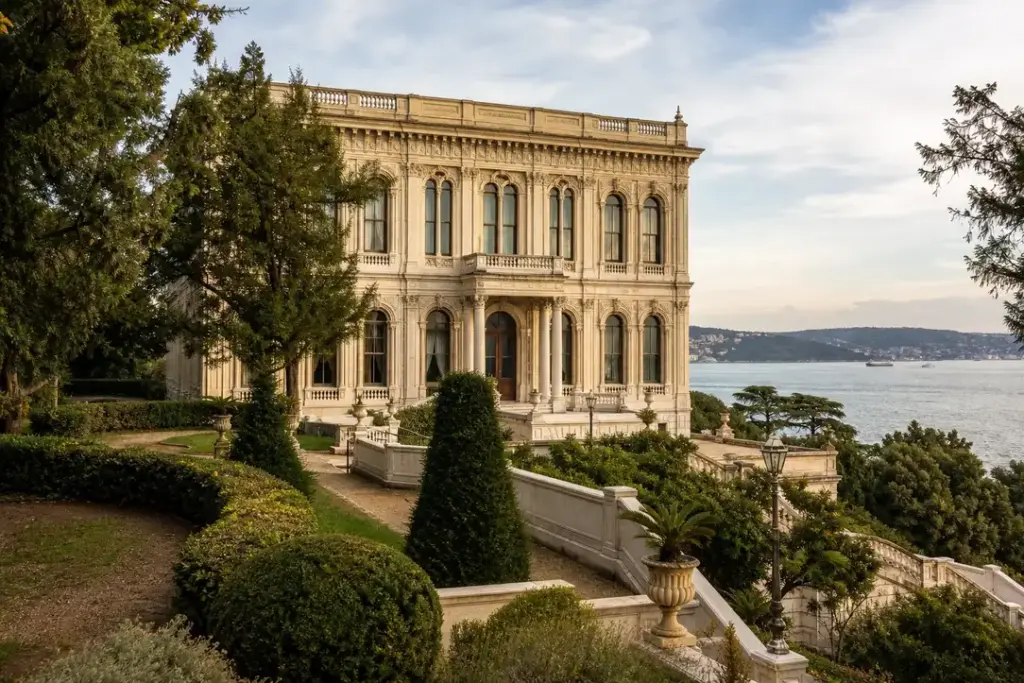
The Beykoz Mecidiye Pavilion stands on a wooded hillside overlooking the Asian shore of the Bosphorus, a jewel of Ottoman Westernizing architecture that few visitors find. Originally commissioned in 1845 by Mehmed Ali Pasha, Governor of Egypt, and completed as a gift to Sultan Abdülmecid in 1854, this small palace reflects a transitional moment in Ottoman design: traditional cedar-wood salons and central sofa halls blend with Baroque domes and European influences.
The pavilion opens to visitors as a National Palaces Museum, displaying original furnishings and offering views across the strait. Its intimate scale and serene setting make it a welcome escape from Istanbul’s crowded imperial sites.
Quick Facts
| Built / opened | 1854 |
|---|---|
| Architect(s) | Nigoğos Balyan |
| Address | Yalıköy, Beykoz Kasrı, 34820 Beykoz/İstanbul Google MapsApple MapsYandex Maps |
| District | Beykoz |
| Admission | ₺₺ |
| Best time to visit | Spring (April–May) and Autumn (September–October) offer mild weather and fewer crowds than summer. Sunset visits are particularly beautiful, when light catches the Bosphorus and the stone pavilion glows. Weekday mornings tend to be quieter than weekends. Avoid peak summer heat (July–August) and rainy winter days (December–February). The pavilion is occasionally closed for half a day on the first day of Islamic holidays (Eid al-Fitr and Eid al-Adha); check ahead. |
| Website | millisaraylar.gov.tr |
What Is (and Isn't) Part of a Visit to Beykoz Mecidiye Pavilion?
| Part | Status | Notes |
|---|---|---|
| Main Pavilion and Rooms | Included in the standard ticket | Two-storey building with reception halls, salons, private chambers, and viewing terraces. Fully open to visitors with ticket. |
| Mountain Bath Kiosk | Included in the standard ticket | Small separate structure in the gardens decorated with oyster shells. Access depends on daily conditions; check with staff. |
| Terraced Gardens and Grounds | Included in the standard ticket | 27 hectares of landscaped park with trees, pathways, and multiple vantage points overlooking the Bosphorus. Accessible to visitors. |
| Audio Guide | Separate ticket or institution | Audio guide available; some tickets include it, others require additional purchase. Verify at booking. |
| Beykoz Glass and Crystal Museum | Outside / not part of it | Located elsewhere in Beykoz district; not part of Beykoz Mecidiye Pavilion. Separate tickets and visit required. |
| Hunkar Pier (Water Landing) | Outside / not part of it | Historic royal landing pier is nearby but separate; access is not guaranteed and historically it was used only for sultans arriving by boat. |
Why Visit Beykoz Mecidiye Pavilion?
Unlike the vast Dolmabahçe and Topkapi palaces, the Beykoz Mecidiye Pavilion preserves a quieter side of Ottoman royal life. The rooms reveal how sultans lived seasonally: crystal chandeliers and mother-of-pearl inlays in sleeping quarters, reception salons with Hereke carpets, terraces where sultans watched the Bosphorus. The surrounding gardens descend in landscaped terraces to the water’s edge, creating a refuge where Ottoman rulers hunted in nearby forests and entertained foreign dignitaries.
It is also historically significant: the first stone building in the new Westernized style built on the Bosphorus shore, predating Dolmabahçe and Beylerbeyi palaces.
How Beykoz Mecidiye Pavilion Is Laid Out
The pavilion occupies a hillside in the Yalıköy neighborhood, arranged on multiple terraces descended from the main building to the shore. The main pavilion is a two-storey neoclassical structure with symmetrical wings. To the east sits a separate small kiosk called the “mountain bath,” decorated inside with oyster shells.
The building sits within a 27-hectare forested park. Visitors enter at the upper terrace and can move through reception rooms, private chambers, and viewing terraces that overlook the water. Allow time to explore the gardens and the secondary structures within the grounds.
Highlights of Beykoz Mecidiye Pavilion
The Central Sofa Hall
The heart of the pavilion follows traditional Ottoman palace design: a tall, light-filled hall with tall windows opening onto terraces. The ornate cedar-wood ceilings, gilded details, and proportions show the architectural transition of the 1850s. This was the sultans' main reception space, where state business and entertaining occurred.
Tip: Look up at the ceiling details and woodwork; the craftsmanship reveals both Ottoman and European decorative traditions.
Crystal Chandelier Room
This salon features massive Baccarat crystal chandeliers and gilded wall decorations. Photographs from Sultan Abdülhamid II's era show how this room was lit and furnished as the most opulent ceremonial space. It exemplifies 19th-century Ottoman imperial splendor and wealth.
Tip: Visit in late afternoon when natural light from the tall windows catches the crystal and mirrors.
Sultan's Bedroom with Mother-of-Pearl Inlays
One of the private chambers displays intricate mother-of-pearl inlay work in furnishings and architectural details. This room was the sultan's personal retreat during summer months, combining intimate comfort with imperial luxury through imported materials and fine craftsmanship.
Tip: The inlay work is subtle; ask staff to point out specific examples to fully appreciate the artisans' skill.
The Mountain Bath Kiosk
A separate, smaller pavilion in the garden grounds, this bathhouse or resting room features interior walls decorated with oyster shells arranged in mosaic patterns. It is a whimsical detail unique to this site and shows the attention to decorative detail throughout the complex.
Tip: This building is often overlooked; inquire at the main pavilion whether it is open on your visit day.
Terraced Gardens and Bosphorus Views
The grounds descend in landscaped terraces from the pavilion to the water, with mature trees providing shade. From multiple vantage points, visitors see across to the European shore and north along the Bosphorus. These gardens were designed for royal leisure and hunting parties.
Tip: Bring a camera or phone with a good zoom function; the Bosphorus view from the upper terraces is one of the clearest in the district.
Marble Hunting Kiosk
The pavilion complex once included spaces for hunting preparation and display. Hunting was an important royal pastime; sultans used Beykoz Mecidiye as a base for expeditions in nearby forests and meadows. Remnants of this hunting heritage persist in the building's original function and architecture.
Tip: The nearby Beykoz meadows and hunting grounds in Tokat village are no longer accessible, but the kiosk preserves this aspect of Ottoman court life.
Colored Porphyry Interior Decoration
The pavilion's interior surfaces, especially floor and lower wall sections, feature valuable colored porphyry stone imported from Egypt and Italy. These rare materials underline the pavilion's status and the wealth invested in its construction as a gift from the Egyptian governor.
Tip: Colored porphyry is difficult to photograph well indoors due to lighting; take time to examine it up close.
Neo-Classical Façade and Double Staircases
The exterior displays symmetrical classical proportions with tall windows and refined stonework. The distinctive double-arm grand staircase leads visitors up to the main entrance—an architectural feature that impresses with formal elegance. The colorful stone walls and careful detailing announce the building's imperial role from the shore.
Tip: The exterior is best photographed from the terraces below or from the water; ask if any viewpoints nearby are accessible.
Atmosphere
The pavilion breathes quiet formality and seasonal escape. Rooms are light-filled, with afternoon sun streaming through tall windows onto parquet floors and Hereke carpets. The scale is intimate compared to grander palaces—never crowded or echoing. The preserved furnishings, period paintings, and soft museum lighting create a sense of stepping into a summer retreat frozen in time.
Outside, the hillside gardens are peaceful and shaded. The sound of water and birds, the view toward the Bosphorus, and the age of the trees create an atmosphere removed from the city, consistent with the site’s original purpose as a refuge. Sunset is particularly evocative, when light catches the water and the pavilion’s stone walls glow.
History of Beykoz Mecidiye Pavilion
In 1845, Mehmed Ali Pasha, the powerful Governor of Egypt, commissioned this pavilion for Sultan Abdülmecid. After Mehmed Ali’s death, his son Said Pasha completed the building in 1854 and presented it to the sultan as a diplomatic gift. The pavilion marked a new phase in Ottoman architecture: the first masonry structure in the modern European style built on the Bosphorus shores, predating Dolmabahçe (1843–1856) and Beylerbeyi (1865) palaces.
The pavilion served several roles over the following century. After Abdülaziz’s reign, it received foreign guests and state visitors. In 1918, during the occupation following the Ottoman defeat in World War I, Sultan Vahdettin converted it to an orphanage. In the Turkish Republic period, it became a hospital and preventorium. The building fell into disuse after 1923.
On 23 December 1997, the pavilion was allocated to the Directorate of National Palaces. Comprehensive restoration began in 2010 and concluded in 2016, faithfully recreating the original interior arrangements based on photographs and archives from Sultan Abdülhamid II’s reign. The site opened as a museum on 11 April 2017, displaying original furnishings, photographs, and period documents that trace its imperial and later institutional history.
Legends and Myths about Beykoz Mecidiye Pavilion
The Egyptian Gift and Abdülmecid's Sorrow
Disputed by historians. Local accounts speak of Sultan Abdülmecid refusing to use the pavilion because it was built by the Egyptian governor. Historians note this was tied to the "Egyptian Question"—a crisis over Mehmed Ali Pasha's rebellious ambitions against the Ottoman Sultan. The gift, intended to honor and appease, instead served as a reminder of humiliation and danger to the empire. Abdülmecid reputedly avoided the place for this reason.
Abdülaziz's Hunting Grounds and the Bosphorus Patrols
Legend – historically unreliable. Stories from the 19th century describe Sultan Abdülaziz hunting wild boar and deer in the forests around Tokat village near Beykoz, using Mecidiye Pavilion as his base. Court records mention that he would station boats on the Bosphorus to watch for game crossing water and to organize elaborate hunting parties with dozens of attendants and dogs.
Eugénie's Parade and the Streets of Beykoz
Disputed by historians. When Empress Eugénie of France visited in 1869, Sultan Abdülaziz hosted a banquet at Beykoz Mecidiye Pavilion. Contemporary accounts describe thousands of Istanbul residents traveling to Beykoz by carriage and boat to watch a ceremonial parade featuring soldiers in full uniform, Turkish and French flags, and a special pavilion erected in nearby meadows. Some versions claim the festivities lasted three days.
Tickets and Booking for Beykoz Mecidiye Pavilion
| Ticket | Price | Includes |
|---|---|---|
| General admission | ₺₺ | Access to pavilion rooms, terraced grounds, and gardens. Does not include audio guide in some cases; verify. |
| Admission with audio guide | ₺₺₺ | General admission plus curated audio tour in multiple languages explaining rooms, history, and architectural features. |
₺ budget · ₺₺ moderate · ₺₺₺ upscale · ₺₺₺₺ splurge. Price levels are estimates compared with typical prices for visitors.
Tickets are sold at the entrance or online in advance through the official National Palaces website (millisaraylar.gov.tr). Online booking may open weeks ahead for international visitors. If a date is not yet available online, it means tickets have not been released for that date; check again closer to your visit. Same-day tickets are usually available if the pavilion is open, though weekend and holiday crowds may mean queues.
No special voucher exchange is required. Visitors may present a printed or digital ticket. Turkish citizens and students receive reduced rates. Concession categories and full pricing details are published on the official Directorate of National Palaces website; rates for Turkish residents and all concession categories differ and are posted there.
Suggested itineraries Beykoz Mecidiye Pavilion
45 minutes
Quick visit: view the central sofa hall, crystal chandelier room, and one private chamber. Descend to the terrace for Bosphorus views. Suitable if time is limited or for first-time visitors.
1.5 hours
Standard visit: explore the main pavilion rooms in sequence. Listen to audio guide excerpts in the key chambers. Walk the upper terraces and seek out the mountain bath kiosk. Rest on the lower terraces overlooking water.
2 hours
Full experience: spend time in each room; study the furnishings, inlays, and photographs on display. Explore multiple terraces and garden areas. Walk to the water's edge if accessible. Late afternoon visit allows better lighting for the interior.
How to Get to Beykoz Mecidiye Pavilion
No metro station serves Beykoz Mecidiye Pavilion directly. The site is in the Yalıköy neighborhood of Beykoz, on the Bosphorus shore.
By bus: From central Istanbul or Üsküdar, take bus 15 or 15B toward Beykoz. Travel time is 45 minutes to 1 hour depending on traffic. Ask the driver to confirm the stop nearest to Beykoz Kasrı (the pavilion). Walk from the bus stop following signs toward the water and Hunkar Pier; the pavilion entrance is uphill.
By taxi or ride-share: Provide the address: Yalıköy, Beykoz Kasrı, 34820 Beykoz/İstanbul. Travel time from central districts is 40–60 minutes depending on traffic. Parking is available near the entrance.
By car: From central Istanbul, head north on the D550 (European shore) or D100 (Asian shore) highway toward Beykoz. Exit toward Yalıköy and follow signs to Beykoz Kasrı. On-site parking is free.
Accessibility
The pavilion is a restored 19th-century building with stairs, uneven terraces, and multilevel gardens. The ground floor and first floor are connected by interior stairs. No elevator is present. Wheelchair access is limited; visitors with reduced mobility should contact the site in advance to discuss which areas are accessible. The terraced gardens involve slopes and steps. Rest benches are scattered throughout. Parking is available near the entrance.
Food Nearby
The Yalıköy neighborhood around the pavilion is primarily residential and forested; few dedicated restaurants or cafes are immediately adjacent. Bring water and snacks. Simple cafes and small eateries exist in the broader Beykoz district a short bus ride away. The pavilion does not have an internal restaurant or cafe.
What to Bring
Comfortable walking shoes (terraces are uneven and may be steep). A bottle of water, as refreshment options are limited. A camera or phone with zoom for Bosphorus photographs. Sunscreen and a hat in summer. Light layers in spring and autumn; wind can be cool near the water.
Best Views and Photo Spots of Beykoz Mecidiye Pavilion
Upper Terrace Overlooking the Bosphorus
Wide view across the strait toward the European shore and northern reaches of the Bosphorus. The pavilion's stone facade is framed by trees, and the water stretches to the horizon.
Best time: Late afternoon, when the sun illuminates the water and casts long shadows on the terraces. Golden hour light is particularly flattering.
Crystal Chandelier Room Window
Looking outward from the interior salon through tall windows, the frame captures ornate woodwork in the foreground and the Bosphorus behind, merging palace interior and seascape.
Best time: Mid-morning when sunlight streams directly through the windows, illuminating the chandelier and interior details.
Grand Staircase Exterior
The symmetrical double staircases and facade present a neoclassical composition. The colorful stone and proportion of the building dominate the frame.
Best time: Early morning light softly illuminates the facade; afternoon shadows accentuate architectural details.
Water's Edge Terrace
Looking back up toward the pavilion from the lowest terrace, the building rises among mature trees against the sky, with water in the immediate foreground.
Best time: Afternoon or evening when warm light highlights the stone and trees are backlit by setting sun.
Photography Rules
Photography is permitted in most areas of the pavilion for personal use. Flash photography is not allowed indoors to protect furnishings and decor. Tripods and professional equipment may require permission; inquire at the entrance. Drones are not permitted. The exterior and gardens are ideal for landscape and architectural photography.
Family Suitability
The pavilion suits history-interested families and older children. The rooms and displays are museum-style and may engage teens and adults more than young children, though the gardens are pleasant for a stroll. Stairs between floors and uneven terraces present challenges for small children and strollers; terrain is steep in places. The site is not loud or crowded, making it a peaceful visit for families seeking a quieter experience than major palaces. No dedicated children's areas or interactive exhibits are present.
Istanbul Vibes Tips
- Visit on a weekday if possible. Weekends and holidays draw larger crowds, especially on sunny days. Mornings are quieter than afternoons, and late afternoon (after 3 PM) offers the best light for photography.
- Allow extra time if you take the audio guide. It provides rich context about architectural styles, historical uses, and furnishings. Some visitors spend 2+ hours because the stories are compelling.
- Ask staff about access to the mountain bath kiosk. It is not always formally advertised or easily found in the gardens, but staff can point you to it if it is open.
- Do not assume the site is on a specific metro line. Unlike central palaces, getting here requires planning; book a taxi or check bus schedules in advance, especially if visiting on a weekend.
- The Bosphorus view from the upper terrace is often clearer in spring and autumn than in summer haze. If photography of the strait is important to you, plan your visit accordingly.
- Combine your visit with nearby Beykoz sites. The Beykoz Glass and Crystal Museum and Küçüksu Pavilion are in the same district; plan a half-day or full-day excursion to maximize your time in the area.
Explore Nearby Beykoz Mecidiye Pavilion
Sights near Beykoz Mecidiye Pavilion
 Küçüksu Pavilion – about 7.1 km away · typical visit: 1–2 hours13 min on foot from Aşiyan metro
Main image: AI-generated illustration. It may not show the place exactly as it looks.
 Hidiv Grove – about 4.1 km away · typical visit: 2–4 hoursOpen daily 08:00–23:00
Main image: AI-generated illustration. It may not show the place exactly as it looks.
Related guides
 Anadolu Kavağı and Yoros Castle: Ferry, Fortress and Bosphorus Views
Main image: AI-generated illustration. It may not show the place exactly as it looks.
 Lacivert: Bosphorus Seafood Under the Bridge
Main image: AI-generated illustration. It may not show the place exactly as it looks.
 Bayramoğlu Döner: Wood-Fired Döner in Kavacık
Main image: AI-generated illustration. It may not show the place exactly as it looks.
 Anadolu Hisarı: Ottoman Fortress and Waterfront Landmark
Main image: AI-generated illustration. It may not show the place exactly as it looks.
 Mihrabat Grove: Forest Walks and Bosphorus Views in BeykozOpen daily 08:00–00:00
Main image: AI-generated illustration. It may not show the place exactly as it looks.
Browse more: More in Beykoz · All Landmarks · All Sightseeing
FAQ: Beykoz Mecidiye Pavilion
Is the Beykoz Mecidiye Pavilion part of Topkapi Palace or Dolmabahçe Palace?
No. It is a separate, independent site operated by the National Palaces Directorate. It predates Dolmabahçe and is smaller and less famous, but it is a distinct imperial pavilion with its own history and admission.
Do I need a separate ticket to visit the gardens?
No. The ticket includes access to the pavilion, all rooms, and the surrounding 27-hectare grounds. The terraced gardens are part of the same site and admission.
Is an audio guide included in the ticket price?
It depends on which ticket you purchase. Some packages include a curated audio guide in multiple languages; others do not. Check the ticket options at booking. Audio guides provide valuable context about the architecture and history.
How long does a typical visit take?
Most visitors spend 1 to 2 hours. 45 minutes allows a quick tour of the main rooms and terraces. Two hours lets you explore in depth, rest in the gardens, and photograph views.
Is the site wheelchair accessible?
Limited accessibility. The building has stairs and the terraced grounds are uneven and steep. Some ground-floor areas are accessible, but upper floors and gardens present challenges. Contact the National Palaces Directorate in advance if you have mobility concerns.
Can I bring a picnic to eat in the gardens?
Policy on outside food and picnicking is not clearly published. There is no cafe on-site. It is best to inquire at the entrance or call ahead (+90 212 236 90 00) to confirm.
When is the best time to photograph the pavilion?
Late afternoon (3–5 PM) offers warm, golden light on the stone facade and water. Early morning is also good for soft light. Avoid midday harsh sun. Sunset creates the most dramatic colors and lighting.
How do I get there from the city center without a car?
Take bus 15 or 15B toward Beykoz from central Istanbul or Üsküdar. Journey time is 45 minutes to 1 hour. Ask the driver for the stop nearest Beykoz Kasrı. Alternatively, hire a taxi, which gives more flexibility and takes 40–60 minutes depending on traffic.
Istanbul Vibes is a one-person project. A coffee keeps it going
Hotels near Beykoz Mecidiye Pavilion
Restaurants near Beykoz Mecidiye Pavilion
Distances are straight-line, from OpenStreetMap data.

Take this guide with you
Get a free PDF of this guide to print or read offline: key facts, tips and a map link on a few clean pages.
Report an issue on this page
How we research and update our guides
About this guide: AI assistance and accuracy
This guide is created with the help of AI and is based on official sources where available. Mistakes can still happen. Opening hours, prices, rules and other details are given to the best of our knowledge as of the date shown and can change without notice. It offers general recommendations only, not professional, legal or travel advice. Please confirm important details with the official source before you travel; you are responsible for your own plans and decisions.
* Affiliate link: as an Amazon Associate we earn from qualifying purchases at no extra cost to you.
