
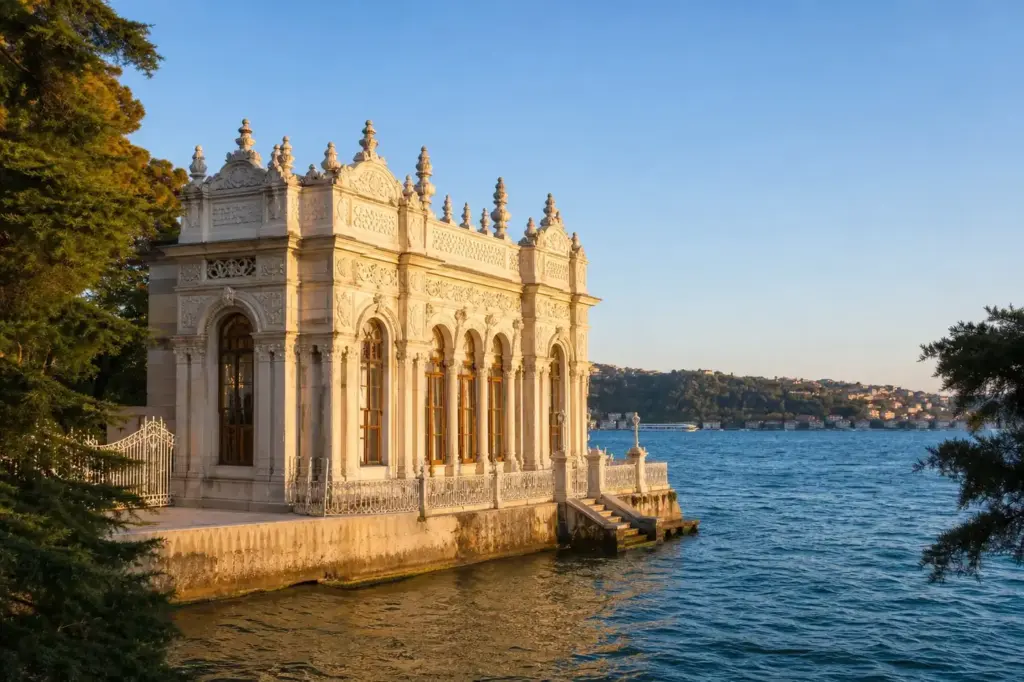
Küçüksu Pavilion, known in Turkish as Küçüksu Kasrı, stands directly on the Bosphorus shore in the Beykoz district on Istanbul’s Asian side. This compact stone pavilion, also historically called Göksu Pavilion, was built between 1856 and 1857 for Sultan Abdülmecid I as an elegant imperial stopping place for short excursions, hunting trips and leisure in the famous meadows between two streams.
Unlike vast residential palaces, Küçüksu was designed for brief daytime visits. The building rises above a basement with two principal floors arranged around a central hall with four corner rooms—a traditional Ottoman floor plan transformed through the decorative language of the 19th-century court. It opened to the public as a museum-palace in 1983 and remains one of the most intimate and visually rewarding introductions to imperial Bosphorus architecture.
Current access notice: As of October 2026: The pavilion is closed on Mondays. Opening hours and ticket availability may vary seasonally; check the official website before planning your visit.
Quick Facts
| Built / opened | 1857 |
|---|---|
| Architect(s) | Nigoğos Balyan |
| Address | Göksu Mahallesi, Küçüksu Caddesi No. 12, 34810 Beykoz, İstanbul Google MapsApple MapsYandex Maps |
| District | Beykoz |
| Admission | ₺₺ |
| Best time to visit | Spring (April–May) and autumn (September–October) offer pleasant temperatures and lower crowds than summer. The pavilion is less busy on weekday mornings (Tuesday to Thursday before noon). Winter months (November–February) are cooler and may see reduced visitors, but weather can be grey and windy along the Bosphorus.Summer (June–August) is peak season; expect larger crowds and heat that makes the walk from the ferry pier less comfortable. The pavilion interior remains cool but exterior views and gardens are less appealing in heat.Avoid Mondays (closed). Avoid Turkish public holidays and weekends if you prefer a quieter experience. |
| Website | millisaraylar.gov.tr |
What Is (and Isn't) Part of a Visit to Küçüksu Pavilion?
| Part | Status | Notes |
|---|---|---|
| The pavilion building (ground and upper floors) | Included in the standard ticket | The main historic palace with all decorated rooms and furnishings. |
| Basement level | Not open to visitors | Contains the kitchen and servants' quarters; not open to visitors. |
| Göksu recreational area (adjacent park) | Separate ticket or institution | A separate outdoor area with gardens and water views; requires a separate ticket and has different hours. |
| Anadoluhisarı fortress | Outside / not part of it | The 14th-century castle lies immediately south; not part of the Pavilion. Requires separate entry. |
| Ferry stop at Anadolu Hisarı | Outside / not part of it | The official ferry landing for Bosphorus tours lies nearby; served by separate ferry operators. |
Why Visit Küçüksu Pavilion?
The pavilion offers a rare glimpse into how Ottoman sultans designed intimate waterfront retreats that blended Ottoman spatial traditions with Western Baroque decoration. Its rooms showcase ornate Italian marble fireplaces, Bohemian crystal chandeliers and carpets from Hereke in elaborate detail. The setting itself is remarkable: positioned where the Göksu and Küçüksu streams meet the Bosphorus, the pavilion commands views across the strait and benefits from the recreational gardens that once made this the ‘Sweet Waters of Asia’ in Ottoman times. For visitors, it provides a quieter, less crowded introduction to 19th-century Ottoman luxury compared with larger palaces.
How Küçüksu Pavilion Is Laid Out
The pavilion is a compact, three-storey structure: a basement containing the kitchen, pantry and servants’ quarters; a ground floor; and an upper floor. Each principal floor contains four corner rooms arranged around a central hall (sofa), a traditional Ottoman house plan elevated to palatial scale. The building sits directly on the waterfront with its garden-facing and Bosphorus-facing façades featuring ornate decoration, sculptural fountains and elaborate cast-iron railings. The basement level is not open to visitors. The main public rooms occupy the ground and upper floors; allow time to view both levels.
Highlights of Küçüksu Pavilion
The Italian Marble Fireplaces
The pavilion contains multiple Italian marble fireplaces, each richly carved. The rooms facing the Bosphorus feature two fireplaces per room, while interior rooms have one. Look for the delicate inlay work and carved decorative elements in each fireplace—they represent the Western materials and craftsmanship Sultan Abdülmecid valued. These fireplaces set the tone for the entire interior aesthetic.
Tip: Compare the Bosphorus-facing fireplaces with those in interior rooms to understand how the sultan prioritised luxury where foreign dignitaries were received.
The Central Hall and Sofa
Each floor features a central hall or 'sofa' from which four corner rooms radiate. This layout preserves the traditional Ottoman house plan but at an imperial scale. The central hall served as a gathering and circulation space; the corner rooms functioned as reception rooms and sitting areas. Ottoman imperial life apparently required many richly decorated rooms—Küçüksu has nine such rooms, all equipped with sofas and chairs for sitting and chatting.
Tip: Stand in the central hall and notice how it creates sight lines to each corner room and to the water—a clever arrangement that makes the compact building feel spacious.
Bohemian Crystal Chandeliers
All rooms feature Bohemian crystal chandeliers, which catch light beautifully and signal the sultan's access to European luxury goods. These hanging fixtures were luxury imports and demonstrate how 19th-century Ottoman elites decorated their spaces with Western treasures while maintaining Ottoman spatial and architectural traditions.
Tip: Look up when entering each room to appreciate the chandelier design and imagine how they lit the rooms for evening gatherings.
Hereke Carpets
The rooms feature carpets from Hereke, a renowned Ottoman carpet-producing centre. These handwoven wool carpets represent the finest domestic textile production of the era and covered the inlaid wood floors, adding warmth and acoustic softness to the marble-heavy interior.
Tip: Note how the carpets coordinate with the overall colour scheme and define the reception areas within each room.
The Stone Exterior and Water Gate
Architect Nikoğos Balyan designed a rococo gem in marble, with an ornate cast-iron fence and boat dock visible from the ferry. Outside are elaborate façades, monumental staircases, sculptural fountains and ornate iron railings facing the water. The waterside orientation reveals that sultans arrived by caique (traditional boat), and the landing area was part of the ceremonial approach.
Tip: Photograph the exterior from the Bosphorus-facing side in afternoon light to capture the stone detail and the water setting.
No Bedrooms: Understanding Its Purpose
The pavilions had neither bedrooms nor hamams, which indicates they were intended for day visits. Officially registered as a 'biniş kasrı' (pleasure kiosk), it was a waterfront retreat used by the Sultan for short stays, hunting and receiving guests—never for overnight stays. This functional distinction shaped the entire interior: emphasis on reception rooms and comfortable seating rather than private chambers.
Tip: This is the key to understanding the pavilion's layout and purpose—spread comfortably but without the vast scale of residential palaces like Topkapi or Dolmabahçe.
Atmosphere
The pavilion interior feels intimate despite its ornate decoration. Rooms are light and airy, with large windows framing the Bosphorus. The water light reflects off the marble and chandeliers, creating a shimmering quality that changes throughout the day. Walking from room to room, you encounter a succession of similarly scaled, richly decorated spaces—each a variation on the same theme of Ottoman luxury expressed through European materials and Baroque decorative language.
The setting is peaceful. As a smaller, less-visited palace compared to Topkapi or Dolmabahçe, you can often explore without crowds. The adjacent recreational area (separate park, not included in the ticket) remains quiet during weekday mornings. The pavilion’s position directly on the water creates an intimate connection to the Bosphorus; you can hear the water and feel the strait’s presence throughout your visit.
History of Küçüksu Pavilion
A two-story wooden palace was completed in the early 18th century during the reign of Mahmud I. In 1715, during a golden age of fountain-building, water from a spring in the hills was fed down to an imperial hunting lodge and fountains in the village of Anadoluhisarı. The area was known as ‘The Sweet Waters of Asia’, a recreational destination that attracted Ottoman rulers for centuries.
A visit to the Sweet Waters made a welcome escape from duties of state for Sultan Mahmud II. His son, the cultured Abdülmecid, who dedicated his life to modernising both his empire and its capital, ordered the old wooden yalı to be replaced by a stone pavilion in the Western manner to complement his Dolmabahçe Palace on the European shore.
The present pavilion was completed in 1857 for Sultan Abdülmecid I and was designed by Ottoman Armenian architect Nigoğos Balyan. French painter and theatre designer Charles Séchan decorated the interior. The building blended Ottoman spatial traditions (the central-hall floor plan) with Western Baroque decoration and Italian materials—a visual expression of Abdülmecid’s Tanzimat reforms and his vision of modernising the Ottoman state.
In 1862 the future Edward VII of England, then Prince of Wales, was entertained here at a banquet given in his honour by Sultan Abdülaziz, demonstrating the pavilion’s role as a venue for imperial hospitality and diplomacy.
During the early years of the Turkish Republic, the palace was used as a state guesthouse. It opened to the public as a museum in 1983 and was thoroughly restored in 1994. In recent years, heavy traffic along the Asian shore road caused shifts in the filled land on which the palace was built, threatening to push it into the Bosphorus. The shore road was re-routed, and steel and concrete bulwarks were sunk on the Bosphorus side to support it.
Legends and Myths about Küçüksu Pavilion
The Sweet Waters of Asia Enchantment
Legend – historically unreliable. Ottoman tradition held that the meadows at the confluence of the Göksu and Küçüksu streams possessed a special beauty and rejuvenating power. Sultans and courtiers retreated there to escape the burdens and intrigues of the palace. The name itself—Sweet Waters of Asia—suggests that the fresh spring water and lush gardens were believed to offer a kind of pastoral escape from urban life. Whether the restoration was literal or metaphorical, the pavilion's location at this spot ensured it carried the spiritual associations of the place.
Prince Edward's Royal Banquet
In 1862, the future King Edward VII of England visited Istanbul as Prince of Wales and was entertained at a grand banquet in the Küçüksu Pavilion. Contemporary accounts emphasize the splendour and diplomatic significance of the event, positioning the pavilion as a stage for Ottoman imperial power and cultural refinement. The event was widely covered in European press and burnished the pavilion's international reputation.
Tickets and Booking for Küçüksu Pavilion
| Ticket | Price | Includes |
|---|---|---|
| Foreign adult (pavilion only) | ₺₺ | Admission to both floors of the pavilion, all decorated rooms, interior furnishings and displays. |
| Child/student (pavilion only) | ₺ | Admission to both floors of the pavilion for visitors under 12 or with valid student ID. |
| Turkish citizen or concession | ₺ | Discounted rates for Turkish residents and concession categories; verify at the ticket office. |
₺ budget · ₺₺ moderate · ₺₺₺ upscale · ₺₺₺₺ splurge. Price levels are estimates compared with typical prices for visitors.
Tickets are sold at the pavilion entrance. Online booking is not typical for this venue; arrive in person to purchase admission. As of October 2026: the pavilion is open Tuesday to Sunday with varying hours; it closes on Mondays. Hours may shift seasonally, so confirm at millisaraylar.gov.tr or call the official number before your visit.
Entry to the Göksu recreational area (the adjacent park) requires a separate ticket and is managed separately. Same-day entry to the pavilion is usually available except during peak tourist seasons or public holidays.
For Turkish citizens and concession holders (students, seniors, etc.), reduced rates apply. Full ticket categories, concession rules and current pricing are posted on the official ticket page at millisaraylar.gov.tr.
Suggested itineraries Küçüksu Pavilion
1 hour
Enter, view the ground floor rooms (central hall, reception areas, corner rooms with fireplaces and chandeliers). Spend time on the Bosphorus-facing side to appreciate the water views and exterior stonework. Exit and photograph the exterior façade and cast-iron fence from the garden area.
1.5–2 hours
Complete tour of both floors. Ground floor: central hall and four corner rooms with fireplaces. Upper floor: repeat layout with attention to decoration details and differences in finish. Study the marble, carpets, chandeliers and furniture placement in each room. Spend time on the terrace or garden area for Bosphorus views. Optional: visit the adjacent Göksu park with a separate ticket.
Half day (with ferry ride)
Take a Bosphorus ferry tour and view the pavilion's exterior from the water, seeing the 'wedding-cake' stone façade, cast-iron fence and boat dock from the strait. Disembark at Anadolu Hisarı ferry pier. Walk 10 minutes south along the shore road to the pavilion entrance. Tour the interior (1.5–2 hours). Optional: continue walking to Anadoluhisarı fortress (5 minutes' walk north) for a combined historical outing.
How to Get to Küçüksu Pavilion
Ferry + walking (most scenic): Take the Şehir Hatları ferry (city ferry) from Eminönü or Beşiktaş to Anadolu Hisarı pier on the Asian side. Follow the shore road (Bosphorus coast road) south for about 10–15 minutes on foot. Signs direct you to Küçüksu Kasrı. This route offers Bosphorus views and a pleasant walk.
Bus from Üsküdar: From Üsküdar, take bus 15 (or check current routes) northbound along the Asian shore toward Beykoz. Alight near Küçüksu Kasrı on the coast road. Journey time is roughly 30–40 minutes depending on traffic.
Marmaray + bus: Take Marmaray (suburban rail) from central Istanbul to Ayrılıkçeşme station on the Asian side. Transfer to a local bus heading north along the Bosphorus shore toward Beykoz and exit near Küçüksu Kasrı.
Taxi or private vehicle: Address: Göksu Mahallesi, Küçüksu Caddesi No. 12, Beykoz. The building sits directly on the shore road with parking available nearby.
Accessibility
The pavilion sits on uneven ground directly on the Bosphorus shore. Access to the main building involves a monumental staircase at the entrance; wheelchair access is not available. The interior features steep stairs between floors.Once inside, the ground and upper floors are navigable for visitors with mobility but contain multiple stairs and narrower doorways typical of 19th-century buildings. Benches and seating are present in most rooms but not throughout. The building has no lift.The adjacent Göksu park area may offer more accessible outdoor views, but requires a separate ticket.
Food Nearby
No cafés or restaurants are inside the pavilion. The adjacent Göksu recreational area may have small refreshment kiosks, but offerings are limited.For meals, head south toward Anadoluhisarı village (10–15 minutes' walk) where waterfront restaurants and cafés line the shore. Options range from casual kebab and seafood spots to sit-down restaurants with Bosphorus views. Alternatively, walk north toward the Fatih Sultan Mehmet Bridge area where local vendors and modest eateries serve the neighbourhood.
What to Bring
Comfortable walking shoes for the shore road and approach from the ferry pier. Sunscreen and a hat for sunny days. A light layer for shade inside the building or to protect from Bosphorus wind. A camera or phone for exterior and water views. No special equipment needed; the building itself is straightforward to tour.Bags and security: Large bags are not restricted, but luggage storage is not available. Normal visitor conduct policies apply.
Best Views and Photo Spots of Küçüksu Pavilion
The Bosphorus-facing terrace or garden area
View of the pavilion's marble façade with the Bosphorus in the background. The cast-iron railings frame the building nicely, and the water light bounces off the stone. Best for showing the pavilion's setting and architectural detail against the strait.
Best time: Late afternoon (3–5pm) when the stone is warm-lit and the Bosphorus glimmers. Avoid harsh midday sun which bleaches detail.
The central hall or sofa (ground floor)
Looking through the central hall toward corner rooms or the window framing the Bosphorus. The chandelier hangs centrally and the carpet anchors the composition. This reveals the spatial arrangement and the way interior decoration framed views of water.
Best time: Mid-morning when light comes through the windows but before noon glare.
A corner room with fireplace and window
The marble fireplace detail in close-up, with the Bohemian crystal chandelier visible above and a Bosphorus window view beyond. This shot captures the luxurious materials and the connection between interior ornament and exterior setting.
Best time: Any time; interior light is consistent. Overcast days reduce glare on marble.
The cast-iron fence and water-gate area at the building's base
Ornate iron railings and architectural detail at water level, showing the boat dock and the water's edge. This reveals how sultans arrived by water and the security and ceremonial importance of the water approach.
Best time: Morning or late afternoon when side light emphasizes the metalwork texture.
From the adjacent Göksu park or shore, looking back at the pavilion
The entire pavilion silhouetted against the Bosphorus, showing its proportions, stone work and setting within the landscape. This perspective captures why the location was valued.
Best time: Evening (5–6pm) when the sun is lower and the Bosphorus reflects gold light.
Photography Rules
Interior photography is permitted in most rooms. No flash photography or tripods inside. Exterior photography is encouraged, especially from the waterfront and garden areas. The building's stone façade and cast-iron fence photograph well in afternoon light. Drone photography is not permitted.
Family Suitability
Suitable for school-age children and teenagers interested in history and architecture. The compact size and manageable number of rooms make it less overwhelming than massive palaces. The luxurious furnishings and decorations (chandeliers, carpets, marble) hold children's attention better than bare historic buildings.Very young children (under 5) may find stairs difficult; strollers cannot navigate the monumental entrance staircase or interior stairs. Children require close supervision on the narrow waterfront paths and stairs.The location on the Bosphorus shore is beautiful for families, and the adjacent Göksu park (separate ticket) offers outdoor space. Overall: moderate family appeal, best for children age 8 and up with an interest in palaces and history.
Istanbul Vibes Tips
- Arrive early on a weekday (Tuesday–Thursday morning) to have the pavilion nearly to yourself. Weekends and afternoons draw tour groups and family visitors, diminishing the intimate atmosphere that makes Küçüksu special.
- Compare the ground floor layout with the upper floor—they are nearly identical, which reinforces the traditional Ottoman 'sofa and four rooms' plan. Observing this repetition helps you understand Ottoman spatial thinking.
- The pavilion's small size is a feature, not a limitation. Tour guides often skip it in favour of larger palaces. Its lack of grandeur is precisely why it reveals 19th-century Ottoman imperial life more intimately than Topkapi or Dolmabahçe.
- If visiting by ferry, stay on the ferry a moment after departure to view the pavilion's exterior from the water—the 'wedding-cake' façade and boat dock are architectural highlights invisible from the land side.
- Do not confuse the pavilion with the adjacent Göksu recreational area (park). They are separate entities with separate tickets and hours. Many visitors buy the park ticket expecting to tour the building, or vice versa. Clarify which you want at the ticket window.
- The walk from Anadolu Hisarı ferry pier to the pavilion is pleasant but exposed. Bring water and sun protection in summer; the shore road offers little shade and can be windy in any season.
Explore Nearby Küçüksu Pavilion
Sights near Küçüksu Pavilion
 Beylerbeyi Palace – about 4.4 km away · typical visit: 1–1.5 hoursOpen 09:00–17:00, closed Mon
Main image: AI-generated illustration. It may not show the place exactly as it looks.
 Bosphorus Bridge – about 4.4 km away · typical visit: 1–2 hoursOpen 24 hours
Main image: AI-generated illustration. It may not show the place exactly as it looks.
 Anatolian Fortress – about 550 m away (~9 min walk) · typical visit: 1–2 hoursOpen 10:00–17:30, closed Mon
Main image: AI-generated illustration. It may not show the place exactly as it looks.
 Ziraat Bank Tower – about 850 m away (~14 min walk) · typical visit: 30 minutes to 1 hour8 min on foot from Aşiyan metro
Main image: AI-generated illustration. It may not show the place exactly as it looks.
 Rumeli Fortress – about 850 m away (~14 min walk) · typical visit: 1–2 hours7 min on foot from Aşiyan metro, Open 09:00–17:00, closed Mon
Main image: AI-generated illustration. It may not show the place exactly as it looks.
 Aşiyan Museum – about 900 m away (~14 min walk) · typical visit: 1–1.5 hours3 min on foot from Aşiyan metro, Open 09:00–17:00, closed Mon
Main image: AI-generated illustration. It may not show the place exactly as it looks.
Metro stations near Küçüksu Pavilion
 Aşiyan – about 750 m away (~13 min walk)Open daily 06:00–00:00
Main image: AI-generated illustration. It may not show the place exactly as it looks.
Nightlife near Küçüksu Pavilion
 Taps Bebek – about 1000 m away (~16 min walk)4 min on foot from Aşiyan metro
Main image: AI-generated illustration. It may not show the place exactly as it looks.
Related guides
 Rumelihisarı: Fortress, History and Bosphorus Views
Main image: AI-generated illustration. It may not show the place exactly as it looks.
 Lacivert: Bosphorus Seafood Under the Bridge
Main image: AI-generated illustration. It may not show the place exactly as it looks.
 Barto’s Burger Place: Smash Burgers in Çengelköy
Main image: AI-generated illustration. It may not show the place exactly as it looks.
 Bayramoğlu Döner: Wood-Fired Döner in Kavacık
Main image: AI-generated illustration. It may not show the place exactly as it looks.
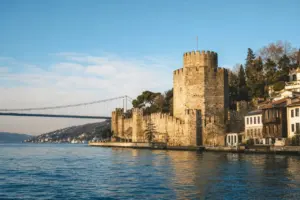 Anadolu Hisarı: Ottoman Fortress and Waterfront Landmark
Main image: AI-generated illustration. It may not show the place exactly as it looks.
Browse more: More in Beykoz · All Landmarks · All Sightseeing
FAQ: Küçüksu Pavilion
Is Küçüksu Pavilion the same as the Göksu recreational area next to it?
No. The pavilion building is a separate museum with its own ticket. The adjacent Göksu park is a separate outdoor recreational area with gardens and a different admission fee and opening hours. You can visit the pavilion alone, the park alone, or both. Verify which you want when buying tickets.
Can I stay overnight at the pavilion?
The pavilion had neither bedrooms nor hamams, indicating it was intended for day visits. It is now a museum and not available for accommodation. It was never a residential palace.
How long does a visit to the pavilion take?
Most visitors spend 1–1.5 hours. The building is compact with 9 decorated rooms (ground and upper floors). You can tour it faster (45 minutes) if you move quickly, or linger 2 hours if you study the decoration and furnishings in detail and enjoy the terrace views.
Is the pavilion accessible by public transport?
Yes. Ferry + walk is most scenic: take a city ferry to Anadolu Hisarı, then walk the shore road 10–15 minutes. Alternatively, take bus 15 from Üsküdar northbound, or use Marmaray to Ayrılıkçeşme station and transfer to a local bus. No metro station is within easy walking distance.
Why was the pavilion built when the sultan already had Dolmabahçe Palace?
Sultan Abdülmecid ordered the old wooden hunting lodge replaced by a stone pavilion in the Western manner to complement Dolmabahçe Palace. The new Küçüksu Kasrı, like the Ihlamur Kasrı built at the same time inland from Dolmabahçe, was a miniature of the palace—designed for day excursions and outdoor recreation, not residence.
Is photography allowed inside?
Yes. Interior photography is permitted without flash or tripods. Exterior photography is encouraged. Drone photography is not allowed.
What is the best time of year to visit?
Spring (April–May) and autumn (September–October) offer comfortable temperatures and fewer tourists. Weekday mornings (Tuesday–Thursday before noon) are quieter than weekends. Avoid Mondays when the pavilion is closed.
Are children welcome?
Yes, for school-age children and teenagers interested in history. The compact size and luxurious furnishings are engaging. Very young children (under 5) may struggle with stairs and the waterfront location; strollers cannot navigate the entrance.
Istanbul Vibes is a one-person project. A coffee keeps it going
Hotels near Küçüksu Pavilion
Restaurants near Küçüksu Pavilion
- Kıyı Emniyeti Tesisi (400 m) Google Maps
- BigChefs (450 m) Google Maps
- Suna'nın Yeri (550 m) Google Maps
Distances are straight-line, from OpenStreetMap data.

Take this guide with you
Get a free PDF of this guide to print or read offline: key facts, tips and a map link on a few clean pages.
Report an issue on this page
How we research and update our guides
About this guide: AI assistance and accuracy
This guide is created with the help of AI and is based on official sources where available. Mistakes can still happen. Opening hours, prices, rules and other details are given to the best of our knowledge as of the date shown and can change without notice. It offers general recommendations only, not professional, legal or travel advice. Please confirm important details with the official source before you travel; you are responsible for your own plans and decisions.
* Affiliate link: as an Amazon Associate we earn from qualifying purchases at no extra cost to you.
