
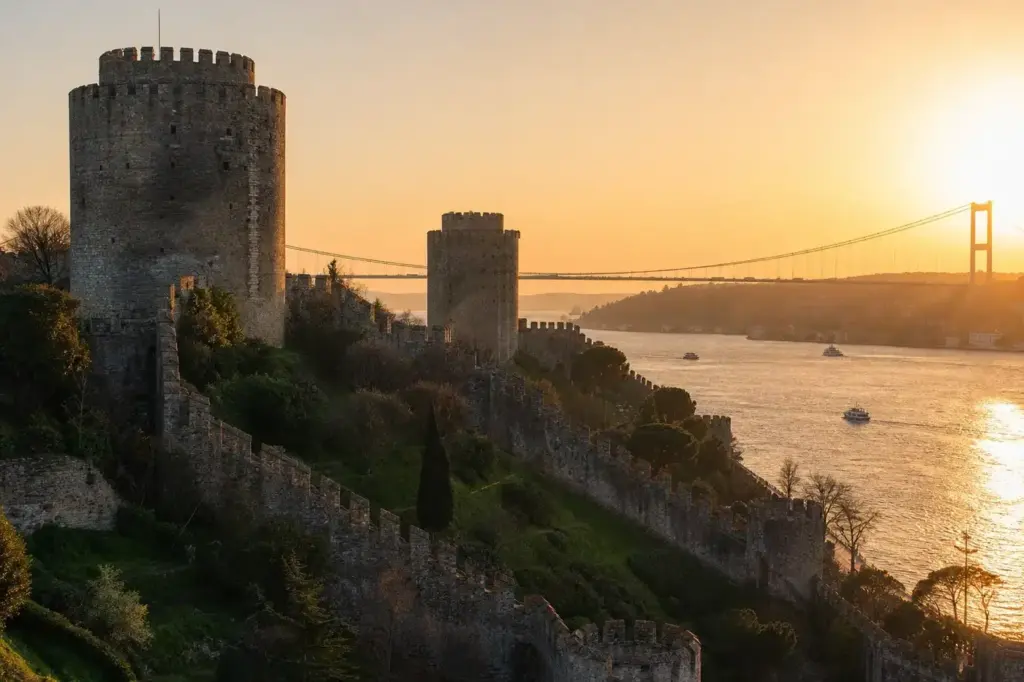
Rumeli Fortress stands on a hilltop above the European shore of the Bosphorus at its narrowest crossing, where the strait is only 660 metres wide. Built in 1452 by Sultan Mehmed II, this medieval fortress was constructed in just four months as a strategic weapon before the Ottoman siege of Constantinople. Today it functions as an open-air museum, preserving the fortress grounds, towers and ramparts that visitors can explore on foot.
The fortress is instantly recognizable by its three large towers—each built under the supervision of a different vizier—connected by defensive walls and smaller watchtowers. Its dramatic setting, facing the Fatih Sultan Mehmet Bridge and the Asian shore across the water, makes it one of Istanbul’s most photogenic historical sites.
Current access notice: As of October 2026: Some upper tower sections and rampart walks may be closed or restricted due to ongoing conservation work. The central courtyard, gardens, and viewpoints remain accessible. Check current status with staff on arrival or at the official museum website.
Quick Facts
| Turkish name | Rumeli Hisarı |
|---|---|
| Built / opened | 1452 |
| Architect(s) | Müslihiddin Ağa |
| Address | Rumeli Hisarı, Yahya Kemal Caddesi No. 42, 34470 Sarıyer/İstanbul Google MapsApple MapsYandex Maps |
| District | Sarıyer |
| Admission | ₺₺ |
| Best time to visit | Spring (April–May) and autumn (September–October) offer mild temperatures and comfortable walking conditions. Summer (June–August) can be very hot, making the steep paths and exposed areas uncomfortable by midday. Early morning (8:30–10:00 am) or late afternoon (15:00–17:00) provide soft light, fewer crowds and cooler temperatures year-round. Weekdays are significantly quieter than weekends. Winter visits are possible but can be wet and windy given the exposed hilltop location; the fortress remains open but paths may be slippery. |
| Website | muze.gov.tr/muze-detay?sectionId=HIS01&distId=MRK |
What Is (and Isn't) Part of a Visit to Rumeli Fortress?
| Part | Status | Notes |
|---|---|---|
| Three main towers (Sarıca, Halil, Zaganos) and courtyard | Included in the standard ticket | All three main towers and the interior courtyard are part of the main ticket admission; upper sections may have limited access due to restoration. |
| Outer walls, ramparts and thirteen smaller watchtowers | Included in the standard ticket | The perimeter walks connecting the three main towers and the smaller watchtowers are included in admission; some sections may be temporarily closed. |
| Soldiers' quarters ruins and mosque site | Included in the standard ticket | Ruins and foundations of military buildings and the small mosque are visible within the central courtyard and are part of the open-air museum. |
| Upper tower climbs and interior stairs | Included in the standard ticket | Access to upper levels and internal stairs varies; recent visitors report some high walkways closed for safety during conservation; arrive early to confirm what is open. |
| Anadolu Hisarı (Anatolian Fortress across the water) | Outside / not part of it | The fortress on the Asian shore is a separate site in a different district; it requires a separate visit and ticket. |
| Fatih Sultan Mehmet Bridge access | Outside / not part of it | The suspension bridge overhead is a modern structure (1988) and is not part of the fortress; visitors cannot access it from the fortress grounds. |
| Café and refreshments | Separate ticket or institution | A café near the main entrance sells drinks and snacks; no food vendors operate inside the fortress grounds. |
Why Visit Rumeli Fortress?
Rumeli Fortress offers a rare chance to walk through genuine 15th-century Ottoman military architecture and understand the engineering that enabled the conquest of Constantinople. The views across the Bosphorus are exceptional from every angle—the strait, the suspension bridge overhead, and the hills beyond create constant visual drama.
History comes alive here in concrete ways: you see the gun ports designed for cannons, understand how the three viziers divided construction labour, and stand at the exact point where Ottoman control of the waterway changed maritime history. The peaceful, tree-lined grounds and café make it easy to linger and absorb the scale of what was built so rapidly.
How Rumeli Fortress Is Laid Out
The fortress occupies roughly 30 acres on a series of connected hills. Entry is typically through the main gate near the road level, from which paths lead upward past informational plaques and gardens. The three main towers—Sarıca Pasha Tower to the north, Halil Pasha Tower in the center courtyard, and Zaganos Pasha Tower to the south—anchor the complex. Thirteen smaller watchtowers connect these strongpoints along the outer walls, which follow the hilltop contours down toward the Bosphorus shore.
The central courtyard contains the remains of soldiers’ quarters and a mosque. Walking routes wind between all three main towers, offering changing perspectives of the water and surrounding landscape. Some sections have open views; others pass through shaded areas beneath ancient walls. The grounds have benches and shaded spots for rest, particularly near the main courtyard and upper viewpoints.
Highlights of Rumeli Fortress
Sarıca Pasha Tower
The northernmost of the three main towers, standing 28 metres tall, this cylindrical tower was built under the supervision of Sarıca Pasha, one of Mehmed II's viziers. Its thick stone walls—7 metres at the base—and multiple levels with interconnected rooms show the fortress's defensive design. The tower commands views of the northern approach to the Bosphorus and the Black Sea entrance.
Tip: Climb to the upper levels if open during your visit for panoramic views; in recent years upper access has been limited due to restoration work, so check current access with staff on arrival.
Halil Pasha Tower
The central tower, 22 metres high, dominates the main courtyard and was built under Halil Pasha's direction. Its position at the heart of the fortress made it the command post. The tower's lower levels contain chambers and stairs carved into the wall thickness, revealing the tight engineering that fit military functions into 15th-century defensive architecture.
Tip: This tower offers the most accessible vantage point over the courtyard and surrounding terrain; it is the best spot to photograph the fortress layout and understand how the three towers work together defensively.
Zaganos Pasha Tower
Standing 21 metres tall at the southern end, this tower was overseen by Zaganos Pasha. Like its companions, it showcases medieval Ottoman military engineering adapted for gunpowder warfare. The tower originally had nine floors with chambers connected by internal stairs. An inscription on the tower records the completion date in 1452.
Tip: The southern tower offers the clearest views toward the Fatih Sultan Mehmet Bridge and the Asian fortress (Anadolu Hisarı) directly across the water—a powerful sight showing how the two fortresses controlled the strait together.
Ramparts and Connecting Walls
Thirteen smaller watchtowers link the three main towers, connected by surviving stone walls and ramparts that step down the hillside toward the Bosphorus. These watchtowers were positioned for spotting ships and coordinating fire. Walking along these walls gives you a direct sense of medieval defensive strategy and the rapid engineering feat—all completed between April and August 1452.
Tip: The perimeter walk provides the best understanding of the fortress's scale and layout; early morning or late afternoon light flatters the ancient stonework and the water views beyond.
Central Courtyard and Gardens
The courtyard at the heart of the fortress is now open ground with shade trees and informational plaques. This is where soldiers were quartered and where a small mosque once stood. The open space allows you to appreciate the fortress's internal organisation and offers shade and rest points. Benches are scattered throughout.
Tip: Bring water and wear sturdy shoes; the ground is uneven and hilly, and there is little commercial food available inside—a café operates near the entrance but not throughout the site.
Bosphorus Views from the Shore Level
Paths descend from the upper towers toward the water's edge, where you can see the fortress from below and understand its relationship to the shipping channel. The narrow passage of water between Rumeli and Anadolu fortresses is visible in full context here. This vantage point shows why Sultan Mehmed chose this precise location.
Tip: Visit this lower section in the afternoon when light rakes across the water toward the Asian shore; smartphone photos from this angle capture the fortress silhouette and bridge in one frame.
Atmosphere
Rumeli Fortress feels peaceful and contemplative rather than crowded, even during busy seasons. Ancient stone walls frame views of flowing water and distant hills. The sound of the Bosphorus carries upward, and the Fatih Sultan Mehmet Bridge’s presence overhead (a modern suspension span completed in 1988) creates a surreal juxtaposition of centuries.
Visitors move at a slow pace, climbing stairs and sitting in shaded courtyards to absorb the scale of what was built so urgently 570 years ago. The site attracts historians, photographers, families taking leisurely walks, and couples seeking quiet moments. Early morning brings light, solitude and views across calm water; late afternoon sun turns the stonework golden and fills the Bosphorus with reflected light. Weekdays are quieter than weekends, and visiting in spring or autumn—outside summer heat—makes the walking more comfortable.
History of Rumeli Fortress
Conception and Rapid Construction (1451–1452)
In the late summer of 1451, Sultan Mehmed II inspected the Bosphorus and chose this site at its narrowest point to build a fortress that would strangle Byzantine Constantinople’s lifeline to the Black Sea. On 15 April 1452, construction began under the direction of the chief architect Müslihiddin Ağa. What followed was a remarkable feat of organization: approximately 300 master craftsmen, 700–800 workers, 200 coachmen, boatmen and transporters worked in coordinated shifts. The three main viziers—Sarıca Pasha, Halil Pasha and Zaganos Pasha—each supervised one tower simultaneously. Sultan Mehmed himself participated in the labour. By 31 August 1452, the fortress was complete: four months and 16 days of continuous building.
Strategic Role in the 1453 Conquest
The fortress was built explicitly to cut off aid and supplies reaching the Byzantine capital from the Black Sea and to control shipping on the Bosphorus. Positioned directly across from the older Anatolian Fortress (built by Sultan Bayezid I in 1394), the two fortresses created a naval stranglehold. During the siege of 1453, Rumeli Fortress and its cannons played a direct role in preventing Byzantine relief ships from reaching the city. The fortress’s alternative name, Boğazkesen (Strait-Cutter), reflects this strategic purpose.
Post-Conquest Uses (1453–Modern Era)
After Constantinople fell in 1453, the fortress lost its original military urgency but remained strategically important. It was converted into a customs checkpoint and later served as a state prison from the 16th century onward. A major fire in 1746 destroyed wooden structures in two of the towers; Sultan Selim III oversaw repairs in the late 18th century. An earthquake in 1509 had caused earlier damage, but the stone structure survived.
Restoration and Museum Opening (1953–1968)
For many decades the fortress fell into disrepair and was largely neglected. In 1953, on the 500th anniversary of the conquest, comprehensive restoration began under the direction of President Celal Bayar, executed by three pioneering Turkish female architects—Cahide Tamer, Selma Emler and Mualla Anhegger-Eyüboglu. The restoration preserved the towers and walls, cleared the overgrown courtyards, and stabilized the structure. On 15 April 1968, exactly 516 years after construction began, Rumeli Fortress officially opened as a monument museum under the Directorate of Fortresses (Hisarlar Museum Directorate). It has functioned as an open-air museum and occasional concert venue ever since.
Legends and Myths about Rumeli Fortress
The Rapid Build as an Omen
Legend – historically unreliable. Local tradition holds that the fortress was completed so swiftly—in just four months—that it appeared to rise overnight like a vision sent by divine will to ensure Ottoman victory. The speed itself seemed miraculous to contemporaries, reinforcing the sense that conquest was divinely ordained. Some accounts suggest that the rapidity proved Mehmed's favour with Allah and the soldiers' exceptional dedication.
The Three Viziers' Competition
Legend – historically unreliable. One widespread retelling claims the three viziers—Sarıca Pasha, Halil Pasha and Zaganos Pasha—each built their tower in competitive rivalry, each striving to build the tallest and strongest. The story emphasizes honour and rivalry as driving force, though historical records show they were assigned sections by the Sultan's own planning rather than competing for glory.
Tickets and Booking for Rumeli Fortress
| Ticket | Price | Includes |
|---|---|---|
| General admission | ₺₺ | Access to all open areas of the fortress including towers, ramparts, courtyard and gardens; informational plaques; views and photography. |
₺ budget · ₺₺ moderate · ₺₺₺ upscale · ₺₺₺₺ splurge. Price levels are estimates compared with typical prices for visitors.
Tickets are purchased at the entrance booth near the main gate. Online advance purchase is not widely available; same-day tickets are typically available except during exceptional crowds or scheduled events. Turkish citizens and concession holders (students, seniors) pay reduced rates; bring ID or relevant documentation. Children under a certain age may enter free—check current policy on the official museum website.
No entry passes or voucher systems are typically used. Visitors simply pay at the gate upon arrival. The site is operated by the Turkish Ministry of Culture and Tourism. For the most current ticket prices, opening hours, and any access restrictions due to restoration work, consult the official museum page at muze.gov.tr.
Suggested itineraries Rumeli Fortress
1 hour
Enter through the main gate, walk directly to the central courtyard to orient yourself. Visit Halil Pasha Tower (central) for overview views, then descend toward the Bosphorus shore for water-level perspectives. Return via the perimeter to exit. This route captures the fortress's main elements without climbing to upper levels.
1.5–2 hours
Begin at the courtyard, climb to Sarıca Pasha Tower (north) for Black Sea views, descend to Halil Pasha Tower (center), then ascend Zaganos Pasha Tower (south) for bridge and Asian shore vistas. Walk the connecting ramparts and watchtowers if open. End at the lower shore level for photos, then return via the main path to exit.
Half day (3–4 hours)
Spend time in each tower exploring chambers and stairs if accessible. Walk slowly along all rampart sections and visit each smaller watchtower. Rest in shaded courtyard areas and read informational plaques to build context. Have lunch or coffee at the entrance café. Photograph from multiple angles throughout the day as light changes. End with sunset views toward the bridge and Asian coast.
How to Get to Rumeli Fortress
Public Transport: Rumeli Fortress is accessible by bus and ferry; metro does not directly serve the site. From central Istanbul (Sultanahmet), take a bus heading north toward Sarıyer district (such as lines 22, 25, or 32). The journey takes 30–45 minutes depending on traffic. Alight at the Rumeli Hisarı stop near Yahya Kemal Caddesi.
Ferry Option: An alternative is the scenic Bosphorus ferry from Eminönü Pier heading north; ferries stop at Rumeli Hisarı pier, and the fortress is a short walk uphill from the landing.
Walking from the Stop: From either the bus stop or ferry pier, follow Yahya Kemal Caddesi uphill toward the fortress entrance (5–10 minutes on foot). The main gate is clearly marked.
Taxi or Private Car: A taxi from Sultanahmet or Taksim to Rumeli Hisarı costs moderate rates and takes 20–40 minutes. Parking is available near the entrance for private vehicles, though spaces are limited on weekends.
Accessibility
The fortress grounds are hilly and involve significant climbing and uneven terrain; visitors with mobility challenges will find movement difficult. The main courtyard is relatively flat but surrounded by ascending paths to the three towers. There are no lifts or purpose-built ramps. Benches and shaded rest areas are scattered throughout for recuperation. Visitors with limited mobility are advised to spend time in the courtyard and lower sections rather than attempting the tower climbs. Partners or companions can assist with navigation. Stroller access is not practical due to steep, rocky paths.
Food Nearby
A café near the main entrance serves drinks, coffee and light snacks. No food vendors operate inside the fortress grounds. Nearby neighbourhoods (Bebek, Arnavutköy) a short walk or drive away have restaurants, cafés and markets, but they are not within immediate walking distance of the fortress. Bring water and snacks if planning a longer visit.
What to Bring
Wear sturdy, closed-toe hiking shoes with good grip; the paths are steep, rocky and uneven. Bring a hat and sunscreen for exposed areas. A water bottle is essential, especially in warm months. The fortress offers no shade in many sections. In winter, a rain jacket is advisable. Binoculars enhance the viewing experience of the water and distant shores. Arrive with a fully charged phone for photography and navigation.
Best Views and Photo Spots of Rumeli Fortress
Upper platform of Zaganos Pasha Tower (south tower)
The most dramatic vantage over the Bosphorus narrowing, with the Fatih Sultan Mehmet Bridge directly overhead and Anadolu Hisarı (Anatolian Fortress) visible across the water. The composition captures the full strategic scope of the site.
Best time: Golden hour (30–60 minutes before sunset) when the western light rakes across the water and the bridge cables catch gold. The Asian shore glows.
Shore level below the southern ramparts
Looking back uphill toward the fortress silhouette against the sky, with all three towers framed against the city skyline beyond. The water in foreground adds depth.
Best time: Late afternoon when the fortress walls are lit from above and shadows define the stonework texture.
Central courtyard framed by the three towers
A composition showing the geometric arrangement of the three main towers and their relationship to the connecting walls, emphasizing the fortress's military logic. Trees and shade add atmosphere.
Best time: Midday when light is high and harsh shadows define the stone; or overcast days for even, dramatic tones.
Rampart walk between Halil and Sarıca towers (north side)
A long view along the ancient wall with the Bosphorus beyond, showing scale and the layered landscape of the European shore north toward the Black Sea entrance.
Best time: Early morning (8:00–9:30 am) when the north-facing rampart is in soft light and the water is often glassy calm.
Gate entrance area with partial tower view
The main entry gate framed by stone arch and fortification walls, with Halil Pasha Tower visible beyond; a classic medieval entrance photograph.
Best time: Mid-morning when entrance area has light but is not harshly shadowed.
Photography Rules
Photography is permitted throughout the site without tripods, drones or professional equipment restrictions typically enforced. No flash photography restrictions are noted for outdoor areas. Internal tower chambers may have limited light; bring a headlamp or phone flashlight if exploring interiors. The fortress is exceptionally photogenic from multiple angles—the water, bridge, ramparts and towers all create compelling compositions. Sunset light is particularly striking.
Family Suitability
Rumeli Fortress is moderately suitable for families with school-age children (8+) who are comfortable with climbing and uneven terrain. The site involves significant walking and ascending steep paths between towers, which young children or those with limited stamina will find challenging. The open fortress layout offers freedom to move at a child's pace, and many children find the towers and ramparts exciting to explore. However, strollers are not practical, and very young children will need adult carrying support on steep sections. Teenagers generally enjoy the historical context and views. The site has no shade in many areas and limited food options, so plan accordingly. The water views and tower exploration appeal to curious minds, making it educational as well as adventurous.
Istanbul Vibes Tips
- Arrive early (opening time or shortly after) to avoid crowds and enjoy the cooler morning temperatures. By late morning, the exposed upper areas become hot, and more tour groups have arrived.
- Check the current status of upper tower access and rampart walks when you arrive; ongoing restoration periodically closes sections without advance notice. Staff at the entrance can advise on what is safely open that day.
- Bring more water than you think you need. The fortress has no shade in exposed sections, especially on the upper platforms and outer ramparts, and dehydration risk is real in warm months.
- Photograph from the lower shore level before climbing; the angle looking back at the fortress against the sky is compelling, and it is less crowded than upper vantage points.
- Combine a visit with a Bosphorus ferry ride from the nearby pier, either before or after exploring the fortress. This gives a water-level perspective of both Rumeli and Anadolu fortresses and extends the afternoon into scenic cruising.
- Visit on a weekday if possible. Weekends and public holidays bring significantly more visitors, particularly tour groups, which can make the narrower paths feel crowded and photography more difficult.
Explore Nearby Rumeli Fortress
Sights near Rumeli Fortress
 Fatih Sultan Mehmet Bridge – about 900 m away (~14 min walk) · typical visit: 30 minutes to 1 hourOpen 24 hours
Main image: AI-generated illustration. It may not show the place exactly as it looks.
 Hagia Sophia – about 10.6 km away · typical visit: 1–1.5 hours8 min on foot from Gülhane metro, Open daily 09:00–19:30
Main image: AI-generated illustration. It may not show the place exactly as it looks.
 Blue Mosque – about 11.1 km away · typical visit: 45–75 minutes3 min on foot from Gülhane metro
Main image: AI-generated illustration. It may not show the place exactly as it looks.
 Aşiyan Museum – about 300 m away (~5 min walk) · typical visit: 1–1.5 hours3 min on foot from Aşiyan metro, Open 09:00–17:00, closed Mon
Main image: AI-generated illustration. It may not show the place exactly as it looks.
 Küçüksu Pavilion – about 850 m away (~14 min walk) · typical visit: 1–2 hours13 min on foot from Aşiyan metro
Main image: AI-generated illustration. It may not show the place exactly as it looks.
 Ziraat Bank Tower – about 950 m away (~15 min walk) · typical visit: 30 minutes to 1 hour8 min on foot from Aşiyan metro
Main image: AI-generated illustration. It may not show the place exactly as it looks.
Metro stations near Rumeli Fortress
 Aşiyan – about 450 m away (~7 min walk)Open daily 06:00–00:00
Main image: AI-generated illustration. It may not show the place exactly as it looks.
 Boğaziçi Üniversitesi – about 900 m away (~14 min walk)Open daily 06:00–00:00
Main image: AI-generated illustration. It may not show the place exactly as it looks.
Restaurants and cafes near Rumeli Fortress
 Sankai by Nagaya – about 1.3 km away (~20 min walk)12 min on foot from Etiler metro
Main image: AI-generated illustration. It may not show the place exactly as it looks.
Nightlife near Rumeli Fortress
 Taps Bebek – about 650 m away (~11 min walk)4 min on foot from Aşiyan metro
Main image: AI-generated illustration. It may not show the place exactly as it looks.
Related guides
 Anadolu Hisarı: Ottoman Fortress and Waterfront Landmark
Main image: AI-generated illustration. It may not show the place exactly as it looks.
 Rumeli Fortress and Emirgan Walk: Ottoman Strategy and Bosphorus Gardens
Main image: AI-generated illustration. It may not show the place exactly as it looks.
 Ural Ataman Classic Car Museum: Vintage Cars, Retro Atmosphere and Practical Info
Main image: AI-generated illustration. It may not show the place exactly as it looks.
 Bosphorus Sunset Cruise: Istanbul’s Best Evening on Water
Main image: AI-generated illustration. It may not show the place exactly as it looks.
 Raffles Istanbul: Luxury above the Bosphorus in Zorlu Center
Main image: AI-generated illustration. It may not show the place exactly as it looks.
Browse more: More in Sarıyer · All Landmarks · All Sightseeing
FAQ: Rumeli Fortress
Can you visit both Rumeli Fortress and Anadolu Hisarı in one day?
Yes. Anadolu Hisarı (Anatolian Fortress) is on the Asian shore and requires a separate ticket and visit, but it is close enough to combine with Rumeli Fortress in a half-day outing. Take a ferry or taxi across the Bosphorus between the two sites. Together they tell the story of how the two fortresses controlled the strait.
Are the tower interiors open to visitors?
Usually yes, but access varies due to ongoing restoration work. Interior stairs and chamber rooms can be explored if open, but recent visitors report some upper sections periodically closed for safety. Confirm current access with staff at the entrance on your visit day.
Is it necessary to hire a guide?
No. The site is well-marked with informational plaques in English and Turkish. Self-guided exploration works well. However, a knowledgeable guide can deepen understanding of the military strategy and construction logistics. Guides are available for hire at the entrance.
How long does a typical visit take?
Plan 1–2 hours as a baseline. If you climb all three towers, explore all ramparts, and rest in the courtyard, 2–3 hours is realistic. Photography enthusiasts or those lingering for atmosphere may spend 3–4 hours.
Is the fortress accessible for someone with limited mobility?
The grounds are hilly and uneven with no ramps or lifts. The main courtyard is relatively flat and accessible, but reaching the towers requires climbing steep paths. Visitors with mobility challenges can enjoy the courtyard and lower sections but will find tower access very difficult.
What was the fortress built for?
Sultan Mehmed II built Rumeli Fortress in 1452 to control the Bosphorus and cut off aid to Byzantine Constantinople from the Black Sea. Positioned opposite Anadolu Hisarı (built nearly 60 years earlier), the two fortresses created a naval bottleneck. Rumeli Fortress played a direct role in the successful 1453 siege and conquest.
Is there food or drink available inside?
A café near the entrance sells drinks and light snacks, but no vendors operate inside the fortress grounds. Bring water and snacks if planning a longer visit.
Can you visit on a Monday?
No. Rumeli Fortress is closed on Mondays. It is open Tuesday to Sunday, 09:00–17:00. Plan your visit accordingly.
Istanbul Vibes is a one-person project. A coffee keeps it going
Hotels near Rumeli Fortress
- Boğaziçi Üniversitesi Misafirhanesi (700 m) Check prices (affiliate link, opens in a new tab)
Affiliate link (opens the booking site): we may earn a commission at no extra cost to you.
Restaurants near Rumeli Fortress
- Iskele (400 m) Google Maps
- Tahin (600 m) Google Maps
- Yenice (650 m) Google Maps
Distances are straight-line, from OpenStreetMap data.

Take this guide with you
Get a free PDF of this guide to print or read offline: key facts, tips and a map link on a few clean pages.
Report an issue on this page
How we research and update our guides
About this guide: AI assistance and accuracy
This guide is created with the help of AI and is based on official sources where available. Mistakes can still happen. Opening hours, prices, rules and other details are given to the best of our knowledge as of the date shown and can change without notice. It offers general recommendations only, not professional, legal or travel advice. Please confirm important details with the official source before you travel; you are responsible for your own plans and decisions.
* Affiliate link: as an Amazon Associate we earn from qualifying purchases at no extra cost to you.
