
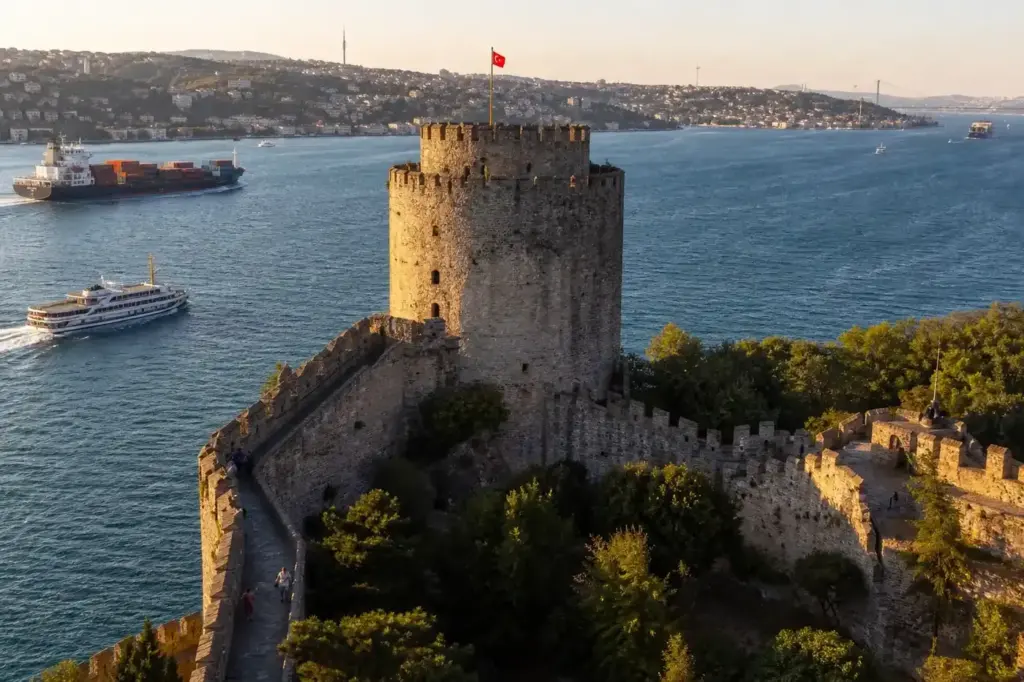
The Anatolian Fortress stands at the narrowest point of the Bosphorus where the Göksu River meets the strait, in Istanbul’s Beykoz district on the Asian shore. Anadolu Hisarı (its Turkish name) was built between 1393 and 1394 by Sultan Bayezid I as part of preparations for an Ottoman siege of Constantinople, then under Byzantine control. It is the oldest surviving Turkish architectural structure in the city.
The fortress originally served as a military stronghold designed with its sister fortress Rumeli Hisarı, built across the strait in 1452, to control maritime movement and protect the Ottoman advance. After the conquest of Constantinople in 1453, it lost its strategic importance but remained a symbol of early Ottoman military architecture. Recent restoration has reopened it as a museum, allowing visitors to climb its walls and discover its layered history.
Current access notice: As of October 2026: The Anatolian Fortress Museum operates with seasonal hours and occasional closures for maintenance. Check the official website before visiting for any updates.
Quick Facts
| Turkish name | Anadolu Hisarı |
|---|---|
| Built / opened | 1393 |
| Architect(s) | Commissioned by Bayezid I |
| Address | Anadolu Hisarı, 34810 Beykoz/İstanbul, Türkiye Google MapsApple MapsYandex Maps |
| District | Beykoz |
| Admission | ₺ |
| Best time to visit | Spring (April–May) and autumn (September–October) offer mild weather and clear visibility across the Bosphorus. Avoid peak summer heat (July–August), when the climb up the tower becomes uncomfortable. Winter (December–February) is mild but can be rainy and cloudy, reducing views. Weekdays are quieter than weekends, and early morning (within 1–2 hours of opening) is recommended to beat crowds and capture best light for photography. Late afternoon (after 16:00) is atmospheric for views but offers less time to explore before closing. |
| Website | ataturkkitapligi.ibb.gov.tr/en/Kitaplik/Muzelerimiz/Anatolian-Fortress-Museum/15 |
What Is (and Isn't) Part of a Visit to Anatolian Fortress?
| Part | Status | Notes |
|---|---|---|
| The fortress itself (tower, walls, courtyard, ramparts) | Included in the standard ticket | All accessible structures within the fortress boundary are included in admission. |
| Museum interpretation and exhibits | Included in the standard ticket | Educational displays about Ottoman history and the fortress's role are part of the site tour. |
| Tower climb | Included in the standard ticket | Visitors may climb the main tower to the top for views; interior stairs are narrow but passable. |
| Rumeli Hisarı (Rumeli Fortress) | Outside / not part of it | The sister fortress on the European shore across the Bosphorus is a separate venue with its own admission; visible from here but not part of this visit. |
| Küçüksu Palace | Outside / not part of it | A nearby Ottoman palace is within walking distance (about 5 minutes north) but is a separate site with independent entry. |
| Waterfront restaurants and cafés | Outside / not part of it | Several restaurants and cafés operate at the water's edge near the fortress but are independent businesses, not part of admission. |
Why Visit Anatolian Fortress?
Climb to the top of the fortress walls for commanding views of the Bosphorus at its narrowest point—a vantage that explains why Bayezid I chose this exact location over 630 years ago. The compact stronghold, with its distinctive main tower and surrounding walls, stands as a tangible example of Ottoman military engineering and early siege strategy.
The site connects directly to a pivotal moment in world history: this fortress and its European counterpart worked together to blockade the strait during the final Ottoman push toward Constantinople. Walking its ramparts brings that history alive, and the waterfront setting offers atmosphere most Istanbul museums cannot match.
How Anatolian Fortress Is Laid Out
The fortress occupies 1.7 acres on a triangular piece of land jutting into the Bosphorus. Entry is from the main courtyard at ground level. At its core stands the main tower (donjon), a four-story square structure originally about 25 meters tall, which can be climbed for views. This is surrounded by an outer wall (the ‘gömlek’ or shirt) that once formed the outer defense. Mehmed II added reinforcing towers during preparations for the final conquest of Constantinople.
The site is compact enough to navigate in an hour, though climbing the tower and exploring the ramparts takes longer. The open courtyard and walls offer multiple vantage points for photography and viewing the strait. A small museum area displays interpretive material about the fortress’s history and role in Ottoman military strategy.
Highlights of Anatolian Fortress
The Main Tower (Donjon)
The fortress's tallest structure, this four-story square tower once stood about 25 meters (82 feet) high. Built with thick stone walls in early Ottoman military style, it served as both a defensive position and a command post overlooking the Bosphorus. Visitors can climb to the top for panoramic views of the strait, modern bridges, and the European shore. Look for the solid stone construction and narrow windows designed for archers.
Tip: Start your visit by climbing the tower first, before the crowds build up; the interior staircase is narrow but manageable.
The Outer Walls and Ramparts
Surrounding the main tower, the outer defensive wall (gömlek) encloses the fortress complex. This 'shirt' of stone once formed the first line of defense. Under Sultan Mehmed II, the fortress was expanded with additional watchtowers and other facilities, and its walls were strengthened. Walking the ramparts gives a sense of the fortress's compact but strategically sound design. The walls frame views through to the water, showing why Ottoman commanders valued this position.
Tip: Walk the entire perimeter if you want to understand the fortress layout; each angle shows a different aspect of its defensive strategy.
Göksu River Meeting Point
Located at the narrowest point of the Bosphorus in Istanbul, where the Göksu River meets the strait, the fortress's position at this natural junction was no accident. The river provided a secondary defense line and gave the site added strategic value. The fortress is situated at the narrowmost point of the Bosporus, where the strait is a mere 660 meters (2,170 ft) wide. Standing at the fortress, you can see directly across to the European shore and understand why controlling this chokepoint mattered.
Tip: Visit in late afternoon when light catches the water and makes the strait views particularly dramatic; the fortress is framed against the late sun.
The Courtyard and Central Space
From a large courtyard in the central area, entry is made to the fortress built by Yıldırım Bayezid. This open space, once bustling with garrison activity, is now where visitors gather and get their bearings. The courtyard gives a sense of how soldiers, officers, and support staff moved through the fortress. Small interpretation boards explain the site's history and Ottoman military strategy.
Tip: The courtyard is the only shaded area on site on hot days; bring water and a hat for climbing the exposed tower.
Views of Rumeli Hisarı and the Strait
Together with the fortress later built across the strait, it formed part of a wider effort to control movement on this crucial waterway. From the Anatolian Fortress ramparts, you can see across the Bosphorus to Rumeli Fortress on the European side. These two fortresses, built half a century apart, form a visual pair that tells the story of Ottoman determination to take Constantinople. The sight of both fortress silhouettes together illustrates the military strategy.
Tip: Visit in clear weather for the best views across the strait; bring binoculars to spot architectural details on Rumeli Hisarı opposite.
Museum Interpretation and Archaeological Context
The historic fortress, restored by Istanbul's Metropolitan Municipality, was opened as the 'Anatolian Fortress Museum' on the centenary of the Republic. The site now includes interpretive displays about the fortress's construction, its role in Ottoman siege strategy, and the broader history of the conquest of Constantinople. Some exhibits explain the archaeological findings and restoration work that brought the structure back to modern use.
Tip: Read the interpretation boards in the courtyard and main tower to understand the military context; without them, the fortress can feel like just an old tower.
Atmosphere
The fortress sits in a remarkably quiet corner of Istanbul, far from the crowded European shore. The Bosphorus waterfront is peaceful, with the constant sound of passing ferries and the lap of water against stone. The site attracts a steady but manageable stream of history enthusiasts, photographers, and locals rather than tour groups. Early morning or late afternoon offers the most serene experience.
Climbing the main tower brings you into intimate contact with 630-year-old stone. The narrow windows frame water and sky. From the top, the site feels both intimate and powerful—you stand where Ottoman sentries once watched for Byzantine ships, now looking at modern container vessels and pleasure boats moving through the same waters. The combination of age and ongoing life on the strait creates a distinct sense of historical continuity.
History of Anatolian Fortress
Anadoluhisarı was built between 1393 and 1394 on the commission of the Ottoman Sultan Bayezid I, as part of his preparations for a siege of the then-Byzantine city of Constantinople. After defeating the Crusader army at the Battle of Nicopolis in 1396, Yıldırım Bayezid turned his attention to Byzantium and began preparations for the siege of Istanbul. The fortress was designed to dominate the Bosphorus’s narrowest point and prevent Byzantine ships from entering the Black Sea. The complex is the oldest surviving Turkish architectural structure built in Istanbul.
The fortress was built under the edict of Bayezid I as an auxiliary structure intended to support the siege of Istanbul, then under Byzantine control. In 1452, Rumeli Fortress was constructed on the opposite shore under the edict of Fatih Sultan Mehmet as reinforcement. The two fortresses created a strategic pair that could effectively close the strait to opposing naval movement. The two fortifications helped significantly in the conquest of Constantinople by the Ottomans in 1453.
After the fall of Constantinople (later renamed Istanbul), Anadolu Hisari was used as a customs house and military prison. The fortress lost its strategic military importance once the Ottomans controlled both shores. However, damage from the great earthquake of 1509 necessitated substantial repairs. Later rulers maintained it as a garrison post and administrative center, though its primary defensive function had ended.
For centuries the fortress remained largely unchanged, becoming one of Istanbul’s oldest surviving Ottoman structures. Following recent restoration efforts, the historic fortress was opened as the ‘Anatolian Fortress Museum’ on the centenary of the Republic, making it accessible to the public for the first time in decades. Today it stands as both a historical monument and an active cultural site hosting exhibitions and events related to Ottoman history.
Legends and Myths about Anatolian Fortress
The Temple of Uranus
Disputed by historians. It was also called Güzelce Fortress (Güzelce Hisar), which literally translates to Beauteous Fortress, and sits on the site of an ancient temple dedicated to Uranus. According to local legend, Ottoman builders deliberately chose this spot not only for its military value but because it held sacred significance from earlier civilizations. Whether Bayezid I consciously selected it for this reason or simply chose the strategic location without knowledge of the ancient temple remains unclear, but the symbolic layering of conquest and construction has long intrigued visitors.
The Narrowest Point Guardian
Legend – historically unreliable. Local tradition holds that the fortress was built at the precise narrowest point of the Bosphorus specifically so that Ottoman cannons could theoretically reach across to the opposite shore—not initially possible with 14th-century artillery, but symbolically representing total control. Some accounts embellish this to claim that Bayezid I personally stood on the Asian shore and pointed to this exact spot as the place where the fortress must rise. The story emphasizes the sultan's strategic vision, though historical records indicate military engineers likely selected the location.
Tickets and Booking for Anatolian Fortress
| Ticket | Price | Includes |
|---|---|---|
| Adult admission (international visitors) | ₺ | Entry to all fortress areas, tower climb, courtyard, ramparts, and museum interpretation. |
| Senior (65+) and children (under 8) | Free | Full access to the fortress and tower. |
₺ budget · ₺₺ moderate · ₺₺₺ upscale · ₺₺₺₺ splurge. Price levels are estimates compared with typical prices for visitors.
The Anatolian Fortress is managed by the Istanbul Metropolitan Municipality and accessed directly at the site; there is no advance online booking system. Admission is paid at the entrance gate in cash (Turkish lira preferred) or card. The site is typically open daily except Mondays.
Same-day entry is available during operating hours. No voucher system or special passes are required for standard admission. Be aware that rates for Turkish citizens are significantly lower than international rates, and various concessions (students, military personnel) may apply; consult the official website for complete categories and current fees.
The fortress is staffed by a small team; during peak tourist hours (mid-morning to mid-afternoon) entry is straightforward, but late afternoon (after 16:30) may see reduced facilities. Check the official Atatürk Library website (the municipal cultural authority managing the site) for current hours, any seasonal changes, and complete ticket information for all categories.
Suggested itineraries Anatolian Fortress
45 minutes
Enter through the courtyard, climb to the top of the main tower for Bosphorus views, walk one circuit of the ramparts, and exit. This covers the key sights without deep historical exploration.
1.5–2 hours
Spend time in the courtyard reading interpretation boards, climb the tower slowly, explore all rampart sections, linger at key viewpoints across the strait toward Rumeli Fortress, and read any museum displays. Photograph from multiple angles.
Half day
Visit the fortress early morning (quieter, better light), then walk north along the waterfront to nearby Küçüksu Palace (5-minute walk), return for lunch at a waterfront restaurant, and spend late afternoon exploring the surrounding neighborhood and marina.
How to Get to Anatolian Fortress
By bus: Bus lines 15 and others serve the Anadolu Hisarı stop on the coastal road (Bosphorus waterfront, Asian side). From central Istanbul (Kadıköy, Uskudar), take any northbound bus marked for Beykoz and ask the driver to stop at Anadolu Hisarı. Journey time is typically 25–40 minutes depending on traffic and starting point.
By ferry: From Uskudar pier on the Asian shore, take a ferry heading north toward Anadolu Kavağı (the final stop on the Bosphorus). Ferries stop at Anadolu Hisarı. The journey is scenic and takes about 20 minutes; ferries run several times daily. Check ferry schedules on the Istanbul ferry authority website before traveling.
By car or taxi: Anadolu Hisarı has a small parking area. Taxis and ride-share apps can bring you to the fortress entrance from anywhere in Istanbul; expect fares comparable to other Bosphorus-side locations on the Asian shore.
From the fortress: Once you arrive, follow signs from the bus stop or ferry pier down to the waterfront; the fortress is visible and sits directly on the Bosphorus coast. Entry is through a gate facing the water.
Accessibility
The fortress has a ground-level entrance and courtyard accessible to wheelchair users and those with limited mobility. However, the main tower climb involves a narrow internal staircase with multiple flights; this is not accessible to wheelchair users or those unable to climb stairs. There are no elevators or accessible routes to the top. Rampart walks are partly accessible at ground level, but many sections involve uneven terrain and steps. Benches are minimal on-site. A companion or assistant may be helpful for visitors with mobility limitations, though no formal companion ticket policy is published. The site's official website should be consulted for any specific accessibility accommodations or services.
Food Nearby
Several seafood restaurants and casual cafés operate along the waterfront immediately adjacent to the fortress, serving fish dishes and Turkish mezze. These are independent businesses, not part of the fortress admission. Fish restaurants located right at the foot of the walls allow you to taste Bosphorus delicacies in the shadow of history. No food vendors operate inside the fortress itself; bring water and snacks if you plan to spend more than an hour on-site. The Anadolu Hisarı neighborhood has a few small shops and markets along the main road (a short walk from the fortress) if you wish to purchase refreshments beforehand.
What to Bring
Wear comfortable walking shoes with good grip; parts of the fortress are uneven and steps are steep. Bring sun protection (hat, sunscreen, sunglasses) as the site offers little shade except in the courtyard. Water is essential—the tower climb and rampart walks can be strenuous, and there are no vendors on-site. Binoculars are useful for viewing details of Rumeli Fortress across the strait and for spotting ships. A camera with a wide-angle lens captures the fortress and Bosphorus setting well. Small bags are permitted; check current security rules at entry.
Best Views and Photo Spots of Anatolian Fortress
Top of the main tower
A panoramic vista of the Bosphorus looking north toward the Black Sea, with Rumeli Fortress visible across the narrowest part of the strait. The modern Fatih Sultan Mehmet Bridge and container ships create a compelling layering of past and present architecture. This is the single best viewpoint for understanding the fortress's strategic location.
Best time: Early morning (golden light, minimal haze) or 30 minutes before sunset (soft warm light on water). Weekdays are clearer than weekends due to less ferry traffic smoke.
Tower base from the courtyard
Framing the main tower's full height against the sky from the courtyard creates a strong vertical composition. The tower's stone construction and narrow windows become clear from this angle. Foreground interest can be added by including courtyard walls or interpretation boards.
Best time: Mid-morning (tower is lit from the front) or late afternoon (side-lit for texture on stone). Weekday mornings are best for composition without crowds.
Rampart looking toward Europe
Walking the rampart wall and looking directly across the strait to Rumeli Fortress creates a symmetrical composition showing both fortresses from the narrowest point. Container ships and ferries passing between them often appear in frame, adding dynamic element.
Best time: Clear days only (haze over the strait ruins the view); late afternoon when European shore gets warmer light. Avoid midday when contrast is harsh.
Waterfront level, fortress reflected
At water level on the rocks below the fortress (if accessible), the structure is reflected in still water, doubling its visual impact. The water frame emphasizes the fortress as a structure rising from the Bosphorus itself, not just sitting on land.
Best time: Very early morning (calm water) or late evening (golden hour light). Requires careful footing on rocks; not suitable for all visitors.
Northeast corner rampart
From this corner, both the main tower and the outer defensive walls are visible in a single frame, giving a sense of the fortress's complete structure. The Göksu River estuary is visible in one direction, open strait in another.
Best time: Afternoon (warm side-lighting) or golden hour (soft light that emphasizes stone texture and age).
Photography Rules
Photography is permitted throughout the fortress courtyard, ramparts, and exterior. Interior photography in any museum displays or enclosed areas may be restricted (check signage on entry). Tripods and drones are not permitted. Flash photography is not needed outside and damages viewing of any interior exhibits. The best light for photography is early morning or late afternoon; midday sun creates harsh shadows on stone walls.
Family Suitability
The fortress is suitable for families with children aged 8 and older who are comfortable with climbing stairs and heights. Younger children may find the tower climb challenging due to narrow spiral stairs and confined space. The courtyard and rampart walks are manageable for most ages. Stroller access is limited to the ground courtyard only; the tower and ramparts are not stroller-accessible. Bring water and snacks for children, as there are no vendors on-site and the experience can be physically demanding. The site has minimal shade and limited seating, so plan for shorter visits with younger children. The views from the tower are dramatic and likely to engage school-age children interested in history, military strategy, or panoramic scenery.
Istanbul Vibes Tips
- Arrive within 1–2 hours of opening (typically 10:00 AM) to beat tour groups and have the ramparts largely to yourself. Mid-morning crowds are manageable but increase significantly after noon.
- Before climbing the tower, read the interpretation boards in the courtyard to understand the fortress's strategic role and what you're seeing across the strait. Context transforms a climb into a lesson in military history.
- If visiting on a hazy day, climb the tower first while visibility is best, then explore ramparts and exhibits if the day clears. Clear views across the strait are essential for understanding the fortress's purpose.
- The waterfront restaurants nearby are tempting but pricier than cafés in the main Anadolu Hisarı neighborhood one block back from the shore. Visit the neighborhood for cheaper food, then return to the fortress or eating overlooking water.
- Combine a visit with nearby Küçüksu Palace (5-minute walk north along the waterfront) to see mid-19th-century Ottoman architecture; the contrast between military and palatial styles enriches both visits. Both can be seen comfortably in a half-day trip.
- Check opening hours before traveling, as the site occasionally closes for maintenance or cultural events. Call ahead or verify the official website if traveling from a distance.
Explore Nearby Anatolian Fortress
Sights near Anatolian Fortress
 Rumeli Fortress – about 950 m away (~16 min walk) · typical visit: 1–2 hours7 min on foot from Aşiyan metro, Open 09:00–17:00, closed Mon
Main image: AI-generated illustration. It may not show the place exactly as it looks.
 Küçüksu Pavilion – about 550 m away (~9 min walk) · typical visit: 1–2 hours13 min on foot from Aşiyan metro
Main image: AI-generated illustration. It may not show the place exactly as it looks.
 Blue Mosque – about 11.4 km away · typical visit: 45–75 minutes3 min on foot from Gülhane metro
Main image: AI-generated illustration. It may not show the place exactly as it looks.
 Hagia Sophia – about 10.9 km away · typical visit: 1–1.5 hours8 min on foot from Gülhane metro, Open daily 09:00–19:30
Main image: AI-generated illustration. It may not show the place exactly as it looks.
 Fatih Sultan Mehmet Bridge – about 1.1 km away (~18 min walk) · typical visit: 30 minutes to 1 hourOpen 24 hours
Main image: AI-generated illustration. It may not show the place exactly as it looks.
 Aşiyan Museum – about 1.1 km away (~18 min walk) · typical visit: 1–1.5 hours3 min on foot from Aşiyan metro, Open 09:00–17:00, closed Mon
Main image: AI-generated illustration. It may not show the place exactly as it looks.
Metro stations near Anatolian Fortress
 Aşiyan – about 1.1 km away (~18 min walk)Open daily 06:00–00:00
Main image: AI-generated illustration. It may not show the place exactly as it looks.
Nightlife near Anatolian Fortress
 Taps Bebek – about 1.4 km away (~22 min walk)4 min on foot from Aşiyan metro
Main image: AI-generated illustration. It may not show the place exactly as it looks.
Related guides
 Üsküdar: The Asian Shore’s Authentic Neighborhoods and Bosphorus Views
Main image: AI-generated illustration. It may not show the place exactly as it looks.
 Lacivert: Bosphorus Seafood Under the Bridge
Main image: AI-generated illustration. It may not show the place exactly as it looks.
 Bayramoğlu Döner: Wood-Fired Döner in Kavacık
Main image: AI-generated illustration. It may not show the place exactly as it looks.
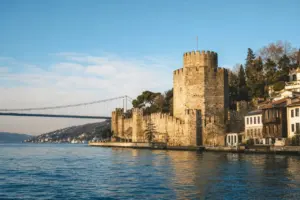 Anadolu Hisarı: Ottoman Fortress and Waterfront Landmark
Main image: AI-generated illustration. It may not show the place exactly as it looks.
 Beykoz Mecidiye Pavilion: Ottoman Summer Retreat and MuseumOpen 09:00–17:00, closed Mon
Main image: AI-generated illustration. It may not show the place exactly as it looks.
Browse more: More in Beykoz · All Landmarks · All Sightseeing
FAQ: Anatolian Fortress
Is the Anatolian Fortress free to enter?
No, entry is paid for international visitors but free for seniors 65 and older and children under 8. Turkish citizens pay a significantly lower rate. As of October 2026, check the official Atatürk Library website for current prices and any changes.
Can I climb to the top of the tower?
Yes, visitors may climb the main tower to its top for panoramic views of the Bosphorus. The internal staircase is narrow and involves multiple flights; it is not accessible to wheelchair users or those unable to climb stairs. The climb takes about 5–10 minutes depending on fitness and pace.
What is the difference between the Anatolian Fortress and Rumeli Fortress?
Both are Ottoman fortresses built to control the Bosphorus strait. Anatolian Fortress (this site) was built first by Bayezid I in 1393–1394 on the Asian shore. Rumeli Fortress was built 60 years later by Mehmed II on the European shore directly opposite. Together they formed a strategic pair that could blockade the strait. Rumeli Fortress is larger and requires separate admission.
How long should I spend here?
A quick visit (tower and ramparts) takes 45 minutes. A more thorough visit (including interpretation and multiple viewpoints) takes 1.5–2 hours. If combining with nearby Küçüksu Palace and lunch, plan a half-day.
Is this the oldest Ottoman building in Istanbul?
Yes, the Anatolian Fortress is the oldest surviving Turkish architectural structure in the city, built in 1393–1394. It predates all other major Ottoman monuments in Istanbul by several decades.
Can I take photographs inside?
Yes, photography is permitted throughout the fortress, ramparts, and courtyard. Tripods and drones are not allowed. Flash is not needed outside. Check on entry for any restrictions on photographing museum displays.
Is the fortress accessible for people with mobility issues?
The courtyard is wheelchair-accessible, but the main tower climb is not. Rampart walks are partly accessible at ground level but involve uneven terrain and some steps. The site offers minimal shade and seating. Those with mobility limitations should verify specific accessibility before visiting.
What is the best time to visit?
Spring (April–May) and autumn (September–October) offer pleasant weather and clear visibility. Weekday mornings are quieter. Summer is hot and crowded; winter can be rainy. Early morning (within 1–2 hours of opening) is recommended for fewer crowds and better light for photography.
Istanbul Vibes is a one-person project. A coffee keeps it going
Hotels near Anatolian Fortress
Restaurants near Anatolian Fortress
- BigChefs (100 m) Google Maps
- Kıyı Emniyeti Tesisi (150 m) Google Maps
Distances are straight-line, from OpenStreetMap data.

Take this guide with you
Get a free PDF of this guide to print or read offline: key facts, tips and a map link on a few clean pages.
Report an issue on this page
How we research and update our guides
About this guide: AI assistance and accuracy
This guide is created with the help of AI and is based on official sources where available. Mistakes can still happen. Opening hours, prices, rules and other details are given to the best of our knowledge as of the date shown and can change without notice. It offers general recommendations only, not professional, legal or travel advice. Please confirm important details with the official source before you travel; you are responsible for your own plans and decisions.
* Affiliate link: as an Amazon Associate we earn from qualifying purchases at no extra cost to you.
