
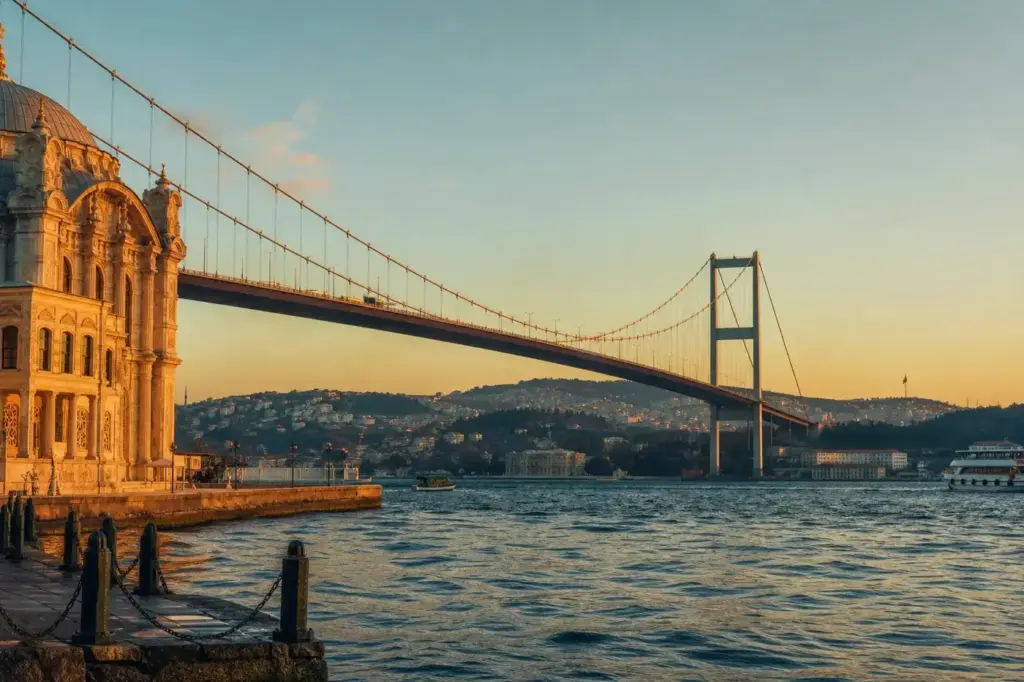
The Bosphorus Bridge, officially the 15 July Martyrs Bridge and known colloquially as the First Bridge, is Istanbul’s most iconic engineering feat. Opened on 30 October 1973—deliberately timed to mark the Turkish Republic’s 50th anniversary—it stretches 1,560 metres across the Bosphorus Strait, connecting the European district of Beşiktaş (Ortaköy) with the Asian side at Beylerbeyi in Üsküdar.
Though you cannot walk across it (except during the annual Istanbul Marathon), the bridge dominates Istanbul’s skyline and remains central to the city’s identity as a place where Europe and Asia literally meet. Designed by British engineers who had previously worked on Wales’s Severn Bridge, it carries around 200,000 vehicles daily and remains one of the longest suspension bridge spans ever built outside the United States.
Quick Facts
| Turkish name | 15 Temmuz Şehitler Köprüsü |
|---|---|
| Built / opened | 1973 |
| Architect(s) | Gilbert Roberts, William Brown, Michael Parsons (Freeman Fox & Partners) |
| Address | Istanbul Çevre Yolu, Istanbul, Turkey Google MapsApple MapsYandex Maps |
| Metro | Boğaziçi Üniversitesi (M6, Northern exit for European side viewpoints) |
| Admission | Free (viewing from public areas); toll applies for vehicles crossing only |
| Best time to visit | Late afternoon and early evening, when the light is golden and the bridge's evening illumination begins. Weekdays are quieter than weekends on the waterfront promenades. Summer and autumn offer clear skies and extended daylight; winter can bring fog that obscures the bridge. The Istanbul Marathon in early November offers a unique daytime experience if you are a participant. Avoid midday rush hour if you plan to cross the bridge by car or ferry, as congestion is severe. |
What Is (and Isn't) Part of a Visit to Bosphorus Bridge?
| Part | Status | Notes |
|---|---|---|
| The bridge roadway (vehicle passage) | Not open to visitors | Open to private cars, taxis, and coaches only; no pedestrians except during the Istanbul Marathon; a toll applies to vehicles crossing from Europe to Asia (toll is charged electronically via HGS system; no cash payment). |
| Pedestrian access | Not open to visitors | Banned since 1978 except during the annual Istanbul Marathon in early November, when the bridge closes to traffic and opens to registered marathon runners and walkers. |
| Public viewpoints from the shore | Included in the standard ticket | The bridge is free to view and photograph from the Ortaköy waterfront on the European side and the Beylerbeyi waterfront on the Asian side. |
| View from Bosphorus ferries | Included in the standard ticket | Regular passenger ferries from Eminönü to Üsküdar and Kadıköy pass directly beneath the bridge; these cost only the standard ferry fare (₺ to ₺₺ depending on time and direction). |
| Fatih Sultan Mehmet Bridge (Second Bridge) | Outside / not part of it | A separate bridge 15 km north, opened in 1988; also off-limits to pedestrians during normal operation. |
| Yavuz Sultan Selim Bridge (Third Bridge) | Outside / not part of it | Another separate bridge 40 km north, opened in 2016; also restricted to vehicles except during special events. |
Why Visit Bosphorus Bridge?
The bridge matters not as a tourist ticket but as an essential way to understand Istanbul’s geography and symbolism. It is the physical embodiment of the city’s dual identity. From Ortaköy on the European shore and from the Asian waterfront at Beylerbeyi, you can stand directly beneath its towers and feel the scale of its engineering: the main span of 1,074 metres and pillars 165 metres high. Ferries passing beneath offer another vantage point. Photography is popular from the embankments on both sides, especially at sunset when the bridge lights up and the traffic creates flowing ribbons of light.
Highlights of Bosphorus Bridge
The Main Suspension Span
The bridge's most striking feature is its central span of 1,074 metres, which at completion in 1973 was the fourth-longest suspension bridge span in the world and the longest outside the United States. The two main towers rise 165 metres above water level. When the bridge is fully loaded with traffic, the deck sags visibly in the middle—about 90 centimetres—an intentional engineering feature that absorbs the load.
Tip: View the towers from below on the Ortaköy or Beylerbeyi waterfront to grasp their true height.
Night Illumination
After dark, the bridge transforms into a glowing landmark. Its cables and towers are lit in white, creating a ethereal vision that can be seen from much of Istanbul's northern shore. The effect is particularly striking during evening ferries and from the waterfront promenades on both sides.
Tip: Sunset and early evening offer the best light for photographs, as the last daylight lingers in the sky behind the illuminated structure.
Ortaköy Waterfront (European Side)
The neighbourhood directly beneath the bridge's European tower is one of Istanbul's liveliest waterfront areas. Ortaköy's small mosque, restaurants, and waterfront promenade sit in the bridge's shadow. The view of the bridge from the water here is dramatic and unobstructed, making it a favorite vantage point for photographers and sunset watchers.
Tip: Arrive early on weekends or visit on a weekday to avoid crowds at the waterfront cafés.
Beylerbeyi Harbour (Asian Side)
The Asian side is quieter and less touristy than Ortaköy. The small harbor here offers views upriver to the bridge's Asian tower and tower foundations. It is a working waterfront with fishing boats and local atmosphere, providing a less crowded perspective on the structure.
Tip: The Asian side is easier to reach by ferry from Eminönü; take time to walk the waterfront after crossing.
Bosphorus Ferries Beneath the Bridge
Regular ferries from Eminönü (European side) to Üsküdar and Kadıköy (both Asian side) pass directly beneath the bridge. These cruises, which cost only the standard ferry fare and take about 15–20 minutes, offer an unparalleled view of the bridge's underside, the engineering of its deck and cables, and its relationship to the wider Bosphorus landscape.
Tip: Board a ferry in late afternoon; you'll pass under the bridge with good light and can see the city skyline developing behind it.
Bridge Lighting at Night
The bridge is illuminated every evening, with white lights tracing the cables and towers. The lighting is neither gaudy nor understated, and transforms the entire waterfront's atmosphere after dark. The effect ripples across the water and becomes a focal point of evening walks on both shores.
Tip: The bridge's lights are most visible and photogenic around 30 minutes after sunset, when the sky still holds color but the lights stand out.
The Istanbul Marathon Crossing (November)
Once a year, during the Istanbul Eurasia Marathon held in early November, the bridge closes to all traffic and opens to thousands of runners and walkers. Participants run from Asia to Europe across the bridge—the only time pedestrians are officially permitted. This transforms the bridge from a traffic-choked motorway into a communal space and creates an extraordinary atmosphere.
Tip: Entry requires advance registration through the marathon's official website. Check dates and registration details as they vary year to year.
Atmosphere
The Bosphorus Bridge is above all a working motorway, and that reality shapes the experience. It thrums with traffic from early morning until late at night. From the waterfront, you hear the constant low roar of engines and the hiss of tires on the roadway 64 metres above. The bridge is never quiet.
Yet there is beauty in that vitality. Rush hour transforms the bridge into rivers of headlights and taillights flowing in opposite directions. The structure frames views of the wider Bosphorus, the European hills to the north, and the Asian shore. At night, when the city lights come on and the bridge glows white, the waterfront becomes contemplative. Photographers, locals on evening walks, and tourists gather on both shores to absorb the view. The bridge is a symbol first and a bridge second—it is as much part of Istanbul’s sense of itself as it is a piece of infrastructure.
History of Bosphorus Bridge
The idea of spanning the Bosphorus dates back centuries. Ottoman sultans and later entrepreneurs imagined fixed crossings, but the engineering challenge and cost were insurmountable until the 20th century. In the 1930s, entrepreneur Nuri Demirağ proposed a suspension bridge similar to the Golden Gate Bridge in San Francisco, to be built between Ahırkapı and Salacak. The scheme met early opposition, citing insufficient traffic to justify the expense.
The decisive decision came in 1957 under Prime Minister Adnan Menderes, who ordered a bridge to be built across the Bosphorus. The British engineering firm Freeman Fox & Partners, which had designed Wales’s Severn Bridge, was chosen to lead the design. The project was assigned to a consortium including the Turkish firm Enka Construction & Industry, Germany’s Hochtief, and Britain’s Cleveland Bridge & Engineering Company.
Construction began on 20 February 1970. The work was intense and complex: the bridge had to withstand not only the weight of traffic but also the seismic forces from Turkey’s location on major fault lines. Engineers designed the towers and foundations to absorb lateral movement. On 1 June 1973, construction was formally completed, and the bridge opened to traffic on 30 October 1973—deliberately one day after the 50th anniversary of the Turkish Republic’s founding. The bridge opened with an official ceremony.
For its first four years, pedestrians could walk across the bridge using lifts inside the towers to reach the deck. But as Istanbul’s traffic exploded and lanes became gridlocked, the weight and volume of vehicles made the bridge increasingly hazardous for pedestrians. In 1978, pedestrian access was banned for safety reasons. Since then, only vehicles have crossed—except once a year, when the annual Istanbul Marathon closes the bridge to cars and opens it to thousands of runners and walkers.
The bridge is also known by its official name, the 15 July Martyrs Bridge. Before that, it was simply the Bosphorus Bridge or, colloquially, the First Bridge (Birinci Köprü), to distinguish it from the Second Bridge (Fatih Sultan Mehmet Bridge, opened 1988) and the Third Bridge (Yavuz Sultan Selim Bridge, opened 2016).
Legends and Myths about Bosphorus Bridge
Leonardo da Vinci's Proposal
Legend – historically unreliable. It is said that Leonardo da Vinci, the Italian Renaissance genius, sent a letter to Ottoman Sultan Bayezid II around 1502 proposing the construction of a bridge across either the Golden Horn or the Bosphorus. The story reflects the long historical appetite for a fixed crossing and da Vinci's restless imagination. No evidence suggests the letter was taken seriously at the time.
The Bridge Built in Exactly 1,260 Days
Disputed by historians. Some accounts describe the bridge's construction as having taken exactly 1,260 days (from early 1970 to mid-1973), lending a neat mathematical quality to the feat. While the dates are close to accurate, the symbolism is often overstated in retellings, and the complexity of the project was far greater than any simple timeline can capture.
Tickets and Booking for Bosphorus Bridge
There are no tickets for viewing the bridge from public areas. The bridge itself is a working motorway and not a ticketed tourist attraction. To cross the bridge by car, a toll is charged electronically only: there are no toll booths or barriers. Vehicles with Turkish license plates have a toll transponder (HGS) installed. Foreign-registered vehicles must have an HGS account opened in advance (at Turkish border crossings or at PTT post offices). The toll is charged by automatic number-plate recognition as you pass through the toll zone on the Asian side. Check the official General Directorate of Highways (Karayolları Genel Müdürlüğü) website for current rates and payment details.
To walk on the bridge, the only official opportunity is during the Istanbul Marathon, held annually in early November. Entry to the marathon requires advance registration through the marathon’s official website and a runner’s bib. Pedestrian access is strictly controlled and is not available on any other day.
Suggested itineraries Bosphorus Bridge
1 hour
Walk to Ortaköy waterfront on the European side (accessible by metro M6 to Boğaziçi Üniversitesi station, then a 10-minute walk downhill, or by taxi). Spend 30 minutes viewing the bridge from directly beneath the European tower, then visit the waterfront mosque and cafés. Photograph from multiple angles as light changes.
2 hours
Take a ferry from Eminönü to Üsküdar (15–20 minutes; ₺ to ₺₺). The ferry passes directly beneath the bridge—an unobstructed view of the underside and engineering. Once in Üsküdar, walk to Beylerbeyi harbour (20 minutes) for views from the Asian side. Return by ferry if time permits.
Half day
Combine both shores. Start at Ortaköy (metro or taxi), spend 45 minutes there, then take a taxi across the bridge (tollable for passengers in a car with a transponder; otherwise negotiate a fare) to Beylerbeyi, where you can walk for 30 minutes along the waterfront. Finish with a ferry back to Eminönü at sunset, which will be a farewell view of the illuminated bridge.
November (Marathon Day)
If visiting during the Istanbul Marathon (early November), register in advance to run or walk the bridge. The experience of being on the roadway itself—the only time pedestrians can be there—is unique. Expect crowds, early starts, and a festive atmosphere. Check the marathon's official website for that year's date and registration details.
How to Get to Bosphorus Bridge
By Metro: The nearest metro station is Boğaziçi Üniversitesi on the M6 line (also served by funicular F4 to Aşiyan). From the station, exit northbound and walk downhill towards the Bosphorus for about 10 minutes to reach the Ortaköy waterfront and a direct view of the European tower and bridge.
To Ortaköy (European Side): Take a taxi directly to Ortaköy waterfront, or use the metro as described above. The neighbourhood sits directly beneath the bridge’s European tower.
To Beylerbeyi (Asian Side): Take a ferry from Eminönü (European side, near the Galata Bridge) to Üsküdar. Ferries run every 10–15 minutes and cost ₺ to ₺₺. Once in Üsküdar, walk north along the waterfront for about 20 minutes to Beylerbeyi Harbour, which sits directly beneath the bridge’s Asian tower. Alternatively, take a taxi across the bridge itself (but you will be charged the toll).
Photography Note: Stopping on the bridge roadway to take photographs is forbidden and monitored by camera. All viewing and photography must be from public waterfront areas on either shore or from a ferry passing beneath.
Accessibility
The waterfront promenades on both the Ortaköy (European) and Beylerbeyi (Asian) sides are largely flat and accessible for wheelchair users, though some areas have uneven paving. The Boğaziçi Üniversitesi metro station is accessible with a lift. Ferries have accessibility features for boarding; check with the operator. The bridge roadway itself is not accessible to pedestrians under any circumstances except the Istanbul Marathon. Benches are available on both waterfronts for resting.
Food Nearby
Ortaköy has numerous waterfront restaurants and cafés ranging from budget to upscale (₺ to ₺₺₺), offering Turkish cuisine, kebabs, and seafood with views of the bridge. Beylerbeyi on the Asian side has fewer but authentic local eateries (₺ to ₺₺). Ferries are a quick 15–20 minutes, so you can eat before or after travelling; Eminönü near the ferry terminal has bakeries and street food stalls.
What to Bring
A camera or smartphone for photography; the bridge is a photographer's favourite subject. Wear comfortable walking shoes if you plan to explore the waterfronts on either side. Bring sun protection in summer; there is limited shade on the waterfront promenades. In winter, a light jacket is advisable, as wind off the Bosphorus can be sharp.
Best Views and Photo Spots of Bosphorus Bridge
Ortaköy Waterfront Promenade (European Side)
Direct view of the bridge's European tower rising above you, with the roadway stretching across to the Asian shore. The small mosque in Ortaköy sits in the bridge's shadow, creating a layered composition. Evening light catches the water and reflects off the bridge's steel.
Best time: Late afternoon; arrive 30–60 minutes before sunset for golden light and the transition to illumination.
Beylerbeyi Harbour (Asian Side)
The bridge recedes into the distance, showing its full span across the strait. The quieter, less crowded perspective from this fishing harbour is often preferred by serious photographers. The bridge is backlit by the western sky at sunset.
Best time: Sunset for backlighting and clear water reflections; weekday mornings for solitude.
Ferry Deck (Eminönü to Üsküdar crossing)
As the ferry approaches the bridge, the massive underside of the deck comes into view, revealing the cable systems, towers, and engineering. The perspective shows the bridge's scale relative to the ferry and the water. The sun is often behind you, illuminating the bridge clearly.
Best time: Late afternoon or early evening crossing; light is warm and the bridge is about to illuminate.
Ortaköy Mosque Courtyard
The small white mosque frames the bridge in the background, with the bridge appearing to rise directly above its minaret. This composition juxtaposes Ottoman religious architecture with modern engineering.
Best time: Golden hour (late afternoon), when warm light fills the courtyard and silhouettes the bridge.
Asphalt Path Along Beylerbeyi Waterfront
A wide-angle view from the walking path on the Asian side shows the entire bridge span, the European hills beyond, and the boats in the harbour. The foreground includes local boats and fishermen, adding human scale.
Best time: Morning light for clarity; overcast days reduce glare off the water.
Photography Rules
Photography is permitted from all public waterfront areas and from ferries. Tripods and drones are not allowed. Flash is not restricted. Stopping on the bridge roadway to photograph is strictly forbidden and monitored by camera; all photography of the bridge itself must be from the water or shore. The best light for photography is the hour before sunset, when the sky is warm and the bridge's lighting is beginning to glow.
Family Suitability
The bridge itself is not suitable for families who want to walk across it, as pedestrian access is prohibited. However, viewing the bridge from the Ortaköy and Beylerbeyi waterfronts is family-friendly and free. Young children enjoy the ferry ride beneath the bridge (15–20 minutes from Eminönü), which is an engaging, low-cost experience. Strollers can navigate the waterfront promenades on both sides, though some paving is uneven. The Ortaköy area has cafés where families can sit and watch the bridge. The Istanbul Marathon (November) is open to families; children and adults can walk or run across the bridge together, though registration is required.
Istanbul Vibes Tips
- The bridge is a motorway, not a tourist sight with operating hours. It functions 24/7, but the best experience for viewing and photography is late afternoon through early evening, when light is warm and the bridge begins to illuminate. Midday offers harsh light and crowds on the waterfront.
- Do not attempt to walk or cycle onto the bridge except during the Istanbul Marathon. The rule is strictly enforced, and you risk fines or police involvement. The same views and a better experience are available from the waterfront, ferries, and promenades.
- Ferries are dramatically cheaper than taxis or driving across and offer an unobstructed view of the bridge's underside. A ferry ride costs ₺ to ₺₺; a taxi crossing or a vehicle toll costs significantly more and gives you a view only of traffic ahead.
- Avoid the bridge area during morning rush hour (7–9 a.m.) and evening rush hour (5–7 p.m.) if driving. Traffic is severe and congestion can trap you for hours. Locals often take ferries or use the Marmaray tunnel during peak times.
- The Istanbul Marathon in early November is the only chance to walk or run the bridge itself as a pedestrian. If you want this unique experience, plan ahead: registration typically opens weeks in advance and slots can fill quickly. Check the official marathon website for that year's date.
- The bridge is especially striking at night when illuminated. If you are staying in central Istanbul, an evening walk to either waterfront to see the lit bridge is worthwhile and costs nothing. The walk from central Ortaköy (where there are restaurants and shops) to the waterfront beneath the bridge takes 10 minutes.
Explore Nearby Bosphorus Bridge
Sights near Bosphorus Bridge
 Beylerbeyi Palace – about 550 m away (~9 min walk) · typical visit: 1–1.5 hoursOpen 09:00–17:00, closed Mon
Main image: AI-generated illustration. It may not show the place exactly as it looks.
 Ortaköy Mosqueabout 650 m away (~11 min walk) · typical visit: 30–60 minutes
Main image: AI-generated illustration. It may not show the place exactly as it looks.
 Ortaköy Waterfront – about 950 m away (~16 min walk) · typical visit: 2–3 hoursOpen 24 hours
Main image: AI-generated illustration. It may not show the place exactly as it looks.
 Küçük Mecidiye Mosqueabout 1.5 km away (~24 min walk) · typical visit: 20–30 minutes
Main image: AI-generated illustration. It may not show the place exactly as it looks.
 Ulus Park – about 1.6 km away (~26 min walk) · typical visit: 1–2 hours14 min on foot from Yıldız metro, Open 24 hours
Main image: AI-generated illustration. It may not show the place exactly as it looks.
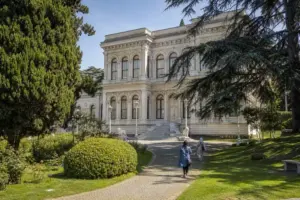 Yıldız Palace – about 1.6 km away (~26 min walk) · typical visit: 2–3 hours13 min on foot from Yıldız metro, Open 09:00–17:00, closed Mon
Main image: AI-generated illustration. It may not show the place exactly as it looks.
Metro stations near Bosphorus Bridge
 Boğaziçi Üniversitesi – about 4.5 km awayOpen daily 06:00–00:00
Main image: AI-generated illustration. It may not show the place exactly as it looks.
Nightlife near Bosphorus Bridge
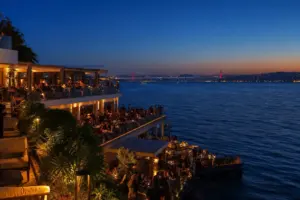 Oligark Istanbul – about 1.2 km away (~20 min walk)Open daily 10:00–04:00
Main image: AI-generated illustration. It may not show the place exactly as it looks.
Related guides
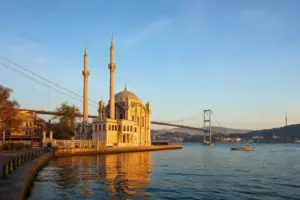 Ortaköy and Beşiktaş Walk: Waterfront Mosques, Street Food and Local Life
Main image: AI-generated illustration. It may not show the place exactly as it looks.
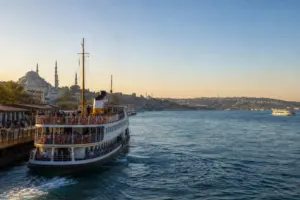 Bosphorus Cruises and Ferry Routes: Routes, Schedules and How to Book
Main image: AI-generated illustration. It may not show the place exactly as it looks.
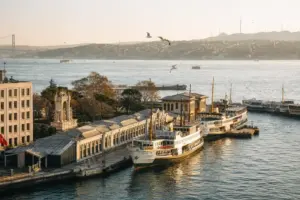 Beşiktaş: Ottoman Palaces, Waterfront Neighborhoods, and Istanbul’s Bosphorus Heart
Main image: AI-generated illustration. It may not show the place exactly as it looks.
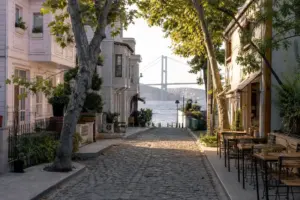 Kuzguncuk: A Quiet Wooden-House Village on the Bosphorus
Main image: AI-generated illustration. It may not show the place exactly as it looks.
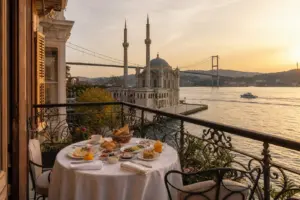 The Stay Bosphorus: A Mansion Hotel in Ortaköy
Main image: AI-generated illustration. It may not show the place exactly as it looks.
Browse more: All Landmarks · All Sightseeing
FAQ: Bosphorus Bridge
Can I walk across the Bosphorus Bridge?
No, pedestrian access has been banned since 1978 for safety reasons due to heavy traffic. The only exception is during the annual Istanbul Marathon in early November. During the marathon, the bridge closes to vehicles and opens exclusively to registered marathon participants (runners and walkers). You must register in advance through the marathon's official website.
Is there a fee to view the bridge?
No. Viewing the bridge from public waterfront areas is free. A toll applies only if you drive a vehicle across the bridge from Europe to Asia; the toll is charged electronically and cannot be paid in cash.
What is the best way to see the bridge if I can't walk across it?
Take a ferry from Eminönü to Üsküdar or Kadıköy. The ferry passes directly beneath the bridge for an unobstructed view of its underside and engineering. The journey takes 15–20 minutes and costs ₺ to ₺₺. Alternatively, walk along the Ortaköy waterfront (European side) or the Beylerbeyi waterfront (Asian side) for views from the shore.
How do I get to the bridge area by public transport?
The nearest metro station is Boğaziçi Üniversitesi on the M6 line. From there, walk downhill towards the Bosphorus (about 10 minutes) to reach Ortaköy and the European tower. For the Asian side, take a ferry from Eminönü to Üsküdar, then walk north for 20 minutes to Beylerbeyi Harbour. Ferries run every 10–15 minutes.
When was the bridge built, and who designed it?
Construction began on 20 February 1970 and was completed on 30 October 1973. The bridge was designed by British engineers Gilbert Roberts and William Brown of Freeman Fox & Partners, who had previously designed Wales's Severn Bridge. It was built by a consortium including Turkish, British, and German companies.
Why was pedestrian access to the bridge banned?
Pedestrian access was banned in 1978 because traffic volume had increased dramatically, making the bridge unsafe for foot traffic. The bridge now carries around 200,000 vehicles daily, and lanes are often gridlocked during rush hours. Only during the Istanbul Marathon is it closed to vehicles and opened to pedestrians.
Can I drive across the bridge if I'm not a resident of Istanbul?
Yes, but you must have an electronic toll payment system set up. Foreign-registered vehicles must open an HGS (highway toll) account before or at the Turkish border, or at a PTT post office. The toll is charged as you pass through the toll zone on the Asian side. Cash payment is not accepted.
Is there parking near the bridge for viewing and photography?
Street parking is available on the Ortaköy waterfront (European side), though it can be difficult during weekends and peak hours. There are no dedicated parking areas for bridge viewing. Paid car parks exist in Ortaköy. The best approach is to use public transport (metro and ferry) rather than drive.
Istanbul Vibes is a one-person project. A coffee keeps it going
Hotels near Bosphorus Bridge
- Beylerbeyi Polisevi (750 m) Check prices (affiliate link, opens in a new tab)
Affiliate link (opens the booking site): we may earn a commission at no extra cost to you.
Restaurants near Bosphorus Bridge
- İstanbul Emniyet Müdürlüğü Polis Evi Ortaköy Sosyal Tesisleri (650 m) Google Maps
- Kırçiçeği (700 m) Google Maps
- Golden Kebap (750 m) Google Maps
- Cengelköy Börekcisi (800 m) Google Maps
Distances are straight-line, from OpenStreetMap data.

Take this guide with you
Get a free PDF of this guide to print or read offline: key facts, tips and a map link on a few clean pages.
Report an issue on this page
How we research and update our guides
About this guide: AI assistance and accuracy
This guide is created with the help of AI and is based on official sources where available. Mistakes can still happen. Opening hours, prices, rules and other details are given to the best of our knowledge as of the date shown and can change without notice. It offers general recommendations only, not professional, legal or travel advice. Please confirm important details with the official source before you travel; you are responsible for your own plans and decisions.
* Affiliate link: as an Amazon Associate we earn from qualifying purchases at no extra cost to you.
