
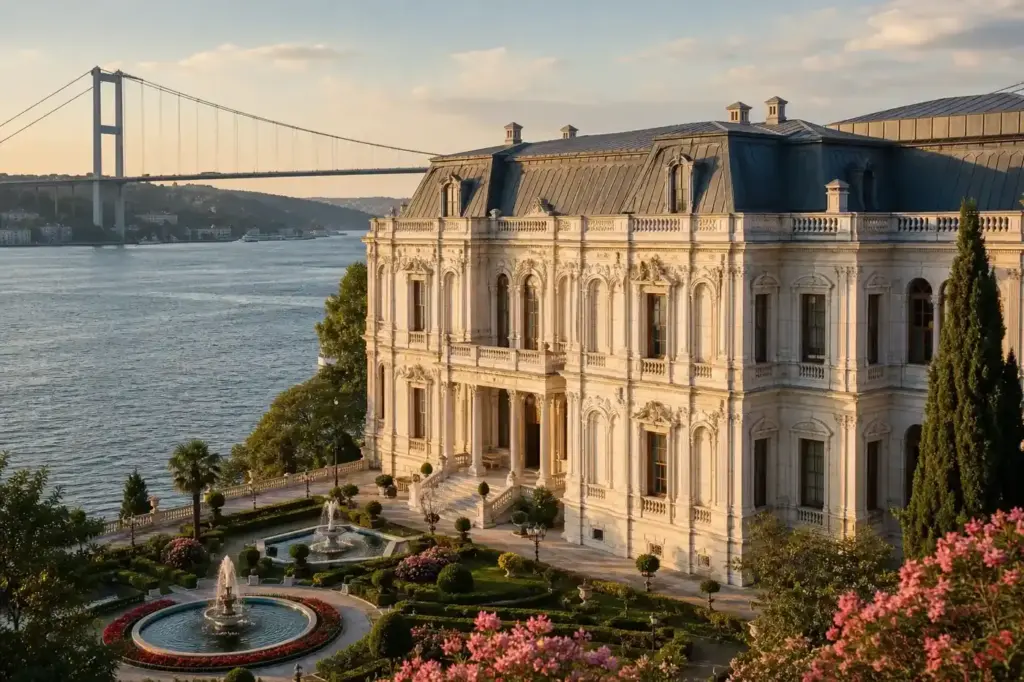
Beylerbeyi Palace is a magnificent Ottoman imperial summer residence built between 1861 and 1865 by Sultan Abdülaziz, designed by Armenian architects Agop and Sarkis Balyan. Unlike the grand, crowded Dolmabahçe on the European shore, this palace offers a quieter, more intimate glimpse into late Ottoman court life on the Asian side of the Bosphorus.
The palace features 26 rooms and 6 grand halls, blending Western neoclassical architecture with traditional Ottoman design. Empress Eugénie of France visited Beylerbeyi on her way to the opening of the Suez Canal in 1869. It opened to the public as a museum in 1984.
Quick Facts
| Turkish name | Beylerbeyi Sarayı |
|---|---|
| Built / opened | 1865 |
| Architect(s) | Agop Balyan and Sarkis Balyan |
| Address | Beylerbeyi, Abdullahağa Caddesi, 34676 Üsküdar, İstanbul Google MapsApple MapsYandex Maps |
| District | Üsküdar |
| Admission | ₺₺ |
| Best time to visit | Spring (April–May) and early autumn (September–October) offer mild weather and golden-hour light without summer crowds. Summer (June–August) brings peak tourism, especially weekends; arrive before 10:00 AM to avoid crowds. Winter (November–February) is quiet but cool; bring a jacket. Avoid Monday (closed) and midday when shadows are harsh indoors. The Bosphorus light is best in late afternoon, reflecting off the water and marble façade. |
| Website | millisaraylar.gov.tr/Lokasyon/4/Beylerbeyi-Sarayi |
What Is (and Isn't) Part of a Visit to Beylerbeyi Palace?
| Part | Status | Notes |
|---|---|---|
| Main palace building, state halls, and harem quarters | Included in the standard ticket | One ticket covers the entire interior, including reception halls, imperial apartments, and private quarters. |
| Palace gardens and waterfront | Included in the standard ticket | Landscaped grounds, terraces, and pavilions on the Bosphorus shore are accessible with the main ticket. |
| Turkish bath (hamam) | Included in the standard ticket | The palace's private hamam is on view as part of the interior tour, though no longer in use. |
| Museum Pass Istanbul | Included in the standard ticket | The Museum Pass Istanbul is accepted at Beylerbeyi Palace. |
| Küçüksu Pavilion | Separate ticket or institution | This hunting lodge a short distance up the same shore requires a separate ticket; it is a smaller, jewel-box alternative experience. |
| 15 July Martyrs Bridge (formerly Bosphorus Bridge) | Outside / not part of it | The bridge that runs above the palace is not part of the palace site; it is a roadway and cannot be toured. |
Why Visit Beylerbeyi Palace?
Built as an Ottoman summer palace and later used as a state guest residence, it stands out for its waterfront setting, refined interiors, and gardens. It is smaller, calmer, and far less queued than Dolmabahçe. The neo-Baroque style palace holds 24 rooms, 6 halls, and one Turkish bath. The opulence of the white marble exterior is matched by the lavish interior, which features French clocks, Bohemian crystal chandeliers, and porcelain vases.
How Beylerbeyi Palace Is Laid Out
The palace sits on a single level overlooking the Bosphorus, with reception halls and ceremonial spaces on the seaward side. The main entrance opens to a foyer and grand halls; the harem (women’s quarters) and selamlık (state apartments) branch off the central reception area. The downstairs hall features a large marble pool, used to cool off during balmy summer months. There are several pavilions and a charming garden café. Gardens extend along the waterfront and behind the main building. The route is self-guided; start at the grand halls, move through the state apartments, then explore the harem quarters and gardens at leisure.
Highlights of Beylerbeyi Palace
The Blue Hall (Mavi Salon)
The iconic Mavi Salon, adorned with turquoise walls and a magnificent crystal chandelier, served as the palace's grandest reception space. This is the first major hall most visitors see after entering. The turquoise colour and gilded ceiling are unmistakable. The chandelier catches light from the Bosphorus views on three sides.
Tip: Arrive in late morning when light floods through the tall windows without casting harsh shadows on the walls and furnishings.
Central Marble Staircase
The elaborate twisting central staircase is another impressive sight. The staircase connects the main halls and harem quarters, its ornate ironwork and curved design a showcase of the architects' skill. Each step draws the eye upward to the upper gallery.
Tip: Look up from the landing to see how the staircase branches and how the light drops from skylights above.
The Harem Quarters
The private quarters of the imperial family feature exquisitely decorated rooms with stained glass windows, silk curtains, and intricate woodwork. The rooms are smaller and more intimate than the state halls, with personal touches including furniture carved by Sultan Abdülhamid II during his imprisonment here.
Tip: Notice the different color schemes and wall treatments in each room—each was decorated for a specific family member.
Nautical Paintings and Maritime Theme
A nautical theme represented in paintings hung throughout the palace reflects the sultan's interest in maritime pursuits. Since Sultan Abdülaziz was very fond of the sea and ships, there are many ship paintings to be observed throughout the palace. The paintings are mostly in the state apartments and hallways.
Tip: Look at the detail in the ships themselves—some paintings show Ottoman navy vessels, others European trading ships, reflecting the sultan's strategic interests.
The Bosphorus Waterfront and Gardens
The palace sits directly beneath the 15 July Martyrs Bridge, right on the waterfront of the Bosphorus Strait. The gardens slope toward the water, and the palace is designed with windows and terraces oriented to the view. The Küçüksu Pavilion—a jewel-box hunting lodge a short ride up the same shore—makes the natural double bill; the two together are the Asian Bosphorus's best quiet day.
Tip: Exit to the gardens in the late afternoon when the angle of sunlight hits the marble façade and the bridge creates dramatic shadows.
Reception Halls with Chandeliers
Beyond the Blue Hall, the palace contains several state reception rooms featuring Bohemian crystal chandeliers, French furniture, and gilt mirrors that reflect views of the Bosphorus. Each hall is scaled for different ceremonial purposes—some for formal dinners, others for smaller audiences.
Tip: Stand in the center of each hall and look up to appreciate how the chandeliers cast light across the ceilings and walls; photography from low angles works well here.
Atmosphere
Beylerbeyi Palace is one of the most elegant imperial residences on Istanbul’s Asian side, located in Üsküdar with a commanding view of the Bosphorus, built as an Ottoman summer palace and later used as a state guest residence. The palace feels quieter than Dolmabahçe, with fewer crowds even in summer. Visitors move through high-ceilinged halls with afternoon light reflecting off marble floors and gilt ornaments. The sound of water from fountains and the hum of traffic on the bridge above provide a subtle backdrop. In the gardens, the Bosphorus breeze carries the salt-water smell; the waterfront pavilions feel intimate and shadowed. Early morning brings clarity to the light; late afternoon brings golden tones.
History of Beylerbeyi Palace
A first wooden palace was built under Sultan Mahmud I around 1750, and was renovated during the reign of Sultan Selim III around 1800. The wooden palace was destroyed by fire in 1851.
Beylerbeyi Palace was built between 1861–1865 by architects Sarkis Balyan and his brother Agop Balyan, upon the order of Sultan Abdülaziz. The palace was built to replace the earlier wooden structure, blending Western styles with a refreshed Ottoman architectural understanding. Its design combines European architectural influences, particularly Neo-Baroque, with traditional Ottoman interior decoration.
The palace was used as a summer residence and also hosted visiting heads of state. Famous guests included Empress Eugénie of France (1826–1920), Franz Joseph I of Austria-Hungary (1830–1916), and Kaiser Wilhelm II of Germany. Empress Eugénie was so impressed with what she saw when she stayed here in 1869, that she had the windows copied in the Tuileries Palace in Paris.
Ottoman Sultan Abdülhamid II was kept captive in the palace between 1912 and 1918. During the Russo-Turkish War of 1877–1878 it was used as a shelter for refugees from the Caucasus and later converted into a hospital. It hosted Reza Shah Pahlavi of Iran in 1934 and held the Balkan Games Festival in 1936. After the establishment of the Turkish Republic, the palace was placed under the Directorate of National Palaces administration. It opened to the public as a museum in 1984.
Legends and Myths about Beylerbeyi Palace
The Slap That Nearly Started a Diplomatic Crisis
Legend – historically unreliable. When Empress Eugénie visited in 1869, Sultan Abdülaziz's mother, Pertevniyal Sultan (1812–1883), slapped Eugénie across the face because she entered the palace on the arm of the Sultan. The incident shocked European diplomats and Ottoman protocol officials, but the empress reportedly accepted it as cultural misunderstanding rather than a personal affront.
Abdülhamid II's Prison Carpentry
Some of the furniture, such as the dining chairs in the harem and selamlık, were carved by Sultan Abdülhamit II during the six years he was imprisoned here until he died in 1918. During his confinement, the deposed sultan reportedly occupied himself with intricate woodwork and decoration, leaving his mark on the palace he once used to receive foreign dignitaries.
Tickets and Booking for Beylerbeyi Palace
| Ticket | Price | Includes |
|---|---|---|
| General admission (foreign visitors) | ₺₺ | Access to all palace halls, harem quarters, gardens, and pavilions |
| General admission (Turkish visitors) | ₺ | Access to all palace halls, harem quarters, gardens, and pavilions |
| Children aged 0–6 | Free | Free entry |
| Student discount | ₺ | Reduced-price entry with valid student ID |
| Gardens only | ₺ | Access to gardens and waterfront pavilions only, without palace interior |
₺ budget · ₺₺ moderate · ₺₺₺ upscale · ₺₺₺₺ splurge. Price levels are estimates compared with typical prices for visitors.
The palace is run by the Directorate of National Palaces. Tickets are sold by the Directorate of National Palaces. The ticket office is open 9:00–17:00, Tuesday to Sunday, so 17:00 is the latest you can get in. You can purchase tickets online, which allows you to skip the queue at the entrance. Tickets can also be purchased on the day at the palace entrance.
The palace is closed on Mondays, New Year’s Day and the first day of Eid al-Fitr and Eid al-Adha. To see the palace and gardens without rushing, arrive at least an hour before the office closes. Arriving early in the morning is recommended to enjoy the halls and gardens with fewer crowds especially during weekends and summer months.
Rates for Turkish citizens differ from foreign visitor rates. Discounted ticket service is offered for the students between the ages of 07–25 who present their student ID card. For all categories, student discounts, and current prices, visit the official website at millisaraylar.gov.tr.
Suggested itineraries Beylerbeyi Palace
1 hour
Enter via the main foyer. Tour the Blue Hall and state reception rooms (20 minutes). Walk through the harem quarters (15 minutes). Exit to the gardens for views of the Bosphorus and bridge (10 minutes). This covers the essential sights without the side pavilions.
1.5 hours
Start in the grand halls and Blue Hall (20 minutes). Explore the harem quarters and private chambers (20 minutes). Visit the hamam and smaller reception rooms (15 minutes). Spend 20 minutes in the gardens and on the waterfront terraces. Visit the garden café if time allows (5 minutes).
Half day (2–3 hours with break)
Begin with the interior (45 minutes). Take a break in the garden café (15–20 minutes). Walk the entire garden and waterfront area (30 minutes). Return indoors to re-examine favorite halls or details missed on the first pass (20 minutes). Walk to the nearby Küçüksu Pavilion for a double-palace experience (requires separate ticket and travel time).
How to Get to Beylerbeyi Palace
By bus from Üsküdar: From Üsküdar ferry terminal on the Asian side, take a dolmuş (shared minibus) or local bus toward Beylerbeyi or Çengelköy. The palace is on the waterfront at the base of the 15 July Martyrs Bridge; any driver will know the stop.
By ferry and taxi: Take a ferry from Eminönü or Karaköy to Üsküdar. From Üsküdar ferry terminal, take a short taxi ride (5–10 minutes) southbound along the shore toward Çengelköy; the palace is on your right as you approach the bridge.
By car or taxi from central Istanbul: Request the driver to head to Beylerbeyi, Abdullahağa Caddesi in Üsküdar. Parking is limited near the entrance but available in the surrounding streets and the palace lot.
Accessibility
The palace is on a single level with ramps at the main entrance. You will be asked to wear plastic shoe covers when entering the building. Once inside, the halls are navigable, though some doorways are narrow and door thresholds are present. Wheelchairs can access most halls but may find the harem quarters and smaller rooms tight. Stairs within the harem lead to upper galleries, which are not wheelchair-accessible. No formal accessible restroom is marked on site; ask staff. The gardens are largely accessible on flat and paved areas. Contact the palace directly at the phone number on the official site to confirm specific accessibility needs.
Food Nearby
The palace's garden café serves light refreshments, tea, and coffee. Beyond the palace grounds, the Çengelköy waterfront neighborhood a short walk away offers small lokantahs (casual restaurants) and cafés serving Turkish home cooking, meze, and fish. Üsküdar's main squares also have modern restaurants and cafés within a short taxi or bus ride. No food stalls or vendors are permitted inside the palace itself.
What to Bring
Comfortable walking shoes (you will remove them and wear shoe covers indoors, so easy-to-remove footwear is helpful). A light jacket in spring and autumn; a thicker coat in winter. Sun protection (hat, sunscreen) for the gardens. The palace is cool indoors; layering is wise. Small bags and backpacks are permitted. Photography equipment is allowed (see photography section). No large luggage or bulky items.
Best Views and Photo Spots of Beylerbeyi Palace
The Blue Hall interior facing the Bosphorus windows
The turquoise walls and crystal chandelier are framed by three large windows overlooking the water. The contrast of the interior colors and the bright outdoor light creates a striking composition, especially in late morning or early afternoon.
Best time: Mid-morning (10:00–11:00 AM) when side light enters without creating harsh shadows.
The central marble staircase from the landing
The sweeping curves of the ornate ironwork staircase and the branching of the steps above create a geometric, symmetrical composition. Light from skylights above illuminates the upper levels.
Best time: Any time the sun is high (mid-morning to early afternoon) to light the upper reaches.
The palace exterior from the garden path facing the Bosphorus
The white marble façade rises above manicured gardens and the 15 July Martyrs Bridge frames the background. Bosphorus water, trees, and sky create layered depth.
Best time: Late afternoon (3:00–4:30 PM) when warm side light hits the marble and the bridge silhouettes against the sky.
The waterfront terrace or pavilion facing the Asian shore
The palace's edge meets the Bosphorus water, with Üsküdar's waterfront neighborhoods visible across the strait. The bridge looms above, creating a dramatic architectural frame.
Best time: Sunset (5:00–6:00 PM, depending on season) when the water turns golden and the bridge lights begin to glow.
The harem quarters' stained glass windows
Colored light filters through ornate stained glass, casting geometric patterns on the interior walls and creating a warm, intimate atmosphere. The detail of the glass is visible against the daylight.
Best time: Mid-morning (9:30–11:00 AM) when the sun strikes the windows at an angle to show color and shadow.
Photography Rules
Interior and exterior photography is permitted without flash. Tripods are not allowed inside. You will be asked to wear plastic shoe covers when entering the building. Outdoor photography of the gardens, terraces, and Bosphorus views is unrestricted. Drone photography is prohibited on the palace grounds. Avoid photographing staff or other visitors' faces without permission.
Family Suitability
The palace is suitable for children aged 8 and up who can walk for 1–1.5 hours and appreciate historical interiors. Children aged 0–6 enter free. Strollers are difficult on the interior's multiple doorway thresholds and tight harem passages; a carrier or backpack is more practical. Older children are drawn to the chandeliers, marble, and water views. The gardens offer open space and shade. The formal nature of the palace and the shoe-cover requirement may frustrate very young children. No playgrounds or child-specific features are present. A short, focused visit (1 hour) works better than a lengthy tour for families with younger children.
Istanbul Vibes Tips
- Arrive at opening (9:00 AM) on a Tuesday or Wednesday to have the halls nearly to yourself. Weekends and summer afternoons bring peak crowds; morning visits guarantee far better light and space to move.
- Wear slip-on shoes or sandals. You will remove them at the entrance and wear plastic shoe covers inside. This makes transitions much faster and more comfortable than struggling with laces or buckles.
- The grand halls on the main level are the most impressive; if time is short, skip the upper harem galleries and focus on the Blue Hall, state rooms, and gardens. The palace's scale rewards a slower pace—rushing diminishes the experience.
- Bring a light scarf or cardigan. The interior stays cool year-round, and breezes off the Bosphorus can be chilly, especially in spring and autumn.
- Ask staff where to find the hamam (Turkish bath) and the carving work of Abdülhamid II if these details interest you. They are easy to miss, and staff can point you to specific pieces and rooms.
- Exit to the gardens in late afternoon. The waterfront light and the angle of sun on the marble are far superior to midday visits, and the bridge creates dramatic shadows.
Explore Nearby Beylerbeyi Palace
Sights near Beylerbeyi Palace
 Üsküdar District – about 2.9 km away · typical visit: 3–4 hours (half day minimum)Open 24 hours
Main image: AI-generated illustration. It may not show the place exactly as it looks.
 Küçüksu Pavilion – about 4.4 km away · typical visit: 1–2 hours13 min on foot from Aşiyan metro
Main image: AI-generated illustration. It may not show the place exactly as it looks.
 Camlica Tower – about 2.4 km away · typical visit: 1–2 hours2 min on foot from Altunizade metro, Open daily 10:00–22:00
Main image: AI-generated illustration. It may not show the place exactly as it looks.
 Bosphorus Bridge – about 550 m away (~9 min walk) · typical visit: 1–2 hoursOpen 24 hours
Main image: AI-generated illustration. It may not show the place exactly as it looks.
 Ortaköy Mosqueabout 1.2 km away (~20 min walk) · typical visit: 30–60 minutes
Main image: AI-generated illustration. It may not show the place exactly as it looks.
 Ortaköy Waterfront – about 1.5 km away (~24 min walk) · typical visit: 2–3 hoursOpen 24 hours
Main image: AI-generated illustration. It may not show the place exactly as it looks.
Related guides
 Istanbul Hop-On Hop-Off Bus: Routes, Tickets and Is It Worth It?
Main image: AI-generated illustration. It may not show the place exactly as it looks.
 Kuzguncuk: A Quiet Wooden-House Village on the Bosphorus
Main image: AI-generated illustration. It may not show the place exactly as it looks.
 Barto’s Burger Place: Smash Burgers in Çengelköy
Main image: AI-generated illustration. It may not show the place exactly as it looks.
 Bayramoğlu Döner: Wood-Fired Döner in Kavacık
Main image: AI-generated illustration. It may not show the place exactly as it looks.
 Beylerbeyi Palace and Kuzguncuk Walk: Ottoman History and Neighborhood Life
Main image: AI-generated illustration. It may not show the place exactly as it looks.
Browse more: More in Üsküdar · All Landmarks · All Sightseeing
FAQ: Beylerbeyi Palace
Is Beylerbeyi Palace the same as Dolmabahçe Palace?
No. Both are 19th-century Ottoman palaces on the Bosphorus, but Beylerbeyi is on the Asian shore (Üsküdar), smaller, and far less crowded. Dolmabahçe is on the European shore and is grander and busier. Beylerbeyi is ideal if you want the palace experience without the tour-bus queues.
How long should I spend at Beylerbeyi Palace?
The duration of visit is 1 to 1.5 hours. This covers the main halls, harem, and gardens at a comfortable pace. Add more time if you want to linger or return for photographs in different light.
Is there parking at the palace?
Limited parking is available in the palace lot and surrounding streets. Street parking near Çengelköy is the backup. If driving, arrive early or use a taxi to avoid parking stress.
Can I visit the hamam (Turkish bath)?
Yes, the palace's private hamam is on view as part of the interior tour, though it is not in use. It is a small, ornate room on the main floor; ask staff to point it out if you miss it.
What is the 'shoe cover' requirement about?
You will be asked to wear plastic shoe covers when entering the building. This protects the original floors and furnishings. Shoe covers are provided at the entrance at no extra cost.
Can I combine Beylerbeyi with other sights nearby?
The Küçüksu Pavilion—a jewel-box hunting lodge a short ride up the same shore—makes the natural double bill; the two together are the Asian Bosphorus's best quiet day. Both require separate tickets. The Üsküdar waterfront also has mosques and tea gardens nearby.
Is audio guide available?
You can purchase tickets online, which allows you to skip the queue at the entrance. Online tickets often include audio guides in multiple languages. Check the booking page for current options.
Can I use the Museum Pass Istanbul at Beylerbeyi Palace?
The Museum Pass Istanbul is accepted at Beylerbeyi Palace. If you hold the pass, you gain free entry.
Istanbul Vibes is a one-person project. A coffee keeps it going
Hotels near Beylerbeyi Palace
- Beylerbeyi Polisevi (350 m) Check prices (affiliate link, opens in a new tab)
Affiliate link (opens the booking site): we may earn a commission at no extra cost to you.
Restaurants near Beylerbeyi Palace
Distances are straight-line, from OpenStreetMap data.

Take this guide with you
Get a free PDF of this guide to print or read offline: key facts, tips and a map link on a few clean pages.
Report an issue on this page
How we research and update our guides
About this guide: AI assistance and accuracy
This guide is created with the help of AI and is based on official sources where available. Mistakes can still happen. Opening hours, prices, rules and other details are given to the best of our knowledge as of the date shown and can change without notice. It offers general recommendations only, not professional, legal or travel advice. Please confirm important details with the official source before you travel; you are responsible for your own plans and decisions.
* Affiliate link: as an Amazon Associate we earn from qualifying purchases at no extra cost to you.
