
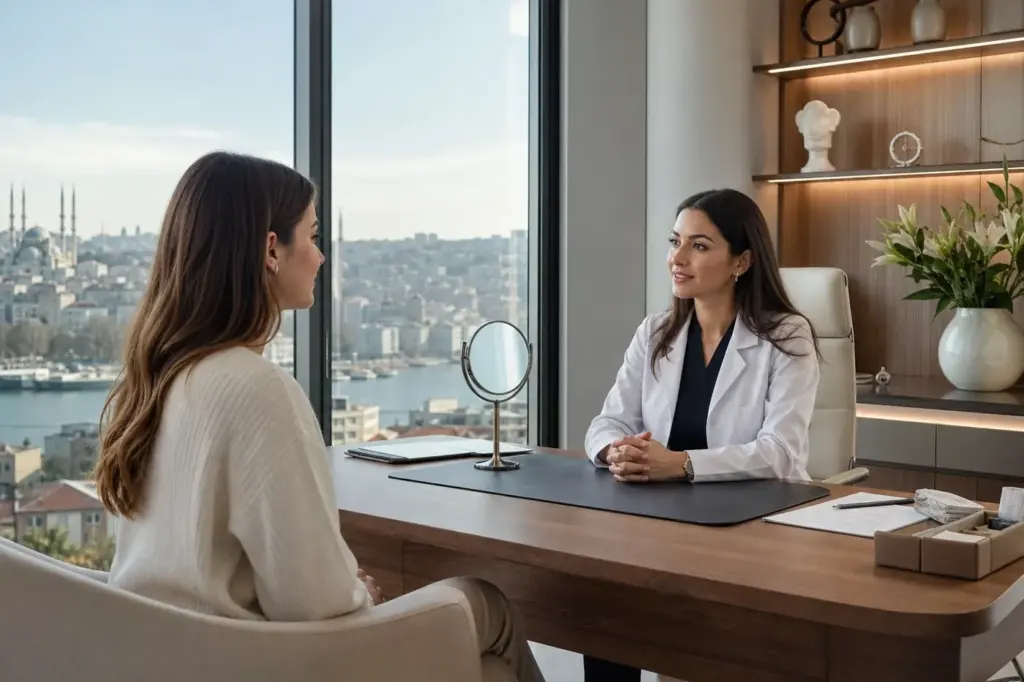
Information only. This article explains what a treatment is and how it is usually carried out. It is not medical advice, not an offer and not a recommendation to have any procedure. Whether it suits you can only be decided by a licensed doctor after an examination.
A breast lift, medically called mastopexy, is a surgical procedure for people whose breasts have sagged or lost shape over time. The surgery aims to restore a more elevated position and firmer contour by removing excess skin and reshaping tissue. Many travellers consider cosmetic treatment abroad; quality, regulation and advertising rules differ by country and by provider.
This article explains what the procedure involves, how it works, typical recovery, risks and what to discuss with a doctor before deciding. It does not recommend that anyone have treatment, nor does it rank clinics or techniques.
Quick answer: A breast lift, medically known as mastopexy, is a surgical procedure that raises and reshapes sagging breasts by removing excess skin and tightening the surrounding tissue to support a more youthful breast contour. The procedure does not add volume on its own. Instead, it reshapes and repositions existing breast tissue to create a firmer, more lifted appearance. The procedure typically takes about two hours. You often can go home on the same day.
At a Glance
| Total time | Procedure: 2–3 hours under general anesthesia. Same-day discharge typical. Recovery to desk work: 1–2 weeks. Recovery to exercise: 6–8 weeks. Final shape: 3–12 months. |
|---|---|
| Typical cost | ₺₺₺ |
What You Need Before You Start
- Medical clearance from your doctor in your home country
- Full health assessment including blood pressure, clotting disorders and history of scar formation
- Time to arrange travel and post-operative follow-up care at home
- Ability to rest and avoid strenuous activity for 1–2 weeks
- A caregiver for the first few days after surgery
- Documentation of any medications you take, especially blood-thinning drugs
Compare Your Options
| Option | Duration | Price | Notes |
|---|---|---|---|
| Periareolar (donut) lift | Typically 2–3 hours | Your surgeon makes an incision around the perimeter of the areola and vertically down from the areola to the breast crease. If you have a moderate degree of sagging and do not want breast implants, your surgeon will likely recommend this approach. | |
| Vertical (lollipop) lift | Typically 2–3 hours | Your surgeon makes an incision around the perimeter of the areola and vertically down from the areola to the breast crease. Suitable for moderate to significant sagging. More visible scarring than periareolar, but greater lift than minimal techniques. | |
| Anchor (inverted-T) lift | Typically 2–3 hours | Your surgeon makes an incision around the perimeter of the areola, vertically down from the areola to the breast crease and horizontally along the breast crease. If you have a severe degree of sagging or are getting a breast reduction with your breast lift, your surgeon will likely recommend this approach. This technique produces the greatest lift, but also leaves the most scars. | |
| Crescent lift (minimal sagging) | Typically 2–3 hours | The Crescent mammary lift involves a semi-circular incision along the upper half of the areola. It provides a vertical shift of about 1–2 cm for patients who require only a minor retouch with Grade I ptosis or pseudoptosis. |
₺ budget · ₺₺ moderate · ₺₺₺ upscale · ₺₺₺₺ splurge. Price levels are estimates compared with typical prices for visitors.
Step-by-Step Instructions
Step 1: Pre-surgery consultation
You and your plastic surgeon will decide the technique and incision placement choices that are right for you. During your consultation, your medical team will assess your degree of breast ptosis (sagging) to determine the most appropriate surgical approach. The surgeon will examine breast shape, skin quality and elasticity, and will mark the incision sites while you are standing. Ask for a written treatment plan and clarify follow-up care at home.
Tip: Bring photos of breast shapes you find appealing, but be realistic about what your anatomy allows.
Step 2: Pre-operative testing and preparation
Blood tests, heart and lung checks, and other assessments are performed based on your health history. Stop taking blood-thinning medications as instructed by your surgeon. Arrange time off work and ensure you have support at home for the first week. Do not eat or drink for several hours before surgery, as instructed.
Tip: If you smoke or vape, stopping before surgery greatly improves healing; nicotine restricts blood vessels the surgery depends on.
Step 3: Anesthesia and initial incisions
Anesthesia is administered to control pain, your skin in the surgical area is cleaned and prepped, your skin is marked with a pen or marker, and incisions are made around your areolas and possibly downward or outward from there.
Tip: The exact incision pattern depends on how much lifting you need; your surgeon chose this during your consultation.
Step 4: Reshaping and repositioning
Your surgeon removes excess breast skin and shifts the nipple to a higher position (the nipple is not removed from the body). If you have a stretched areola, your surgeon will reduce its size. Your surgeon then reshapes your breast by bringing the skin located above your areola down and together, beneath your breast.
Step 5: Closure and immediate aftercare
The cuts are closed with stitches, surgical tape or skin glue. You will have bandages around your breasts and chest, or you may have to wear a compression garment such as a surgical bra. You also may have some surgical drains.
Tip: Drains prevent fluid buildup and are usually removed within a few days.
Step 6: Recovery week 1: rest and pain management
Most people who have mastopexy go home the same day. When the anesthesia wears off, you may experience some pain. If the pain is extreme or long-lasting, contact your surgeon. You will have some redness and swelling after the surgery. Your chest region may feel stiff and sore for two to five days. The day after surgery, you should get out of bed for short periods of time. Rest and sleep on your back in an inclined position for the initial postoperative days. Use wedge pillows or sleep in a recliner chair.
Tip: Have pain medication ready before you leave the hospital; do not wait until pain becomes severe.
Step 7: Recovery weeks 2–6: returning to routine
Many women go back to desk work and gentle activities such as walking about a week afterward. You may not be cleared for vigorous activities, such as lifting things, exercising and having sex, for up to six weeks. Most people can shower from around day three, keeping water off the dressings as instructed.
Tip: Wear a supportive bra or compression garment as instructed; it reduces swelling and supports the new contour.
Step 8: Recovery weeks 6–12: resuming activity
Most patients can resume normal activities within a few weeks but should avoid exercise for six to eight weeks. Do not lift heavy things for several weeks, and avoid sex for at least two weeks. With all activities, start gently.
Tip: Incisions are still healing internally; even light impact exercise can cause complications. Wait for your surgeon's clearance.
Step 9: Follow-up at 3–12 months: final shape
Incisions may take several months to heal fully. Scars keep fading for 12–18 months. Early improvements are visible by week four, major shape and position settle between three and six months, final results continue to refine for up to twelve months, and scars soften and fade gradually with proper care.
Tip: It is normal for your breasts to feel high or the skin tight at first. The shape settles gradually as swelling reduces.
Step 10: Follow-up care at home and urgent symptoms
Keep all follow-up appointments with a surgeon in your home country if possible, or contact your surgeon abroad if complications arise. Seek urgent medical help for severe pain, fever above 38°C (100.4°F), heavy bleeding, difficulty breathing, chest pain, or signs of infection such as spreading redness, warmth or pus.
Common Mistakes to Avoid
- Assuming the procedure adds volume: Breast lift surgery cannot add volume to the breasts. As the breasts are lifted and reshaped, they become more compact and may seem smaller. If you want both lift and volume, discuss combined lift and implant surgery with your surgeon.
- Underestimating recovery time: Many people expect to return to normal within days. Breast lift recovery time is roughly two weeks back to desk work, eight weeks before chest-engaging exercise, and six to twelve months for the final shape to settle.
- Not planning for follow-up care: If you travel abroad for surgery, arrange in advance for a doctor in your home country to oversee your recovery, remove drains, and assess any complications.
- Smoking or vaping during recovery: Nicotine severely restricts blood flow and dramatically increases the risk of tissue damage and poor scarring. Stopping before and throughout recovery is critical.
- Comparing results before 3 months: The final shape emerges gradually as swelling reduces and tissue settles. Judging the result in the first month will lead to unnecessary worry.
Tickets, Payment and Booking
Breast lift surgery in Istanbul is performed at private hospitals and clinics. Many international patients book consultations online or by video call before travel. To schedule a procedure:
- Research the clinic and surgeon’s credentials: Verify that the surgeon is registered with the Turkish Medical Association and that the facility holds accreditation such as JCI certification.
- Arrange a consultation: Discuss your goals, health history, and recovery plan. Ask for a written treatment plan and clarification on follow-up care in your home country.
- Confirm what is included: Confirm whether the quoted cost covers the surgeon, anesthesia, hospital, initial drains removal, and follow-up visits during your stay in Turkey.
- Understand payment: Clinics typically accept international bank transfers, credit cards, and cash. Confirm payment terms, refund policies, and whether your home insurance covers complications abroad.
- Book accommodation and transport: Allow at least 7–10 days in Istanbul for surgery and initial recovery before traveling home.
Good to know
- Plan travel carefully: Arrange to stay in Istanbul for at least 7–10 days after surgery for initial recovery, wound checks and drain removal. Do not book your flight home too soon; complications can delay departure and flying early can increase swelling and bleeding risk.
- Wear the surgical bra and compression garment continuously for the first 2–4 weeks as instructed. This reduces swelling, supports the new contour and allows better healing. Do not remove it to check your progress; leave it on.
- Sleep on your back at a 25–45 degree angle (use a wedge pillow or recliner) for at least the first 1–2 weeks. Sleeping on your stomach or side pressures the incisions and increases swelling.
- Avoid straining, heavy lifting, and strenuous exercise for 6–8 weeks. This includes housework, carrying children, and gym work. Light walking is fine; sudden movements or impact can reopen incisions or cause bleeding.
- Photograph your breasts regularly (for your own reference) from the same angle and lighting at 1 week, 4 weeks, 3 months and 6 months. This helps you track normal settling and separates real concerns from normal temporary changes.
- If traveling from abroad, arrange in advance for a surgeon or GP in your home country to review your surgical notes, remove any remaining sutures if needed, and oversee follow-up. Do not assume all complications can be managed by the clinic abroad.
Explore Nearby Breast Lift
Sights near Breast Lift
 Galata Bridge · typical visit: 30 minutes to 1 hour10 min on foot from Haliç metro, Open 24 hours
Main image: AI-generated illustration. It may not show the place exactly as it looks.
 Spice Bazaar · typical visit: 1–2 hours13 min on foot from Haliç metro, Open daily 08:00–19:30
Main image: AI-generated illustration. It may not show the place exactly as it looks.
 Topkapi Palace · typical visit: 3–4 hours without Harem; 4–5 hours with Harem15 min on foot from Gülhane metro, Open 09:00–18:30, closed Tue
Main image: AI-generated illustration. It may not show the place exactly as it looks.
 Hagia Sophia · typical visit: 1–1.5 hours8 min on foot from Gülhane metro, Open daily 09:00–19:30
Main image: AI-generated illustration. It may not show the place exactly as it looks.
Browse more: All Other · All Treatments
FAQ
How long does a breast lift take?
The procedure usually takes about two hours, and many patients go home the same day. If drains were placed near the incisions, the healthcare team usually removes them a few days after the procedure.
What affects the cost of a breast lift in Istanbul?
Costs vary widely by surgeon, technique, facility and what is included. When comparing quotes, it helps to check what is covered, such as surgery, anaesthesia, hospital stay, drain removal and follow-up visits during the stay. Insurance coverage for complications can be clarified with the home insurer.
Can a breast lift affect breastfeeding?
Reduced ability to breastfeed in the future is a possible risk, although many women do breastfeed after a lift. The risk depends on the technique and individual healing. It is a point to discuss with the surgeon when future breastfeeding matters.
How does a lift change breast size?
A breast lift does not add volume. As the breasts are lifted and reshaped they become more compact and may look smaller. Combining a lift with an implant is a separate decision to discuss with a surgeon.
When can exercise and sports be resumed?
Many patients return to normal daily activities within a few weeks, while exercise is usually avoided for about six to eight weeks. High-impact sports and weight training are usually delayed further. The surgeon gives specific guidance.
Will there be visible scars?
Any incision leaves a scar. Scars usually keep fading for a year or more. Scarring depends on the incision type, skin type and aftercare, and differs from person to person. The surgeon can explain typical scar placement for each technique.
Can a breast lift be done when planning to have children?
Pregnancy after a lift can stretch the breasts again. Some surgeons advise waiting until after childbearing, while others consider a repeat lift later if needed. The timing is something to discuss with a licensed surgeon.
How can a surgeon's qualifications be checked?
The surgeon's licence and specialist qualification can be checked in the official register, and the clinic's licence with the Turkish Ministry of Health, which sets the rules for health services and for foreign patients. Complication handling and the surgeon's experience with the procedure are worth asking about before booking.
Before you decide anything
Risks and possible complications
- Breast asymmetry (they don't look the same).
- Bleeding or blood clots.
- Changes in sensation, like numbness of your breast skin, nipples or areolas. In addition, the left and right nipples and areolas may feel different.
- Complications from anesthesia, like nausea, vomiting or trouble waking up.
- Damage to nerves, blood vessels, muscles or organs.
- Hematoma (a pocket of blood under your skin), which may have to be drained.
- Inability to lactate (breastfeed) in the future.
- Incisions that don't heal properly.
- Infection.
- Loss of nipple or areola.
- Pain or swelling that lasts longer than expected.
- Problems with your heart or lungs.
- You may have thickened, painful or keloid scars after your surgery.
Alternatives to talk about with a doctor
- Supportive bras and exercises: Cannot address sagging caused by pregnancy, weight loss, or aging, but may help maintain the current shape.
- Non-surgical skin tightening treatments: Limited effectiveness for significant sagging; discuss realistic expectations with a dermatologist.
- Breast implants alone: If only volume loss is a concern and the nipple position is acceptable, implants alone may work. Ask your surgeon about the 'pencil test': if the nipple sits above the inframammary fold when a pencil is placed under the breast, implants may suffice.
- Combined lift and implant: If you have both sagging and desire more volume, discuss whether a combined procedure suits your anatomy and recovery ability.
Questions to ask a licensed doctor
- Is my degree of sagging (ptosis) mild, moderate or severe, and what incision technique is most appropriate for my anatomy?
- What is the realistic outcome for my breasts given my skin quality, elasticity and current shape?
- What are the signs of infection or other complications I must watch for, and what should I do if I notice them?
- Will this procedure affect my ability to breastfeed in the future?
- What are your complication rates, and how many of these procedures do you perform per year?
- What will the scars look like, and how long does scar fading typically take?
- If I am not happy with the result, what are my options?
- Can I combine this with other procedures, and does that change recovery time or risks?
- What happens if I become pregnant after the surgery—will the breasts sag again?
- This page is information. It is not medical advice and not a recommendation to have any treatment or to choose any clinic, doctor or country.
- Every medical procedure has risks, and results and healing differ from person to person. A licensed doctor who has examined you decides whether a treatment is suitable.
- Talk to a doctor in your home country before you decide, and plan follow-up care at home: problems can appear after you return.
- Check that the clinic and the doctor are licensed in the official register of the Türkiye Cumhuriyeti Sağlık Bakanlığı, and ask for a written treatment plan and a consent form you understand.
- After a procedure, get urgent medical help for severe pain, fever, heavy bleeding or breathing problems. In an emergency call the local emergency number.
Kontrendikasyonlar olabilir. Bir uzmana danışmak gerekir.

Take this guide with you
Get a free PDF of this guide to print or read offline: key facts, tips and a map link on a few clean pages.
Report an issue on this page
How we research and update our guides
About this page: AI assistance and accuracy
This page was prepared with the help of AI and checked by automatic rules. It is general information only, not medical advice and not a recommendation to have any treatment or to choose any clinic. Mistakes can still happen and details can change without notice. Please check important details with the official source and talk to a licensed doctor before you decide anything.
