
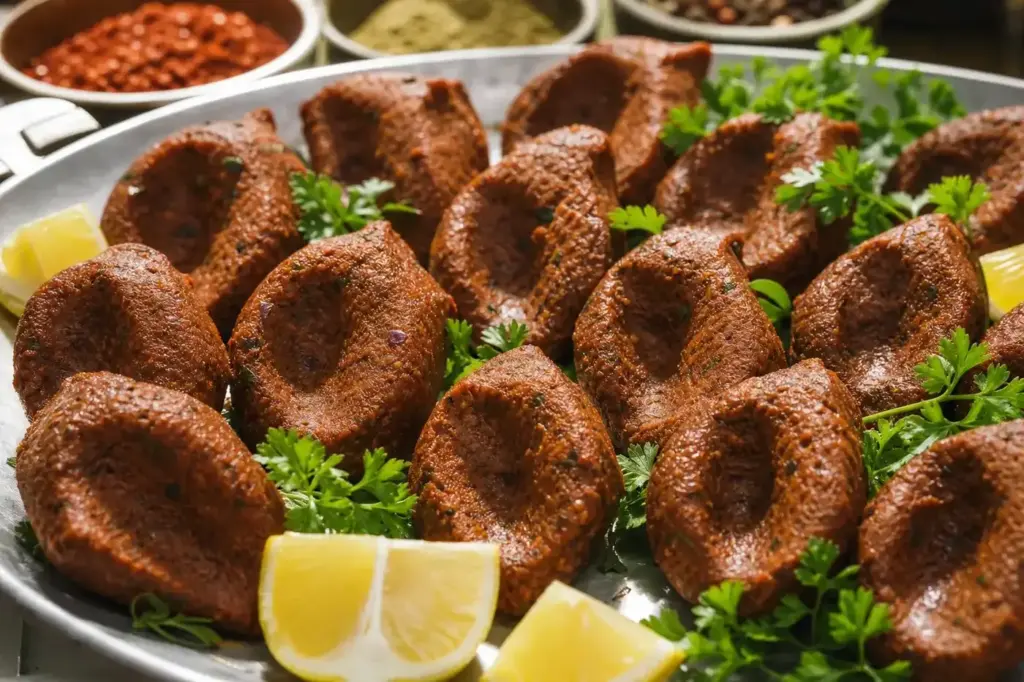
Çiğ Köfte: how to make Turkish spicy bulgur is essential knowledge for anyone who wants to understand Istanbul’s street food culture. Though it translates as “raw meatballs,” this beloved snack is almost always meatless today—a vegan mixture of finely textured bulgur, tomato and pepper pastes, and spices, kneaded until tender and richly flavored. It comes from southeastern Turkey, particularly the ancient city of Şanlıurfa.
Whether you encounter it at a Grand Bazaar stall or a busy street corner, the simplest way to eat it is wrapped in a cold lettuce leaf and squeezed with fresh lemon. This guide shows you how to prepare it at home, from ingredient ratios to the crucial kneading technique that creates its signature texture.
Quick answer: Mix fine bulgur with hot water, then knead with tomato paste, pepper paste, onion, garlic, and spices for 5–10 minutes until the mixture becomes soft and cohesive. Shape into small ovals by hand, pressing each with your thumb to leave a handprint. Serve immediately in lettuce leaves or bread with lemon juice. Total time: 30–40 minutes.
At a Glance
| Type | Street food & snacks |
|---|---|
| Origin | Çiğ köfte is a regional specialty of southeastern Turkey in Şanlıurfa. For centuries in Urfa and Adıyaman it was raw lamb and fine bulgur kneaded for hours with isot pepper until the meat 'cooked' in the spice and friction. According to legend, this Turkish dish was created as a result of a ban on lighting fires, forcing people to prepare meat without cooking it. In 2008, public sales of çiğ köfte with raw meat were banned by the Health Ministry of Turkey, leading to the modern meatless version that dominates Turkish street food today. |
| Servings | 2–4 servings (about 12–16 small ovals) |
| Total time | 30–40 minutes |
| Difficulty | Easy |
History and Story of Çiğ Köfte
The origins of çiğ köfte lie in the ancient city of Şanlıurfa in southeastern Turkey—one of the oldest continuously inhabited cities in the world, with human settlement dating back over ten thousand years. In the traditional version of the dish, finely ground raw lamb is kneaded intensively with bulgur wheat, onion, tomato paste, and an extraordinary quantity of spices—including isot (a local smoked dried pepper), cumin, black pepper, and others—until the heat generated by the kneading process effectively ‘cooks’ the meat through friction and the antimicrobial action of the spices and salt. This technique reflects the resourcefulness of ancient cooking: in a time before reliable fuel for cooking fires, the discovery that meat could be made safe and delicious through intensive spicing and kneading represented genuine culinary ingenuity.
In recent decades, there has been a significant change in the way çiğ köfte is prepared in Turkey. Due to hygiene regulations and health standards, the Turkish government banned the sale of çiğ köfte containing raw meat in restaurants. The widely consumed version of çiğ köfte today contains no meat—only fine bulgur wheat, tomato paste, onion, and a blend of spices, kneaded together with pomegranate molasses and lemon juice until the bulgur softens and the mixture becomes a cohesive, richly flavored dough.
Ingredients
- 200 g fine bulgur (köftelik bulgur)
- 450 ml hot water
- 2 medium onions, grated
- 3 cloves garlic, minced
- 3 tablespoons tomato paste
- 2 tablespoons red pepper paste (biber salçası)
- 2 teaspoons isot pepper (Urfa biber)
- 2 teaspoons pul biber (Aleppo pepper)
- 1 teaspoon ground cumin
- 1 teaspoon sumac
- 1/4 teaspoon black pepper
- 2 tablespoons pomegranate molasses
- 2 tablespoons olive oil
- 3 tablespoons fresh parsley, finely chopped
- 2 tablespoons fresh lemon juice
- Salt to taste
How Çiğ Köfte Is Made
Step 1: Soak the bulgur
Add the bulgur wheat to a large mixing bowl. Pour hot water (not boiling water) over the bulgur and let it sit for 5 minutes. Fluff with a fork after soaking.
Tip: Use fine bulgur labeled 'köftelik bulgur'—coarse bulgur will not give the correct tender texture.
Step 2: Prepare the grated vegetables
Grate the onions and squeeze out as much water as possible using paper towels. Mince the garlic finely. Grate the fresh tomatoes if using them instead of paste, and save the juice. These steps remove excess liquid so the mixture stays firm.
Tip: Squeezing onions removes their bitterness and prevents the mixture from becoming watery.
Step 3: Combine all ingredients
Add the red pepper paste, pul biber, isot biber, ground cumin, salt, and pepper. Then knead until everything is combined. Add the grated onion, garlic, tomato paste, lemon juice, pomegranate molasses, and olive oil.
Tip: Add ingredients gradually and taste as you go—both tomato and pepper pastes are already salty.
Step 4: Knead the mixture
Knead the mixture for around 5 minutes by repeatedly scraping it with the palm of your hand over the bottom of the tray. The bulgur will soften and absorb the flavors. The mixture should become smooth, cohesive, and hold together when shaped.
Tip: Good kneading is essential—this is what creates the silky texture that defines çiğ köfte.
Step 5: Add fresh herbs
Fold in the finely chopped fresh parsley at the very end, after the kneading is mostly complete. This preserves the color and fresh flavor.
Tip: Do not add parsley too early or it will darken and lose its brightness.
Step 6: Shape into ovals
Çiğ köfte balls are oval rather than round and each bears the handprint of their maker. Using your hands (wet them slightly if the mixture sticks), roll small portions into oval shapes about 2 inches long. Press your thumb into the top of each to create a shallow indent.
Tip: Work quickly once shaped—the dish is traditionally eaten fresh, as soon as the bulgur softens but before it continues to absorb moisture.
Step 7: Serve immediately
Arrange the çiğ köfte on a platter with fresh lettuce leaves, lemon wedges, and finely chopped parsley for garnish. Serve at room temperature. Wrap each piece in lettuce, squeeze lemon over it, and eat.
Tip: Some vendors press the mixture into a large mound and shape individual pieces as guests order them, keeping the rest fresh in the tray.
Variants
- With walnuts: ground walnuts replace the meat in some recipes, adding nuttiness and a firmer structure.
- With eggs: in Şanlıurfa itself, a local version uses scrambled eggs as a meat substitute.
- Wrapped in lavash or dürüm: instead of a lettuce wrap, the mixture is spread on thin flatbread or flour tortillas.
- With extra heat: some vendors make a spicier version by increasing the amount of pul biber or isot pepper.
- With pomegranate sauce: some serve it with nar ekşisi (pomegranate molasses) drizzled on top rather than stirred in.
Common Mistakes to Avoid
- Using coarse bulgur instead of fine bulgur. Coarse bulgur creates a lumpy, grainy texture instead of the smooth, cohesive paste that defines the dish.
- Not squeezing excess water from grated onions. This causes the mixture to become wet and sticky instead of firm and shapeable.
- Skipping or rushing the kneading. The friction and time spent kneading is what softens the bulgur and binds everything together into a proper texture.
- Adding parsley too early. It will oxidize and turn dark green if mixed before the final steps.
- Making it hours ahead. Çiğ köfte is meant to be eaten fresh. If made too far in advance, the bulgur over-softens and the texture becomes mushy.
- Not tasting as you season. Both tomato and pepper paste are salty; adding extra salt without tasting can make the final result too salty.
How to Order and Eat It
Eat your cig kofte in a sheet of iceberg or romaine lettuce, with a generous splash of fresh lemon juice. The favorite way to eat çiğ köfte is to roll it in a lettuce leaf and squeeze some lemon on top. Ask for nar ekşisi, pomegranate syrup or some chilli if you want to spice it up. Çiğ köfte is also served as dürüm, which means wrapped. Note that meat is replaced by ground walnut, ask before if you have allergic concerns.
To order: Bir porsiyon çiğ köfte lütfen [Bir porsiyon chee kofta lutfen] (One portion of çiğ köfte please)
Diet and Allergens
- Vegan
- Vegetarian
- Gluten-free (if using gluten-free bulgur)
Where to Try Çiğ Köfte
 Develi Samatya Gaziantep (Antep) kebab and Turkish dishes
Main image: AI-generated illustration. It may not show the place exactly as it looks.
Istanbul Vibes Tips
- Timing matters: the best çiğ köfte is eaten within minutes of shaping, while the texture is still firm and the bulgur hasn't over-absorbed liquid. At vendor stalls, you'll see them working in batches throughout the day for this reason.
- Fine bulgur is non-negotiable: look for bags labeled 'köftelik bulgur' or 'ince bulgur' in Middle Eastern or Turkish shops. This is the only bulgur that creates the proper smooth texture; substitutes will fail.
- Kneading by hand matters more than exact measurements: the mixture should feel smooth and cohesive when pressed, not dry or grainy. If it seems too dry after kneading, add a tablespoon of water at a time; if too wet, knead longer and let it rest 5 minutes.
- Isot pepper (Urfa biber) is essential, not optional: it gives çiğ köfte its signature smoky, slightly sweet heat. Regular chili powder or paprika will not replicate this flavor.
- At street stalls in Istanbul, look for small shops with bright colors and the mixture displayed in a large mound; these are usually high-volume vendors with fresh stock. Avoid any stall where the mixture looks dry or where vegetables sit in the sun uncovered.
- Ask for extra lemon and extra greens: the acidity of fresh lemon juice is not just a topping—it's integral to the flavor, brightening the rich spices and preventing the richness from feeling heavy.
Explore Nearby Çiğ Köfte
Related guides
 Best Street Food and Markets: Where Istanbul Eats
Main image: AI-generated illustration. It may not show the place exactly as it looks.
 Istanbul Markets Morning Tour: Spice Bazaar and Grand Bazaar Itinerary
Main image: AI-generated illustration. It may not show the place exactly as it looks.
 Street Food Tour Route: A 3-Day Walking Guide to Istanbul’s Best Eats
Main image: AI-generated illustration. It may not show the place exactly as it looks.
 Spice Bazaar and Grand Bazaar Route: Two Markets, Six Centuries
Main image: AI-generated illustration. It may not show the place exactly as it looks.
Browse more: All Food & Drink · All Other
FAQ
Is çiğ köfte actually made with raw meat?
Modern commercial çiğ köfte in Istanbul is generally made without meat. The name means 'raw meatballs,' but in 2008, public sales of çiğ köfte with raw meat were banned by the Health Ministry of Turkey. The meatless bulgur version is what you will find on the street and in restaurants.
Is çiğ köfte vegan?
Yes. Çiğ means raw and köfte means meatballs by name, but this version is actually a meat-free vegan sandwich filling. It is made with fine bulgur, pepper, tomato paste, onion, garlic, and a mix of Turkish spices. Always ask at a vendor if walnuts (which may contain traces of gluten from processing) are a concern for you.
How is çiğ köfte different from kısır?
Both are bulgur-based dishes from Turkey, but kısır is a salad served cold with separate salad vegetables mixed in, while çiğ köfte is hand-kneaded into a cohesive paste and shaped into ovals. Çiğ köfte is much spicier and more concentrated in flavor.
Can I make çiğ köfte ahead of time?
It is best eaten fresh, within 30 minutes of shaping. If you must make it ahead, cover it tightly and refrigerate for up to a few hours, but the texture will soften as the bulgur continues to absorb moisture and the flavors will dull slightly.
Where can I find çiğ köfte in Istanbul?
Today, çiğ köfte is one of the most ubiquitous street foods in Turkey. Small shops—often brightly colored, always crowded—sell it by weight across the country, from Istanbul's busiest neighborhoods to the smallest Anatolian towns. Look in areas like Taksim Square, near the Grand Bazaar, and the Spice Bazaar.
What spices are essential in çiğ köfte?
The spices include isot (a local smoked dried pepper), cumin, black pepper, and others. Isot pepper (also called Urfa biber) is the most distinctive; without it, the dish loses its signature smoky, slightly sweet heat.
Is çiğ köfte gluten-free?
Traditional çiğ köfte contains bulgur (cracked wheat), so it contains gluten. However, gluten-free varieties made with gluten-free bulgur or other grains exist, but they are rare. Always ask vendors about ingredients if you have a gluten sensitivity.
What is pomegranate molasses and can I substitute it?
Pomegranate molasses (nar ekşisi) is a thick syrup made from pomegranate juice, giving çiğ köfte its characteristic tangy-sweet background note. You can substitute it with a mix of balsamic vinegar and a pinch of sugar, but the flavor will be different; pomegranate molasses is worth seeking out.
Istanbul Vibes is a one-person project. A coffee keeps it going

Take this guide with you
Get a free PDF of this guide to print or read offline: key facts, tips and a map link on a few clean pages.
Report an issue on this page
How we research and update our guides
About this guide: AI assistance and accuracy
This guide is created with the help of AI and is based on official sources where available. Mistakes can still happen. Opening hours, prices, rules and other details are given to the best of our knowledge as of the date shown and can change without notice. It offers general recommendations only, not professional, legal or travel advice. Please confirm important details with the official source before you travel; you are responsible for your own plans and decisions.
* Affiliate link: as an Amazon Associate we earn from qualifying purchases at no extra cost to you.
