
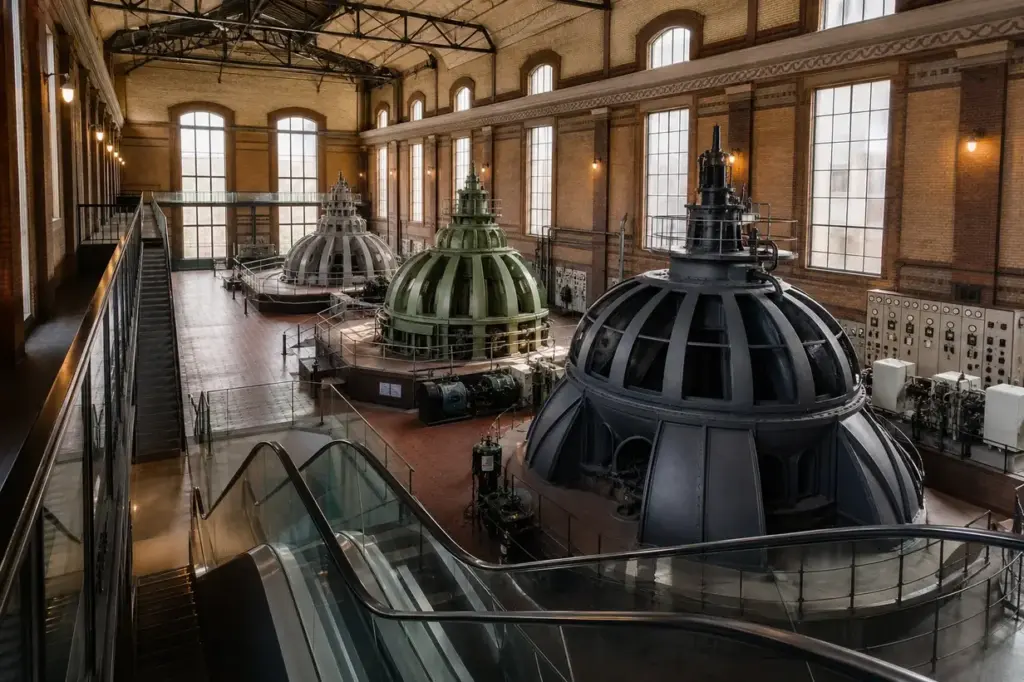
The Energy Museum at Santralistanbul offers a rare glimpse inside the former Silahtarağa Power Station, which served from 1914 to 1983 for supplying Istanbul with electric power. Located at the upper end of the Golden Horn in the Eyüp district, this venue preserves the original industrial machinery and allows visitors to walk directly through the historic engine halls and control rooms.
The center, consisting of an energy museum, an amphitheater, concert halls and a public library, is situated within the Silahtarağa campus of Istanbul Bilgi University. The museum’s layout places you on walkways high above the massive turbines and generators, so you see them from above and at close range simultaneously—a perspective rarely available in industrial museums.
Current access notice: As of October 2026: The Energy Museum is closed on official holidays and January 1st. The museum is located within Istanbul Bilgi University's Santralistanbul campus; entry requires registering at the campus gate. ID exchange is required.
Quick Facts
| Built / opened | 1914 |
|---|---|
| Architect(s) | Han Tümertekin (museum integration) |
| Address | Eski Silahtarağa Elektrik Santrali, Kazım Karabekir Caddesi No:2, 34060 Eyüp, Istanbul Google MapsApple MapsYandex Maps |
| District | Eyüp |
| Metro | Haliç (T1, 15–20 min walk along Golden Horn) |
| Admission | free |
| Best time to visit | October to May offers the most comfortable temperatures for navigating the large halls and outdoor campus areas. Mornings, especially weekdays, are quieter; weekends and afternoons see more families visiting the interactive zone. Sunlight is best in the morning when it streams through the tall turbine-hall windows onto the machinery. Avoid January 1st and official Turkish holidays when the museum is closed. |
| Website | enerjimuzesi.bilgi.edu.tr/en |
What Is (and Isn't) Part of a Visit to Energy Museum at Santralistanbul?
| Part | Status | Notes |
|---|---|---|
| Energy Museum (main industrial machinery and control room) | Included in the standard ticket | Admission is free for all visitors. |
| Energy Play Zone (interactive exhibits, lower floor) | Included in the standard ticket | Free, included with general admission. |
| University campus buildings (library, concert halls, amphitheater) | Separate ticket or institution | These are part of Istanbul Bilgi University's campus; access policies differ and may require separate inquiry. |
| Contemporary art exhibitions and galleries | Separate ticket or institution | The campus hosts rotating contemporary art exhibitions; these may have separate admission or limited hours. |
| Cafes and restaurants on campus | Outside / not part of it | Food and beverage venues operate independently; they are not part of the museum but available on the grounds. |
| Parking | Included in the standard ticket | Parking is available on campus for visitors; the museum entrance is near the parking area. |
Why Visit Energy Museum at Santralistanbul?
The power station first powered up in 1914, bringing power to the city’s trams and lit the Sultan’s chambers at Topkapı Palace. The machinery itself is extraordinary: steam turbines, electrical generators and the equipment of the former Silahtarağa power plant are on display in almost their original conditions.
The ground floor features the Energy Play Zone with over 20 interactive exhibits where visitors can generate their own electricity or experiment with magnetic fields. Admission is free for all visitors, and the experience combines industrial archaeology with hands-on science, making it engaging for both technical enthusiasts and casual learners.
How Energy Museum at Santralistanbul Is Laid Out
Modern glass escalators replaced the former coal conveyors between the floors. In order to have a good overview of the machinery in the huge hall, a podium hung at a height of 12 meters leads the visitors to the control room. The museum comprises three floors within the turbine hall, with the most visually striking machinery—the massive generator sets—occupying the central space at ground level.
The lower floor contains interactive learning exhibits and information panels. The main floor showcases the operating equipment and control room in situ. The upper platforms and walkways allow you to navigate around the equipment, offering changing perspectives on the scale and complexity of the machinery. The entire campus surrounds the museum building, with cafes, galleries and library spaces accessible on the grounds.
Highlights of Energy Museum at Santralistanbul
Turbine Hall and Generator Sets
The museum is situated in the turbine hall with three generator groups of steam turbines and electrical generators. These machines originally powered the entire city; their size is truly monumental. The original array of three 6MW generators was increased, in time, to a capacity for 80MW. Standing beneath them on the viewing platforms gives a visceral sense of industrial engineering from the early 20th century.
Tip: Arrive early in the morning to see the sunlight streaming through the high windows; it illuminates the machines beautifully and minimizes crowds.
Control Room and Dispatch Centre
The control room is largely intact, with original panels, switches, and instruments arranged as they were when operators managed the city's electricity supply. Visitors to the space can walk among enormous turbo-generators and see the dispatch room, where a large part of the equipment has also been preserved. This gives direct insight into how the plant operated daily.
Tip: Look for the instructional plaques that explain what each control panel and gauge did; they are in English and reveal the complexity of managing power distribution.
Energy Play Zone
The Energy Play Zone features over 20 interactive exhibits where visitors can generate their own electricity or experiment with magnetic fields. These hands-on stations allow you to physically engage with energy concepts without lengthy explanations, making it accessible regardless of background knowledge.
Tip: Bring comfortable shoes; the interactive floor requires movement between stations. This section appeals especially to younger visitors and groups.
Industrial Heritage Context
The station was built by the Ottoman Electric Company, a business interest formed by the Austro-Hungarian Gas & Electric Company in association with Belgian investors. The coal-fired generators were assembled in the Silahtarağa neighbourhood of Eyüp, on a plot of land beside the upper reaches of the Golden Horn. On 11th February 1914 the power station was fired up. Information panels trace the plant's role in electrifying Istanbul.
Tip: Read the timeline panels to understand how this single facility powered the entire city for decades before the national grid expanded.
Architectural Integration
The museum design was integrated by architect Han Tümertekin, who preserved the industrial structure while adding modern elements like the glass escalators and viewing platforms. The contrast between the original brick and steel and the contemporary interventions is itself an interesting design story.
Tip: Notice how the renovation respected the original industrial language of the building rather than disguising it; the machinery is the decoration.
Atmosphere
The turbine hall is vast and echoing, with industrial light filtering through tall windows onto the painted surfaces of massive machinery. It feels simultaneously abandoned and alive—abandoned in that the machines no longer roar with purpose, but alive because their scale and presence demand attention. The atmosphere is quiet and contemplative rather than frenetic; most visitors move slowly, processing the sheer engineering effort before them.
The campus itself is quieter than central Istanbul. The upper end of the Golden Horn has fewer tourists, and the university grounds create a scholarly, unhurried pace. On weekends, families visit the interactive zone on the ground floor, adding some gentle energy, but the overall mood is exploratory rather than crowded. The presence of university buildings and cafe areas nearby means there is activity without the commercial tourism rush.
History of Energy Museum at Santralistanbul
The station was built by the Ottoman Electric Company, a business interest formed by the Austro-Hungarian Gas & Electric Company in association with Belgian investors. The coal-fired generators were assembled in the Silahtarağa neighbourhood of Eyüp, on a plot of land beside the upper reaches of the Golden Horn. On 11th February 1914 the power station was fired up, bringing life to the tram network of Istanbul.
The plant provided electricity to the city from 1911, when it first went into service on the Golden Horn, Istanbul’s oldest industrial district, to 1983. Initially, until 1952, the power plant supplied electricity to the entire city of Istanbul. Initially, electricity from here was supplied only to the European side of the city, but after the installation of an underwater cable across the Bosphorus, residents of the Asian side also gained access to the power plant’s resources.
The Ottoman Electric Company had been granted an Imperial Concession lasting 50 years – but in 1937, after the fall of the empire, that company was nationalised… and the following year it was absorbed into the Municipality of Istanbul. The plant was closed due to environmental concerns because it was a coal-powered facility.
The Silahtarağa Electric Power Plant was granted to Istanbul Bilgi University on 1 May 2004 under a protocol convened with the Ministry of Energy and Natural Resources. Between 2004-2007, extensive renovations were conducted at the power plant. Santralistanbul opened its doors on 8 September 2007.
Tickets and Booking for Energy Museum at Santralistanbul
| Ticket | Price | Includes |
|---|---|---|
| General admission (all ages) | Free | Access to all three floors of the museum, the Energy Play Zone, original machinery, control room, and interpretive displays. |
| Guided tour (group, 45 minutes, Turkish or English) | ₺ | Narrated tour for groups of up to 25 people; must be arranged in advance by email. |
₺ budget · ₺₺ moderate · ₺₺₺ upscale · ₺₺₺₺ splurge. Price levels are estimates compared with typical prices for visitors.
Entry is free; no advance booking required for general visits. Visitors must register and exchange ID at the campus gate entrance. Bring a valid passport or ID document.
Guided tours: To arrange a group guided tour in English or Turkish (approximately 45 minutes), send an email to rehberliturlar@santralistanbul.org or info@santralistanbul.org with your preferred date, time, and group size. Tours must be arranged in advance and are limited to groups of 25 or fewer.
The Energy Museum is closed on official holidays and January 1st. For the most current opening hours and any temporary closures, visit the official website at enerjimuzesi.bilgi.edu.tr/en/.
Suggested itineraries Energy Museum at Santralistanbul
1–1.5 hours
Enter and go directly to the main turbine hall. Spend 30–45 minutes on the elevated walkways observing the three generator sets and taking in the scale of the machinery. Then move to the control room level (approximately 15 minutes). Finish with a brief look at the Energy Play Zone on the lower floor (10–15 minutes). This covers the highlights without extended engagement with each station.
2 hours
Begin with the main turbine hall and control room as above (1 hour). Spend 30–40 minutes exploring the Energy Play Zone interactives, experimenting with 4–5 different stations. End with a walk around the upper campus grounds and a cafe visit (15–20 minutes). This plan balances the original machinery with hands-on engagement.
Half day (3–4 hours)
Spend 1.5 hours in the museum proper, including all machinery levels and the interactive zone. Take a 20–30 minute break at a campus cafe. Then explore the broader campus: the contemporary art galleries, the public library atrium (if open), and the waterside promenade overlooking the Golden Horn. End with lunch at a campus restaurant.
How to Get to Energy Museum at Santralistanbul
By metro (T1 Tram): The nearest tram stop is Haliç (Golden Horn station) on the T1 tram line, which runs along the waterfront. From Haliç, it is a 15–20 minute walk uphill (northeast) along the shore toward Eyüp. Follow the T1 tracks as they head away from the city center; the campus is signposted.
By bus: Several bus lines serve the upper Golden Horn area. Bus 36E and 36T run toward Eyüp; ask the driver to let you off near Santralistanbul or Bilgi University.
By taxi: Direct the driver to “Santralistanbul” or “Silahtarağa Elektrik Santrali” at Kazım Karabekir Caddesi, Eyüp. The address is well known locally.
Parking: There is dedicated parking on the university campus. When you arrive, proceed to the main campus gate where visitors register and receive a parking pass.
Accessibility
Modern glass escalators replaced the former coal conveyors between the floors, allowing step-free vertical access to the main levels. The museum interior has level walkways and viewing platforms appropriate for wheelchairs. The campus itself has paved paths. However, the approach from the T1 tram stop involves a 15–20 minute uphill walk over uneven ground; visitors with mobility challenges may prefer a taxi to the campus entrance. Accessible restrooms are available on site. Contact the museum in advance if you require specific accommodations.
Food Nearby
The Santralistanbul campus includes cafes and restaurants; you can find light refreshments and coffee in the complex without leaving. The campus espresso bar and cafe near the parking area serve simple fare. Outside the campus, the Eyüp waterfront area has several casual restaurants and tea gardens overlooking the Golden Horn, a 20 minute walk downhill. For sit-down meals, ask staff for recommendations; options are limited in this quieter district compared to central Istanbul.
What to Bring
Wear comfortable walking shoes and bring a light jacket, as the turbine hall can feel cool despite the high ceilings. A camera or phone is fine for personal photos, though check current rules at entry. Bring water; there are fountains on campus but no vending machines inside the museum itself. In summer, sunscreen may be useful for the outdoor campus paths. Avoid large backpacks if possible, though security is generally relaxed.
Best Views and Photo Spots of Energy Museum at Santralistanbul
Main turbine hall from upper walkway
Looking down and across the three massive generator sets arranged in the hall below. The foreground captures the railing and platform structure; the background shows the layered machinery and distant brick walls with tall windows. Industrial geometry and scale dominate the frame.
Best time: Morning, when sunlight from the east-facing windows illuminates the machinery edges and casts shadows that emphasize the three-dimensional structure.
Control room panel wall
Close-up perspective of the original control panels, gauges, and switches in situ. The accumulated patina and labeling convey the age and technical sophistication of the equipment. Works as both documentation and atmospheric detail.
Best time: Any time; artificial lighting in the control room is consistent and soft, suitable for detailed photography.
Escalator descending toward turbines
The modern glass escalator framed against the backdrop of the massive machinery below, contrasting contemporary design with industrial heritage. The perspective emphasizes the scale and vertical drop.
Best time: Mid-morning or mid-afternoon, when the angle of light defines the glass and frames the machinery clearly without strong shadows.
Campus promenade overlooking Golden Horn
From the waterside paths or outdoor seating areas, the view back toward the Santralistanbul buildings with the Golden Horn in the foreground and distant hills beyond. Captures the site's relationship to the urban landscape and water.
Best time: Late afternoon for warm, raking light on the buildings and water; sunset offers a full-frame amber tone.
Photography Rules
Photography for personal use is generally permitted inside the museum. Tripods and commercial photography require advance permission; contact the museum before your visit if you plan professional use. Flash is not needed due to the high natural light but should not disturb others. Drones are not permitted on campus. Respect any specific notices at individual displays.
Family Suitability
The Energy Museum is suitable for families with children aged 7 and up. The machinery itself fascinates younger viewers, and the elevated walkways are safe with railings. The Energy Play Zone features over 20 interactive exhibits where visitors can generate their own electricity or experiment with magnetic fields, making it especially engaging for ages 8–14. Strollers are difficult to manage on the narrow walkways and escalators; children should be able to walk. The campus grounds are open and pleasant for family visits, with cafes and outdoor areas for breaks. A 1–1.5 hour visit is typical for families; interactive zones may extend the stay. The quiet atmosphere and free admission make it stress-free for children.
Istanbul Vibes Tips
- Arrive between 09:00 and 11:00 on a weekday morning to avoid university staff and afternoon groups. The museum is noticeably quieter early in the day, allowing you to linger on the walkways and truly absorb the machinery.
- Start at the top level and work downward. This orients you to the spatial layout and prevents backtracking. The upper platforms give the best vantage point for understanding the three-generator arrangement.
- Bring your passport or ID; you will not enter the campus without registering at the gate, and you must exchange ID for a visitor badge. Have this ready before arrival to speed up entry.
- Allow extra time if you plan a guided tour. These 45-minute tours are available in both Turkish and English for groups. If solo, ask staff whether a tour is currently available or planned; you may join an existing group.
- The museum has no gift shop inside, but the campus cafes sell light snacks and drinks at moderate prices. Bring your own water bottle if you prefer to avoid purchasing inside.
- Visit the campus library's atrium if time allows; it is architectural in its own right and offers a different perspective on how the former industrial site was redeveloped. The transition between the preserved machinery and contemporary library design is striking.
Explore Nearby Energy Museum at Santralistanbul
Sights near Energy Museum at Santralistanbul
 Eyüp Cemetery – about 1.8 km away (~29 min walk) · typical visit: 1–2 hours2 min on foot from Piyer Loti metro, Open 24 hours
Main image: AI-generated illustration. It may not show the place exactly as it looks.
 Fener and Balat Districtsabout 4.2 km away · typical visit: 3–5 hours
Main image: AI-generated illustration. It may not show the place exactly as it looks.
 Theodosian Walls · typical visit: 2–3 hours
Main image: AI-generated illustration. It may not show the place exactly as it looks.
 Miniaturkabout 750 m away (~13 min walk) · typical visit: 2–3 hours
Main image: AI-generated illustration. It may not show the place exactly as it looks.
 Pierre Loti Hill – about 1.7 km away (~28 min walk) · typical visit: 1–2 hours2 min on foot from Piyer Loti metro, Open daily 08:00–23:00
Main image: AI-generated illustration. It may not show the place exactly as it looks.
 Eyüp Sultan Mosque – about 2.3 km away · typical visit: 1–2 hours7 min on foot from Feshane metro, Open daily 08:30–18:30
Main image: AI-generated illustration. It may not show the place exactly as it looks.
Metro stations near Energy Museum at Santralistanbul
 Haliç – about 5.2 km awayOpen daily 06:06–00:06
Main image: AI-generated illustration. It may not show the place exactly as it looks.
Related guides
 Eyüp: Sacred History, Cemeteries, and Golden Horn Views
Main image: AI-generated illustration. It may not show the place exactly as it looks.
 Eyüp Ferry Terminal: Tickets, Schedules and Golden Horn Routes
Main image: AI-generated illustration. It may not show the place exactly as it looks.
Browse more: More in Eyüp · All Museums · All Sightseeing
FAQ: Energy Museum at Santralistanbul
Is the Energy Museum truly free?
Admission is free for all visitors. No ticket is required; you register at the campus gate and exchange your ID for a visitor badge.
Is a guided tour necessary to understand the museum?
Guided tours are optional. Informational panels throughout the museum explain the machinery and its historical role in English. The layout is logical and self-explanatory. Guided tours are best for groups or if you want deeper historical context; solo visitors typically find self-guided exploration sufficient.
What is the difference between Santralistanbul and the Energy Museum?
Santralistanbul is the entire arts and cultural complex, which includes the Energy Museum, contemporary art galleries, concert halls, a public library, and university facilities. The Energy Museum is the specific museum housed in the preserved turbine hall and showing the historical machinery.
Can I bring a camera?
Yes, personal photography is generally permitted. Professional or commercial photography requires advance permission. Tripods and drones are not allowed without prior approval.
Is the museum accessible with a wheelchair?
Modern glass escalators replaced the former coal conveyors between the floors, providing step-free access. Most walkways are level and railing-protected. However, the uphill approach from the T1 tram stop may be difficult; a taxi to the campus entrance is easier for mobility-challenged visitors.
What if I want to eat at the museum?
The museum itself has no internal dining. However, the Santralistanbul campus has cafes and restaurants. There is an espresso bar near the parking area and other food options throughout the campus grounds.
How long should I spend in the museum?
A typical visit is 1.5–2 hours. The highlight machinery and control room can be seen in 45–60 minutes. Allow extra time if you engage with the interactive Energy Play Zone on the ground floor.
Are there restricted areas or closed sections in the museum?
All public areas of the turbine hall and the viewing platforms are open to visitors. The museum is closed on official Turkish holidays and January 1st. If you visit on a day when the university is quiet (such as mid-summer), some campus facilities may have reduced hours.
Istanbul Vibes is a one-person project. A coffee keeps it going
Hotels near Energy Museum at Santralistanbul
- AVA Boutique (300 m) Check prices (affiliate link, opens in a new tab)
Affiliate link (opens the booking site): we may earn a commission at no extra cost to you.
Restaurants near Energy Museum at Santralistanbul
Distances are straight-line, from OpenStreetMap data.

Take this guide with you
Get a free PDF of this guide to print or read offline: key facts, tips and a map link on a few clean pages.
Report an issue on this page
How we research and update our guides
About this guide: AI assistance and accuracy
This guide is created with the help of AI and is based on official sources where available. Mistakes can still happen. Opening hours, prices, rules and other details are given to the best of our knowledge as of the date shown and can change without notice. It offers general recommendations only, not professional, legal or travel advice. Please confirm important details with the official source before you travel; you are responsible for your own plans and decisions.
* Affiliate link: as an Amazon Associate we earn from qualifying purchases at no extra cost to you.
