
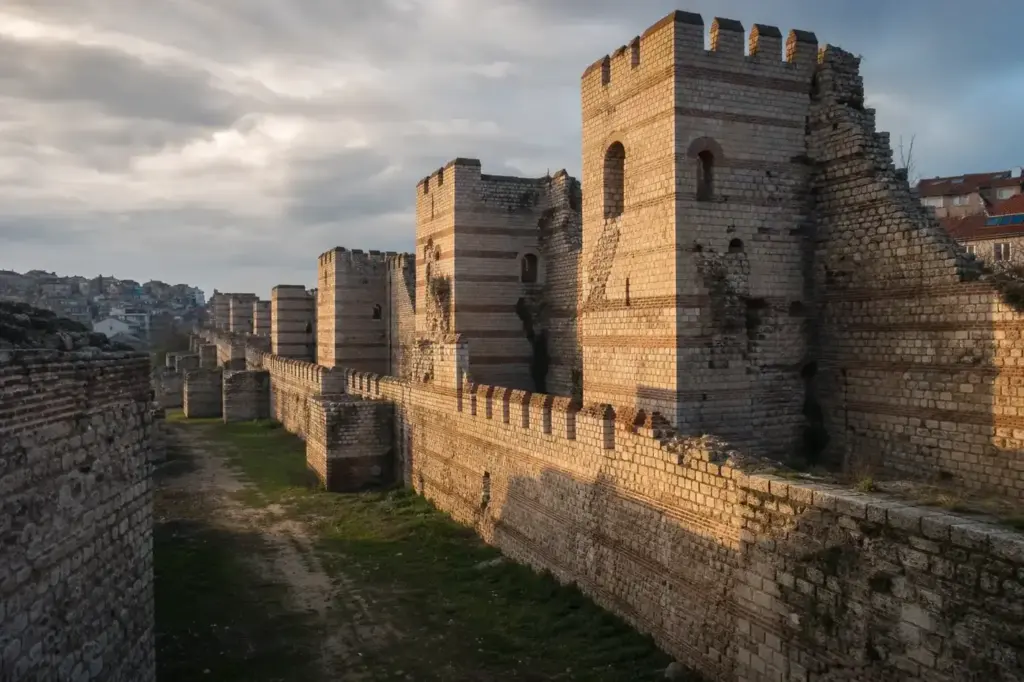
The Theodosian Walls are among the most formidable fortifications of the ancient world. Built under Byzantine Emperor Theodosius II, these massive defensive structures stretch nearly 7 kilometers across Istanbul’s western edge, from the Golden Horn in the north to the Marmara Sea in the south, defining the boundary of Constantinople for over 1,000 years.
Today, visitors can explore substantial surviving sections of these historic walls, with several newly opened visitor centers and restored walkways offering access to tower interiors, battlements, and the space between the inner and outer fortifications. Walking here means moving through layers of Byzantine and Ottoman history, past Ottoman-era mosques and restored parks, in a part of Istanbul that most travelers never discover.
Current access notice: As of October 2026: Three visitor centers provide formal access with facilities—Mevlanakapı, Silivrikapı, and Belgradkapı (opened September 2022, 2022, and 2024 respectively). Additional centers are planned for Edirnekapı and Sulukulekapı. Opening hours and facility availability may vary; check with the Istanbul Municipality or local tourism information for current details. Much of the wall system remains accessible as public outdoor ruins viewable from street level without entry fees.
Quick Facts
| Built / opened | 413 |
|---|---|
| Architect(s) | Anthemius of Tralles (attributed; chief design and construction under Emperor Theodosius II) |
| Address | 10. Yil Caddesi, Yedikule Mahallesi, Fatih, Istanbul |
| District | Fatih |
| Admission | Free |
| Best time to visit | Spring (April–May) and autumn (September–October) offer ideal conditions: moderate temperatures, clear light for photography, and manageable crowds. Weekday mornings are noticeably quieter than weekends.Summer (June–August) brings heat; early morning (before 09:00) or late afternoon (after 16:00) walking is advisable. Winter (November–February) can be wet, but clear winter days provide sharp light on restored stone.Avoid midday sun in June–August; the walls offer limited shade. Visitor centers at Belgradkapı and Silivrikapı provide shelter if you must visit during peak heat. |
What Is (and Isn't) Part of a Visit to Theodosian Walls?
| Part | Status | Notes |
|---|---|---|
| Wall walk between Silivrikapı and Belgradkapı | Included in the standard ticket | Fully restored and open to the public; visitor centers provide shelter and facilities; free access. |
| Visitor centers (Belgradkapı, Silivrikapı, Mevlanakapı) | Included in the standard ticket | Free entry; offer shelter, small libraries, café facilities, and direct wall access with marked walkways. |
| Tower climbing (restored sections) | Included in the standard ticket | At accessible visitor centers, you can climb to tower interiors and walk battlements; free access. |
| Yedikule Fortress (southern terminus) | Separate ticket or institution | Separate institution with own admission fee; marks the southern boundary of the wall system. |
| Palace of the Porphyrogenitus (northern end, Ayvansaray) | Separate ticket or institution | Separate Byzantine palace ruin; irregular access; check local conditions; often included in longer wall walks. |
| Panorama 1453 Museum | Separate ticket or institution | Nearby museum depicting the 1453 siege; separate admission; not part of the wall system itself. |
| Rough or unreconstructed wall sections | Not open to visitors | Many stretches remain partial ruins without formal visitor infrastructure; viewable from public streets and adjacent parks but not designed for climbing or extended access. |
| Karasurları Parks (adjacent public gardens) | Included in the standard ticket | Free public parks landscaped adjacent to walls near Silivrikapı, Belgradkapı, and Sulukulekapı; open access. |
Why Visit Theodosian Walls?
The Theodosian Walls represent a pivotal moment in military history. They withstood over 40 siege attempts for more than a thousand years before finally falling to Mehmed II’s cannons in 1453, marking the end of the Byzantine Empire. Sections between Silivrikapı and Belgradkapı showcase the original double-wall design—a 12-meter inner wall and a 9-meter outer wall with a moat, all still largely intact.
Beyond their military significance, the walls offer a unique walking experience through living Istanbul neighborhoods. Unlike polished museums, the Theodosian Walls remain partially embedded in the city’s fabric—running past gardens, alongside modern roads, and through residential areas, giving visitors tangible sense of how defensive geography shaped an empire.
How Theodosian Walls Is Laid Out
The Theodosian Walls form a continuous defensive line stretching from the Ayvansaray area on the Golden Horn southward to Yedikule Fortress near the Marmara. The system consists of three sections: the Land Walls (the main defensive circuit), the Marmara Walls, and the Golden Horn Walls.
The most accessible and best-preserved section runs approximately 3 kilometers between Silivrikapı Gate in the north and Belgradkapı Gate to the south. This segment clearly shows the full defensive design and is the focus of current restoration and visitor infrastructure. Edirnekapı, the highest point of the walls at 77 meters elevation, serves as a natural midpoint and orientation reference.
Three visitor centers have been established: Mevlanakapı (opened September 2022), Silivrikapı (opened September 2022), and Belgradkapı (opened 2024). Each offers shelter, basic facilities, and direct access to restored wall sections. Additional centers are planned at Edirnekapı and Sulukulekapı. Between and beyond these centers, sections vary from well-preserved restored areas to partial ruins integrated into neighborhoods and gardens.
Highlights of Theodosian Walls
The Double-Wall System at Belgradkapı
The Belgradkapı visitor center (Belgradkapı Ziyaretçi Merkezi) provides direct access to the best-preserved section, with walkways on both the inner and outer walls. The inner wall rises 12 meters high, the outer wall 9 meters, and the moat between them has been preserved as a distinctive hollow. You can enter towers 15–26 and walk the battlements between them, experiencing what Byzantine defenders would have seen across the approach fields. Three shelters with small libraries and café facilities support extended visits. This section opened in 2024 and represents the most developed visitor infrastructure.
Tip: Visit in early morning or late afternoon for better light on the restored stone and fewer crowds. The shelters provide shade and rest points if you plan to walk the entire visible section.
Edirnekapı Gate at the Highest Point
Edirnekapı (the Gate of Edirne, formerly the Charisius Gate) stands at the highest elevation of the wall system—77 meters above sea level. This strategic location controlled access from the northwest and was deliberately chosen for maximum visibility and defensive advantage. The gate's Turkish name honors the direction toward Edirne; Mehmed II's forces breached here during the final siege. The surrounding area offers sweeping views across the city and access to both inner and outer wall lines.
Tip: Start your walk here if you want to follow the walls downslope toward Belgradkapı. The descent makes for easier walking than climbing upward.
Silivrikapı Visitor Centre and Roman Hypogeum
Silivrikapı (the Gate of Silivri, formerly the Porta Polyandrion) opened as a visitor center in September 2022, featuring the Silivrikapı Roman Hypogeum—an underground structure from the Roman period discovered during restoration work. The center provides shelter and facilities; the hypogeum extends beneath the walls and offers a tangible connection to the pre-Theodosian fortifications. This is the northernmost major restored section, closer to the Golden Horn approach.
Tip: The hypogeum visit is included in the visitor center access. Allow extra time if you want to descend and explore this archaeological feature alongside the wall walkways.
Topkapı Gate and the Cannon Breach
Topkapı Gate (formerly the Romanos Gate) is marked by a distinctive breach in the wall—the point where Mehmed II's bombard cannon shattered the structure during the 1453 siege. The Turkish name, meaning 'Cannon Gate,' commemorates this pivotal moment. Though less heavily restored than Belgradkapı, the section remains visibly prominent and serves as a powerful testament to the engineering that ended the Byzantine era. The gate area connects to major modern thoroughfares (Adnan Menderes Caddesi), making it an easy access point.
Tip: The breach is visible from street level without needing paid entry to a visitor center. Walk the area to understand how the wall integrated with the medieval city.
Karasurları National Parks (Black Walls Parks)
Adjacent to the walls, particularly near Silivrikapı, Belgradkapı, and the Fourth Military Gate (Sulukulekapı), restored parkland areas—collectively called Karasurları Millet Bahçesi (National Park of the Black Walls)—have been cleared and landscaped as public gardens. These provide rest areas, seating, and shade while offering unobstructed views of the wall's outer face and restored sections. The parks transform the walls from defensive remnants into accessible public spaces.
Tip: Pack water and a light snack. The parks provide shade but few commercial facilities; the nearby neighborhoods offer cafés and small shops.
Palace of the Porphyrogenitus at Ayvansaray
The Palace of the Porphyrogenitus (Tekfur Sarayı), located at Ayvansaray on the northern section where the walls reach the Golden Horn, is a ruined Byzantine imperial residence from the 14th century. Although technically separate from the walls, it marks the traditional endpoint of the wall system and demonstrates how late-Byzantine palaces integrated with the defensive circuit. The palace's distinctive marble and brick construction contrasts with the stone walls. Access is limited and irregular; check local conditions before planning a dedicated visit.
Tip: This is more a reference point for understanding the walls' full extent than a primary visitor stop. Include it in a longer walk if you have 4+ hours and local guidance.
Nine Operational Gates Along the Circuit
Nine major gates remain identifiable along the Theodosian Walls, each serving as a historical waypoint and orientation marker: Ayvansaray, Mevlanakapı, Silivrikapı, Belgradkapı, Topkapı, Fourth Military Gate (Sulukulekapı), Fifth Military Gate, Yedikule, and others. Each gate has a distinct historical name (often from the district it led to) and a Turkish military designation. The gates interrupt the wall line with passage tunnels and gate towers, and several are now integrated into visitor infrastructure or visible as archaeological markers.
Tip: Familiarize yourself with the gate names and locations before walking. They serve as reliable distance markers when planning your route.
Yedikule Fortress (Seven Towers)
At the southern terminus of the walls where they meet the Marmara Sea, Yedikule Fortress represents the integration of the Theodosian defensive system with later Ottoman fortifications. Built using portions of the original Byzantine gates, Yedikule features seven towers (yedi = seven, kule = tower in Turkish) and served as an Ottoman arsenal and prison. The fortress is a separate monument with its own entrance and fee, but it marks the southern boundary of the wall system and is often visited as the natural conclusion to a northbound walk.
Tip: Yedikule requires a separate ticket and visit plan. Budget 1–2 hours if including it with your wall walk, or treat it as a second day's destination. The Marmaray train (Kazlıçeşme station) provides direct access.
Atmosphere
Walking the Theodosian Walls is like moving through textured time. In restored sections, you stand on stone worn smooth by centuries of soldiers’ feet, with views across the approaches that defenders once watched. In rougher stretches, the wall cuts through vegetable gardens, residential courtyards, and alleyways where the historical and everyday coexist—washing lines hang from Ottoman-era structures, children play in the shadow of Byzantine towers.
The atmosphere varies by location and time. Early mornings feel contemplative and uncrowded, with soft light on restored stone. The Belgradkapı section, with its developed facilities, draws more visitors but remains calm compared to major monuments. Sections near busy roads carry an urban energy, sometimes jarring against the 1,600-year history underfoot. Ottoman-era neighborhoods like Fatih, which grew up behind the walls after they ceased being the city boundary, add layers of texture: small mosques, traditional shops, and call to prayer echoing off the stones.
History of Theodosian Walls
The Theodosian Walls were constructed under Byzantine Emperor Theodosius II and completed in 413 CE, replacing an earlier line of fortifications built under Theodosius I. The construction represents one of antiquity’s greatest engineering achievements—a massive coordinated project that built nearly 7 kilometers of defensive masonry in just four years. The chief architect and planner is traditionally attributed to Anthemius of Tralles, though historical records are incomplete.
The original design was revolutionary: a double line of walls with the inner wall standing 12 meters high and the outer wall 9 meters, separated by a wide moat that could be flooded. This arrangement meant an attacker breaching the outer wall would face a second, higher obstacle while exposed in the moat. The system incorporated 96 towers (in the original layout) positioned to provide overlapping defensive fire and housed garrison troops. Nine major gates controlled entry and exit.
For over 1,000 years, these walls withstood repeated assaults. Historian accounts record over 40 major siege attempts, including attacks by Huns, Persians, Avars, Arabs, and Bulgars. The walls proved nearly impregnable because of their design, the garrison’s organization, and the logistical difficulty of maintaining a siege against a city supplied by sea. Even when the city’s power declined and territory beyond the walls was lost, the fortifications remained effective.
By the 14th century, the walls’ military role began to diminish as Ottoman expansion reduced Byzantine-controlled territory. However, they remained largely intact through Ottoman rule, partly because the Ottomans maintained them for their own defenses. Deterioration accelerated in the 19th century when sections were dismantled for urban development and stone was quarried for new construction.
In 1453, the final siege by Mehmed II’s Ottoman forces proved decisive. Massive bombard cannons—new artillery technology—breached the wall, most famously at Topkapı Gate. The breach allowed Ottoman troops to pour into the city, ending the Byzantine Empire. The walls’ fall was not due to medieval design weakness but to the emergence of cannon artillery, for which no medieval fortification was adequately designed.
After Ottoman conquest, the walls were incorporated into the new empire’s defensive perimeter but were gradually dismantled or left to decay. Modern restoration began in the 1980s following the walls’ inclusion in UNESCO’s World Heritage listing for the Historic Areas of Istanbul in 1985. Recent restoration (2020s) has focused on stabilizing key sections, opening visitor centers, and creating public parks. Current efforts continue, with new centers planned and ongoing structural conservation.
Legends and Myths about Theodosian Walls
The Walls That Stopped Attila the Hun
Disputed by historians. One of the most famous legends holds that the Theodosian Walls saved Constantinople from Attila the Hun's invasion in 447 CE. Attila reportedly marched to the walls, saw their formidable double-line design, and—allegedly in awe or fear—withdrew rather than attempt a siege. Though historians debate whether Attila actually reached the walls or whether a payment of tribute played a larger role, the story became a foundational part of Byzantine identity: the walls as unconquerable guardians. The legend elevated the walls to mythic status even in antiquity.
The Miraculous Appearance of the Virgin Mary
Legend – historically unreliable. Byzantine legend claims that during one of the Arab sieges (likely the 7th or 8th century), when the walls were under extreme assault and breakthrough seemed imminent, the Virgin Mary appeared on the walls in a vision, radiating light and rallying the demoralized defenders. This apparition, according to legend, struck fear into the attackers and inspired the defenders to hold the line. The story reinforced religious faith as a defense alongside military engineering and became embedded in Byzantine spiritual culture, with the walls themselves becoming sacred symbols of divine protection.
The Sealed Door and the Lost Emperor
Disputed by historians. A widely known legend surrounds the final breach during the 1453 siege. According to some accounts, when the walls fell and Ottoman troops poured in, the last Byzantine Emperor, Constantine XI, made a final stand near one of the gates, allegedly sealing himself in a tower room rather than surrender. The legend claims that he died in the sealed chamber, a final symbolic act of defiance. Historical sources suggest Constantine XI died fighting, but his exact location and the manner of his death remain uncertain, lending the legend enduring power.
Tickets and Booking for Theodosian Walls
| Ticket | Price | Includes |
|---|---|---|
| Visitor Center Access | Free | Entry to any of the three operational visitor centers (Belgradkapı, Silivrikapı, Mevlanakapı), access to restored wall sections, tower walkways, battlements, interior facilities including shelter and small libraries. |
₺ budget · ₺₺ moderate · ₺₺₺ upscale · ₺₺₺₺ splurge. Price levels are estimates compared with typical prices for visitors.
The Theodosian Walls and their visitor centers are free to enter; no advance booking is required. The walls themselves, as outdoor ruins, are accessible 24 hours as public outdoor monuments, though unlit sections are hazardous at night.
The three operational visitor centers (Belgradkapı, Silivrikapı, Mevlanakapı) are open during daylight hours and offer the safest, best-interpreted access with marked walkways and maintained facilities. Belgradkapı, the newest center (opened 2024), offers the most comprehensive experience with sheltered seating, small on-site libraries, and refreshments. Exact opening hours and seasonal variations should be confirmed with the Istanbul Municipality or local tourism offices.
Entry is on a first-come, first-served basis. No tickets or ID are required for international visitors. For detailed current information, visit the official Istanbul tourism website or contact the Istanbul Municipality directly.
Suggested itineraries Theodosian Walls
2 hours
Start at Belgradkapı Visitor Center (take tram T1 to Pazartekke or Fatih, then walk). Spend 1 hour walking the restored section between towers 15–26 on both wall lines, climbing towers and viewing the moat. Rest at one of the shelters. Walk northward for 20–30 minutes toward Silivrikapı, passing through Karasurları Park. End at Silivrikapı Visitor Center. This is the most manageable introduction to the wall system.
3–4 hours
Begin at Edirnekapı Gate (highest point; take bus or tram to Edirnekapı station). Walk the walls downslope southward through Mevlanakapı and Silivrikapı sections, visiting each visitor center briefly. Continue to Belgradkapı, spending 1–1.5 hours on the fully restored section. Total distance is approximately 3 kilometers with gentle slope advantage. End near Belgradkapı with views toward the Marmara.
Full day (5–6 hours)
Start at Ayvansaray and the Palace of the Porphyrogenitus (Golden Horn end). Walk the full visible wall system southward through all major gates: Ayvansaray, Mevlanakapı, Silivrikapı, Belgradkapı, Topkapı, Sulukulekapı. Visit each visitor center briefly. Conclude at Yedikule Fortress (separate entry), approximately 7 kilometers total. This requires good physical fitness and comfortable walking shoes. Bring water and plan rest stops in Karasurları Parks.
How to Get to Theodosian Walls
The Theodosian Walls stretch across western Istanbul and are best accessed via multiple entry points rather than a single location.
By Tram (T1 line): The historic red tram line T1 runs parallel to the walls on Divan Yolu and Adnan Menderes Caddesi. Key stops include Pazartekke (near Belgradkapı), Fatih (near Mevlanakapı), and Edirnekapı. Board T1 westbound from Sultanahmet or Eminönü and ride for 20–30 minutes.
By Bus: Multiple bus routes serve the wall areas. Routes to Topkapı Gate, Edirnekapı, and Yedikule are frequent from central districts.
By Marmaray (suburban rail): For Yedikule Fortress and southern sections, Kazlıçeşme station on the Marmaray line is closest.
Recommended entry points:
- Belgradkapı: Most developed visitor center; take T1 to Pazartekke stop, walk 10 minutes south on Adnan Menderes Caddesi.
- Silivrikapı: Take T1 to Fatih stop; walk north 15 minutes toward the walls.
- Edirnekapı: Direct tram stop; highest elevation of wall system; good starting point for southbound walks.
- Yedikule: Marmaray to Kazlıçeşme station, then walk 10 minutes, or take a bus to Yedikule Fortress.
Parking: Street parking is limited and unreliable. Public transport is strongly recommended. Taxis or ride-sharing apps can deposit you at any gate for convenient access.
Accessibility
Accessibility is variable across sections. The fully restored Belgradkapı section has level walkways, marked paths, and shelters with seating, making it accessible for most mobility levels. Stairs and narrow passages exist in tower interiors.Silivrikapı and Mevlanakapı visitor centers similarly offer accessible ground-level paths, though the Roman Hypogeum at Silivrikapı requires descending stairs.Unreconstructed sections feature uneven terrain, loose rubble, and no formal pathways; these are not wheelchair-accessible. Strollers can navigate visitor center areas but are impractical on rougher stretches.No formal companion pass system exists; companions may accompany visitors freely at no cost. Contact the Istanbul Municipality for specific accessibility information at individual centers.
Food Nearby
The neighborhoods surrounding the walls (Fatih, Topkapı, and others) contain numerous small restaurants, kebab shops, and cafés serving Turkish food. Within the Belgradkapı and Silivrikapı visitor centers, basic refreshments (tea, coffee, light snacks) are available at small café facilities.Near Edirnekapı, local eateries serve traditional Turkish breakfast and lunch. The areas are not purpose-built for tourism food; expect authentic neighborhood restaurants, not tourist-oriented chains. Water, fresh juice, and bread are easy to find. Plan to carry snacks if you're walking the full system; facilities are spaced 1–2 kilometers apart.
What to Bring
Comfortable walking shoes are essential—surfaces vary from restored stone to uneven terrain. Bring water, especially in summer; shade is limited except near visitor centers. A hat and sunscreen are advisable. A light layer or jacket is useful if temperatures drop or wind picks up along the exposed walls.A camera or phone is worthwhile for photography, particularly at early morning or late afternoon light. Binoculars are optional but enhance observation of defensive details and distant views. Small bags or rucksacks are fine; large luggage is awkward on narrow paths. Security and bag checks are not typical at visitor centers; entry is informal.
Best Views and Photo Spots of Theodosian Walls
Belgradkapı Gate, from the inner wall looking outward
Wide view across the restored moat to the outer wall and the countryside beyond. The double-line fortification system is clearly visible in this perspective, with towers framing the approach. The moat, now a sunken garden, creates compositional depth.
Best time: Late afternoon, when shadows define the moat's contours and light rakes across the inner wall stone.
Tower 22 interior at Belgradkapı, looking through the crenellations
Framed view through the tower's defensive openings (embrasures) toward open ground beyond the walls. This perspective shows the defender's sightline and creates a sense of historical vantage point.
Best time: Morning light entering from the east through the crenellations; creates silhouette effects and highlights interior stonework.
Edirnekapı Gate from the south, with city skyline backdrop
The gate and surrounding wall sections rise against Istanbul's modern skyline beyond. This juxtaposition of medieval and contemporary architecture illustrates how the walls sit within living city landscape.
Best time: Early morning or late afternoon light; avoids harsh midday contrast between shadows and bright stone.
Karasurları Park viewing platform facing the outer wall
Frontal view of the restored outer wall face, unobstructed by buildings. The wall's full 9-meter height is visible, with tower sections and weathered stone texture prominent. Adjacent parkland adds greenery framing.
Best time: Overcast days or golden hour, when light is soft and the stone's detail is clear without harsh shadows.
Topkapı Gate breach area, street-level perspective
The visible breach in the wall where the 1453 cannon fire broke through remains distinctive. The damage is evident in the disrupted stonework and reconstructed sections visible as contrasting material.
Best time: Any time; the breach's historical significance and visible damage are clear regardless of light. Late afternoon creates dramatic shadows.
Walking the wall top at Belgradkapı, looking north toward the Golden Horn
Long sightline along the restored battlements northward; the wall line curves toward the horizon with multiple towers visible in succession. Golden Horn water is visible in the distance to the left.
Best time: Late afternoon or early morning, when the angle of light makes the wall's length visually apparent and reduces heat haze.
Photography Rules
Photography is permitted throughout the wall system, including interiors of visitor centers and towers. No restrictions on tripods, drones, or professional equipment have been formally established; however, drones may be restricted in certain areas near military or sensitive zones—check locally before launching. Flash photography indoors in towers is not restricted but can disorient in dim light.The best light for photography falls during golden hour (early morning and late afternoon), when low-angle sunlight enhances the textured stone and creates dramatic shadows. Overcast days offer even light suitable for architectural detail photography.
Family Suitability
The Theodosian Walls are moderately family-friendly. Children aged 6 and up with comfortable walking shoes can enjoy the visitor center sections and short wall walks. The restored Belgradkapı section, with its shelters and marked paths, is ideal for families; 1–2 hours here is manageable with young children.Uneven or unreconstructed sections are hazardous for small children; supervise closely. Strollers are impractical on the wall walks but work in adjacent parks. The Silivrikapı Roman Hypogeum involves stairs, which older children may find interesting but younger children may struggle with. Bring water, snacks, and sun protection; lack of commercial facilities means self-catering is essential.
Istanbul Vibes Tips
- Start at Belgradkapı or Silivrikapı, not the rough sections. These visitor centers have facilities, marked paths, and orientation; starting at isolated stretches is disorienting and less rewarding. You can explore rougher sections after understanding the system's layout.
- Walk the walls in the early morning or late afternoon, not midday. The walls offer almost no natural shade, and midday summer sun is intense. Early or late light also makes photography and detail observation far better.
- Don't aim to walk the full 7 kilometers on a first visit. Even experienced hikers find the uneven terrain and lack of facilities taxing. A 2–3 hour section (Belgradkapı to Silivrikapı) gives satisfying context without exhaustion. A second visit can expand the scope.
- Bring water and snacks from the city, not from limited cafe facilities within the visitor centers. The supplies are basic and overpriced relative to neighborhood shops near tram stops.
- Respect the ruins; many sections outside visitor centers are genuine archaeological sites. Stay on marked paths, don't climb unstable sections, and don't remove stones or artifacts. The wall's longevity depends on treating it as a fragile monument, not an adventure park.
- Ask at visitor centers about upcoming restoration or closures. The wall system is a living restoration project; sections occasionally close for structural work. A 5-minute check can save you from finding a planned route blocked.
Explore Nearby Theodosian Walls
Sights near Theodosian Walls
 Yedikule Fortress · typical visit: 2–3 hours9 min on foot from Kazlıçeşme metro, Open 09:00–17:00, closed Mon
Main image: AI-generated illustration. It may not show the place exactly as it looks.
 Chora Church · typical visit: 2–3 hoursOpen 09:00–18:00, closed Fri
Main image: AI-generated illustration. It may not show the place exactly as it looks.
Related guides
 Eyüp: Sacred History, Cemeteries, and Golden Horn Views
Main image: AI-generated illustration. It may not show the place exactly as it looks.
 Asitane: Ottoman Palace Cuisine Beside the Chora Church
Main image: AI-generated illustration. It may not show the place exactly as it looks.
 Alibeyköy Metro Station: M7 Line Transfer HubOpen daily 06:00–00:00
Main image: AI-generated illustration. It may not show the place exactly as it looks.
 Piyer Loti Cable Car: Upper Station, Views and AccessOpen daily 08:00–23:00
Main image: AI-generated illustration. It may not show the place exactly as it looks.
 Energy Museum at Santralistanbul: Ottoman Power Plant Turned Free MuseumOpen daily 08:30–17:00
Main image: AI-generated illustration. It may not show the place exactly as it looks.
Browse more: More in Fatih · All Landmarks · All Sightseeing
FAQ: Theodosian Walls
Is entry to the Theodosian Walls free?
Yes, entry to the walls and visitor centers is completely free. No tickets or advance booking are required. The walls remain accessible 24 hours as outdoor ruins, though visitor centers have daylight hours.
Can I climb on the Theodosian Walls?
Yes, but only in officially restored and marked sections. The Belgradkapı, Silivrikapı, and Mevlanakapı visitor centers provide safe access to wall tops and tower interiors with maintained pathways. Other sections are unsecured ruins; climbing them is hazardous and discouraged. Stay within marked areas.
How long does it take to walk the Theodosian Walls?
A short visitor-center focused visit (Belgradkapı or Silivrikapı) takes 1–2 hours. A moderate walk between visitor centers (Silivrikapı to Belgradkapı) takes 2–3 hours. The full 7-kilometer system requires 5–6 hours and is suited only to experienced walkers with good fitness.
Are the walls the same as Yedikule Fortress?
No. The Theodosian Walls are the main fortification line extending 7 kilometers. Yedikule Fortress (Seven Towers) marks the southern terminus where the walls meet the Marmara Sea. It's a separate monument with its own admission fee and is often visited as a separate destination, though it forms part of the broader defensive system.
Do I need a guide to visit the walls?
A guide is helpful but not necessary. Visitor centers provide orientation and basic information. Self-guided walks are manageable if you carry a map and stay on marked paths. Licensed guides can provide historical context and access to otherwise closed sections; book through Istanbul tourism offices if interested.
What's the best section of the walls to visit?
Belgradkapı (newest, best facilities, fully restored), followed by Silivrikapı. These two visitor centers offer the safest, clearest experience of the wall system's double-line design. Edirnekapı offers the highest elevation and broader views. All three are free and interconnected by a manageable walk.
Is the Palace of the Porphyrogenitus part of the walls?
The palace is a separate Byzantine structure located at the northern terminus of the walls near Ayvansaray, on the Golden Horn. Though architecturally adjacent, it is not part of the wall system itself and has its own irregular opening hours and access conditions.
Can I bring a bike or skateboard on the walls?
Bikes and skateboards are not permitted on the restored wall sections or in visitor centers. The paths are designed for pedestrians only, and the narrow crenellated walkways and stairs are hazardous for wheeled vehicles.
Istanbul Vibes is a one-person project. A coffee keeps it going

Take this guide with you
Get a free PDF of this guide to print or read offline: key facts, tips and a map link on a few clean pages.
Report an issue on this page
How we research and update our guides
About this guide: AI assistance and accuracy
This guide is created with the help of AI and is based on official sources where available. Mistakes can still happen. Opening hours, prices, rules and other details are given to the best of our knowledge as of the date shown and can change without notice. It offers general recommendations only, not professional, legal or travel advice. Please confirm important details with the official source before you travel; you are responsible for your own plans and decisions.
* Affiliate link: as an Amazon Associate we earn from qualifying purchases at no extra cost to you.
