
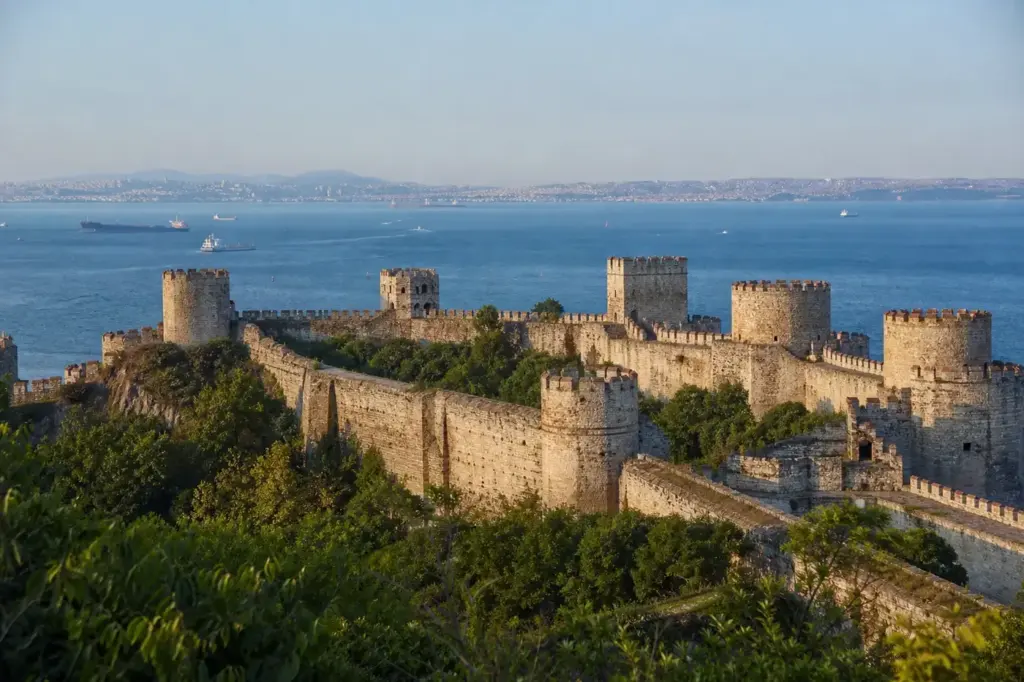
Yedikule Fortress stands where three empires have left their mark: Byzantine ramparts from the 5th century, the legendary Golden Gate (Porta Aurea), and Ottoman towers added in 1458 by Mehmed the Conqueror. Locally called the Fortress of the Seven Towers, this open-air monument occupies the southern anchor of Constantinople’s land walls, overlooking the Sea of Marmara.
Unlike the sprawling complexes of Topkapi Palace or the Hagia Sophia, Yedikule is compact and atmospheric. You can walk the stone ramparts, descend into the dungeons, and stand inside the Golden Gate—all while tracing the transition from Byzantine ceremonial grandeur to Ottoman pragmatism. Fewer crowds, lower admission, and stories embedded in every tower make it one of Istanbul’s most underestimated historical sites.
Current access notice: As of October 2026: Yedikule Fortress is open to visitors with some ongoing restoration work affecting specific sections. Check the official website (yedikulehisari.com) or the Turkish Ministry of Culture museums site (muze.gov.tr) for current hours and any temporary closures or guided tour requirements.
Quick Facts
| Turkish name | Yedikule Hisarı |
|---|---|
| Built / opened | 1458 |
| Architect(s) | Mehmed II |
| Address | Yedikule Mahallesi, Yedikule Meydanı Sokak, Fatih, İstanbul, Türkiye Google MapsApple MapsYandex Maps |
| District | Fatih |
| Metro | Yedikule (M1A, main station exit, 5 min walk to fortress) Kazlıçeşme (M1A, 10 min walk to fortress) |
| Admission | ₺₺ |
| Best time to visit | Spring (April–May) and autumn (September–October) offer comfortable temperatures and clear light without summer heat or crowds. Visit early morning (before 10 AM) or late afternoon (after 3 PM) to avoid midday heat and any afternoon crowds. Weekdays are quieter than weekends. Avoid Mondays (closed). Winter is cold and wet; summer afternoon heat can be intense in the exposed courtyard and on the ramparts. Late afternoon light on the towers and Marmara is excellent for photography. |
| Website | yedikulehisari.com/en |
What Is (and Isn't) Part of a Visit to Yedikule Fortress?
| Part | Status | Notes |
|---|---|---|
| Main fortress courtyard and tower interiors | Included in the standard ticket | The central courtyard, the seven towers (or accessible sections thereof), and dungeon areas are included in standard admission. |
| Rampart walk and outer walls | Included in the standard ticket | The stone ramps and accessible sections of the outer walls and ramparts are included; some sections may be closed for ongoing restoration. |
| Golden Gate | Included in the standard ticket | Both the inner and outer faces of the Byzantine Golden Gate are accessible; you can stand inside the vaulted passage. |
| Guided tours (municipal) | Separate ticket or institution | Free municipal guided tours are offered on weekends and by advance reservation. Evening 'Nostalgic Lantern' walks require separate registration. Self-guided visits are standard admission. |
| Theodosian Walls outside fortress perimeter | Outside / not part of it | The walls extending beyond the fortress to north and east are public rights-of-way but not part of the ticketed site. The Theodosian Walls Walk (linked itinerary) covers the broader system. |
| Museum of Turkish Ceramics / Artillery Museum | Outside / not part of it | These are separate institutions housed elsewhere in Istanbul; they are not part of Yedikule Fortress. |
| Yusufpaşa neighborhood streets and surrounding area | Outside / not part of it | Streets, shops, and residential areas surrounding the fortress are not part of the fortress site itself. |
Why Visit Yedikule Fortress?
Yedikule offers what many major Istanbul monuments cannot: a genuine encounter with architectural layers. The Golden Gate alone—once gilded and reserved for imperial triumphs—justifies the visit.
The fortress is less crowded than Sultanahmet‘s museum circuit, making it possible to sit quietly and absorb centuries of history. The rampart walk offers views across the Marmara and the neighborhood beyond. A licensed guide can explain which tower held which prisoner, turning stone into narrative. Budget-conscious visitors appreciate both the low admission and the value: two hours here yields more tangible history than a rushed tour of larger sites.
How Yedikule Fortress Is Laid Out
Yedikule forms an irregular polygon enclosed by walls and seven towers. The main courtyard opens from the main gate on the north side; the towers (numbered 1 through 7) are positioned around the perimeter. The oldest and most historically significant is the Golden Gate, a pair of Byzantine towers at the southern edge—one on the inner wall, one on the outer—separated by a vaulted passage.
The three largest Ottoman towers (built 1457–1458) frame the complex on the western, northern, and eastern sides. The Young Osman Tower (also called the Prison Tower) stands prominently on the west; its dungeons are accessible and crucial to understanding the fortress’s later history. Ramps connect the courtyard level to the rampart walk, which runs the circuit of the walls and offers views of both the inner and outer defenses.
Visitors typically enter at the main gate, explore the courtyard, climb into the towers, and complete the loop via the rampart walk. Signage in Turkish and English marks the main points. The fortress is compact enough to walk fully in 90 minutes, but the layers reward a slower pace.
Highlights of Yedikule Fortress
The Golden Gate (Porta Aurea)
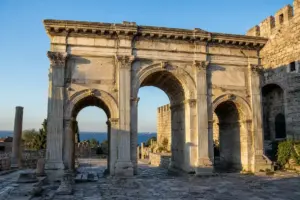
The ceremonial gateway built during the reign of Byzantine Emperors Theodosius I and II in the 5th century, originally gilded and used exclusively for imperial triumphs and coronation processions. Two massive towers flank a barrel-vaulted passage; you can enter and stand within the gate itself, glimpsing both its outer and inner faces. This is the oldest structure on the site and arguably the most historically significant.
Tip: Stand in the vaulted passage and look upward to see the architectural precision of the Byzantine construction. The outer face of the gate is visible from outside the fortress—walk south along the outer wall to see how the Sea of Marmara side differs.
Young Osman Tower (Prison Tower)
Named after Sultan Osman II, who was executed here in 1622 at age 14. The tower's dungeons are among the fortress's most evocative spaces. Stone cells and chains remain visible, along with plaques identifying historical prisoners. From ambassador interrogations to royal murders, this tower encapsulates the fortress's grim role as state prison from the 16th century onward.
Tip: Descend into the lower dungeons even if the light is dim—your eyes adjust and the cold, confined space becomes tangible. A guide can explain which cell held which prisoner and how long sentences typically lasted.
The Outer Rampart Walk
Stone ramps and stairs connect the courtyard to a walkable section of the outer walls, offering 360-degree views of the fortress structure, the Sea of Marmara, and the surrounding Fatih neighborhood. The walls are solid and about 3–4 meters high; handrails mark the steeper sections. This circuit takes about 30 minutes and provides the best understanding of how the fortress sits in relation to the ancient city walls.
Tip: Walk the rampart in late afternoon light, when the towers cast long shadows and the views toward the Marmara are clearest. The circuit is gentler and less vertiginous than it appears from ground level.
The Theodosian Walls Section
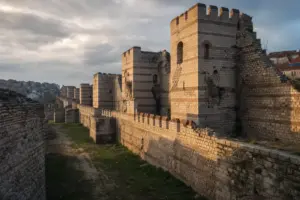
Yedikule preserves one of the few accessible sections of the Theodosian Walls (built in the 5th century), the massive dual-wall system that defended Constantinople for over a thousand years. Inside the fortress, you stand within the inner wall; outside and to the south, the outer wall runs parallel. The engineering—thick brick and stone, designed to absorb siege assault—is still evident.
Tip: Exit the fortress and walk south along the outer wall to see the defensive system's full profile. The gap between inner and outer walls, designed to prevent breached outer walls from immediately exposing the city, becomes clear from this perspective.
The Ottoman Towers (1458)
Three large round towers were added by Mehmed II in 1458 to enclose and defend the Golden Gate and treasury stores. The towers are massively built, designed to house different types of imperial wealth: one for documents and seals, one for arms and gunpowder, one for coins and precious metals. Their placement reinforces the fortress's role as a secured administrative center, not primarily a military stronghold.
Tip: Climb into at least one Ottoman tower to feel the difference in construction: narrower windows, thicker walls, and smaller interior chambers compared to Byzantine towers. The shift from ceremonial grandeur to practical security becomes tangible.
The Courtyard and Mosque Remains
The central courtyard originally held a mosque built immediately after Mehmed II's conquest (1453–1458) and quarters for guards and treasury officials. Traces of the mosque foundation and scattered stones remain. This space, enclosed by towers and walls, once functioned as a separate quarter of the city—a contained administrative and religious center within the fortress perimeter.
Tip: Sit on a bench in the courtyard (often quieter than major Istanbul monuments) and observe how the light falls differently on each tower throughout the day. The stillness here contrasts sharply with the city outside the walls.
Sea of Marmara Views and the Outer Wall
From the southern rampart and outer wall, the fortress overlooks the Sea of Marmara, emphasizing its role as a coastal gateway. The fortress was positioned to control trade and naval access to the city. Modern ships pass where Byzantine galleys and Ottoman galleys once anchored. The seaward towers remain some of Istanbul's best vantage points for the Marmara shore.
Tip: Visit in the afternoon or late morning, when light hits the Marmara and you can see Princes' Islands on clear days. The fortress's strategic position becomes immediately obvious from this view.
Stone Tower Bases and Reconstruction Seams
Careful observation reveals where Ottoman construction (1458) was grafted onto Byzantine foundations and walls. Different stone patterns, mortar types, and mason marks show how Ottoman builders reused and reinforced existing structures. These seams tell the story of continuity and conquest: the Ottomans didn't tear down; they adapted.
Tip: Run your hand along the outer wall and note where the stone texture, color, and pattern change. These transitions mark centuries. Guides can point out which repairs followed earthquakes, which followed Ottoman renovations.
Atmosphere
Yedikule feels older and quieter than Istanbul’s top-tier monuments. Stone echoes in the towers; wind moves across the ramparts. You hear more birds and distant traffic than tour groups. The courtyard is often empty enough to sit undisturbed. The dungeons are cool and dim, their atmosphere deliberately heavy—this was a prison, and the stones remember it.
Morning visits tend to be emptier than afternoons. Weekdays see fewer visitors than weekends. The site has the character of a working historical site under ongoing conservation, not a polished museum. Expect broken pavement in places, uneven stairs in towers, and occasional signs indicating sections closed for restoration. This rawness is part of the appeal: you’re walking through history, not a curated version of it.
The sound changes as you move through different towers and levels. The courtyard is relatively quiet; the dungeons are almost silent; the rampart walk catches wind and opens to city noise beyond the walls. At dusk, shadows deepen and the fortress takes on a more dramatic silhouette.
History of Yedikule Fortress
Byzantine foundations (413–1453). The site was originally fortified as part of the Theodosian Walls, which Emperor Theodosius II commissioned in the 5th century (413 CE) to defend Constantinople’s land side. The Golden Gate—originally the triumphal arch of Emperor Theodosius I, built centuries earlier—was incorporated as the ceremonial southern gateway. Byzantine emperors used the gate exclusively for triumphal processions after military victories and for coronation processions. By the 10th century, a five-tower fortress called the Pentapyrgion stood here; it was rebuilt to seven towers (Heptapyrgion) after destruction during the Fourth Crusade in 1204.
Ottoman reconstruction (1457–1458). After the conquest of Constantinople in 1453, Mehmed II moved quickly to secure and rebuild the city’s defenses and administrative centers. In 1457–1458, he ordered construction of Yedikule Fortress—not primarily as a military stronghold but as the empire’s official treasury. Three large round towers were added to the inner wall, fully enclosing the ancient Golden Gate and the pre-existing Byzantine towers. The completed seven-tower complex could store documents, seals, coins, gold and silver ingots, arms, and gunpowder—each tower designated for a specific type of imperial wealth.
Treasury era (1458–16th century). Contemporary Ottoman accounts describe Yedikule as one of the Sultan’s palaces, adorned and maintained with care befitting its role as a repository of state power. Guards and treasury officials lived within the complex. A mosque was built in the courtyard for daily worship. The fortress functioned as a secure administrative quarter, separate and walled off from the city—a practice the Ottomans had adopted from Byzantine precedent.
Transition to state prison (16th century onward). When Sultan Murad III transferred the imperial treasury to Topkapi Palace in the 16th century, Yedikule’s economic importance declined but its isolation made it ideal for imprisonment. The dungeons held ambassadors of the Russian, Polish, and other empires at various times. Ottoman princes deemed threats to the current sultan, grand viziers who fell from favor, and rebel governors were confined here.
The most infamous prisoner was Sultan Osman II, imprisoned in the Young Osman Tower and executed by the Janissaries in 1622 at age 14. Other notable prisoners included the last Emperor of Trebizond, David Megas Komnenos (1463); Prince Constantin Brâncoveanu of Wallachia and his family (1714); and Ottoman ministers and pashas whose careers ended in disgrace or court intrigue. The fortress’s reputation grew darker over time, becoming synonymous with the dungeon and the death that often awaited those imprisoned within.
Decline and restoration (17th–21st centuries). By the Industrial era, the fortress lost its administrative and custodial functions. The courtyard became residential, with apartment buildings erected inside the walls. By the mid-20th century, Yedikule had fallen into near-ruin, used as a dumping ground and losing its cultural standing. A comprehensive restoration project, undertaken by the Fatih Municipality, began in the early 2000s and has continued in phases. The fortress reopened to visitors after extended restoration, now functioning as an open-air museum and cultural venue. Conservation work is ongoing, but the core structures—towers, courtyard, ramparts, and the Golden Gate—are fully accessible.
Legends and Myths about Yedikule Fortress
The Gilded Gate and Imperial Triumphs
Legend – historically unreliable. The Golden Gate's doors were traditionally gilded with gold leaf, reserving the gate exclusively for imperial triumphs and coronations. Legend held that the gate was so glorious that invaders coveted it, leading later emperors to partially seal it in wartime to prevent capture. The Ottomans maintained reverence for the gate even after conquest, treating its Byzantine grandeur as a trophy of their own power. Over centuries, the gilding wore away, but the name and mystique endured.
Sultan Osman II and the Janissary Rebellion
Disputed by historians. Young Sultan Osman II was imprisoned in the tower now bearing his name in 1622, at age 14, by rebellious Janissaries who opposed his military and administrative reforms. Historical accounts record his execution within the Young Osman Tower—he either was strangled or died during torture. The tower and its dungeons became notorious as the place where even a reigning sultan was not safe from military revolt. The incident marked the beginning of the 'Sultanate of Women' and the Janissaries' rise to power over Ottoman sultans.
The Fortress as Istanbul's Portal to Three Empires
Locals and historians refer to Yedikule as 'the place where three empires met'—Roman (Theodosian walls), Byzantine (Golden Gate and fortifications), and Ottoman (towers and enclosure). The fortress is unique in preserving not copies or re-imaginations of earlier builders' work, but their actual stones and gates reused and adapted. Walking through the fortress is walking through a continuous timeline, with each empire's hand literally visible on the walls. This layering—rather than replacement—distinguishes Yedikule from many other Istanbul monuments.
Tickets and Booking for Yedikule Fortress
| Ticket | Price | Includes |
|---|---|---|
| General admission (foreign adults) | ₺₺ | Access to all towers, courtyard, rampart walk, Golden Gate, and dungeons. |
| Free guided tour (municipal, weekends) | Free | 1–2 hour municipal guided tour; registration required; starts at set times. |
| Evening Nostalgic Lantern walk (municipal, by reservation) | ₺ | Guided evening walk with atmospheric lighting and historical narrative; reservation required. |
₺ budget · ₺₺ moderate · ₺₺₺ upscale · ₺₺₺₺ splurge. Price levels are estimates compared with typical prices for visitors.
Tickets are sold on-site at the entrance; advance purchase is not required, as Yedikule rarely reaches capacity. Visitors can usually pay at the entrance with Turkish lira or card.
Guided tours: Free municipal walking tours are offered on weekends (typically Saturday and Sunday mornings); these start at set times and require online or on-site registration. Evening ‘Nostalgic Lantern’ tours are available by separate booking and charge an additional fee. Register on the official website or call ahead for current times and availability.
Entry note: As of October 2026, admission rates for foreign visitors and Turkish residents differ. Children and concession categories (students, seniors) have separate pricing. Museum Pass Istanbul does not reliably cover Yedikule; bring cash or card to be safe. Check the Turkish Ministry of Culture official museums site (muze.gov.tr) and the fortress website (yedikulehisari.com) for exact current rates and any changes.
Suggested itineraries Yedikule Fortress
1.5 hours
Enter at the main gate and explore the central courtyard. Climb into the Young Osman Tower (Prison Tower) and descend into the dungeons. Walk the rampart circuit for fortress overview and Marmara views. Exit and walk south along the outer wall to see the Theodosian Walls from the seaward side.
2–2.5 hours
Main gate → courtyard. Visit 3–4 towers, entering the Young Osman Tower and at least one Ottoman round tower. Descend into dungeons. Complete the full rampart walk, pausing at each tower for interior exploration. Stand inside the Golden Gate's vaulted passage. Exit and walk the outer wall to survey the complete defensive system.
3+ hours (with guide)
Attend a municipal guided tour (weekends, ~1.5–2 hours), which includes detailed prison history, architectural transitions between Byzantine and Ottoman periods, and explanations of each tower's original function. After the tour, explore independently for an additional hour. Walk the Theodosian Walls outside the fortress perimeter to understand the broader city wall system.
Evening visit (1.5–2 hours)
Book the 'Nostalgic Lantern' evening tour for atmospheric lighting and historical narrative focused on the fortress's prison era and the Young Osman legend. Tours typically start 1–2 hours before sunset and conclude as dusk falls.
How to Get to Yedikule Fortress
By metro: Take the M1A line to Yedikule station. The fortress entrance is a 5-minute walk south from the station exit, downhill toward the Sea of Marmara. Exit the station and follow signs or main street toward the fortress walls—you cannot miss the large towers. Alternatively, take the M1A to Kazlıçeşme and walk ~10 minutes south.
By bus: Several lines serve the area: bus 80 and 81 from Eminönü (near the Galata Bridge and Spice Bazaar) go to Yedikule; bus 80T from Taksim also reaches the area. Journey time from Eminönü ~25–35 minutes depending on traffic. Buses stop near the fortress entrance.
By taxi or ride-share: Give the driver the address: Yedikule Mahallesi, Yedikule Meydanı Sokak, Fatih. Ride-share apps work well for this destination. Fares from Sultanahmet or Taksim are moderate (₺₺).
Walking from Theodosian Walls: If visiting the broader Theodosian Walls Walk (linked itinerary), Yedikule is the natural southern terminus; the fortress marks the main wall’s southernmost point.
Accessibility
The fortress has uneven stone surfaces, steep stairs in towers, and ramps connecting levels. Wheelchair access is limited: the courtyard and rampart ramps are navigable, but tower interiors require climbing stairs that are narrow and steep. Some tower bases have steps of 30+ cm; no elevators exist. The outer wall walk has handrails in sections but is not universally accessible. Visitors with mobility challenges should plan to explore the courtyard and some rampart sections; full access to all towers is not practical. No accessible toilets are noted on-site; facilities at nearby cafes may be available.
Food Nearby
The fortress area has limited immediate food options within its perimeter. The nearby Yedikule neighborhood has casual kebab and soup stalls, tea gardens (çayhane), and street food vendors a 5–10 minute walk away. Restaurants and cafes are sparse compared to central Istanbul. Most visitors eat before or after visiting the fortress rather than lingering for a meal on-site. Water fountains and occasional refreshment kiosks may be available within the fortress grounds, but supplies are limited. Bring water, especially in summer.
What to Bring
Comfortable walking shoes with good grip (stairs are stone and can be slippery in damp weather). Sun protection: hat, sunscreen, and sunglasses (the courtyard and ramparts offer limited shade). Water bottle, especially in summer heat. A light jacket or layer if visiting late afternoon or evening, as the stone structures hold cold. Camera or phone for photos. Identification if planning to visit museums nearby. No large bags or backpacks are restricted, but hand luggage is normal; expect minimal security screening at entry.
Best Views and Photo Spots of Yedikule Fortress
The Golden Gate from inside the vaulted passage
Standing inside the barrel-vaulted gateway facing outward toward the Sea of Marmara (or inward toward the courtyard), you capture both the Byzantine architectural precision and the fortress's strategic location. The contrast between shadow and light through the vault is striking.
Best time: Afternoon, when light streams through the outer opening, creating dramatic shadows on the vaulted ceiling.
Rampart walk, southern section overlooking the Marmara
The stone rampart walk offers an unobstructed view across the Sea of Marmara with the fortress towers framing the foreground. Modern ships, the Princes' Islands (on clear days), and the Istanbul skyline to the north create depth.
Best time: Late afternoon, when light is warm and the Marmara glows. Golden hour (30 min before sunset) intensifies the colors.
Young Osman Tower exterior and surrounding courtyard
The tower's round Ottoman shape contrasts with the more angular Byzantine structures. The surrounding courtyard, with rough stone walls and the tower rising above, captures the fortress's layered history and isolation.
Best time: Morning light, when shadows are long and the tower's volume is most apparent. Avoid harsh midday when shadows flatten details.
Outer wall and Golden Gate exterior (south side, outside fortress)
Exit the fortress and walk south along the outer wall. The Golden Gate's twin towers and the defensive wall system reveal themselves from this exterior perspective, showing the architectural intention and scale that's less clear from within.
Best time: Golden hour, when the Byzantine stonework glows. The angle makes the gate's monumentality apparent.
The courtyard from the rampart edge, looking down
A high angle looking down into the central courtyard shows the fortress's enclosed geometry: the towers positioned around the perimeter, the open courtyard, the scale of the walls. This vantage reveals the fortress as a unified defensive system.
Best time: Midday, when the courtyard is fully lit and the shadows are minimal, making the geometry clear.
The junction of Byzantine and Ottoman stonework (base of inner walls)
Where the pre-existing Theodosian walls meet the Ottoman additions, you can see the different stone patterns, sizes, and mortar styles. This transition is a close-up that reveals the fortress's continuous history and the Ottomans' adaptation of Byzantine foundations.
Best time: Morning or late afternoon, when raking light highlights texture and differences in stone.
Photography Rules
Photography is permitted throughout the fortress for personal use; commercial filming and drone flights require advance permission from the Fatih Municipality. Tripods are not formally restricted but may be subject to space constraints during busy periods. Flash photography indoors (in towers and dungeons) is allowed but not always necessary due to the layout and available light. The outer walls and ramparts offer the best unobstructed views for wide-angle shots; the inner towers frame dramatic close-up perspectives, especially at dusk.
Family Suitability
Yedikule is suitable for families with school-age children (8+) who can manage stairs and uneven surfaces. The open-air layout, towers to climb, and dungeons to explore engage curious visitors. Toddlers and very young children may struggle with steep stairs, steep ramps, and the lack of enclosed shade. Stroller access is limited to the courtyard level; rampart walks and tower climbs are not stroller-friendly. Bathrooms are minimal; plan toilet breaks before or after entry. The fortress is less crowded than major Sultanahmet sites, giving families space to move and children freedom to explore. Summer heat can be intense in the exposed courtyard; bring water and sun protection. Older children (10+) enjoy the climb and the prison history; younger children may tire before completing the full circuit.
Istanbul Vibes Tips
- Visit on a weekday morning (Tuesday–Thursday, before 11 AM) to avoid weekend crowds and midday heat. Mondays are closed.
- Bring water and sun protection. The courtyard and rampart walk have no shade; summer temperatures can exceed 30°C. A hat and sunscreen are essential.
- Do not miss the outer wall walk south of the fortress. Most visitors stay inside; the seaward face of the Golden Gate and the outer Theodosian wall are visible from outside and provide crucial context for understanding the structure's defensive logic.
- If you have time, book a free municipal guided tour (weekends, advance registration). Guides explain which prisoner was held in which tower and the architectural transitions between Byzantine and Ottoman periods—this transforms the stones into coherent history.
- Wear shoes with good grip. Stone stairs and ramps are often worn smooth and can be slippery, especially after rain. Avoid flip-flops and delicate soles.
- Stand in the Young Osman Tower dungeon even if you normally avoid dark spaces. The cell size and coldness make the fortress's prison reality tangible in a way surface-level history cannot.
Explore Nearby Yedikule Fortress
Sights near Yedikule Fortress
 Theodosian Walls · typical visit: 2–3 hours
Main image: AI-generated illustration. It may not show the place exactly as it looks.
 Eyüp Cemetery – about 6.7 km away · typical visit: 1–2 hours2 min on foot from Piyer Loti metro, Open 24 hours
Main image: AI-generated illustration. It may not show the place exactly as it looks.
 Panorama 1453 – about 2.8 km away · typical visit: 1–2 hours2 min on foot from T1 Topkapı metro, Open daily 08:00–19:00
Main image: AI-generated illustration. It may not show the place exactly as it looks.
 Golden Gate – about 50 m away (~1 min walk) · typical visit: 1–2 hours8 min on foot from Kazlıçeşme metro, Open 09:00–17:00, closed Mon
Main image: AI-generated illustration. It may not show the place exactly as it looks.
 Stoudios Monasteryabout 550 m away (~9 min walk) · typical visit: 1–2 hours (exterior viewing only)
Main image: AI-generated illustration. It may not show the place exactly as it looks.
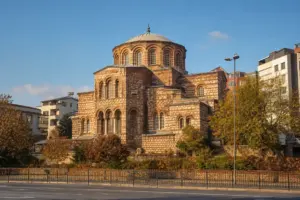 Constantine Lips Monastery Ruins – about 3.0 km away · typical visit: 45 minutes to 1 hour12 min on foot from Yusufpaşa metro
Main image: AI-generated illustration. It may not show the place exactly as it looks.
Metro stations near Yedikule Fortress
 Zeytinburnu – about 3.0 km awayOpen daily 06:00–00:00
Main image: AI-generated illustration. It may not show the place exactly as it looks.
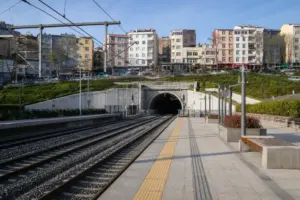 Kazlıçeşme – about 550 m away (~9 min walk)Open daily 06:00–23:59
Main image: AI-generated illustration. It may not show the place exactly as it looks.
Related guides
 Develi Samatya: Gaziantep Kebab Since 1966
Main image: AI-generated illustration. It may not show the place exactly as it looks.
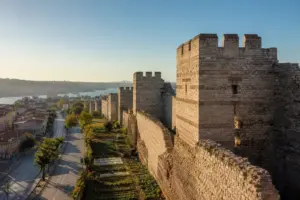 Theodosian Walls and City Gates Walk: 7 km Along Byzantine Defenses
Main image: AI-generated illustration. It may not show the place exactly as it looks.
 Spice Bazaar Shopping Guide: What to Buy in Eminönü
Main image: AI-generated illustration. It may not show the place exactly as it looks.
 Chora Church (Kariye Mosque): Mosaics and Visitor Route
Main image: AI-generated illustration. It may not show the place exactly as it looks.
 Blue Mosque Visiting Guide: Prayer, Courtyard and Tiles
Main image: AI-generated illustration. It may not show the place exactly as it looks.
Browse more: More in Fatih · All Landmarks · All Sightseeing
FAQ: Yedikule Fortress
What is the difference between Yedikule and other Istanbul castles?
Yedikule uniquely preserves both Byzantine (5th-century Theodosian Walls, the Golden Gate) and Ottoman (15th-century towers and enclosure) structures in a single site. It was not destroyed and rebuilt, but rather adapted over time. It served as treasury and prison, not primarily as a military stronghold. Fewer visitors and lower admission than Topkapi Palace or Hagia Sophia make it more intimate and easier to navigate.
Is Yedikule really open, or is it closed for restoration?
Yedikule is open to visitors. Multi-year restoration work was completed; the fortress is no longer fenced off and inaccessible. Some ongoing conservation work may affect specific sections at any time, but the core—courtyard, towers, ramparts, and the Golden Gate—is fully accessible. Check the official website (muze.gov.tr or yedikulehisari.com) for any current section closures.
Can I climb the towers and walk the walls?
Yes. Several towers are open to climb, including the Young Osman Tower (with dungeon access). The rampart walk is accessible via ramps and stairs; handrails mark steeper sections. Some stairs are steep and narrow. Wear shoes with good grip. Not all towers are open at all times; a guide can advise which are accessible on your visit day.
How long should I plan to spend at Yedikule?
A minimum of 90 minutes for a self-guided walk through the courtyard, key towers, and ramparts. Two hours is comfortable. 2.5–3 hours allows for slower exploration and interior details. With a municipal guided tour, expect 1.5–2 hours for the tour itself, plus additional time for independent exploration.
What is the Young Osman Tower, and why is it important?
The Young Osman Tower is the fortress's most historically charged space. Sultan Osman II, age 14, was imprisoned and executed here in 1622 by rebellious Janissaries. The dungeons and cells remain visible. It became the iconic symbol of the fortress's prison era and the moment when the Janissaries' power over sultans became undeniable in Ottoman history.
Can I visit Yedikule if I'm in Istanbul for only one day?
Yes. Yedikule is compact and can be visited in 1.5–2 hours. It is a 5-minute walk from the Yedikule metro station on the M1A line. If you are already in Sultanahmet (Topkapi or Hagia Sophia), you can reach Yedikule by metro in ~30 minutes. It fits into a half-day itinerary, or as a morning or afternoon supplement to central Istanbul sights.
Is the Museum Pass Istanbul valid for Yedikule Fortress?
The Museum Pass Istanbul does not reliably cover Yedikule. Yedikule is a fortress-museum managed by the Fatih Municipality and the Istanbul Metropolitan Municipality, not the national Ministry of Culture in the same way that Topkapi or Hagia Sophia are. Bring cash or card rather than assuming your pass works. Check the official source before your visit.
Istanbul Vibes is a one-person project. A coffee keeps it going
Hotels near Yedikule Fortress
- Hampton by Hilton Istanbul Zeytinburnu (350 m) Check prices (affiliate link, opens in a new tab)
- Queen seagull hotel (400 m) Check prices (affiliate link, opens in a new tab)
Affiliate link (opens the booking site): we may earn a commission at no extra cost to you.
Restaurants near Yedikule Fortress
- Büfe (100 m) Google Maps
- Yedikule kebap pilavcı (100 m) Google Maps
- Safir Köfte (100 m) Google Maps
- Kebapçıoğlu (150 m) Google Maps
Distances are straight-line, from OpenStreetMap data.

Take this guide with you
Get a free PDF of this guide to print or read offline: key facts, tips and a map link on a few clean pages.
Report an issue on this page
How we research and update our guides
About this guide: AI assistance and accuracy
This guide is created with the help of AI and is based on official sources where available. Mistakes can still happen. Opening hours, prices, rules and other details are given to the best of our knowledge as of the date shown and can change without notice. It offers general recommendations only, not professional, legal or travel advice. Please confirm important details with the official source before you travel; you are responsible for your own plans and decisions.
* Affiliate link: as an Amazon Associate we earn from qualifying purchases at no extra cost to you.
