
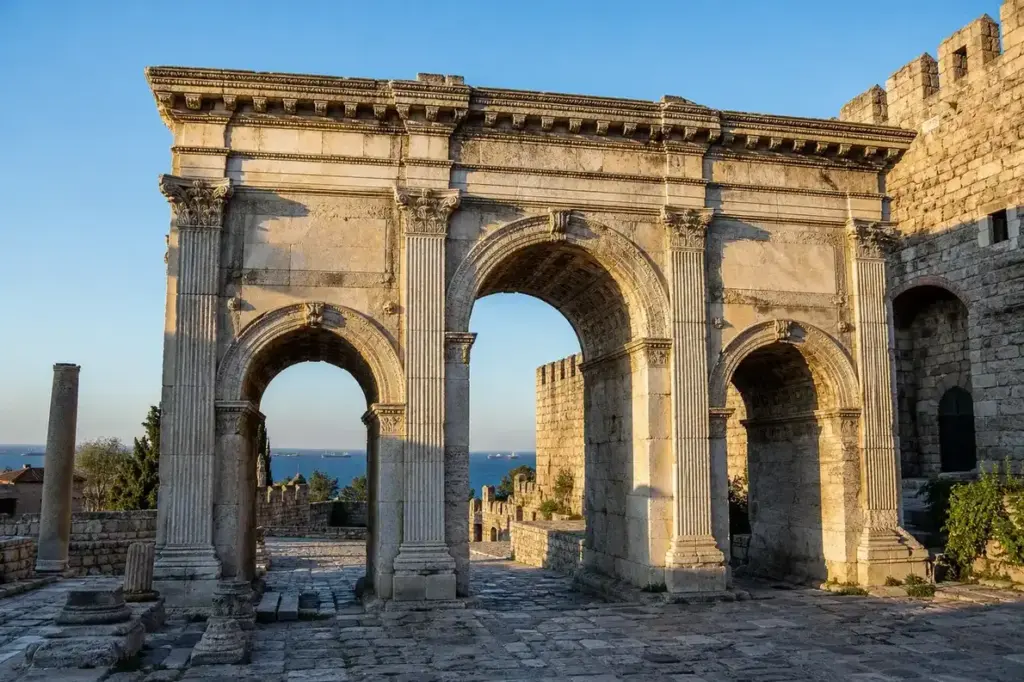
The Golden Gate (Altınkapı in Turkish) stands at the southern end of Istanbul’s ancient Theodosian Walls, a magnificent marble arch that once welcomed the city’s most powerful rulers. Built in the late 4th and early 5th centuries under Emperors Theodosius I and II, the Golden Gate served as Constantinople’s principal ceremonial entrance—the portal through which victorious generals, emperors, and their processions passed in triumph.
The gate takes its name from the gilded bronze doors and inscriptions that once adorned it, reflecting the wealth and authority of the Byzantine capital. Today, its weathered marble blocks and arches remain visible within Yedikule Fortress, where visitors can still trace the outlines of this once-glorious structure against the backdrop of the Sea of Marmara.
Current access notice: As of October 2026: The Golden Gate is located within Yedikule Fortress, which is open to visitors. The fortress is currently undergoing phased conservation work but remains accessible. Some tower sections or rampart portions may be closed temporarily during active restoration. Check the official Turkish Ministry of Culture website (muze.gov.tr) for current access status before visiting.
Quick Facts
| Turkish name | Altınkapı |
|---|---|
| Built / opened | 390–410 |
| Architect(s) | Emperor Theodosius I, likely completed under Theodosius II |
| Address | Yedikule Mahallesi, Yedikule Meydanı Sokak, Fatih, İstanbul Google MapsApple MapsYandex Maps |
| District | Fatih |
| Metro | Kazlıçeşme (Sirkeci-Kazlıçeşme Rail Line (T6), Follow signs to Yedikule; approximately 1 km walk east) |
| Admission | ₺₺ |
| Best time to visit | Spring (April–May) and autumn (September–October) offer mild temperatures and clear light without summer heat. Visit early morning (before 10:00 AM) or late afternoon (after 15:00) to avoid crowds and enjoy dramatic side-lighting on the marble. Sunrise casts a soft glow across the gate; sunset illuminates the Marmara Sea beyond. Winter visits are possible but windy conditions and shorter daylight hours require planning. Avoid midday summer sun, when the exposed fortress site offers limited shade. |
What Is (and Isn't) Part of a Visit to Golden Gate?
| Part | Status | Notes |
|---|---|---|
| Golden Gate (the marble triumphal arch itself) | Included in the standard ticket | The gate is part of the standard admission to Yedikule Fortress and accessible from the fortress courtyard. |
| Yedikule Fortress towers and ramparts | Included in the standard ticket | The fortress encircling the gate is included in your admission; several towers are accessible to visitors, though some stairs are steep and uneven. |
| Theodosian Walls (outer sections) | Included in the standard ticket | The fortress gates remain accessible to exterior viewpoints where you can see the adjoining sections of the land walls stretching north and south. |
| Istanbul Archaeological Museum fragments | Separate ticket or institution | Sculptural reliefs and other artifacts from the Golden Gate are displayed in the Istanbul Archaeological Museum in Sultanahmet; a separate ticket is required. |
| Scenic view of the Sea of Marmara | Included in the standard ticket | The fortress's western rampart, near the gate, offers views across the Marmara; accessible during normal visiting hours. |
| Ottoman-era prison towers (Young Osman Tower, etc.) | Included in the standard ticket | These towers, added by Mehmed II, are part of the Yedikule Fortress complex and covered by the same admission. |
Why Visit Golden Gate?
The Golden Gate offers a rare tangible connection to Constantinople’s imperial ceremony and military strategy. Unlike museums, you stand directly before the ancient marble—seeing the three-arched design, the flanking towers, and the architectural seams where Ottoman builders reinforced it centuries later. It represents a threshold between empires: the Byzantines valued it as a symbol of dynastic power; the Ottomans repurposed it as a fortress strongpoint.
For history enthusiasts and photographers, the gate rewards quiet morning visits when light falls dramatically on the stone and crowds are few. The surrounding fortress walls and Sea of Marmara views amplify the sense of historical depth.
How Golden Gate Is Laid Out
The Golden Gate is not a standalone structure but part of the larger Yedikule Fortress ensemble. Within the fortress, the Golden Gate occupies the western wall facing the Marmara Sea. The main gate consists of three arches: a broad central archway once reserved for imperial passage, flanked by smaller side passages for public use. Two towers once rose above the gate—these were incorporated into the fortress when Sultan Mehmed II added the surrounding defensive structures in 1457–1458.
To reach the Golden Gate on a visit to Yedikule, enter the fortress courtyard, then walk or climb to the western rampart. The gate’s monumental marble blocks are visible from both inside and outside the fortress walls. Climbing the accessible towers provides perspective on how the gate functioned as both a ceremonial entry and a military checkpoint controlling passage along the Via Egnatia, the great road connecting Istanbul to Rome.
Highlights of Golden Gate
The Three-Arched Structure
The Golden Gate's marble facade displays the classical triumphal-arch design: three barrel-vaulted passages arranged side by side. The central arch, measuring 8.5 metres wide and 15.5 metres high, was reserved exclusively for imperial use, while the two flanking arches served general passage. The arches were originally constructed without mortar, their massive white marble blocks from Proconnesian (modern-day Marmara Island) interlocked precisely—a technique reflecting Roman engineering at its finest.
Tip: Stand back from the gate to appreciate its full triumphal proportions; the entrance is best photographed from the fortress interior looking toward the Marmara side.
The Gilded Bronze Inscriptions
The Golden Gate earned its name from bronze inscriptions inlaid with gilded letters, which once covered both sides of the central archway. Holes into which these letters were inserted remain visible today, pocked into the marble surface. Literary sources describe elaborate dedicatory inscriptions in Greek and Latin, though the exact texts remain debated by historians. These inscriptions would have proclaimed imperial authority and religious blessing to all who entered.
Tip: Look closely at the weathered marble faces on either side of the central arch—the small circular holes are remnants of the ancient fastening system that held the gilded inscription plates.
Sculptural Reliefs and Decorative Elements
The outer gate was originally surrounded by an ensemble of marble reliefs depicting mythological scenes—particularly the Labours of Hercules. These reliefs, likely added in the 9th or 10th century to refresh the gate's imperial character, have largely been lost since the 17th century. However, fragments survive in the Istanbul Archaeological Museum, where Roman eagle reliefs and other sculptural pieces from the Golden Gate are preserved and displayed.
Tip: Pair your Yedikule visit with a visit to the Istanbul Archaeological Museum (in Sultanahmet, roughly 3 km north) to see the surviving marble relief fragments that once decorated the gate's exterior.
The Via Egnatia Connection
The Golden Gate marked the beginning of the Via Egnatia, the great Roman road that connected Constantinople to Rome via the Balkans—a route of supreme strategic and commercial importance. Within the city, the gate connected directly to the Mese, Constantinople's main thoroughfare, which ran north through the urban core to Hagia Sophia and the imperial palace. This routing made the Golden Gate not merely a ceremonial entry but the vital link in an empire-spanning infrastructure.
Tip: The path from the gate northward along the old Mese roughly follows today's Divanyolu (Divan Road) in the Sultanahmet district—a walking tour connecting the gate to Ottoman Istanbul makes the historical geography tangible.
The Towers Flanking the Gate
Two rectangular towers originally stood immediately adjacent to the central gateway, their tops crowned with Roman eagle reliefs. These were monumental structures in their own right, constructed of marble blocks and rising prominently above the surrounding walls. When the Ottomans built Yedikule Fortress in 1457–1458, they preserved and incorporated these ancient towers as the foundation, adding three additional towers to create the seven-tower ensemble visible today.
Tip: Climb the accessible fortress towers to see how the ancient marble of the Byzantine towers is visibly different in colour and texture from the later Ottoman stonework added around them.
The Imperial Procession Route
The Golden Gate's layout reflects its ceremonial function: the central arch was precisely wide enough for an emperor on horseback, flanked by guards on foot who used the side passages. Emperors like Heraclius (returning with the True Cross in 628) and Basil II (after victorious Balkan campaigns) entered through this gate in elaborate processions, their triumph enacted before crowds assembled in the Strategion plaza immediately inside the gate.
Tip: Read historical accounts before visiting—imagining the ceremonial processions helps you understand why such an enormous expenditure on marble and gilded decoration was justified in a militarily crucial defensive gate.
The Earthquake Damage and Partial Destruction
The gate survived largely intact through over a thousand years of warfare and neglect, until a catastrophic earthquake struck Constantinople in 1509. This quake, measuring an estimated magnitude 7.3, caused widespread destruction and partially collapsed the Golden Gate's structure. The gates themselves were destroyed, and the three-arched passage was significantly compromised. Ottoman builders of Yedikule subsequently reinforced the surviving masonry but never fully restored the gate to its original ceremonial function.
Tip: Notice the irregular stonework and visible repairs in sections of the gate's marble—these scars of the 1509 earthquake are still readable in the architecture today.
Transformation into Ottoman Military Architecture
The Golden Gate was converted into a fort surrounded by a wall protected by towers during the Ottoman period. Yedikule was formed by adding three identical cylindrical towers and an octagonal tower to the three existing towers. The ceremonial archway became a defensive strongpoint, its grand marble arches now serving a purely military function. The symbolic importance of the Altınkapı losing functionality was also significant in terms of reinforcing the defence against attacks from the sea and from within the city.
Tip: Walk around the exterior of the fortress to see how the Ottoman additions—visible in their different stone and construction technique—wrap around and reinforce the ancient Byzantine core.
Atmosphere
The Golden Gate site exerts a quiet, contemplative atmosphere, especially in early morning or late afternoon. Few crowds cluster here compared to central Istanbul sites; the fortress feels remote despite lying only kilometres from Sultanahmet. Weathered marble glows pale in sunlight, while gaps in the arches frame views of the Sea of Marmara beyond. Stone echoes footsteps on the ramparts. The physical presence of the Byzantine marble—heavy, unyielding, centuries-old—creates an almost tactile sense of historical time. Walking around the gate at different hours reveals how light transforms its character: bright and harsh at midday, soft and amber in late afternoon, moody and atmospheric at dusk. Local restoration workers occasionally move through the fortress, emphasizing that this is a living archaeological site, not a frozen museum display.
History of Golden Gate
Foundation in the Late Roman Era (late 4th century)
The Golden Gate was constructed under the reigns of Roman Emperors Theodosius I and II and served as the main ceremonial entrance to Constantinople, marking the start of the Mese, the city’s principal thoroughfare. Historians generally agree that the Golden Gate was constructed around 390–410 AD, probably during the reign of Theodosius II. The Golden Gate features a triple-arched structure and massive stone blocks, representing the continuation of the Roman triumphal arch tradition into the Byzantine era. The monumental complex, covered with Proconnesian marble, owes its name to the (disappeared) gilded door wings.
The Ceremonial Function (4th–15th centuries)
The gate was the main ceremonial entrance into the capital, used especially for the occasions of a triumphal entry of an emperor into the capital on the occasion of military victories or other state occasions such as coronations. Many emperors and commanders made a triumphant entry through it, including Emperor Heraclius in 628, known for recovering the True Cross and riding into the city on a chariot drawn by four elephants. The large arch in the middle was reserved only for emperors, while the small arched doors on both sides were made for public use.
Decorative Programme and Reliefs (9th–10th centuries)
The reliefs, lost since the 17th century with the exception of some fragments now in the Istanbul Archaeological Museum, were probably put in place in the 9th or 10th centuries to form the appearance of a triumphal gate. These reliefs were arranged in two tiers, and featured mythological scenes, including the Labours of Hercules. This secondary decorative programme suggests that Byzantine emperors continued to value the gate as a symbol of imperial legitimacy and power even as its ceremonial use declined.
The 1509 Earthquake and Partial Destruction
The gate survived until the Ottoman Era and was partly destroyed by an earthquake only in 1509. This catastrophic event damaged the marble arches and compromised the structural integrity of the gate, though sufficient masonry remained visible.
Ottoman Transformation: Yedikule Fortress (1457–1458)
Mehmet the Conqueror took advantage of the two towers flanking the Golden Gate, added an additional five towers, and enclosed them within a new defensive fortress. Yedikule was formed by adding three identical cylindrical towers and an octagonal tower to the three existing towers. In addition to the symbolic importance of the Altınkapı losing functionality, it was also significant in terms of reinforcing the defence against attacks from the sea and from within the city. The once-glorious ceremonial gate became a fortress, its role transformed from imperial symbol to military strongpoint.
Legends and Myths about Golden Gate
The Last Roman Emperor Will Reclaim the Gate
Legend – historically unreliable. It was believed that the last Roman emperor would reclaim the city by re-entering through this very gate. This eschatological prophecy embedded the Golden Gate deeply in Christian tradition, suggesting that some future Christian ruler would restore Constantinople to Christian hands by passing through its golden archway. The prophecy persisted through the Ottoman conquest and has echoed in Greek Orthodox folklore for centuries.
Heraclius and the True Cross
Disputed by historians. Emperor Heraclius in 628, known for recovering the True Cross and riding into the city on a chariot drawn by four elephants. This triumphant entry through the Golden Gate became legendary among Byzantine sources and later historians, symbolizing both military victory and religious validation. The image of an emperor in such ceremonial splendor passing beneath the gilded archway became an archetype for imperial authority.
Tickets and Booking for Golden Gate
| Ticket | Price | Includes |
|---|---|---|
| Standard admission (foreign adults and visitors) | ₺₺ | Access to the fortress grounds, ramparts, accessible towers, and the Golden Gate viewing areas. |
₺ budget · ₺₺ moderate · ₺₺₺ upscale · ₺₺₺₺ splurge. Price levels are estimates compared with typical prices for visitors.
Admission to the Golden Gate is included in the standard entrance fee to Yedikule Fortress. Tickets are purchased on-site at the fortress entrance; no advance online booking system is currently available. The Turkish Ministry of Culture website (muze.gov.tr) lists current admission rates and hours. Entry fees differ for Turkish citizens and various concession categories (students, children, disabled visitors); verify the current schedule and all ticket categories on the official government museum portal.
Suggested itineraries Golden Gate
1 hour
Enter the fortress courtyard, locate the Golden Gate marker on the western rampart, view the gate's three arches and marble structure, and walk along the adjacent walls. Take photographs from multiple angles. Exit via the main fortress gate.
1.5–2 hours
Begin at the fortress entrance and climb one or two of the accessible towers for orientation views. Descend to the courtyard and walk to the Golden Gate on the western rampart. Study the marble masonry, the arches, and the visible damage from the 1509 earthquake. Walk the rampart sections north and south to understand the gate's place within the larger defensive system. Visit the Young Osman Tower (Ottoman-era prison tower) if open.
2.5–3 hours
Follow the longer itinerary above, then exit the fortress and walk the exterior perimeter walls to view the gate from outside (weather and access permitting). Return to the fortress for a second internal circuit focusing on architectural details and transitions between Byzantine and Ottoman stonework. If a licensed guide is available, join a tour to access stories of the gate's ceremonial use and the fortress's role as an imperial prison.
How to Get to Golden Gate
By rail (recommended): Take the Sirkeci-Kazlıçeşme Rail Line (T6, a light rail service that also operates as Marmaray commuter rail) and alight at Kazlıçeşme station. From the platform, walk approximately 1 kilometre east toward the massive silhouette of the fortress towers rising above the Theodosian Walls; the path is generally flat and passes through the Yedikule neighbourhood. The fortress entrance is well-signposted from the station. Journey time: approximately 20–25 minutes from Eminönü or Sirkeci in the old city.
By bus: Buses 80 and 81 from Eminönü (the ferry terminal area) run to the fortress vicinity; journey time roughly 20–30 minutes depending on traffic. The bus stop is a short walk from the fortress entrance. Bus 80T from Taksim also serves this route but takes longer.
Walking from Theodosian Walls: If you are already walking the land walls route south from Topkapi or Edirnekapı, the Golden Gate at Yedikule marks the southern terminus. A 2–3 hour walk along the ramparts connects the northern gates to the fortress.
Accessibility
The fortress site is partially accessible. The courtyard and approach paths are generally level and passable. However, climbing the towers requires ascending steep, uneven stone stairs—some without handrails—and is not suitable for wheelchair users or those with limited mobility. The viewing areas near the Golden Gate itself, positioned on the rampart, require navigating stone surfaces and steps. Accessible seating is limited. The fortress operator recommends advance contact to discuss individual accessibility needs; current facilities information is available on muze.gov.tr.
Food Nearby
The Yedikule neighbourhood offers a limited selection of casual eateries within walking distance of the fortress, including small kebab shops, tea gardens (çay bahçesi), and food stalls near the railway station. For more substantial dining options, travel north approximately 2–3 kilometres to Aksaray or Zeytinburnu neighbourhoods, where restaurants and cafes are more numerous. Pack water and snacks if visiting during a long site exploration; the fortress site itself has no food vendors.
What to Bring
Wear comfortable walking shoes with good grip, as stone surfaces are uneven and can be slippery in damp conditions. Bring plenty of water, as the exposed fortress site offers minimal shade and can be hot or windy. Sun protection (hat, sunscreen) is essential, especially in summer. A light jacket or windbreaker is advisable, particularly on windy days or in cooler months. Camera or smartphone for photographs. Small bags are permitted; follow current security rules posted at the entrance.
Best Views and Photo Spots of Golden Gate
The three-arched facade of the Golden Gate, viewed from the fortress courtyard
This head-on perspective captures the triumphal-arch proportions—the central arch's width and the symmetrical flanking passages. The weathered marble contrasts dramatically with blue sky, and if clouds are present, dramatic shadows define the archways. This is the most iconic angle and works equally well in soft morning light or late afternoon.
Best time: Late afternoon (16:00–17:30) when side-lighting creates strong shadow definition on the marble arches; alternatively, early morning with softer, more diffuse light.
The Golden Gate as seen from the western fortress rampart, with the Sea of Marmara beyond
From this vantage, the gate recedes into depth, framed by surrounding fortress walls and with water visible at the horizon. This perspective emphasizes the gate's integration into the defensive system and its strategic position overlooking the maritime approach.
Best time: Clear days with minimal haze; morning for warm directional light, late afternoon for silhouetting the gate against bright water.
The marble inscriptions holes on the central arch
A detailed close-up of the weathered marble surface showing the regular pattern of circular holes where gilded inscription letters were once anchored. These small details reveal the gate's ornamental sophistication and the passage of time. Macro or telephoto photography works well here.
Best time: Soft, directional side-light that casts shadows into the holes, revealing their depth and distribution pattern.
The junction between Byzantine marble and Ottoman stone reinforcements
This archaeological detail shows the visible seam where ancient Roman-era masonry meets medieval Ottoman additions—a literal timeline carved into stone. Walk around the gate's perimeter to find the clearest examples of this transition.
Best time: Any time when direct light hits the stone face, emphasizing the colour and texture difference between marble and later stonework.
The fortress towers flanking the gate, viewed from ground level looking upward
Positioning yourself directly beneath the towers and tilting your camera upward creates a dramatic perspective emphasizing their scale and height. The stone faces recede into the frame, conveying the fortress's defensive dominance.
Best time: Clear days with strong directional light; midday sun can create harsh shadows, so early morning or late afternoon work better for balanced exposure.
Photography Rules
Photography for personal use is permitted throughout the fortress and at the Golden Gate. Tripods and professional equipment require advance permission from the site management; check with the ticket office before setting up. Drone photography is prohibited. Flash photography is not restricted but is unnecessary given the site's excellent natural light. The marble and surrounding walls photograph exceptionally well during early morning and late afternoon when light is low and shadows define the masonry.
Family Suitability
The site is suitable for families with older children (ages 8+) who can manage steep, uneven stone stairs and extended walking. The fortress courtyard is relatively flat and safe for younger children if closely supervised. However, climbing the accessible towers is physically demanding—steep stone stairs, narrow passages, and minimal railings make it unsuitable for toddlers or children with balance difficulties. The open ramparts, while featuring some protective wall sections, offer few barriers; careful supervision is essential. No dedicated children's facilities, play areas, or frequent sitting spots are available. Best visited during cooler months or early morning to minimize heat exposure. Allow at least 90 minutes if your family climbs one tower; a casual ground-level visit takes 45 minutes to 1 hour.
Istanbul Vibes Tips
- Arrive early (before 10:00 AM) on weekdays to encounter the site at its quietest and enjoy morning light on the marble. The fortress typically draws fewer visitors than central Sultanahmet sites, but weekends and holidays bring noticeably more crowds.
- Study one section of marble closely with a magnifying glass or smartphone camera zoom to read the archaeological record—seeing the earthquake cracks, ancient fastener holes, and later patch mortar transforms a visit from casual sightseeing to active observation.
- Do not confuse the Golden Gate (Altınkapı) with the Golden Horn (Altın Boynuz), the waterway in northern Istanbul. The Golden Gate stands at the opposite (southern) end of the city's walls, near the Sea of Marmara.
- Bring binoculars if you have them. From the fortress towers, these reveal architectural details in the distant land walls stretching north, and occasionally allow spotting of waterbirds or seasonal migrants over the Marmara—adding a natural history dimension to the historical visit.
- Combine your Golden Gate visit with a walk along the outer Theodosian Walls to the north (toward Topkapi or Edirnekapı gates) or visit the Istanbul Archaeological Museum in Sultanahmet to see the relief fragments that once adorned the gate's exterior—these separated visits create a fuller understanding of the site's original splendour.
- Visit on an overcast day if possible. Harsh midday sun washes out the marble's colour and texture; cloud cover or golden-hour light reveals the stone's true character and makes photography far more rewarding.
Explore Nearby Golden Gate
Sights near Golden Gate
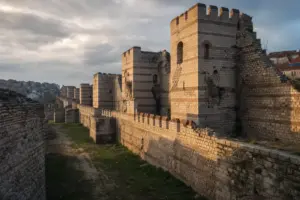 Theodosian Walls · typical visit: 2–3 hours
Main image: AI-generated illustration. It may not show the place exactly as it looks.
 Istanbul Military Museumabout 7.9 km away · typical visit: 2–3 hours
Main image: AI-generated illustration. It may not show the place exactly as it looks.
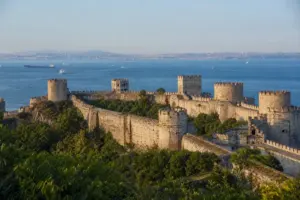 Yedikule Fortress – about 50 m away (~1 min walk) · typical visit: 2–3 hours9 min on foot from Kazlıçeşme metro, Open 09:00–17:00, closed Mon
Main image: AI-generated illustration. It may not show the place exactly as it looks.
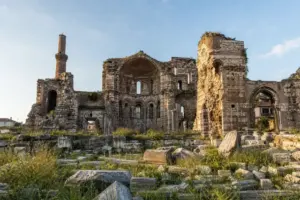 Stoudios Monasteryabout 600 m away (~10 min walk) · typical visit: 1–2 hours (exterior viewing only)
Main image: AI-generated illustration. It may not show the place exactly as it looks.
 Panorama 1453 – about 2.8 km away · typical visit: 1–2 hours2 min on foot from T1 Topkapı metro, Open daily 08:00–19:00
Main image: AI-generated illustration. It may not show the place exactly as it looks.
Metro stations near Golden Gate
 Kazlıçeşme – about 500 m away (~8 min walk)Open daily 06:00–23:59
Main image: AI-generated illustration. It may not show the place exactly as it looks.
Related guides
 Theodosian Walls and City Gates Walk: 7 km Along Byzantine Defenses
Main image: AI-generated illustration. It may not show the place exactly as it looks.
 Spice Bazaar Shopping Guide: What to Buy in Eminönü
Main image: AI-generated illustration. It may not show the place exactly as it looks.
 Chora Church (Kariye Mosque): Mosaics and Visitor Route
Main image: AI-generated illustration. It may not show the place exactly as it looks.
 Blue Mosque Visiting Guide: Prayer, Courtyard and Tiles
Main image: AI-generated illustration. It may not show the place exactly as it looks.
 Topkapı Palace Visiting Guide: Courtyards, Treasury and Harem
Main image: AI-generated illustration. It may not show the place exactly as it looks.
Browse more: More in Fatih · All Landmarks · All Sightseeing
FAQ: Golden Gate
Is the Golden Gate free to visit?
No. The Golden Gate is located within Yedikule Fortress, which charges an admission fee (approximately ₺₺ for foreign visitors as of 2026). Turkish citizens and certain concession categories pay different rates. Check muze.gov.tr for current pricing before your visit.
Can I see the Golden Gate without entering the fortress?
Partially. The gate is visible from outside the fortress walls when viewed from certain angles on the adjacent streets, but a meaningful visit requires fortress admission. Interior views and close examination of the marble structure are only possible inside.
Is the Golden Gate the same as the Golden Horn?
No. The Golden Gate (Altınkapı) is a Byzantine triumphal arch in the southern Theodosian Walls. The Golden Horn (Altın Boynuz) is a major waterway in the northern part of Istanbul. They are entirely different locations and historical features.
How long should I spend at the Golden Gate?
Allow 1–2 hours for a thorough visit. This includes viewing the gate structure itself, walking the fortress ramparts, and climbing one or two towers. If you hire a licensed guide or explore the full fortress grounds including all towers, add another 1–1.5 hours.
Is it safe to climb the fortress towers?
The accessible towers feature stone stairs and some protective railings, but stairs are steep, uneven, and narrow. The site is generally safe if you move carefully and stay alert to uneven surfaces. Wearing sturdy footwear and using handrails where available is essential.
Can I visit the Golden Gate and the Istanbul Archaeological Museum on the same day?
Yes. The fortress (approximately 7 km south of Sultanahmet) can be visited in 1.5–2 hours, then travel north by bus, rail, or taxi to the Archaeological Museum (30–45 minutes depending on traffic) to see marble relief fragments from the gate's original decoration. This makes a rewarding combined itinerary.
When was the Golden Gate built?
Construction occurred in the late 4th and early 5th centuries CE, likely beginning under Emperor Theodosius I and completed under Theodosius II (around 390–410 CE). It served as Constantinople's main ceremonial entrance for over a thousand years.
Why is it called the 'Golden' Gate if it no longer has gold?
The gate's name derives from its original gilded bronze doors and inscriptions inlaid with gilded letters, visible until the 17th century. These gold elements disappeared centuries ago, but the historical name persists. Holes where the gilded letters were anchored remain visible in the marble today.
Istanbul Vibes is a one-person project. A coffee keeps it going
Hotels near Golden Gate
- Hampton by Hilton Istanbul Zeytinburnu (300 m) Check prices (affiliate link, opens in a new tab)
- Queen seagull hotel (450 m) Check prices (affiliate link, opens in a new tab)
Affiliate link (opens the booking site): we may earn a commission at no extra cost to you.
Restaurants near Golden Gate
- Büfe (150 m) Google Maps
- Yedikule kebap pilavcı (150 m) Google Maps
- Safir Köfte (200 m) Google Maps
- Kebapçıoğlu (200 m) Google Maps
Distances are straight-line, from OpenStreetMap data.

Take this guide with you
Get a free PDF of this guide to print or read offline: key facts, tips and a map link on a few clean pages.
Report an issue on this page
How we research and update our guides
About this guide: AI assistance and accuracy
This guide is created with the help of AI and is based on official sources where available. Mistakes can still happen. Opening hours, prices, rules and other details are given to the best of our knowledge as of the date shown and can change without notice. It offers general recommendations only, not professional, legal or travel advice. Please confirm important details with the official source before you travel; you are responsible for your own plans and decisions.
* Affiliate link: as an Amazon Associate we earn from qualifying purchases at no extra cost to you.
