
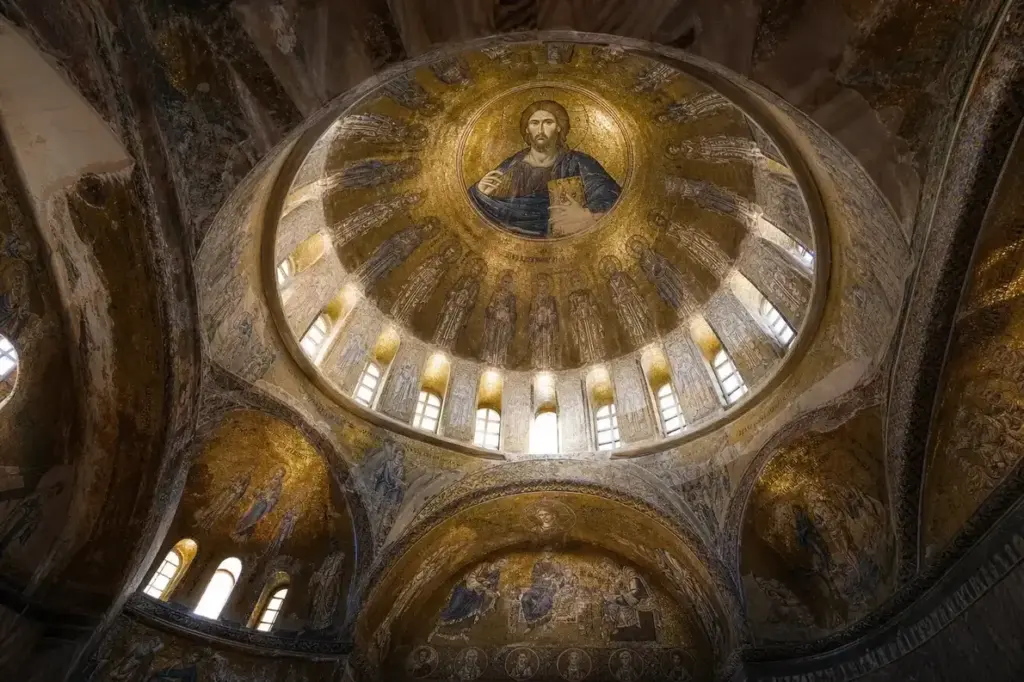
Chora Church, now formally called Kariye Mosque (Kariye Camii), houses the world’s most complete cycle of late-Byzantine mosaics and frescoes. Located in Istanbul’s Fatih district near the ancient Theodosian Walls, this 14th-century artistic masterpiece remains virtually untouched by time, preserved first under plaster during centuries of Ottoman rule, then restored painstakingly by American scholars from 1948 to 1959.
The building reopened to visitors in May 2024 after a four-year restoration, functioning as an active mosque while remaining open to tourists outside prayer times. Entry requires a separate ticket; the Museum Pass is not accepted.
Current access notice: As of October 2026: Chora Church (Kariye Mosque) is open to foreign visitors for a fee. The mosque is closed to tourist visits on Fridays for prayer. Entry is not permitted during the five daily prayer times; visitors are turned away 15 minutes before each prayer and may wait outside. Check the official website for prayer times before visiting.
Quick Facts
| Built / opened | 1077 |
|---|---|
| Architect(s) | Maria Doukaina (1077–1081); Isaac Komnenos (early 12th century); Theodore Metochites (1316–1321) |
| Address | Dervişali Mah., Kariye Camii Sk. No:18, 34087 Edirnekapı/Fatih/İstanbul Google MapsApple MapsYandex Maps |
| District | Fatih |
| Metro | Edirnekapı (T1, T4, Follow signs for Kariye Camii; about 8 minutes' walk uphill) |
| Admission | ₺₺ for foreign adults; children 8 and under free |
| Best time to visit | Visit early morning (9:00–11:00 am) to beat crowds and catch warm light through south-facing windows illuminating the mosaics. Avoid Friday entirely; the mosque is closed to tourists and focused on worship. Avoid prayer times (typically around noon, mid-afternoon and early evening; check the official site or ask at your hotel for exact times). Autumn (September–November) and spring (April–May) offer mild weather and fewer visitors than summer. The building is less crowded than Hagia Sophia and the Blue Mosque, but midday in peak summer tourist season (July–August) brings more people. |
| Website | muze.gen.tr/muze-detay/kariye |
What Is (and Isn't) Part of a Visit to Chora Church?
| Part | Status | Notes |
|---|---|---|
| Main church (naos), exonarthex (outer entrance hall) and narthex (inner vestibule) | Included in the standard ticket | Core Byzantine building with mosaics and the main Christ Pantocrator image in the dome. |
| Parekklesion (funerary chapel, south side) | Included in the standard ticket | Contains the famous Anastasis fresco and Last Judgment cycle; same ticket as main church. |
| The Ebu Said El Hudri Tomb | Outside / not part of it | Ottoman structure next to the entrance gate; you pass it but do not enter as part of the visit. |
| Courtyard garden | Included in the standard ticket | You cross this area before entering; security checkpoint is located here. |
| Interior decoration (mosaics and frescoes) | Included in the standard ticket | All visible artwork is included in the ticket. Some areas may be temporarily restricted during daily prayers. |
| Audio guide (QR code) | Included in the standard ticket | Digital audio guide available with ticket; bring your own headphones. Narrates the mosaics and frescoes. |
| Islamic prayer ceremony | Not open to visitors | The five daily prayers are for worshippers only; tourists must exit during these times. |
Why Visit Chora Church?
The mosaics and frescoes here represent the final flowering of Byzantine painting before the Ottoman conquest. Biblical scenes unfold across walls and domes with astonishing detail and emotional depth—from the Life of Christ and Mary to the Resurrection (Anastasis), the most famous image in the building. The Parekklesion, a side chapel added in the 14th century by Theodore Metochites, contains frescoes of the Last Judgment that move visitors across centuries.
Unlike the busier Hagia Sophia and Blue Mosque, Chora draws fewer crowds, allowing quiet contemplation of these irreplaceable works. The building itself—a blend of Byzantine quincunx design with Ottoman minarets—tells Istanbul’s layered religious history on its facade.
How Chora Church Is Laid Out
The church is a compact, single structure oriented east to west in traditional Byzantine style. The main body is the naos (central chamber), entered from the narthex (entrance hall). On its south side stands the Parekklesion, a funerary chapel added by Theodore Metochites in 1316–1321 and decorated with the famous frescoes of the Last Judgment. Two Ottoman minarets are visible on the exterior.
Visitors enter through a gate next to the Ebu Said El Hudri Tomb in the garden courtyard, pass security, and arrive at the main entrance. The layout is simple enough to explore in under an hour, though mosaics reward slow study.
Highlights of Chora Church
The Anastasis Fresco
In the Parekklesion's dome, Christ pulls Adam and Eve from their tombs while figures watch in amazement. Painted between 1315 and 1321, this is the most celebrated image in the building—a powerful expression of salvation and resurrection that appears in few other locations. The golden light and expressive faces show Late Byzantine painting at its peak. Look for the broken gates of Hell beneath Christ's feet.
Tip: The dome is high; bring binoculars or a zoom camera to see the faces clearly. Visit early morning when light from the south side illuminates it best.
Scenes from the Life of Mary
The walls of the exonarthex (outer entrance passage) display cycles of Mary's infancy, dedication and marriage narrated in mosaics. Created around 1315–1321 under Theodore Metochites, these scenes show Byzantine craftsmen at their finest, with gold backgrounds making figures glow. Each scene is labeled in Greek above.
Tip: The light in the exonarthex changes through the day; the morning light from the windows is warmest. Study the details of clothing and architectural backgrounds—the artists rendered the world with remarkable realism.
Christ Pantocrator Mosaic
In the main naos, a monumental Christ Pantocrator (Almighty judge) gazes outward from the dome, one of several Christ images throughout the church. These mosaics survived intact because Ottoman plaster covered them for centuries. The restoration from 1948–1959 by the Byzantine Institute of America painstakingly removed the plaster without damaging the underlying gold and stone tesserae.
Tip: Look carefully at the tesserae (tiny stone and glass tiles) that compose the images—the iridescent quality comes from ancient glass that catches light differently from each angle.
The Parekklesion Frescoes
This funerary chapel contains a complete Last Judgment cycle painted in fresco (not mosaic), spanning the west, north and south walls and dome. Angels blow trumpets, the dead rise from their tombs, and Christ sits in judgment while the righteous ascend and the damned descend. Painted around 1320, these survive in remarkable colour despite age and the mosque's moisture.
Tip: The frescoes here are painted, not tiled, so they convey softer, more intimate emotion than the formal mosaics in the main church. Stand in the centre and turn slowly to take in the whole cycle.
Byzantine Architectural Details
The building itself embodies Byzantine architectural tradition. Built in the quincunx (inscribed cross) style, it features a central dome supported by four squinches, creating a cross plan inscribed within a square. This design, rebuilt by Maria Doukaina in 1077–1081 and enlarged after partial collapse in the early 12th century, showcases the engineering and aesthetic principles Byzantine architects perfected.
Tip: Look up at the dome structure to understand the engineering—how the four supporting arches meet the central dome is the key to understanding Byzantine churches throughout Istanbul.
Ottoman-Era Additions
After conversion to a mosque in 1511 by Grand Vizier Atik Ali Pasha, two minarets were added to the exterior, a mihrab (prayer niche) was installed in the naos, and the belfry was removed. The Ottomans largely left the artistic programme untouched, simply covering many mosaics with plaster and whitewash—a decision that ultimately preserved them.
Tip: View the exterior from the street outside the garden gate to see how the Ottoman minarets sit alongside the Byzantine domes, a visual record of the building's transformations.
Atmosphere
The Parekklesion is intimate and meditative, with painted frescoes creating softer light than the glittering main chamber. The naos feels grander, its dome rising overhead with Christ watching from above. Gold tessellated backgrounds and the play of natural light from high windows make the mosaics shimmer and shift.
Quiet attentiveness defines the space. Visitors speak in hushed tones, eyes upward. During morning hours before prayer times, you may have the building nearly to yourself. Fridays are busy with worshippers and closed to tourists. The space smells faintly of age, plaster and incense. Outside, call to prayer echoes from the minarets.
History of Chora Church
Early Origins (4th Century)
The site began as a chapel outside the walls of Constantinople, possibly housing relics of the saint Babylas. The Chora Church was originally built in the early 4th century as part of a monastery complex outside the city walls of Constantinople. The name—derived from the Greek word for “countryside” or “land”—reflected this remote location. When Theodosius II built his formidable land walls in 413–414, the church became incorporated within the city’s defences, but retained the name Chora.
Early Byzantine Period (6th Century)
The first Chora Church was rebuilt by Justinianus (527-565) in place of this chapel. In the era of Komnenoi, it served as the court chapel for important religious ceremonies, thanks to its nearness to the Palace of Blachernae.
Crusader Period and Early Reconstruction (1204–1281)
Chora Church was destroyed during the Latin invasion (1204-1261) and repaired in the reign of Andronikos II (1282-1328) by the Treasury Minister of the palace, Theodore Metochites (1313).
11th-Century Rebuilding (1077–1081)
The majority of the fabric of the current building dates from 1077–1081, when Maria Dukaina, the mother-in-law of Alexius I Comnenus, rebuilt the Chora Church as an inscribed cross or quincunx: a popular architectural style of the time. Early in the 12th century, the church suffered a partial collapse, perhaps due to an earthquake. The church was rebuilt by Isaac Comnenus, Alexius’s third son.
Late Byzantine Masterpiece (1315–1321)
Chora Church was destroyed during the Latin invasion (1204-1261) and repaired in the reign of Andronikos II (1282-1328) by the Treasury Minister of the palace, Theodore Metochites (1313). It was expanded towards north, an exonarthex was added to its western side and a chapel (Parecclesion) to its southern side, and it was decorated with mosaics and frescoes. They were completed between 1315 and 1321. The mosaics and frescoes in the Chora are the most beautiful examples dating from the last period of the Byzantine painting (14th century).
Ottoman Conversion (1511–1945)
After continuing to serve as a church following the conquest of Istanbul in 1453, the building was converted into a mosque in 1511 by Vizier Hadim Ali Pasha. A mihrab was added, the belfry was removed, and a minaret was built, while the Christian mosaics and frescoes were covered with plaster. For over four centuries, the Byzantine art lay hidden beneath whitewash and plaster.
Museum Era and Restoration (1945–2020)
It was converted into a museum in 1945, and during the restoration in 1948-1959 carried out by the Byzantine Institute of America, the mosaics and frescoes were uncovered and brought to the daylight. Studies, led by the American scholars Thomas Whittemore and Paul A. Underwood, launched a painstaking restoration project. For nearly 75 years, the building functioned as a museum, allowing the world to marvel at preserved Byzantine art.
Return to Mosque (2020–Present)
A presidential decree of 21 August 2020 transferred the building to Turkey’s Directorate of Religious Affairs and reconverted it into a mosque. After a four-year restoration, it officially reopened for worship and visitors on May 6, 2024 as Kariye Camii. The building now functions as a working mosque that welcomes tourists outside prayer times, blending its multiple identities into the present.
Legends and Myths about Chora Church
Saint Babylas's Relics
Legend – historically unreliable. According to tradition, the site originally housed the relics of Saint Babylas, an early Christian martyr. The location gained spiritual significance as a necropolis for his burial, and the chapel that preceded the formal church was built to honor him. When the city walls later enclosed the site, the saint's presence was believed to sanctify the ground.
The Hidden Mosaics
For nearly 400 years, the Byzantine mosaics were invisible beneath Ottoman plaster and whitewash. When American scholars Thomas Whittemore and Paul Underwood began systematic uncovering in 1948, workers discovered pigments and tesserae so vibrant they seemed almost painted yesterday. The story of their revelation—layer by layer, fresco by fresco—became legendary among art historians, a resurrection of beauty thought permanently lost.
Tickets and Booking for Chora Church
| Ticket | Price | Includes |
|---|---|---|
| Foreign adult | ₺₺ | Entry to the main church, exonarthex, narthex and Parekklesion; digital QR-code audio guide (bring headphones); access to gardens and courtyard. |
| Child (8 and under) | Free | Free entry; same access as adults. |
| Turkish citizen / resident | Free | Discounted or free entry according to official policy; check current rates on the official site. |
₺ budget · ₺₺ moderate · ₺₺₺ upscale · ₺₺₺₺ splurge. Price levels are estimates compared with typical prices for visitors.
Tickets are purchased on site at the entrance counter, located next to the Ebu Said El Hudri Tomb. Online tickets (skip-the-line e-tickets) can be purchased in advance from the official ticketer, DEM MUSEUMS, via the Directorate of Religious Affairs website (muze.gen.tr). E-tickets reduce wait time but are not required.
Online tickets become available several days before each date. If a date shows as not yet available, it means sales have not opened; check back in a few days. Same-day on-site tickets are usually available unless the site reaches capacity during peak tourist season.
Entry is not permitted during the five daily prayer times. Admission closes 15 minutes before prayer and remains closed for the duration of prayer (typically 20–30 minutes). Visitors waiting outside can re-enter after prayer concludes.
The Istanbul Museum Pass is not accepted. Rates differ for Turkish citizens, residents and concessions (student, pilgrim, disability and accompanying carer). Check the official Directorate of Religious Affairs website (muze.gen.tr) for all current ticket categories and rates.
Suggested itineraries Chora Church
1–1.5 hours (quick visit)
Enter through the garden gate and security. Walk through the exonarthex (outer hall) to observe the Life of Mary mosaics, then enter the main naos to see Christ Pantocrator overhead. View the dome structure. Spend 10–15 minutes in the Parekklesion to see the Anastasis fresco and Last Judgment frescoes. Exit through the same gate.
2–3 hours (standard visit)
Begin in the exonarthex, studying each mosaic panel on the Life of Mary with the audio guide. Enter the naos and spend time identifying Christ imagery and architectural details. Move to the Parekklesion for the Anastasis fresco, tracing the Last Judgment cycle from west to south to north. Sit quietly in the Parekklesion to absorb the frescoes. Return to the main naos to review favourite mosaics before leaving.
Half day (4–5 hours with nearby sites)
Spend 2–3 hours in Chora Church as above. Exit and walk to the nearby Theodosian Walls (10 minutes; visible from outside). Walk down to Balat neighbourhood near the Golden Horn (15–20 minutes) to see traditional wooden houses and small cafés. Return via tram or uphill to Edirnekapı.
How to Get to Chora Church
By Tram: Take the T1 or T4 tram to Edirnekapı station. Walk uphill (northeast) away from the Golden Horn for about 8 minutes, following signs for Kariye Camii. The church is set back from the street; look for the garden gate entrance next to the Ebu Said El Hudri Tomb. You will know you are close when you see a small courtyard with trees.
By Taxi or Private Car: Taxis can drop you at the intersection of Kariye Camii Sokak and Dervişali Mahallesi. The entrance is off a quiet lane; confirm the address (Dervişali Mah., Kariye Camii Sk. No:18) with your driver.
On Foot from Balat: Balat neighbourhood (10–12 minutes’ walk; reached by T1 tram to Balat station) connects uphill via winding streets to Edirnekapı and Chora Church. This route is picturesque but steep.
Accessibility
The church is difficult to access for those with limited mobility. The entrance requires climbing a sloped garden path and several steps. There is no wheelchair access to the interior. The interior is a single compact level with no lifts or ramps between the main naos and Parekklesion (one step down). Staff may assist, but mobility aids are not practical in this historic space. Seating benches are available for rest. Hearing aids do not function well in the echoing space. Check with staff upon arrival if you have specific access needs; the official Directorate of Religious Affairs (muze.gen.tr) does not publish detailed accessibility information.
Food Nearby
Edirnekapı is quieter than central Istanbul and has limited dining options within walking distance. Small cafés and tea shops are clustered on the street leading up to the church and in the surrounding neighbourhood—look for informal establishments catering to local residents rather than tourists. Better options are in Balat neighbourhood (15–20 minutes walk downhill toward the Golden Horn), where you will find small restaurants serving Turkish breakfast, meze and fish. The Theodosian Walls area nearby is mostly residential. Bring water, as the area is hilly and can be hot in summer.
What to Bring
Wear modest clothing (covered shoulders and knees); women may wish to bring a headscarf for the main prayer chamber, though not strictly required. Bring binoculars or a camera with good zoom to see details of high mosaics in the dome. Headphones for the audio guide. Water (the area is elevated and can be hot). Comfortable shoes for uphill walking from the tram. Small notebook to sketch or take notes. Flash photography is prohibited; bring a tripod only if you have prior permission from staff.
Best Views and Photo Spots of Chora Church
Parekklesion dome (interior, looking up)
The Anastasis fresco fills your frame—Christ pulling Adam and Eve from the tomb, surrounded by apostles, angels and saints. The dome curves around you, creating an immersive composition. The frescoed faces have remarkable expression and depth.
Best time: Early morning (9:00–11:00 am) when indirect light from the south window creates soft, even illumination without harsh shadows on the faces.
Exonarthex west wall (Life of Mary mosaic panels)
Golden background tessellations catch light while the narrative scenes of Mary's life unfold in precise Byzantine detail. The composition emphasizes the figures against architectural backgrounds. Greek inscriptions label each scene.
Best time: Morning light (9:00–11:00 am) enters from the south, illuminating the mosaics' iridescent quality and making the gold shimmer.
Main naos, standing beneath the central dome
The dome rises overhead with Christ Pantocrator at the apex, surrounded by supporting arches and squinches. The architectural geometry and the Christ figure create a powerful upward perspective. Look for the light effects created by the dome's windows.
Best time: Midmorning to midday (10:00 am–2:00 pm) when light from high windows fully illuminates the dome structure.
Parekklesion, west wall (Last Judgment fresco, full view from centre)
The Last Judgment spans the entire west wall—a complex narrative of Resurrection, judgment and eternal consequence. The composition shows movement, emotion and Renaissance-like perspective unusual in Byzantine art. Figures ascend and descend in distinct zones.
Best time: Late afternoon (4:00–5:00 pm) when western light floods the west wall, warming the frescoed figures and creating dramatic shadows that emphasize the composition's depth.
Exterior view from the street (garden gate)
Two Ottoman minarets rise alongside Byzantine domes—a striking visual of the building's dual history. The stone construction and dome proportions are visible. The garden gate and entrance path frame the view.
Best time: Late morning (10:00–11:00 am) when the minarets cast long shadows defining their silhouettes against the sky.
Narthex, Christ Pantocrator mosaic (looking up at the dome pendentive)
A monumental Christ gazes down directly over the entrance passage. This mosaic is brightly lit by high windows, making the gold background glow. The intimacy of the space makes the figure's gaze feel direct.
Best time: Any time of day when the sun is high enough to illuminate the dome; the covered interior remains consistently lit by high windows.
Photography Rules
Photography without flash is permitted throughout the building. Flash photography is strictly prohibited to protect the delicate mosaics and frescoes. Tripods require staff permission before use. Drone photography is not permitted. Video recording for personal use is allowed without commercial intent. Do not photograph worshippers during prayer times.
Family Suitability
Chora Church suits older children (ages 10+) and teens interested in history, art and architecture. The building involves climbing a sloped garden path and stairs, and the interior features high, detailed artwork that benefits from height and reading ability. Strollers are not practical due to steps and narrow passages. Young children may struggle with the physical demands and the length of time required to appreciate the art. The quiet, contemplative atmosphere is not ideal for families with small children prone to running or noise. Families visiting should allow time to sit, study details and ask the audio guide questions.
Istanbul Vibes Tips
- Visit before noon if possible. Prayers at midday (Zuhr prayer) and throughout the afternoon can interrupt visits. The exonarthex and Parekklesion generally remain accessible longer than the main naos, but all areas close 15 minutes before prayer. Early morning ensures the longest uninterrupted time to study the artwork.
- Use the audio guide and zoom in on details. The mosaics are small and high; bring binoculars or use your camera's zoom function to see faces, inscriptions and architectural details in the domes and vaults. The audio guide explains iconography and Byzantine art history, making the artwork richer.
- Do not assume the Istanbul Museum Pass works here. Many visitors arrive with a Museum Pass expecting entry and are surprised at the gate. Chora Church requires its own separate ticket (₺₺ for foreigners) purchased on site or in advance online.
- The neighbourhood is quiet and hilly. Wear comfortable walking shoes and bring water. There are few cafés or rest areas nearby. Allow extra time to climb from the tram station. If visiting after 4:00 pm in autumn or winter, light begins fading earlier, affecting photography and the visibility of high mosaics.
- Dress modestly (covered shoulders and knees). The building is an active mosque, and you are expected to respect worship customs. Women may wish to carry a headscarf as a courtesy, though it is not strictly required outside prayer times. Photography during prayers is strictly prohibited out of respect.
- Learn the basic structure before you arrive. The quincunx (inscribed cross) architectural plan and the layout of the main naos, exonarthex, narthex and Parekklesion will make navigation intuitive and help you plan your time efficiently. Byzantine church layouts reward understanding their symbolism.
Explore Nearby Chora Church
Sights near Chora Church
 Blue Mosque – about 4.3 km away · typical visit: 45–75 minutes3 min on foot from Gülhane metro
Main image: AI-generated illustration. It may not show the place exactly as it looks.
 Hagia Sophia – about 4.3 km away · typical visit: 1–1.5 hours8 min on foot from Gülhane metro, Open daily 09:00–19:30
Main image: AI-generated illustration. It may not show the place exactly as it looks.
 Theodosian Walls · typical visit: 2–3 hours
Main image: AI-generated illustration. It may not show the place exactly as it looks.
 Fethiye Mosqueabout 650 m away (~11 min walk) · typical visit: 1–1.5 hours
Main image: AI-generated illustration. It may not show the place exactly as it looks.
 Church of St. Mary of the Mongols – about 850 m away (~14 min walk) · typical visit: 45 minutes to 1 hourOpen 09:00–17:00, closed Mon
Main image: AI-generated illustration. It may not show the place exactly as it looks.
 Bulgarian St. Stephen Church – about 900 m away (~15 min walk) · typical visit: 30–45 minutesOpen daily 09:00–17:00
Main image: AI-generated illustration. It may not show the place exactly as it looks.
Metro stations near Chora Church
 Ayvansaray – about 1.0 km away (~17 min walk)Open daily 05:00–00:00
Main image: AI-generated illustration. It may not show the place exactly as it looks.
 Topkapı-Ulubatlı – about 1.1 km away (~18 min walk)Open daily 06:00–23:30
Main image: AI-generated illustration. It may not show the place exactly as it looks.
Train stations and river piers near Chora Church
 Eyüp Ferry Terminalabout 1.8 km away (~29 min walk)
Main image: AI-generated illustration. It may not show the place exactly as it looks.
Related guides
 Best Restaurants by Cuisine: Turkish, Ottoman, Mediterranean and More
Main image: AI-generated illustration. It may not show the place exactly as it looks.
 Best Museums by Category: Ottoman Palaces to Contemporary Art
Main image: AI-generated illustration. It may not show the place exactly as it looks.
 Best Mosques and Religious Sites: Ottoman Masterpieces and Sacred Spaces
Main image: AI-generated illustration. It may not show the place exactly as it looks.
 Best Underground Cisterns in Istanbul: Three Sites Compared
Main image: AI-generated illustration. It may not show the place exactly as it looks.
 The Red School in Fener: A Castle above the Golden Horn
Main image: AI-generated illustration. It may not show the place exactly as it looks.
Browse more: More in Fatih · All Churches · All Sightseeing
FAQ: Chora Church
Is Chora Church open to visitors right now?
Yes, as of May 2024, Chora Church (now Kariye Mosque) is open to foreign visitors for a fee. It functions as an active mosque but welcomes tourists outside prayer times. The building is closed entirely on Fridays and during the five daily prayers (15 minutes before prayer through the end of prayer). Check current prayer times on the official website or ask your hotel before visiting.
What is the difference between Chora Church and Kariye Mosque?
They are the same building. Originally built as a Byzantine church in the 4th century and rebuilt in the 11th–14th centuries, it was converted to a mosque in 1511 during Ottoman rule. It functioned as a museum from 1945 to 2020 and was reconverted to a mosque in 2020. Today it is officially called Kariye Mosque (Kariye Camii) but is commonly known as Chora Church. The artwork remains the same—Byzantine mosaics and frescoes.
Is the Istanbul Museum Pass accepted?
No. The Istanbul Museum Pass is not valid at Chora Church (Kariye Mosque). You must purchase a separate ticket (₺₺ for foreign adults) on site at the entrance or online in advance. This is a common mistake—many visitors expect the Museum Pass to work and arrive unprepared. Plan accordingly.
How long does a typical visit take?
Plan 2–3 hours for a thorough visit using the audio guide and studying the mosaics and frescoes. A quick visit (just main highlights) takes 1–1.5 hours. If you want to sit quietly and absorb the Parekklesion frescoes or sketch details, add another hour. Prayer time interruptions may reduce available visiting time by 20–30 minutes.
What are the must-see artworks?
The Anastasis fresco (Resurrection) in the Parekklesion dome is the most famous image in the building—don't miss it. The Life of Mary mosaic cycle in the exonarthex, the Christ Pantocrator in the main naos dome, and the Last Judgment frescoes in the Parekklesion are equally important. The audio guide explains each.
Can I visit during prayer times?
Visitors are not permitted inside during the five daily Islamic prayers. The mosque closes 15 minutes before each prayer and remains closed for the duration of prayer (typically 20–30 minutes). You may wait outside or return after prayer ends. Friday is closed entirely to tourists. Check prayer times online or ask staff for the schedule.
Do I need a guide?
A guide is not required. The audio guide included with your ticket is excellent and covers the mosaics, frescoes, history and artistic techniques. If you prefer a human guide, private tours can be arranged, but they are not necessary to understand the artwork. The self-guided tour with audio is highly effective.
Is Chora Church different from the Blue Mosque and Hagia Sophia?
Yes, all three are different. Hagia Sophia is a massive Ottoman mosque with Byzantine foundations. The Blue Mosque is primarily Ottoman. Chora Church is the best-preserved Byzantine artwork (mosaics and frescoes) in Istanbul, much smaller and quieter. It appeals most to visitors interested in art history and detailed Byzantine decoration. Chora is less crowded than the other two.
Istanbul Vibes is a one-person project. A coffee keeps it going
Hotels near Chora Church
- Kariye otel (50 m) Check prices (affiliate link, opens in a new tab)
Affiliate link (opens the booking site): we may earn a commission at no extra cost to you.
Restaurants near Chora Church
- Asitane (50 m) Google Maps
- Fatih Belediyesi (50 m) Google Maps
- Ak Çiçek Mangal (150 m) Google Maps
- Akçiçek doner (150 m) Google Maps
Distances are straight-line, from OpenStreetMap data.

Take this guide with you
Get a free PDF of this guide to print or read offline: key facts, tips and a map link on a few clean pages.
Report an issue on this page
How we research and update our guides
About this guide: AI assistance and accuracy
This guide is created with the help of AI and is based on official sources where available. Mistakes can still happen. Opening hours, prices, rules and other details are given to the best of our knowledge as of the date shown and can change without notice. It offers general recommendations only, not professional, legal or travel advice. Please confirm important details with the official source before you travel; you are responsible for your own plans and decisions.
* Affiliate link: as an Amazon Associate we earn from qualifying purchases at no extra cost to you.
