
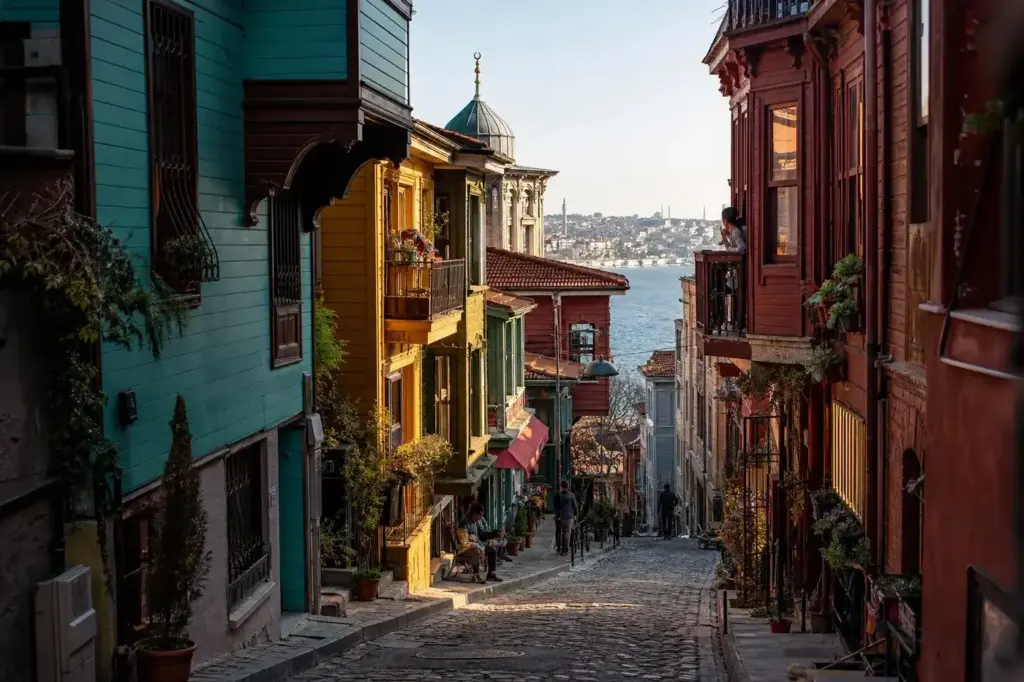
Balat is one of Istanbul’s most atmospheric neighborhoods, hugging the western shore of the Golden Horn in the Fatih district. Its narrow, steep streets wind between brightly painted Ottoman-era wooden houses, shops, cafés, and small religious buildings—a living snapshot of the city’s multicultural past that feels far removed from the tourist circuits of Sultanahmet.
Unlike monumental sightseeing destinations, Balat reveals the intimate side of Istanbul shaped by centuries of migration and everyday life. The neighborhood attracts photographers, artists, and travelers seeking texture and authenticity. What was once the center of Istanbul’s Jewish community and later home to Greek Orthodox and Armenian populations remains today one of the city’s richest cultural palimpsests.
Quick Facts
| Address | Balat, Fatih, Istanbul Google MapsApple MapsYandex Maps |
|---|---|
| District | Fatih |
| Metro | Balat (T5 Tram, Waterfront station; 5–10 min walk uphill to main residential area) Emniyet-Fatih (M1, West/northwest exit; 15–20 min walk south) |
| Best time to visit | Spring (April–May) and autumn (September–October) offer mild weather, low rainfall, and soft light ideal for walking and photography. Summer (June–August) brings heat, humidity, and peak tourist crowds; early mornings are preferable. Winter (December–February) is cool and often rainy; some cafés and galleries reduce hours. Weekday mornings are quieter than weekends and late afternoons. Visit during daylight hours (street navigation is difficult after dark; lighting in alleyways is minimal). Late afternoon golden light is exceptional for photography. |
| Recommended duration | 2–3 hours |
What Is (and Isn't) Part of a Visit to Balat?
| Part | Status | Notes |
|---|---|---|
| Balat neighborhood streets and public areas | Included in the standard ticket | Free to explore at any time. Steep topography and narrow passages; wear comfortable shoes. |
| Ahrida Synagogue | Separate ticket or institution | Historic religious building; visiting may require guided tour or advance arrangement. Check locally for current access policy. |
| Bulgarian St. Stephen Church (Iron Church) | Separate ticket or institution | Reopened to visitors in 2018 after restoration. Hours may vary; located at waterfront near T5 tram station. |
| Ferruh Kethüda Mosque | Separate ticket or institution | Active mosque; entrance during prayer times restricted. Modest dress required. No separate ticket; worshippers and respectful visitors welcome outside prayer hours. |
| Yavuz Sultan Selim Mosque | Separate ticket or institution | Active neighborhood mosque; prayer times may restrict access. Modest dress required. No entry charge for respectful visitors. |
| Palace of the Porphyrogenitus ruins | Separate ticket or institution | Outdoor Byzantine ruin; visible from adjacent passages but formal access not managed for tourists. Interior is unsafe and not open. |
| Local cafés, galleries, and shops | Included in the standard ticket | Private businesses operating independently. Prices moderate; most welcome visitors. Support local owners by purchasing refreshments. |
| Fener (neighboring district) | Outside / not part of it | Adjacent neighborhood with its own landmarks (Greek Orthodox Patriarchate, Greek High School). Connected to Balat by walking bridges and Vodina Street; covered in separate article. |
| Egyptian Bazaar and Grand Bazaar | Outside / not part of it | Major markets in neighboring Eminönü; not part of Balat. Reachable by short walk or tram but distinct destinations. |
Why Visit Balat?
Balat rewards exploration for its genuine atmosphere rather than marquee attractions. The steep topography and narrow alleyways create constantly shifting perspectives—each corner reveals a different colored façade, a hidden café, a small shrine, or a view of the Golden Horn below. The architecture spans centuries: Byzantine stonework sits next to Ottoman wooden structures, prefabricated iron church components, and Neoclassical details.
The neighborhood preserves something rarely seen in central Istanbul: working-class life as it has evolved over generations. Laundry hangs between balconies, children play in the streets, local residents patronize neighborhood shops. Recent restoration and the opening of small galleries and cafés have brought new energy without erasing the past.
How Balat Is Laid Out
Balat stretches along the Golden Horn’s waterfront and rises steeply inland. The T5 tram terminus sits at the water level; from there, main streets and passages lead uphill through residential zones. Vodina Caddesi (Vodina Street) forms a rough spine connecting Balat northward to Fener; the boundary between the two neighborhoods is fluid, and many visitors walk both as a single outing.
The core of colorful houses and most visitor amenities cluster on the slopes immediately above the waterfront—roughly a 10-minute walk from the tram station. Steep staircases and narrow passages connect upper and lower levels; wear comfortable shoes. The neighborhood has no single central plaza; instead, small gathering points emerge around older religious buildings and newer cafés. Orientation is easier than it initially appears: keep the water in mind as a reference point, and steep downhill paths always lead toward it.
Highlights of Balat
Ahrida Synagogue
Built in the 15th century by the Sephardic Jewish community from Ohrid (modern Macedonia), Ahrida is the oldest and largest surviving synagogue in Turkey. Its interior showcases a carved wooden pulpit and rich period decorations. The synagogue still functions for Jewish holidays and special occasions, though regular worship has declined. Located on Vodina Street, it remains a quiet testament to Balat's historical role as the heart of Ottoman Jewry. Entry is usually by guided tour arranged in advance; check with local sources for current visiting arrangements.
Tip: Visit in the morning when light filters through the building; the interior photography rules vary, so ask before entering.
Bulgarian St. Stephen Church (Iron Church)
Officially Sveti Stefan, this church rises dramatically from the waterfront as one of Istanbul's most unusual structures. Built between 1898–1899 as a prefabricated iron framework, its parts were cast in Vienna and shipped to Istanbul for assembly—a technical marvel of the late Ottoman era. The Bulgarian community erected it to assert their independence from the Greek Orthodox Patriarchate. Restored and reopened to visitors in 2018, its iron lattice skeleton and brick infill remain visually striking. Located at water level near the T5 tram station.
Tip: The best view is from outside, especially in afternoon light. Opening hours for interior visits vary; confirm locally.
Ferruh Kethüda Mosque
A jewel of Ottoman mosque design traditionally attributed to the great architect Mimar Sinan, this small 16th-century building showcases classical proportions and restrained ornamentation. It served historically as both a place of worship and a courthouse for neighborhood disputes. The mosque sits within the residential fabric of Balat rather than dominating a square, reflecting how religious life was woven into daily community life. Still actively used for prayer five times daily.
Tip: Remove shoes before entering; visit outside prayer times if possible, and dress respectfully. Women may be asked to cover hair.
Colorful Street Facades and Merdivenli Yokuş
Balat's most photographed asset is its houses, many painted in jewel tones—crimson, mustard, turquoise, pale green—though these bright colors are relatively recent (applied during restoration projects from the 1990s onward). Historically, the buildings were modest two and three-story terraced residences in more muted tones. Merdivenli Yokuş (Staircase Slope) is perhaps the neighborhood's most Instagram-famous alley, lined with wooden balconies and climbing toward a small mosque. The steep narrow passages create constantly shifting sightlines and framing.
Tip: Visit early morning or late afternoon to avoid crowds and photo-selfie congestion. The houses are private residences—be respectful when photographing and never enter without permission.
Yanbol Synagogue
Built in the 18th century for the Bulgarian Jewish community from Yambol (Yambol, Bulgaria), this synagogue with a capacity of around 300 worshippers reflects the diversity of Jewish communities within Ottoman Istanbul. Like other Balat synagogues, it is now rarely used for regular worship but remains a cultural landmark. The building exemplifies the architectural language of Ottoman-era Jewish institutions—modest exterior, ornate interior focus.
Tip: Hours and access are irregular. Contact local tourism for guidance on viewing arrangements.
Palace of the Porphyrogenitus (Tekfur Sarayı)
A haunting ruin of late 13th-century Byzantine origin, this palace once housed imperial family members. Its broken walls and exposed stonework sit above a modern residential zone, accessible by a steep passage. The remains show Byzantine construction techniques and masonry patterns. Local tradition links the neighborhood name 'Balat' to 'palace' (from Greek palation)—though scholars debate whether this site or the nearby Palace of Blachernae inspired the name. The ruins are visible from outside; interior access is unreliable.
Tip: Best photographed from the side passages or surrounding high points. Check locally for access; the site is not formally managed for tourists.
Yavuz Sultan Selim Mosque
Perched on Balat's upper slopes, this Ottoman mosque was commissioned by Sultan Selim I in the early 16th century. Its strategic hilltop placement allowed it to serve both spiritual and urban functions. The building retains its classical Ottoman proportions and interior detail, though it has undergone restoration. The courtyard and surrounding area offer views back toward the Golden Horn. Still an active neighborhood mosque.
Tip: Arrive outside prayer times; remove shoes and dress respectfully. Modest dress required.
Local Cafés and Galleries
Since the 2000s, Balat has attracted artists, young entrepreneurs, and restored-house owners who have converted historic buildings into small galleries, vintage shops, and cafés. These are not major institutions but rather intimate spaces—a room-sized gallery, a café built inside a restored mansion, a workshop selling handmade goods. The scene is organic and changes; some venues close, new ones open. The energy reflects recent urban revival rather than curated tourism.
Tip: Wander without a firm agenda; stumble upon places. Prices at cafés are moderate and prices are reasonable by Istanbul standards. Many places close midweek in low season.
Atmosphere
Balat feels lived-in and working-class in a way that central tourist zones do not. Laundry hangs between balconies; children play football in alleyways while adults chat on stoops; elderly residents occupy the ground-floor cafés. The soundtrack is domestic: voices in Turkish and accented Turkish, the rattle of carts on cobbles, occasional construction or restoration work, muezzin calls to prayer, the ambient sound of the Golden Horn below.
Mornings are quieter and smell of bread from small neighborhood bakeries. Afternoons bring local foot traffic and tourists wandering. Early evenings—especially spring and autumn—see residents claiming the steep streets as informal gathering places. The light changes dramatically as the sun tracks across the hills; shadows lengthen through narrow passages, golden hour light floods certain alleyways, then fades quickly as the topography blocks the setting sun.
Aesthetically, Balat is a study in weathered surfaces: chipped paint revealing layers of older pigment, cracked plaster, patched masonry, tangled electrical wires, dried plants on balconies. This texture is both chaotic and beautiful—nothing is polished or pristine, yet this incompleteness feels authentic rather than neglected.
History of Balat
Balat’s name likely derives from the Greek word palation (palace), possibly referring to the nearby Palace of Blachernae or the Palace of the Porphyrogenitus whose ruins still stand in the neighborhood. The area occupied a strategic position on the Golden Horn’s western shore, which made it valuable for trade and settlement throughout the Byzantine era.
After the Ottoman conquest of Constantinople in 1453, the district began its transformation into a major center of Jewish life. Following the Spanish Inquisition’s expulsion of Jews from Spain and Portugal in 1492, Sultan Bayezid II issued an edict welcoming Sephardic Jews to Ottoman lands. Large numbers settled in Balat and nearby Fener, establishing synagogues, schools, charitable institutions, and businesses. By the 16th and 17th centuries, the neighborhood boasted at least 18 synagogues and had become the largest Sephardic Jewish quarter in the Ottoman Empire. The community thrived for over three centuries, accumulating considerable wealth and cultural influence.
Alongside the Jewish majority, Greek Orthodox and Armenian Christian communities also lived in Balat, each maintaining churches, schools, and community buildings. This multicultural fabric—Jewish, Greek, Armenian, and Turkish Muslim populations living in proximity—created a unique urban environment where different faiths coexisted within the same neighborhood. The 16th-century Ferruh Kethüda Mosque, traditionally attributed to Mimar Sinan, exemplifies this era of Ottoman architectural achievement.
The 19th century brought decline. Fires devastated parts of the neighborhood; industrialization and economic change altered trade patterns. The emergence of new European-style districts and the transfer of Jewish community leadership to Galata gradually eroded Balat’s centrality. By the late Ottoman period, the neighborhood had become less prosperous, though it retained its cultural and religious institutions.
The 20th century brought rapid change. The founding of the Turkish Republic (1923) altered the legal status of non-Muslim minorities. The 1955 Istanbul riots accelerated the departure of Greek residents; many Jews emigrated following the establishment of Israel in 1948 and subsequent regional tensions. Economic migration patterns favored newer neighborhoods. By the 1960s–1980s, Balat had become a predominantly Muslim, working-class district—many residents migrating from the Black Sea region. Historic buildings fell into disrepair; the neighborhood acquired a reputation as run-down and neglected.
Beginning in the 1990s, restoration projects and UNESCO World Heritage designation (shared with Fener as part of Historic Istanbul) sparked renewed interest. Small-scale preservation efforts began restoring wooden houses; property values rose gradually. From the 2000s onward, young artists, café owners, and tourists began discovering Balat’s authentic atmosphere and architectural texture. Recent years have brought visible revitalization: houses repainted in bright colors, galleries and cafés opened, local walking tours established—yet the neighborhood has largely resisted complete gentrification. Residents and visitors coexist; working-class families remain; the sense of place feels lived-in rather than museumified.
Legends and Myths about Balat
The Iron Church's Vienna Connection
Legend – historically unreliable. Legend holds that the Bulgarian St. Stephen Church was prefabricated in Vienna as a technical marvel to be assembled on-site, a feat of late industrial engineering. While the basic fact is true (cast iron parts shipped from Vienna, reassembled in Istanbul), local stories elaborated the logistics into tales of engineering impossibility and Ottoman Ottoman amazement. Some versions claim the Ottomans hired European engineers to oversee construction; others that the iron structure was a secret Bulgarian nationalist statement against the Greek Orthodox hierarchy.
The Ahrida Synagogue's Hidden Treasures
Legend – historically unreliable. Balat residents long spoke of valuables—Hebrew manuscripts, ritual objects, gold—hidden within the Ahrida Synagogue's walls and cavities, supposedly cached during periods of danger or uncertainty. Popular versions link these to wartime trade or to families keeping their heirlooms safe. Though no systematic hoarding has been documented, the story reflects the profound emotional connection residents maintained to the building as a symbol of community survival through upheaval.
Jewish Golden Age and Sultanic Favor
Legend – historically unreliable. A widely repeated narrative claims that Sultan Bayezid II personally sent his fleet to rescue Spanish Jews and that Balat subsequently flourished as a reward for this act of tolerance. While Bayezid II did welcome Sephardic refugees with an official edict, the popular version transforms this into an almost fairy-tale rescue mission with magical favor flowing eternally. Historical records show the reality was more complex: commercial opportunity, labor demand, and tax revenue motivated Ottoman policy, not sentimentality.
Tickets and Booking for Balat
Balat is a public neighborhood; exploration is free. Most streets and alleyways are open to walk during daylight hours. Religious buildings (mosques, synagogues) may require modest dress and may close during prayer times or special services.
Religious sites: Ahrida Synagogue and other active synagogues typically operate limited hours and may require advance notice for visits. The Ferruh Kethüda Mosque and Yavuz Sultan Selim Mosque are active neighborhood mosques; respectful visitors may enter outside prayer times, but dress code is required. The Bulgarian St. Stephen Church has variable visiting hours; confirm locally before making the trip.
Cafés and galleries: These are independent businesses. Most welcome drop-in customers. Opening hours vary; some close one or two days per week, especially in winter months.
No official tourism office manages Balat as a formal attraction. For guided tours, synagogue access, and current events, check with Istanbul tourism operators or contact the Fatih district municipality.
Suggested itineraries Balat
1.5–2 hours
Enter via T5 tram at Balat station. Walk uphill along Vodina Street, pausing at street-level observations: colorful house facades, small shops. Locate Ahrida Synagogue; view exterior or arrange entry. Continue uphill to Ferruh Kethüda Mosque and surrounding residential area. Descend via different passages to experience shifting perspectives. End at a waterfront café with Golden Horn views.
2–3 hours
Start at Bulgarian St. Stephen Church by the waterfront (T5 station area). Explore interior if open. Walk uphill through residential core, visiting colorful streets and Merdivenli Yokuş. Detour to Yavuz Sultan Selim Mosque on upper slopes for views. Locate and view exterior of Ahrida Synagogue. Browse local galleries and small cafés. Descend slowly, allowing time for photography and café stops.
3–4 hours (combined with Fener)
Spend 1.5–2 hours in Balat as above. Cross via Vodina Street to adjacent Fener neighborhood; visit Fener Greek Orthodox Patriarchate exterior, Fener Greek High School views, and Fener's own residential streets. Return to Balat for sunset light and evening refreshment. Total experience covers two interdependent historic neighborhoods.
How to Get to Balat
By tram (T5): The T5 streetcar line terminates at Balat station on the Golden Horn waterfront. From the station, walk uphill via Vodina Street or side passages into the residential neighborhood (5–10 min to main colorful streets). This is the most scenic and straightforward arrival.
By metro (M1): Exit at Emniyet-Fatih station on the M1 line. Walk south toward the Golden Horn; the walk is approximately 15–20 minutes downhill. Less scenic than the tram but practical if combining with other central attractions like Topkapi Palace.
Walking from Sultanahmet: Balat is within 25–30 minutes’ walk southwest from the Blue Mosque or Topkapi Palace. Head toward the Golden Horn; follow waterfront or Vodina Street north into Balat. This approach orients you geographically but is steep and requires comfort with urban navigation.
Taxi or dolmuş: From anywhere in central Istanbul, ask the driver for ‘Balat’ (or show the address). Traffic can be heavy; meter taxis are more reliable than negotiated fares for tourists.
Accessibility
Balat's steep topography and narrow, uneven cobbled streets make full accessibility challenging for wheelchair users or those with limited mobility. No formal ramps or level pedestrian passages exist in the residential core. The T5 tram station is accessible, and the flat waterfront area is manageable. Ground-floor cafés and some shops are accessible. Mosques and synagogues typically require stair entry. Comfortable, stable walking shoes essential. Benches are scattered but uncommon. The neighborhood rewards wandering but demands physical capability.
Food Nearby
Balat's café and restaurant scene has expanded significantly. Small independent cafés dot the neighborhood—many occupying restored houses, serving Turkish tea, coffee, light snacks, and simple meals. Prices are moderate. Traditional bakeries and pastry shops serve local residents. Waterfront restaurants near the T5 station offer Golden Horn views at moderate cost. A few galleries double as cafés. Choices tend toward simple Turkish fare rather than elaborate cuisine; this reflects the neighborhood's working-class character. Avoid expecting high-end dining; the appeal is authenticity and local flavor.
What to Bring
Comfortable, sturdy walking shoes with good grip (cobblestones are steep and uneven, especially when wet). Sun protection (hat, sunscreen) for exposed passages and waterfront areas. Water bottle; there are few formal vendors in upper streets. A light rain jacket or scarf for unexpected weather. Power bank if photographing extensively. Small notebook or sketch materials if artistically inclined. Modest dress if visiting religious buildings (covered shoulders, knees; women may need a headscarf for mosques).
Best Views and Photo Spots of Balat
Merdivenli Yokuş staircase alley
Narrow climbing passage with wooden balconies, tiled doorsteps, and colorful façades framing a small mosque cupola at the top. The layering of architectural styles and compressed perspective create a compelling visual narrative. Famous among photographers and social media.
Best time: Early morning (6–8 AM) for minimal crowds and soft directional light; late afternoon (4–6 PM) for warm golden glow across the facades.
Vodina Street looking toward Golden Horn
Main thoroughfare descending toward the waterfront; colorful houses line both sides, creating a visual corridor. The Golden Horn and Fener district are visible in the distance. Captures the neighborhood's breadth and waterfront geography.
Best time: Morning light from the east; crowds thin out by mid-afternoon.
Bulgarian St. Stephen Church (Iron Church) from waterfront
The prefabricated iron church structure rises steeply from the Golden Horn shore. The latticed iron framework and brick infill create a distinctive silhouette and visual texture unique in Istanbul. The waterfront promenade provides clear sightlines.
Best time: Afternoon and early evening when the structure is backlit or sidelit, emphasizing the iron lattice pattern. Golden hour (before sunset) is optimal.
Upper residential passages overlooking Golden Horn
From higher streets near Yavuz Sultan Selim Mosque, views look west and north across the Golden Horn toward Fener and the Phanar Greek Orthodox Patriarchate. The water, opposite shoreline, and foreground of tiled roofs create depth and context.
Best time: Sunrise or early morning when light is soft and the opposite shore is clearly visible; mid-afternoon heat creates haze.
Colorful façade clusters (various locations)
Brightly painted house façades in jewel tones (turquoise, crimson, mustard, pale green) create bold color compositions. Best experienced at street level when multiple facades fill the frame, showing the recent restoration aesthetic.
Best time: Overcast skies or shaded morning passages; direct noon sunlight can flatten color. Late afternoon creates subtle shadows that enhance texture.
Ahrida Synagogue exterior from adjacent passage
The 15th-century synagogue's stone exterior and modest entry framed by narrow alley walls. The juxtaposition of this religious building within dense residential fabric conveys its integration into daily community life.
Best time: Mid-morning when side light reveals stonework texture; mid-afternoon light is also favorable.
Photography Rules
General photography is welcome on public streets and exterior building facades. Respect privacy; do not photograph residents or children without permission. Interior photography in synagogues and mosques varies by site; always ask. Some cafés and galleries permit interior photos; others request no photography. Drones are not permitted in urban residential areas. Tripods should be used respectfully and not block passages. Flash may not be permitted indoors. The steepness and narrow passages make large camera gear cumbersome.
Family Suitability
Balat appeals to families with older children (8+) and adults comfortable with steep, uneven terrain. Young children in strollers will struggle; the cobbled streets are not stroller-friendly, and many passages are stairs. The neighborhood is safe and the pace is relaxed, with local residents generally welcoming to visitors. Children often enjoy exploring narrow alleyways, spotting cats, and discovering colorful passages. Cafés are child-friendly, and most are family-oriented. Expect a 2–3 hour outing; shorter visits with specific stops work better than extended wandering if children have limited walking tolerance. Avoid midday heat in summer; spring and autumn are ideal.
Istanbul Vibes Tips
- Wear comfortable walking shoes with good grip and ankle support. Balat's cobbled streets are steep and uneven; slipping is a real risk, especially on wet days or in worn-down passages. Fashion footwear is impractical.
- Don't aim for a 'complete' tour of every religious building in one visit. Many have irregular hours or require advance arrangement. Instead, identify 2–3 key sites (e.g., Ahrida Synagogue, Iron Church, Ferruh Kethüda Mosque) and plan accordingly. Ask locally about access options before setting your heart on interior entry.
- Visit on a weekday if you want to avoid crowds and experience Balat as residents do. Weekends and afternoons are busy with domestic and international tourists. Early morning (7–9 AM) is noticeably quieter and offers better light for photography.
- Budget time to sit in a café and observe rather than rushing between photo spots. Balat's charm lies as much in its rhythms and street life as in landmarks. A single café stop for tea or coffee on a terrace overlooking the Golden Horn is an essential part of the experience.
- Bring cash (Turkish lira) for small cafés and shops; many do not accept cards. Street ATMs exist but are sometimes unreliable. Have small bills for Tips are appreciated but not compulsory.
- Dress respectfully if entering mosques or synagogues. Women should cover shoulders and knees; a lightweight scarf can be worn as a headscarf in mosques if needed. Shoes must be removed at entrances. This is not a formality but a sign of respect to active religious communities.
Explore Nearby Balat
Sights near Balat
 Bulgarian St. Stephen Church – about 350 m away (~6 min walk) · typical visit: 30–45 minutesOpen daily 09:00–17:00
Main image: AI-generated illustration. It may not show the place exactly as it looks.
 Golden Horn · typical visit: 1–3 hours (waterfront walk or boat tour)
Main image: AI-generated illustration. It may not show the place exactly as it looks.
 Grand Bazaar – about 3.1 km away · typical visit: 2–4 hours4 min on foot from Beyazıt-Kapalıçarşı metro, Open 08:30–19:00, closed Sun
Main image: AI-generated illustration. It may not show the place exactly as it looks.
 Fethiye Mosqueabout 400 m away (~7 min walk) · typical visit: 1–1.5 hours
Main image: AI-generated illustration. It may not show the place exactly as it looks.
 Church of St. Mary of the Mongols – about 450 m away (~7 min walk) · typical visit: 45 minutes to 1 hourOpen 09:00–17:00, closed Mon
Main image: AI-generated illustration. It may not show the place exactly as it looks.
 Chora Church – about 600 m away (~9 min walk) · typical visit: 2–3 hoursOpen 09:00–18:00, closed Fri
Main image: AI-generated illustration. It may not show the place exactly as it looks.
Metro stations near Balat
 Ayvansaray – about 800 m away (~13 min walk)Open daily 05:00–00:00
Main image: AI-generated illustration. It may not show the place exactly as it looks.
Train stations and river piers near Balat
 Eyüp Ferry Terminalabout 1.7 km away (~28 min walk)
Main image: AI-generated illustration. It may not show the place exactly as it looks.
Related guides
 Fener: Istanbul’s Historic Greek Quarter on the Golden Horn
Main image: AI-generated illustration. It may not show the place exactly as it looks.
 Best Specialty Coffee Shops in Istanbul: Local Roasters
Main image: AI-generated illustration. It may not show the place exactly as it looks.
 Digital Nomad Istanbul: Coworking, Cafés and Remote Work
Main image: AI-generated illustration. It may not show the place exactly as it looks.
 Asitane: Ottoman Palace Cuisine Beside the Chora Church
Main image: AI-generated illustration. It may not show the place exactly as it looks.
 Feshane Tram Station: Access, Hours and What to See NearbyOpen daily 06:00–23:00
Main image: AI-generated illustration. It may not show the place exactly as it looks.
Browse more: More in Fatih · All Hidden Istanbul · All Neighborhoods
FAQ: Balat
Is Balat inside the Fatih district?
Yes. Balat is officially a neighborhood (mahalle) within the Fatih district, which encompasses much of old Istanbul on the European side.
Can I visit the Ahrida Synagogue?
The Ahrida Synagogue is the oldest surviving synagogue in Turkey. Visiting arrangements vary. Interior access typically requires a guided tour or advance contact with local tour operators or Jewish community organizations. Exterior viewing is always possible from the street.
Is there an entrance fee to walk through Balat?
No. Balat is a public neighborhood. Walking through streets and viewing exterior façades is free. Some cafés and galleries are independent businesses; small purchases support the community.
How long should I spend in Balat?
Most visitors enjoy 2–3 hours exploring streets, visiting a café, and viewing key sites. A shorter 1–1.5 hour visit works if you have limited time. A full half-day to full day is possible if combining with the adjacent Fener neighborhood or if you're particularly interested in photography or detailed building study.
What's the best way to get to Balat from Sultanahmet?
The T5 tram from Sultanahmet or the Grand Bazaar area to Balat station (at the waterfront) is scenic and straightforward. Walking (25–30 min) is possible if you know the route. Metro + walk is practical if combining with other central sights.
Is Balat suitable for families with small children?
Balat's steep cobbled streets are difficult for strollers and challenge young children. Families with older children (8+) who enjoy walking and exploring narrow passages will have a good time. The neighborhood is safe and welcoming; cafés are family-oriented.
What's the difference between Balat and Fener?
Balat (historically Jewish) and Fener (historically Greek Orthodox) are adjacent neighborhoods in Fatih with shared architecture and parallel histories of decline and recent revival. Both are worth visiting; many travelers combine them into a single walking tour. They are connected by Vodina Street.
Is it safe to wander alone in Balat?
Balat is generally safe for solo travelers, both day and early evening. The neighborhood is residential and busy during daytime; locals are accustomed to visitors. Avoid very late night wandering (narrow, poorly lit passages). Standard city awareness applies: don't display valuables, stay aware of surroundings.
Istanbul Vibes is a one-person project. A coffee keeps it going

Take this guide with you
Get a free PDF of this guide to print or read offline: key facts, tips and a map link on a few clean pages.
Report an issue on this page
How we research and update our guides
About this guide: AI assistance and accuracy
This guide is created with the help of AI and is based on official sources where available. Mistakes can still happen. Opening hours, prices, rules and other details are given to the best of our knowledge as of the date shown and can change without notice. It offers general recommendations only, not professional, legal or travel advice. Please confirm important details with the official source before you travel; you are responsible for your own plans and decisions.
* Affiliate link: as an Amazon Associate we earn from qualifying purchases at no extra cost to you.
