

The Kara Mustafa Pasha Tomb in Istanbul is one of the city’s lost monuments. It belonged to Kemankeş Kara Mustafa Pasha, a grand vizier of the early 1640s, and it stood at Çarşıkapı, on the busy road between Bayezid Mosque and Çorlulu Ali Pasha Mosque. It was demolished during road widening in 1937, so there is no building to enter today.
That does not make the spot pointless. The tomb was part of a small charity complex, and the pasha’s mosque in Karaköy still stands across the Golden Horn. This guide explains what was here, where to stand, and how to combine the old site with the surviving mosque, so you do not arrive looking for a dome that is no longer there.
Quick Facts
| Built / opened | 1641 |
|---|---|
| District | Fatih |
| Metro | Beyazıt-Kapalıçarşı (T1, Walk to the Çarşıkapı stretch of Ordu Caddesi, between Bayezid Mosque and Çorlulu Ali Pasha Mosque) |
| Admission | Free in words: there is no tomb building left to enter, and the site is a public street. |
| Best time to visit | Morning is calmer, with fewer shoppers and softer light on the mosque façades. Spring and autumn are the most comfortable seasons for walking. Midday and late afternoon are the busiest hours around the Grand Bazaar and the tram. |
| Recommended duration | 30–45 minutes |
What Is (and Isn't) Part of a Visit to Kara Mustafa Pasha Tomb?
| Part | Status | Notes |
|---|---|---|
| Tomb of Kemankeş Kara Mustafa Pasha | Not open to visitors | The building was removed in 1937 and no tomb can be visited at Çarşıkapı today. |
| Çarşıkapı site on the main road | Outside / not part of it | A public street and bus stop; you can stand where the complex once stood, but there is nothing to enter. |
| Kemankeş Kara Mustafa Pasha Mosque in Karaköy | Separate ticket or institution | His surviving mosque, covered in its own article, in a different neighbourhood. |
| Children's school and fountain beside the Karaköy mosque | Separate ticket or institution | Built in 1732 by a later official, not part of the pasha's original plan. |
| Bayezid Mosque | Outside / not part of it | A neighbouring landmark, not part of the lost complex. |
| Çorlulu Ali Pasha Mosque | Outside / not part of it | A neighbouring Ottoman complex that helps you imagine the lost one. |
| Kara Mustafa Pasha of Merzifon | Outside / not part of it | A different grand vizier of a later generation; he is not the person this site belongs to. |
Why Visit Kara Mustafa Pasha Tomb?
Come for the story of how a street changed, not for a monument. The pasha built a lecture hall, a prayer room, a tomb, a fountain and a drinking kiosk at Çarşıkapı in the early 1640s, and all of it was cleared in the 1930s to make room for traffic. Standing on the pavement, you can see how the old city was cut open.
The site also sits in one of the most walkable stretches of the old city. Bayezid Mosque, Çorlulu Ali Pasha Mosque and the Grand Bazaar entrances are all within a short walk, and the pasha’s surviving mosque in Karaköy makes a natural second stop for anyone interested in the man.
How Kara Mustafa Pasha Tomb Is Laid Out
Think of the area as a short strip along the main road that links Beyazıt with Çemberlitaş. The old tomb stood on this strip, between Bayezid Mosque on one side and Çorlulu Ali Pasha Mosque on the other, at the spot now associated with the Çarşıkapı bus stop.
A sensible route starts at the Beyazıt tram stop, walks along the road toward Çarşıkapı, and pauses where the tomb stood. From there, continue to Çorlulu Ali Pasha Mosque for a look at a surviving Ottoman complex of a similar kind. If you want to see the pasha’s own surviving mosque, take the tram or a taxi toward Karaköy afterwards; it is a separate stop, not a walk from here.
Highlights of Kara Mustafa Pasha Tomb
The Çarşıkapı site
This is where the tomb stood. The pasha built a medrese here in 1641, and its lecture hall included a small mosque, the tomb, a drinking kiosk and a fountain. All of it was removed in 1937 for road widening. Today the place is pavement and traffic, marked by a bus stop rather than a plaque, so use the neighbouring mosques to orient yourself.
Look at how close the road runs to both neighbouring mosques; that tight squeeze shows why the little complex did not survive.
Tip: Visit in the morning, when pavements are quieter and the sun lights the mosque façades along the road.
Bayezid Mosque
One of the neighbouring landmarks that helps you place the lost tomb. The mosque belongs to the early sixteenth century and sits beside the Beyazıt square and the old university gate. It is the large domed building on one side of the former tomb site.
Open it up as your reference point: the pasha's tomb lay between this mosque and Çorlulu Ali Pasha Mosque, so once you can see both you are in the right place.
Tip: Use the courtyard fountain side as a quiet place to read about the area before walking on.
Çorlulu Ali Pasha Mosque
The other neighbour of the lost tomb. It is a small Ottoman complex of the same general kind as the one Kara Mustafa Pasha built here: a mosque with a courtyard, a medrese and a tomb, set along the old processional road. Walking through it gives you a good idea of what the demolished complex would have felt like.
Look for the courtyard arcade and the way the buildings enclose a small green space away from the road.
Tip: Check the opening times on site; small complexes like this are sometimes only partly open.
Kemankeş Kara Mustafa Pasha Mosque in Karaköy
The pasha's surviving building is his mosque in Karaköy, built in the early 1640s on the site of a former Genoese church. It is a separate site and a separate article on this guide (see Kara Mustafa Mosque). It stands beside a car park near the waterfront side of Karaköy, so it is easy to walk past.
The mosque is the place to connect the lost tomb to a real, visitable building from the same patron.
Tip: Treat Karaköy as a second trip, not a walk from Çarşıkapı.
The 1732 school and fountain beside the Karaköy mosque
Next to the Karaköy mosque are a small children's school and a fountain, built in 1732 by a later official, not by the pasha himself. They are easy to mistake for part of his original complex. They are worth a look as one of the few quiet corners left in a busy commercial area.
Look at the stonework of the fountain panel and the small windows of the school.
Tip: Do not assume everything beside the mosque dates from the 1640s.
Beyazıt Square and the Grand Bazaar approach
Just a few minutes from the lost tomb is Beyazıt Square, the open space beside the university gate and the main approach to the Grand Bazaar. It is useful as a start or end point, and as a reminder of how the area was once a crossing point of processions and trade.
The square is also the easiest place to find a tram stop, a taxi and a drink.
Tip: Start here, then walk toward Çarşıkapı so the tomb site comes at the end of a short, easy stroll.
Atmosphere
The site is loud rather than contemplative. Trams rattle past, buses stop at the kerb, and shoppers stream between the Grand Bazaar entrances and the university. The mosques on either side are the only quiet notes, with domes and minarets rising over the traffic.
Mornings are calmer, with shop shutters going up and students crossing toward the university. Late afternoon is the busiest time. Treat this as a short thoughtful pause in a lively street, not as a place to linger for an hour.
History of Kara Mustafa Pasha Tomb
A pasha from the Ottoman court. Kemankeş Kara Mustafa Pasha was of Albanian origin, and his nickname Kemankeş refers to his skill as an archer. He rose through court service and served as grand vizier from 1638 to 1644.
The Çarşıkapı complex, 1641. In 1641 he founded a medrese at Çarşıkapı. The lecture hall of the medrese included a small mosque, a tomb, a drinking kiosk and a fountain. The tomb was built during his lifetime, which was a common Ottoman practice for a man of his rank.
The mosque in Karaköy. In the same years he founded a mosque in Karaköy, on the site of a former Genoese church that had been seized in 1606 and later demolished. Sources give the date as around 1640 or 1642. The mosque was later repaired; an inscription over the door dates to 1766.
His death, 1644. He was strangled on 31 January 1644 in the Hocapaşa market area and was buried in his own tomb at Çarşıkapı.
Later additions in Karaköy. In 1732 a children’s school and a fountain were built beside the Karaköy mosque by another official, adding to the complex without being part of the pasha’s original plan.
Loss of the tomb, 1937. When the road through Çarşıkapı was widened in 1937, the medrese, the small mosque, the tomb, the kiosk and the fountain were all removed. Only the mosque in Karaköy survives as a building connected to the pasha.
Tickets and Booking for Kara Mustafa Pasha Tomb
There is nothing to book. The tomb no longer exists, and the Çarşıkapı site is an ordinary public street, so no ticket, reservation or entry procedure applies.
If you continue to the pasha’s mosque in Karaköy, it is a working place of worship and is normally entered like any other mosque, without a ticket. Check the times and dress expectations on site, and see the separate article on that mosque for details.
For any official information about historic monuments in Istanbul, use the websites of the relevant municipal and heritage authorities.
Suggested itineraries Kara Mustafa Pasha Tomb
30 minutes
Take the T1 tram to Beyazıt-Kapalıçarşı and walk along the road toward Çarşıkapı. Stop at the spot between Bayezid Mosque and Çorlulu Ali Pasha Mosque where the tomb once stood, then continue a few steps to look at Çorlulu Ali Pasha Mosque.
1.5 hours
Start at Beyazıt Square, walk to Çarşıkapı and read the site, then visit Çorlulu Ali Pasha Mosque and finish with a coffee near the Grand Bazaar entrance.
Half day
Do the Çarşıkapı walk in the morning, then travel to Karaköy to see the pasha's surviving mosque with its 1732 school and fountain. End with a walk along the Karaköy waterfront or a ride on the Tünel funicular.
How to Get to Kara Mustafa Pasha Tomb
The simplest way is the T1 tram to Beyazıt-Kapalıçarşı. From the stop, walk along the main road toward Çemberlitaş; the former tomb site lies between Bayezid Mosque and Çorlulu Ali Pasha Mosque.
You can also reach the area from Vezneciler on the metro with a short walk uphill. Taxis can drop you near Beyazıt Square.
For the Karaköy mosque, take the tram to Karaköy or use the Tünel funicular and walk the short distance; see the mosque’s own article for directions.
Accessibility
The site is an ordinary pavement on a main road with tram and bus stops nearby. Some stretches are crowded and uneven, and surrounding mosque courtyards can have steps. Detailed accessibility information for the neighbouring mosques is not covered here; check on site.
Food Nearby
The streets around Beyazıt and the Grand Bazaar have many simple places for tea, coffee, simit and quick lunches, as well as traditional restaurants a short walk toward Sultanahmet. In Karaköy you will find cafés and bakeries within a few minutes of the mosque.
What to Bring
Comfortable shoes, a light layer for mosque visits, and a scarf if you plan to enter one of the neighbouring mosques. A small bottle of water is useful in summer.
Best Views and Photo Spots of Kara Mustafa Pasha Tomb
Pavement between Bayezid Mosque and Çorlulu Ali Pasha Mosque
A view that places both mosque façades along the road, with trams crossing the foreground. It shows how tightly the old city is packed along this road.
Best time: Early morning for quiet pavements and soft side light.
Beyazıt Square
The open space in front of the university gate and Bayezid Mosque gives wider views of domes and minarets.
Best time: Late afternoon, when the light warms the stone.
Karaköy mosque and fountain
The small mosque beside its 1732 school and fountain makes a quiet, compact subject in a busy commercial area.
Best time: Morning, when the street is calmer.
Çorlulu Ali Pasha Mosque courtyard
The arcaded courtyard shows what a small Ottoman complex looked like, which is helpful for imagining the lost tomb complex.
Best time: Mid-morning, when the courtyard is bright but not crowded.
Photography Rules
There is nothing to photograph inside, since the tomb is gone. On the street, photography is normal, but be considerate around prayer times if you shoot the mosques, and avoid blocking pavements and tram stops.
Family Suitability
This is not a destination for young children, since there is nothing to see at the tomb site itself and the surrounding pavements are busy. Older children interested in history may enjoy the walk past the mosques. Strollers manage the main road but will be awkward in crowded areas and courtyards with steps.
Istanbul Vibes Tips
- Walk the strip in the order Beyazıt, Çarşıkapı, Çorlulu Ali Pasha Mosque so that the lost tomb comes as a natural middle point.
- Read the area as a story of lost buildings: look for the gaps between the mosques and imagine a small tomb, a fountain and a lecture hall filling them.
- Do not confuse this pasha with Kara Mustafa Pasha of Merzifon, a different grand vizier of a later generation.
- If your main interest is the pasha, put the Karaköy mosque first and treat Çarşıkapı as a short side stop.
- Combine this stop with the Grand Bazaar rather than planning a separate trip.
Explore Nearby Kara Mustafa Pasha Tomb
Sights near Kara Mustafa Pasha Tomb
 Kara Mustafa Mosque · typical visit: 30 minutes10 min on foot from Şişhane metro
Main image: AI-generated illustration. It may not show the place exactly as it looks.
 Beyazit Tower · typical visit: 20–30 minutes (viewing from outside)7 min on foot from Vezneciler metro
Main image: AI-generated illustration. It may not show the place exactly as it looks.
Metro stations near Kara Mustafa Pasha Tomb
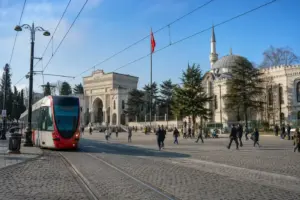 Beyazıt-KapalıçarşıOpen daily 06:00–00:00
Main image: AI-generated illustration. It may not show the place exactly as it looks.
 VeznecilerOpen daily 05:59–00:24
Main image: AI-generated illustration. It may not show the place exactly as it looks.
Related guides
 Bayrampaşa-Maltepe: Historic Metro Station and Transit HubOpen 24 hours
Main image: AI-generated illustration. It may not show the place exactly as it looks.
 Best Underground Cisterns in Istanbul: Three Sites Compared
Main image: AI-generated illustration. It may not show the place exactly as it looks.
 The Red School in Fener: A Castle above the Golden Horn
Main image: AI-generated illustration. It may not show the place exactly as it looks.
 Orient Occident Hotel: Green and Brass in Sirkeci
Main image: AI-generated illustration. It may not show the place exactly as it looks.
 AJWA Sultanahmet: Ottoman Luxury Near the Blue Mosque
Main image: AI-generated illustration. It may not show the place exactly as it looks.
Browse more: More in Fatih · All Hidden Istanbul · All Sightseeing
FAQ: Kara Mustafa Pasha Tomb
Can you visit the Kara Mustafa Pasha Tomb in Istanbul?
No. The tomb at Çarşıkapı was removed in 1937 during road widening, so there is no building to enter. You can stand near the place where it stood and visit the pasha's surviving mosque in Karaköy.
Where exactly did the tomb stand?
On the main road at Çarşıkapı, between Bayezid Mosque and Çorlulu Ali Pasha Mosque, near the spot now associated with a bus stop. There is no marker I could verify, so use the two mosques to orient yourself.
Who was buried in the tomb?
Kemankeş Kara Mustafa Pasha, a grand vizier who served from 1638 to 1644. He was strangled on 31 January 1644 and buried in the tomb he had built during his lifetime.
Is this the same man as Kara Mustafa Pasha of the siege of Vienna?
No. The pasha of this article lived in the 1640s. The better-known Kara Mustafa Pasha associated with Merzifon belongs to a later generation and is a different person.
Is the Karaköy mosque the same as the tomb?
No. The mosque is the pasha's surviving building in Karaköy, a different neighbourhood. The tomb was at Çarşıkapı and no longer exists. See the separate article on the mosque.
Is there anything else from the original complex?
The medrese, the small mosque, the kiosk and the fountain at Çarşıkapı were removed along with the tomb in 1937. The only surviving building connected to the pasha is his mosque in Karaköy.
How long does a visit take?
About thirty to forty-five minutes for the Çarşıkapı site and the neighbouring mosques. Add time if you continue to the mosque in Karaköy.
Do I need a guide?
No. The site is a short walk from the tram stop. A guide would only be useful as part of a wider tour of the old city.
Istanbul Vibes is a one-person project. A coffee keeps it going

Take this guide with you
Get a free PDF of this guide to print or read offline: key facts, tips and a map link on a few clean pages.
Report an issue on this page
How we research and update our guides
About this guide: AI assistance and accuracy
This guide is created with the help of AI and is based on official sources where available. Mistakes can still happen. Opening hours, prices, rules and other details are given to the best of our knowledge as of the date shown and can change without notice. It offers general recommendations only, not professional, legal or travel advice. Please confirm important details with the official source before you travel; you are responsible for your own plans and decisions.
* Affiliate link: as an Amazon Associate we earn from qualifying purchases at no extra cost to you.
