
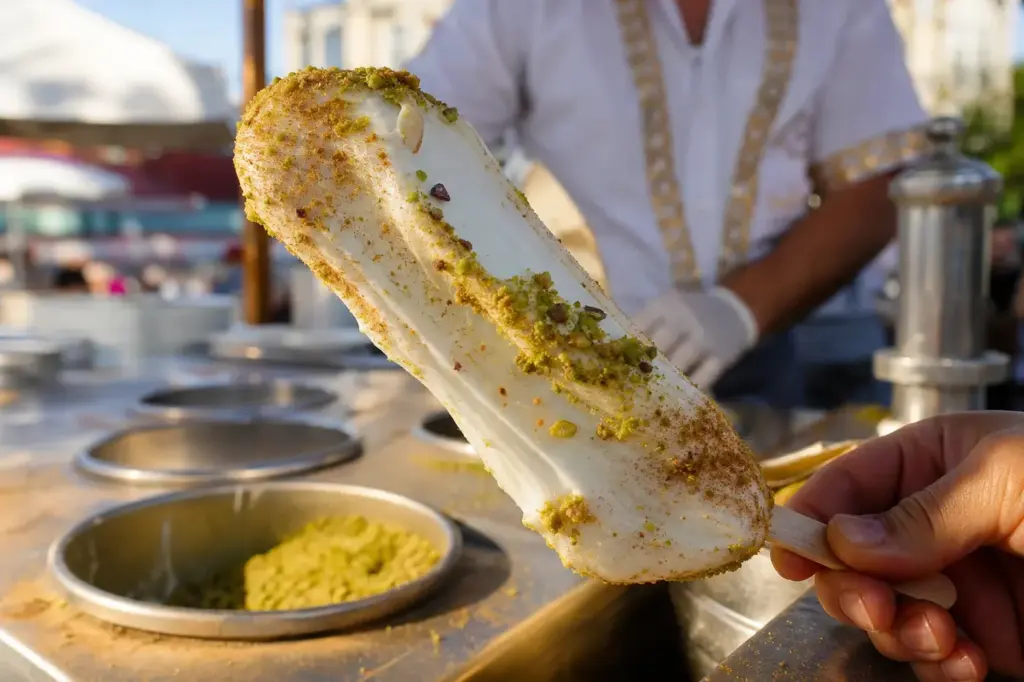
Turkish ice cream, or dondurma, is unlike any other frozen dessert you may have encountered. Visitors often watch in amazement as street vendors stretch and fold the mixture like taffy, then hand it over on a stick—or play tricks by pretending to hand it over, only to pull it away at the last moment. This guide teaches you how to make authentic dondurma at home using simple, natural ingredients.
By the end, you will understand why traditional Turkish ice cream dondurma recipe has been perfected over centuries, what salep and mastic do to create its legendary elasticity, and how to achieve the chewy, dense texture without expensive equipment. The recommended approach uses hand-churning, which brings out the best flavor and texture.
Quick answer: Make Turkish ice cream dondurma by heating milk with sugar and salep (orchid flour), cooling it, then freezing while stirring every 30 minutes. Add ground mastic for authentic flavor. Total time: 30 minutes preparation plus overnight freezing.
At a Glance
| Type | Desserts & sweets |
|---|---|
| Origin | Originating in the city of Kahramanmaraş in southeastern Turkey, it dates back several centuries. Culinary historians believe that dondurma was refined and perfected in this region during the Ottoman Empire, with some accounts tracing its earliest forms as far back as the 16th century. |
| Servings | 4–6 |
| Total time | 30–40 minutes active preparation; overnight freezing (8–12 hours) |
| Difficulty | Medium |
History and Story of Turkish Ice Cream
Historical sources document a variety of ice creams in Ottoman cuisine. These included milk-based ice cream, ice cream made from snow or ice, and non-dairy varieties prepared with ingredients such as strained aşure or sugar-based mixtures. Recipes and descriptions from the 18th and 19th centuries also mention strawberry, apricot, sour-cherry and cream-based ice creams, as well as varieties made with different kinds of milk and with salep.
According to legend, an Ottoman man called Osman Agha would sell sahlep, a hot beverage made from powdered orchid tubers and milk, to Ottoman mansions. One day, a large quantity of his product remained unsold, and he decided to bury it into the snow so as to keep it from going sour. The other day, when he retrieved it, it had turned into ice cream.
Ingredients
- 1 liter (4 cups) whole milk
- 250 ml (1 cup) heavy cream
- 250 g (1¼ cups) sugar
- 15 ml (1 tablespoon) salep powder
- 3 g (1 teaspoon) mastic beads
- Freezer-safe container with lid
- Fork or whisk for hand-churning
How Turkish Ice Cream Is Made
Step 1: Freeze and grind the mastic
Place mastic beads in a freezer for 15 minutes. Take them out, join with a pinch of sugar, and finely grind with a spice grinder or a mortar and pestle. Mastic must be frozen before grinding to prevent clumping.
Tip: Work quickly after removing from the freezer.
Step 2: Prepare the salep mixture
Take 125 ml (1/2 cup) of milk and dissolve the salep in it. Whisk until completely smooth with no lumps.
Tip: Use pure salep powder, not the salep mixture sold for hot drinks.
Step 3: Heat the milk and cream
Take a large skillet and fill it with cream and the remaining 625 ml (2 1/2 cups) milk. Warm over low-medium heat. Add mastic, combine, and follow with salep mixture.
Tip: Do not boil; keep the heat moderate to prevent the mixture from curdling.
Step 4: Stretch and thicken the mixture
Grab some of it using a ladle, and pour it back in from a height. Keep repeating this procedure for 20 minutes or until the mixture becomes dense: for an even chewier texture, continue doing this for another 20 minutes.
Tip: This stretching process, called dövme, develops the elastic texture that makes authentic dondurma unique.
Step 5: Cool the mixture
Transfer the mixture to a bowl, cover with plastic wrap and let it cool. Allow it to reach room temperature before freezing.
Tip: Cooling ensures the mixture will freeze evenly without separating.
Step 6: Freeze and hand-churn
Cover the container with plastic wrap and place in the freezer. After 30 minutes, remove it and mix the base with a fork for 2-3 minutes. Make sure to fold in icy bits on the sides into the mixture. Place the mixture back into the freezer for another 30 minutes. Repeat this process 4-5 times.
Tip: Consistent hand-churning creates the chewy, firm texture. Do not skip this step.
Variants
- Pistachio dondurma: topped with crushed pistachios and cinnamon
- Chocolate dondurma: made without mastic, flavored with cocoa
- Fruit-flavored dondurma: infused with apricot, strawberry, or sour-cherry
- Kaimaki: Greek variety traditionally associated with elastic texture and mastic flavor
- Plain dondurma (sade dondurma): made without additional flavorings, showcasing the salep and mastic base
Common Mistakes to Avoid
- Using salep mixture intended for hot drinks instead of pure salep powder. Pure salep contains only ground orchid tubers and creates the signature stretch; the drink mixture has additives that will not thicken the ice cream properly.
- Skipping the hand-churning step. It is said that dondurma tastes better when it is hand churned. Without repeated churning, the mixture will freeze into a solid block with large ice crystals rather than a creamy, elastic consistency.
- Adding mastic without freezing it first. Mastic resin becomes sticky and lumpy if ground at room temperature; freezing it for 15 minutes makes it brittle and easy to powder.
- Boiling the milk mixture. Excessive heat can cause the milk proteins to break down, resulting in a grainy or separated texture instead of the smooth, dense consistency that salep creates.
- Freezing immediately after cooling. The mixture needs time to rest and for the salep to fully hydrate. Skipping this allows proper thickening to develop.
How to Order and Eat It
Turkish ice cream is best eaten shortly after removing from the freezer, while it is still firm and elastic. Tough and sticky, it is sometimes eaten with a knife and fork. You can also eat it on a stick like a lollipop. The chewy texture means it melts slowly, making it perfect for savoring on a warm day. Pistachios and cinnamon are traditional garnishes.
To order: Dondurma lütfen [Dondurma please]
Diet and Allergens
- Contains dairy
General information only. Ask the staff about ingredients if you have allergies or dietary needs.
Istanbul Vibes Tips
- Buy salep from Middle Eastern or Turkish grocery shops, not from general supermarkets. Pure salep powder is essential; the pre-mixed salep for hot drinks will not work and will result in a runny, flavorless base.
- Prepare dondurma a full day ahead. The overnight freezing allows the flavors to mature and the texture to set properly. Trying to eat it after just a few hours will give you a texture that is too soft.
- If you have an ice cream maker, use it, but still hand-churn occasionally. Cook the mixture over low heat, stirring continuously. This step is crucial as it helps develop the stretchy texture. You'll notice the mixture thickening and becoming more elastic. This process can take around 25-30 minutes depending on the quality and pureness of the salep powder, so patience is key.
- Mastic adds authentic pine-like flavor but is optional if you cannot find it. For those who want stretchy ice cream without the evergreen taste, dondurma comes in chocolate and fruit flavors.
- Do not use ultrapasteurized cream, which can prevent the mixture from thickening. Use heavy cream with at least 35% fat content.
Explore Nearby Turkish Ice Cream
Related guides
 Spice Bazaar and Grand Bazaar Route: Two Markets, Six Centuries
Main image: AI-generated illustration. It may not show the place exactly as it looks.
 Istanbul Food Itinerary: Three Days Through Markets, Street Food and Neighborhoods
Main image: AI-generated illustration. It may not show the place exactly as it looks.
 Best Street Food and Markets: Where Istanbul Eats
Main image: AI-generated illustration. It may not show the place exactly as it looks.
Browse more: All Food & Drink · All Other
FAQ
What makes Turkish ice cream different from regular ice cream?
What sets dondurma apart from other ice creams are two key ingredients: salep and mastic. Salep is a flour made from the tubers of wild orchids, specifically from the genus Orchis. This ingredient gives dondurma its characteristic elasticity and resistance to melting. Mastic, a resin obtained from the mastic tree, imparts a subtle pine-like flavor and further enhances the chewiness of the ice cream.
Can I make dondurma without an ice cream maker?
Yes. It only takes five ingredients: milk, cream, sugar, salep, and mastic. No eggs, no custard base, and no ice cream maker required. Hand-churning in the freezer every 30 minutes works well and may produce better results than a machine alone.
What is salep and where do I find it?
Salep is a flour made from the tubers of wild orchids native to Anatolia. It's rich in starch and acts as a natural thickener. Middle Eastern grocers and online Turkish food stores carry salep. It's expensive due to orchid harvesting restrictions.
Why does my dondurma freeze solid instead of staying creamy?
Insufficient hand-churning is the main cause. Every time you hand churn the ice cream, make sure to mix it very well. You need to keep incorporating the crystals that have formed on the side of the container. This will give you the best stretchy texture and consistency for this Turkish stretchy ice cream.
Is dondurma gluten-free?
Salep is a flour made from orchid tubers, which contains no gluten. Mastic and other traditional ingredients are also gluten-free. However, always check the label on packaged salep, as some brands may include additives or be processed in facilities that handle gluten.
How long can I store homemade dondurma?
Homemade dondurma keeps in the freezer for up to two weeks when stored in an airtight container. Traditional dondurma made with natural ingredients and no preservatives does not stay fresh as long as commercial ice cream. Use it within one week for the best texture and flavor.
Can I use goat's milk instead of cow's milk?
Traditionally goat's milk is used for making dondurma for its natural flavor, but cow's milk or a combination of both is okay too. Goat's milk will give a more authentic, slightly tangy flavor, but either works well.
What if I cannot find mastic?
Mastic adds authentic flavor and contributes to the chewy texture, but is not essential for the stretch. You can omit it and still produce stretchy dondurma, though the flavor will be less complex. Some recipes use vanilla extract or other flavorings as alternatives.
Istanbul Vibes is a one-person project. A coffee keeps it going

Take this guide with you
Get a free PDF of this guide to print or read offline: key facts, tips and a map link on a few clean pages.
Report an issue on this page
How we research and update our guides
About this guide: AI assistance and accuracy
This guide is created with the help of AI and is based on official sources where available. Mistakes can still happen. Opening hours, prices, rules and other details are given to the best of our knowledge as of the date shown and can change without notice. It offers general recommendations only, not professional, legal or travel advice. Please confirm important details with the official source before you travel; you are responsible for your own plans and decisions.
* Affiliate link: as an Amazon Associate we earn from qualifying purchases at no extra cost to you.
