

Baklava appeals to anyone wanting to master a classic Middle Eastern dessert that seems intimidating but is surprisingly straightforward. This guide shows you exactly how to layer phyllo dough, mix nuts, and soak the pastry in syrup to create the crisp-outside, juicy-inside texture that makes baklava unforgettable.
Making baklava at home—how to make baklava at home—requires patience more than skill. The key is brushing each phyllo sheet carefully with butter and baking until golden, then immediately soaking the hot pastry in cooled syrup so each layer absorbs the sweetness evenly.
Quick answer: Layer phyllo sheets with chopped nuts and butter in a baking pan, bake at 350°F for 45–60 minutes until golden, prepare a honey or sugar syrup while baking, then pour the cooled syrup over the hot baklava. Total time: about 90 minutes plus cooling time.
At a Glance
| Type | Desserts & sweets |
|---|---|
| Origin | Modern baklava originated in the Ottoman Empire, specifically in Constantinople (now Istanbul), where imperial chefs perfected the dish, though roots go back to ancient Assyrian layered dough pastries filled with nuts and honey. |
| Servings | 2–4 servings (12–16 pieces) |
| Total time | 90 minutes plus cooling |
| Difficulty | Medium |
History and Story of Baklava
The version known today was probably developed in the kitchens of Topkapi Palace, where the sultan presented trays of baklava to the Janissaries every 15th of Ramadan in a ceremonial procession. The paper-thin form of modern phyllo dough was developed in the Ottoman Empire by the 15th century. Baklava was refined into its present form in the Ottoman court kitchen, and from the Ottoman Empire it spread across Turkey, the Levant, Greece and the Balkans. Today, baklava is claimed with equal pride by Turkey, Greece, Lebanon, Syria, and Iraq—each country contributing its own regional character to the recipe.
Ingredients
- 300 g phyllo dough, thawed
- 200 g chopped nuts (pistachios, walnuts, or almonds)
- 100 g melted butter
- 1 cup sugar
- 1 cup water
- 100 g honey
- 2 teaspoons ground cinnamon
- 1 tablespoon lemon juice
How Baklava Is Made
Step 1: Make the syrup first
Combine sugar and water in a saucepan. Bring to a boil over medium-high heat, stirring until sugar dissolves. Add honey, cinnamon, and lemon juice. Reduce heat to low and simmer for 10–15 minutes until the syrup thickens slightly. Remove from heat and let cool completely—the syrup must be fully cooled before pouring over hot baklava, otherwise it will not absorb properly into the layers.
Tip: Prepare the syrup first so it has time to cool while you assemble the baklava.
Step 2: Prepare the nut filling
Pulse the chopped nuts in a food processor a few times until they are medium-fine in texture; do not grind them into powder. Transfer to a bowl and mix with cinnamon. If the nuts seem very dry, add a tablespoon of the cooled syrup to help bind them slightly, which prevents them from falling out during baking.
Tip: Medium-fine chopped nuts hold together better than powder and create better texture.
Step 3: Butter the pan and layer the base
Preheat oven to 350°F (175°C). Melt butter gently in a small saucepan—do not let it brown. Brush a 9×13 inch (23×33 cm) baking dish generously with melted butter on the bottom and sides. Unroll the phyllo dough and keep it covered with a damp kitchen towel to prevent it drying out. Lay down the first sheet, trim it to fit the pan, and brush generously with melted butter. Repeat with a second sheet, then continue for a total of 8–10 bottom sheets.
Tip: Keep phyllo covered while working—even 2–3 minutes of air exposure makes sheets brittle and hard to handle.
Step 4: Add the filling layers
Spread roughly one-quarter of the nut mixture evenly over the phyllo base. Layer 4–5 more phyllo sheets over the nuts, brushing each one with butter. Add another quarter of the nut mixture. Repeat this layering pattern twice more—phyllo sheets, butter, then nuts—until all the nut filling is used, finishing with phyllo sheets brushed with butter on top.
Tip: Brush butter all the way to the edges; this helps the phyllo crisp and separate.
Step 5: Cut into pieces before baking
Using a very sharp knife, score the baklava into diamond shapes, squares, or triangles. Press down firmly to cut through all the layers; shallow cuts will not divide the pieces cleanly during baking. Bake for 45–60 minutes until puffed and deep golden brown. The pastry will rise slightly and the layers will separate.
Tip: Cut before baking, not after—it is easier to score cold phyllo than to cut through hot, crispy layers.
Step 6: Pour the syrup while hot
Remove the baklava from the oven. Immediately and slowly pour the cooled syrup evenly over the entire hot pastry—you will hear it sizzle. This temperature difference is crucial: the hot baklava absorbs the syrup into every layer as it soaks. If the syrup is also hot, it will not absorb properly and will sit on top.
Tip: Pour in a thin stream across the entire surface, not in one spot, so every piece gets syrup.
Step 7: Cool and serve
Let the baklava cool to room temperature before serving. It will continue to absorb syrup as it cools, becoming more tender. For best texture, allow it to sit overnight. Store at room temperature in an airtight container; baklava keeps well for several days.
Tip: Some cooks prefer to let baklava soak overnight—the phyllo becomes softer and more cohesive.
Variants
- Turkish versions traditionally use bright green pistachios from the southern region, while Bosnian varieties predominantly use walnuts.
- Gaziantep style is renowned for pistachios with a deeply roasted, savoury aroma, ultra-thin pastry sheets, and syrup carefully reduced to a glossy finish.
- Turkish baklava is sometimes served with kaymak, a rich clotted cream that adds extra indulgence.
- Bülbül yuvası (nightingale's nests) are disc-shaped baklava found in Turkey and the Middle East, made by wrapping phyllo dough around a thin rolling pin to resemble a nest-like shape.
- Dilber dudağı (lady's lips) is common in Turkey, made by rolling and folding baklava into clamshell shapes before baking, most commonly filled with pistachios or walnuts.
- Sütlü nuriye (milky Nuriye) is a Turkish dessert similar to baklava but uses milk instead of syrup, giving it a paler color and softer sweetness.
Common Mistakes to Avoid
- Pouring hot syrup over hot baklava: the syrup will sit on the surface instead of soaking into the layers. Always let syrup cool completely before pouring.
- Grinding nuts into powder: this creates an oily paste that makes the baklava soggy instead of crispy. Pulse until medium-fine, not powder.
- Not using enough butter: phyllo needs generous buttering between layers to separate and crisp properly. Skimping results in dense, chewy baklava.
- Letting phyllo dry out: even a few minutes uncovered makes sheets brittle and impossible to layer. Always cover with a damp cloth.
- Baking at the wrong temperature: too hot and the outside browns before the inside cooks; too cool and it never crisps. 350°F is the standard.
- Cutting after baking: trying to saw through hot, crispy layers shatters them. Score before baking.
How to Order and Eat It
Baklava is eaten as a dessert, typically after a meal or with strong coffee or tea. Eat it at room temperature with your hands or a small fork—the layers will flake slightly, and that is normal. Many people pair a piece with a small glass of cold water or sweet coffee (Turkish or Arabic style). In Turkey, baklava is often served with kaymak (clotted cream) on the side. One piece is usually enough; baklava is rich due to the butter, nuts, and syrup.
To order: Baklava lütfen [Baklava, please]
Diet and Allergens
- Contains gluten (phyllo dough)
- Contains tree nuts
- Contains dairy (butter)
Where to Try Baklava
 Best Baklava Shops in Istanbul: Where to Eat Authentic Turkish Baklava Turkish pastry and sweets
Main image: AI-generated illustration. It may not show the place exactly as it looks.
 Tuğra Ottoman palace and modern Turkish fine dining
Main image: AI-generated illustration. It may not show the place exactly as it looks.
 Hafız Mustafa 1864 Turkish Desserts and Confectionery
Main image: AI-generated illustration. It may not show the place exactly as it looks.
 Hamdi Restaurant Southeast Turkish, kebabs, meze
Main image: AI-generated illustration. It may not show the place exactly as it looks.
 Neolokal Turkish, Modern Anatolian
Main image: AI-generated illustration. It may not show the place exactly as it looks.
 Matbah Restaurant Ottoman Turkish
Main image: AI-generated illustration. It may not show the place exactly as it looks.
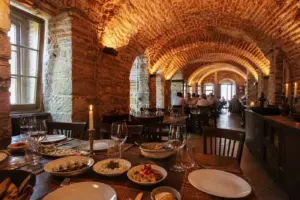 Pepo's Galata Turkish, Mediterranean
Main image: AI-generated illustration. It may not show the place exactly as it looks.
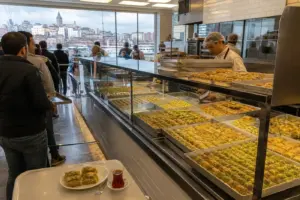 Karaköy Güllüoğlu Turkish Desserts & Baklava
Main image: AI-generated illustration. It may not show the place exactly as it looks.
Istanbul Vibes Tips
- If phyllo sheets tear while layering, do not discard them. Patch the tear by overlapping a small piece of phyllo from another sheet and brushing with butter; it will fuse together as it bakes.
- Room-temperature syrup poured over hot baklava creates the ideal balance: the pastry absorbs the sweetness while staying crispy outside. This single step separates good homemade baklava from the soggy kind.
- Different nuts create different flavors and textures—pistachios are delicate and slightly sweet, walnuts are earthy and bold, hazelnuts are mellow. Try each once to find your preference.
- If you want to make baklava ahead, fully cool it, wrap it tightly, and store at room temperature for up to 5 days. Do not refrigerate, as cold makes the phyllo tough.
- Brush butter all the way to the edges of the pan—the outside edges will be crispier than the center, and that is desirable. Some people prefer to break off and eat the corner pieces first.
- Adding a tiny pinch of orange zest or rose water to the syrup adds complexity without overpowering the nut flavor—taste a small spoonful and adjust if you like.
Explore Nearby Baklava
Browse more: All Food & Drink · All Other
FAQ
Can I use store-bought phyllo dough?
Yes, and most home cooks do. Store-bought phyllo works perfectly; just thaw it according to package directions and keep it covered while working. It is significantly easier than making phyllo from scratch.
What if I cannot find pistachios?
Walnuts, almonds, or hazelnuts work just as well. The flavor changes—walnuts are earthier, almonds lighter, hazelnuts creamier—but the method is identical. Mix nuts if you like: half walnuts, half almonds creates a balanced flavor.
Why does my baklava turn out soggy?
The most common cause is hot syrup poured over hot baklava, which prevents absorption and creates a wet layer on top. Always cool the syrup completely first. The second cause is too little butter between phyllo sheets, leaving no crispy structure to hold up under the syrup.
How much syrup should I use?
The recipe proportions given (1 cup sugar, 1 cup water, 100 g honey) are standard and will soak an entire 9×13-inch pan adequately. Pour it all—do not hold back. The baklava will seem very wet immediately after, but it firms up as it cools.
Can I make baklava without honey?
Yes. Use all sugar syrup (increase sugar to 1½ cups, water to 1 cup) and add lemon juice or a splash of rosewater. The result is less floral but still delicious and classic in many Greek and Turkish kitchens.
Do I have to cut baklava before baking?
Yes, it is much easier. Cutting through hot, crispy layers shatters the phyllo and crumbles the pieces. Scoring before baking ensures clean cuts that hold together.
How long does baklava keep?
Store at room temperature in an airtight container for 4–5 days. Do not refrigerate; cold makes the phyllo tough and leathery. Baklava does not freeze well because the syrup and phyllo separate during thawing.
Is baklava difficult to make for a beginner?
No. It requires patience and care with phyllo, but no advanced technique. The steps are straightforward: layer, brush, bake, pour syrup. Most first attempts succeed; small tears or imperfect layers are invisible once the pastry is baked and soaked.
Istanbul Vibes is a one-person project. A coffee keeps it going

Take this guide with you
Get a free PDF of this guide to print or read offline: key facts, tips and a map link on a few clean pages.
Report an issue on this page
How we research and update our guides
About this guide: AI assistance and accuracy
This guide is created with the help of AI and is based on official sources where available. Mistakes can still happen. Opening hours, prices, rules and other details are given to the best of our knowledge as of the date shown and can change without notice. It offers general recommendations only, not professional, legal or travel advice. Please confirm important details with the official source before you travel; you are responsible for your own plans and decisions.
* Affiliate link: as an Amazon Associate we earn from qualifying purchases at no extra cost to you.
