
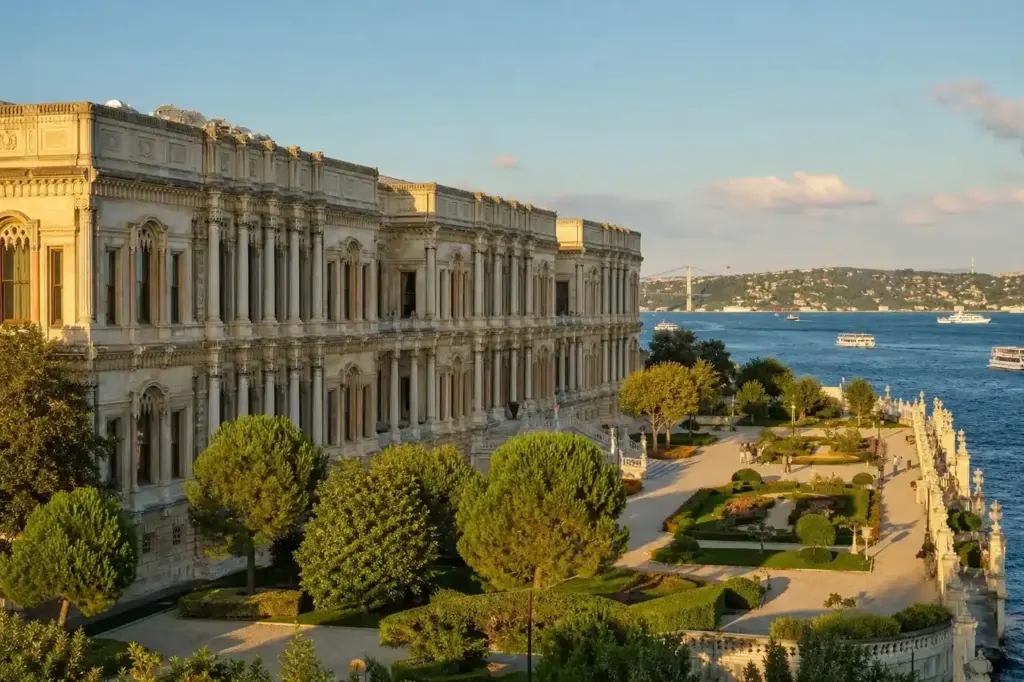
Dolmabahce Palace stands on the European shore of the Bosporus as the largest palace in Turkey and one of the most visually extravagant. Commissioned by Sultan Abdülmecid I and completed in 1856, this 19th-century palace replaced Topkapı Palace as the Ottoman Empire’s main administrative centre. The palace served as the official residence of six sultans and later as a presidential residence for Mustafa Kemal Atatürk, the founder of modern Turkey.
Today Dolmabahce Palace is a museum open to international visitors, showcasing rooms of extraordinary opulence: gilded ceilings, vast crystal chandeliers, marble halls, and centuries-old furnishings collected across the empire. The site itself is divided into separate sections—the main palace, the harem, and the clock tower outside—each telling a distinct chapter of Ottoman history and republican modernization.
Quick Facts
| Built / opened | 1856 |
|---|---|
| Architect(s) | Garabet Balyan, Nikoğos Balyan, James William Smith |
| Address | Vişnezade, Dolmabahçe Cd., 34357 Beşiktaş, Istanbul Google MapsApple MapsYandex Maps |
| District | Beşiktaş |
| Metro | Kabataş (Red Line (T1 Tram), Exit to Dolmabahçe Caddesi; walk uphill toward the palace gates, approximately 5 minutes) |
| Admission | ₺₺ |
| Best time to visit | Visit on a weekday morning (Tuesday–Friday, 09:00–11:00) to avoid weekend crowds and tour groups, which arrive mid-morning. Spring (April–May) and autumn (September–October) offer the best weather—mild temperatures and lower humidity than summer. Summer (June–August) brings intense heat and peak tourist congestion; if you must visit then, arrive at opening time. Winter (November–February) is quieter but colder; heating in the palace is minimal, and some sections feel drafty. Avoid 10 November (Atatürk Commemoration Day), when Turkish citizens visit in large numbers and some sections may be restricted. |
| Website | millisaraylar.gov.tr |
What Is (and Isn't) Part of a Visit to Dolmabahce Palace?
| Part | Status | Notes |
|---|---|---|
| Main Palace (Selamlık and Harem) | Included in the standard ticket | Both wings are covered in a single admission ticket; tours flow through both sections. |
| Dolmabahce Mosque | Separate ticket or institution | Located just outside the palace gates; separate admission required; not part of the palace ticket. |
| Clock Tower | Outside / not part of it | Visible from the palace gates but not entered on the standard tour; exterior viewing only. |
| Palace Gardens | Included in the standard ticket | The waterfront gardens are part of the palace complex; visitors pass through on arrival and departure. |
| Topkapı Palace | Outside / not part of it | A separate palace on the opposite shore; requires its own ticket and visit; different institution. |
| Beylerbeyi Palace | Outside / not part of it | Another Ottoman palace across the Bosporus; separate institution and ticket required. |
Why Visit Dolmabahce Palace?
The palace offers a window into the final era of Ottoman power and the beginning of the Turkish Republic. Unlike Topkapı Palace’s warren of pavilions arranged around courtyards, Dolmabahce presents a unified, European-influenced structure: vast salons designed to project imperial strength and modernity. The interiors contain artefacts rare elsewhere: one of the largest crystal chandeliers in the world (from Bohemia and Baccarat), gilded ceiling work using 14 tonnes of gold leaf, marble imported from across the Mediterranean, and gifts presented to sultans by European rulers.
A visit encompasses Ottoman ceremonial life, the architecture of the Tanzimat reform era (mid-19th century), and the personal quarters where Atatürk spent his final days. The setting itself—overlooking the busy Bosporus—connects the palace to the maritime trade routes and geopolitics that shaped the empire.
How Dolmabahce Palace Is Laid Out
Dolmabahce Palace consists of several interconnected sections you enter as a single ticketed visit. The main palace building is divided into two halves: the Selamlık (official administrative and ceremonial rooms where sultans conducted state business) occupies the western wing, while the Harem (private family quarters) fills the eastern side. Between them stands the Muayede Hall, an enormous ceremonial space used for imperial receptions.
The palace sits on the waterfront, so you enter from the hillside above, passing through gates into gardens. The main entrance leads into the Selamlık first. Your visit typically flows through ceremonial halls, the private chambers, dining spaces, and smaller reception rooms arranged along corridors. Allow time to linger in the larger rooms—the scale and decoration merit it. The Harem section, more intimate in character, contrasts starkly with the vast state halls. Outside the palace building stand the Dolmabahce Mosque (a separate viewing point) and the Clock Tower, visible from the palace but not entered as part of the standard tour.
Highlights of Dolmabahce Palace
Crystal Chandelier Hall (Muayede Salonu)
The largest and most visually arresting space in the palace. This ceremonial hall is dominated by one of the world's largest crystal chandeliers, a four-tonne Bohemian chandelier that required 400 candles to light and took engineers weeks to install. The room has a soaring domed ceiling and is ringed with balconies where the imperial family observed state ceremonies. The scale alone—the hall stretches 58 metres—conveys the grandeur sultans wished to project. This is the room visitors remember most vividly.
Tip: Go early in the day when morning light reflects through the crystals; arrive in the first group after opening to avoid crowds.
Red Room (Kırmızı Oda)
A gilded parlour lined in red velvet and Turkish carpets, used as a private receiving room by the sultan. The walls are decorated with inlaid mother-of-pearl and semi-precious stones. The furnishings are 19th-century Ottoman and European hybrid: Western upholstered sofas sit alongside traditional seating. This room illustrates how Ottoman elites had begun to absorb European domestic tastes while maintaining Ottoman ceremonial traditions.
Tip: Notice the inlay work on the walls—these details repay close looking but are easily missed in the flow of the tour.
Harem: Imperial Family Quarters
The private residence section, entered separately from the state rooms. The Harem comprises bedrooms, bathing chambers (hammams), kitchens, and sitting rooms arranged over multiple levels. The spaces are smaller and more domestic than the Selamlık halls—notice the fireplaces, smaller chandeliers, and personal touches. The imperial family, particularly the mother of the reigning sultan (the Valide Sultan), lived and governed domestic life here. A tour of the Harem is included with the main palace ticket and takes 30–45 minutes.
Tip: The Harem section is often less crowded than the main palace; if you tire of crowds, spend more time here.
Atatürk's Bedroom and Death Room
The chamber where Mustafa Kemal Atatürk, founder of modern Turkey, spent his final days and died on 10 November 1938. The room is preserved much as it was, including his bed and medical equipment. This space holds deep meaning for Turkish visitors and commemorates a pivotal moment in 20th-century Turkish history. The palace's role shifted after the Ottoman era to become a presidential residence, and this room documents that transition.
Tip: This room is small and often crowded on national holidays (particularly 10 November, Atatürk Commemoration Day); visit on a quieter day for reflection.
Grand Staircase
A marble staircase that descends from the upper floors of the Selamlık. The balustrades are carved stone and marble, and the walls are decorated with Ottoman-style plasterwork and gilding. The staircase was designed to be a visual statement—sultans made ceremonial descents down this stair for formal occasions. The craftsmanship visible here—marble cut and fitted without visible seams, gilding applied to plaster—exemplifies the technical skill employed throughout the palace.
Tip: Photograph from the landing midway up, where you can capture the full sweep of the stair and the architectural detail.
Clock Tower (Saat Kulesi)
A four-storey Ottoman Neo-baroque tower standing outside the palace, built 1890–1895, designed by architect Sarkis Balyan. The tower is 27 metres high and originally functioned to regulate time for the palace compound. It is visible from across the Bosporus and has become an iconic symbol of Dolmabahce. The tower is not entered on the regular palace tour but is a striking photo subject from the palace gates.
Tip: Photograph the Clock Tower from the palace gates at late afternoon, when the tower is lit by the setting sun over the Bosporus.
Atmosphere
Dolmabahce Palace is a study in formal grandeur and deliberate intimidation. The scale of the rooms—soaring ceilings, walls extending 30+ metres—makes visitors feel small, which was precisely the intent. The atmosphere is hushed and reverential; visitors speak quietly, and footsteps echo on polished marble. Crowds are typically moderate on weekday mornings and heavier on weekends and afternoons.
The palazzo’s waterfront location means you are aware of the Bosporus’s presence throughout: windows frame views of the strait, and from some rooms, the sound of passing ferries carries in. The lighting is often dim—galleries rely on original oil lamps converted to electric bulbs, casting warm, theatrical shadows on gilded surfaces. Guides move groups through at a steady pace; you are not encouraged to linger, so the experience feels slightly rushed. Mornings tend to be quieter and more contemplative; afternoons grow noticeably busier with tour groups.
History of Dolmabahce Palace
The site’s history begins long before the palace. The name Dolmabahce derives from Turkish “dolma” (filled) and Persian “bahçe” (garden)—in the 18th century the area was a filled-in garden and seaside retreat for Ottoman elites. By the 1840s, Ottoman sultans had become dissatisfied with Topkapı Palace, which was seen as cramped, outdated, and symbolically rooted in a past era.
Sultan Abdülmecid I, the empire’s 31st sultan, commissioned a new palace to project Ottoman modernity and strength to a sceptical world. Construction began on 13 June 1843, overseen by the Armenian Balyan family of court architects—Garabet Balyan and his son Nikoğos—alongside British architect James William Smith. The work took 13 years and consumed an estimated 35 tonnes of gold and vast quantities of imported marble, crystal, and furnishings. The palace was completed and first used on 7 June 1856.
From 1856 to 1887, Dolmabahce served as the main administrative centre of the Ottoman Empire. Six sultans made it their residence during this period. However, in 1889, Sultan Abdülhamid II preferred the security and seclusion of Yıldız Palace, and Dolmabahce fell into secondary use. In 1909, following the Young Turk Revolution, control of the palace returned to the state, and it resumed its role as the seat of power until 1922, when the Ottoman sultanate collapsed following Turkey’s War of Independence.
In 1924, a law transferred the palace to the newly formed Turkish Republic. Mustafa Kemal Atatürk, founder of the Republic, used Dolmabahce as a presidential residence and office, particularly in summer months. He enacted crucial state reforms and decisions within these walls. Atatürk died in the palace on 10 November 1938, an event now commemorated annually as a national memorial day. After Atatürk, the palace continued as a presidential residence and venue for state functions until 1984, when it was converted into a museum and opened to the public under the management of the Directorate of National Palaces.
Legends and Myths about Dolmabahce Palace
The Ghost of Sultan Abdülhamid II
Legend – historically unreliable. Local folklore claims that Sultan Abdülhamid II, who lived for years under house arrest at Dolmabahce after his deposition in 1909, haunts the palace. Accounts describe unusual sounds, footsteps in empty corridors, and doors opening on their own, particularly in the sections he inhabited. Palace guides and staff have reported these incidents over the decades, though sceptical observers attribute such sounds to the building's age and settling.
Atatürk's Spirit at the Bedside
Legend – historically unreliable. On the anniversary of Atatürk's death (10 November), visitors and guards have reported sensing a presence in the death chamber. Some accounts describe a figure in military uniform standing silently at the foot of the bed. These reports intensified in the 1980s and 1990s but remain anecdotal rather than verified.
Tickets and Booking for Dolmabahce Palace
| Ticket | Price | Includes |
|---|---|---|
| General Admission (International Visitors) | ₺₺ | Access to the main palace (Selamlık), Harem section, and palace gardens. Guided group tours are typically included; individual exploration is not permitted—you must move with assigned groups. |
₺ budget · ₺₺ moderate · ₺₺₺ upscale · ₺₺₺₺ splurge. Price levels are estimates compared with typical prices for visitors.
Tickets are sold officially through the Directorate of National Palaces website (millisaraylar.gov.tr) and at the palace gates. International visitors can purchase tickets online in advance or on the day of visit, subject to availability. Online booking opens roughly 30–60 days before your visit date; if a date is not yet available online, it has not been opened for booking yet.
Same-day tickets are available at the ticket office (Bilet Gişesi) near the main entrance, typically until 17:00, to allow time for the final tour of the day. During peak tourist season (May–September) and on Turkish public holidays, same-day tickets may sell out; advance booking is strongly recommended.
Tickets for Turkish citizens and certain concession categories (children, students, seniors) are available at discounted rates. Rates differ significantly and are updated annually. Visit the official National Palaces website (millisaraylar.gov.tr) to see all ticket categories, current prices, and booking terms, as these change frequently.
Suggested itineraries Dolmabahce Palace
2 hours
Enter through the main gates, pass through the Selamlık state rooms in sequence: antechamber, grand reception halls, and smaller administrative chambers. Descend the Grand Staircase, brief visit to the Harem (bedrooms and bathing rooms), and exit. This covers the highlights without deep exploration of every room.
3 hours
Begin as above, but linger in major halls: spend 10–15 minutes in the Muayede Hall (Crystal Chandelier) and Red Room, take the full Harem tour including the kitchen and servants' quarters, view Atatürk's bedroom and death room, and walk the palace gardens before departure.
Half day (4+ hours)
Take a guided tour (available through the palace or via tour operators) that includes detailed history and architectural commentary. Explore the Selamlık thoroughly, take a full Harem tour, visit smaller rooms and display cases, photograph from the palace waterfront, and conclude with tea in the palace café (if available) overlooking the Bosporus.
How to Get to Dolmabahce Palace
By tram: Take the T1 (Red Line) tram to Kabataş station. Exit toward Dolmabahçe Caddesi (the main road along the waterfront). The palace gates are uphill; walk east along the road for approximately 5 minutes, passing the Clock Tower on your left. Look for the iron gates and guard post marking the entrance. The walk from the tram is steep but straightforward.
By taxi or rideshare: Provide the address: Vişnezade, Dolmabahçe Caddesi, Beşiktaş. Taxis can drop you at the palace gates, though traffic congestion along the waterfront during peak hours may cause delays. Expect the fare to be moderate.
Walking from nearby areas: The palace is accessible on foot from Kabataş (5 min), Beşiktaş (10 min), or Ortaköy (20 min). The walk from Kabataş involves an uphill climb; comfortable shoes are advisable.
Accessibility
The palace has wheelchair access to the ground floor of the main Selamlık and Harem sections via ramps at the main entrance. Upper floors are not wheelchair accessible due to stairs. Disabled visitors and one companion receive free entry; bring documentation. The palace has benches in some rooms where visitors can rest. Assistance animals are permitted. Accessible toilets are located near the main entrance. The marble floors are slippery when wet; wear non-slip footwear.
Food Nearby
The palace has a small café inside (seasonal hours; check on arrival). For meals outside the palace, the waterfront district of Kabataş and the adjacent Ortaköy neighbourhood offer numerous restaurants, cafés, and bakeries. Ortaköy is famous for its street food (crispy pastries, fish sandwiches) and casual dining. For a sit-down meal overlooking the Bosporus, restaurants line the waterfront; these range from budget-friendly to upscale. Stock up on snacks before entering if you plan a short visit, as leaving and re-entering is typically not allowed.
What to Bring
Wear comfortable walking shoes with a firm sole (marble floors are slippery). Layers are essential, as interior heating is inconsistent; the palace can be cool even in summer. Bring a camera; photography is permitted in most rooms (check for 'no photo' signs). A small daypack is acceptable; luggage and large bags may be restricted at the gate. Sunscreen and a hat are useful if you arrive early and spend time in the gardens. Mobile phone cameras work well in the dim lighting; professional tripods may require permission.
Best Views and Photo Spots of Dolmabahce Palace
Muayede Hall (Crystal Chandelier Room)
The 4-tonne Bohemian chandelier dominates the ceiling of this vast ceremonial hall. Photograph from the entrance door to capture the full length of the hall with the chandelier overhead, or stand to one side and frame the chandelier against the geometric ceiling plasterwork.
Best time: Morning light (9:00–11:00) entering from the tall windows creates a crisp, well-lit scene; afternoon light becomes more golden and diffuse.
Grand Staircase Landing
A marble staircase descending from the upper Selamlık, flanked by carved railings and lit by overhead skylights. Photograph from the landing midway up to capture the stair's sweep and the architectural detail of the railings and walls.
Best time: Mid-morning when skylights are brightest; avoids harsh shadows from sidelighting.
Palace Waterfront, from the Gardens
The 600-metre facade of the palace rises directly from manicured gardens, with the Bosporus visible beyond. The view frames the palace's European-style architecture against the waterfront and strait.
Best time: Late afternoon (16:00–17:30) when the setting sun highlights the stone facade and the Bosporus reflects golden light; fewer visitors are present.
Clock Tower (exterior view from gates)
The four-storey neo-baroque tower stands between the palace and the street. The ornate exterior and domed top are framed by palace walls and gate structures; it is an iconic symbol of the palace complex.
Best time: Late afternoon or golden hour, when the tower is side-lit and stands out against the sky; avoid midday when sun is directly overhead.
Red Room (interior)
An ornate gilded parlour lined in red velvet, with mother-of-pearl inlay on walls and European and Ottoman furnishings. The close framing of ornament and colour creates an intimate, jewel-like photograph.
Best time: When interior lighting is brightest (morning to early afternoon); the gilding reflects light well in these hours.
Photography Rules
Photography is generally permitted in the main palace rooms, though flash is prohibited to protect furnishings and reduce glare on gilded surfaces. Some display cases and certain rooms may have 'no photography' signs; respect these. Professional equipment (large cameras, tripods) may require advance permission. Drones are not permitted. The most photogenic locations are the Muayede Hall (with its massive chandelier), the Red Room, the Grand Staircase, and the waterfront gardens.
Family Suitability
Dolmabahce Palace is suitable for older children (8 years and up) with an interest in history or architecture. The scale of the rooms and the presence of famous objects (the enormous chandelier, gilded ceilings) captivate many children. However, visits require moving quietly with a group for 1.5–2 hours, which may challenge younger children. Strollers cannot be used inside the palace; infants must be carried. Children under 12 may find the pace slow and details arcane; families with young children should plan a shorter 1.5-hour visit focused on highlights. Teenagers with an interest in Ottoman history, architecture, or Atatürk will find the palace rewarding.
Istanbul Vibes Tips
- Arrive at 09:00 or 09:30, immediately after opening. The palace becomes noticeably crowded after 11:00 and remains busy until 16:00. An early visit gives you quieter access to the major halls and better light for photography.
- Do not expect to wander independently. Tours move as assigned groups through fixed routes; you cannot choose your own path through rooms or linger indefinitely. Ask your guide about the most important rooms if you are short on time, and prioritise the Muayede Hall and Red Room.
- Wear comfortable, non-slip shoes with firm soles. The marble floors throughout are polished and slippery, especially on stairs. Many visitors lose their footing, particularly on descents.
- Bring layers. Interior heating is inconsistent; rooms can feel cold even on warm days outside. A light sweater or cardigan prevents discomfort during the 2-hour tour.
- If you are interested in Atatürk or 20th-century Turkish history, ask your guide to spend extra time on Atatürk's rooms and the final period of the palace's use as a presidential residence. These sections are often rushed in standard tours but offer profound historical context.
- The palace café is small and can run out of hot drinks during peak hours. If you anticipate needing tea or coffee, arrive early or bring a drink with you.
Explore Nearby Dolmabahce Palace
Sights near Dolmabahce Palace
 Blue Mosque – about 4.3 km away · typical visit: 45–75 minutes3 min on foot from Gülhane metro
Main image: AI-generated illustration. It may not show the place exactly as it looks.
 Hagia Sophia – about 3.9 km away · typical visit: 1–1.5 hours8 min on foot from Gülhane metro, Open daily 09:00–19:30
Main image: AI-generated illustration. It may not show the place exactly as it looks.
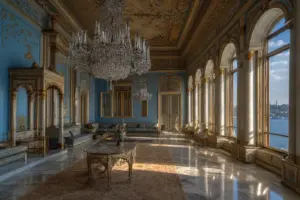 Dolmabahce Palace Harem – about 50 m away (~1 min walk) · typical visit: 2–3 hours14 min on foot from Kabataş metro, Open 09:00–17:00, closed Mon
Main image: AI-generated illustration. It may not show the place exactly as it looks.
 Istanbul Museum of Painting and Sculpture – about 250 m away (~4 min walk) · typical visit: 1–2 hours11 min on foot from Kabataş metro
Main image: AI-generated illustration. It may not show the place exactly as it looks.
 Istanbul Naval Museumabout 400 m away (~7 min walk) · typical visit: 1.5–2 hours
Main image: AI-generated illustration. It may not show the place exactly as it looks.
 Maçka Park – about 950 m away (~15 min walk) · typical visit: 1–2 hoursOpen 24 hours
Main image: AI-generated illustration. It may not show the place exactly as it looks.
Metro stations near Dolmabahce Palace
 Kabataş – about 900 m away (~15 min walk)Open daily 06:15–00:00
Main image: AI-generated illustration. It may not show the place exactly as it looks.
Restaurants and cafes near Dolmabahce Palace
 Healin Foods – about 750 m away (~12 min walk)Open 07:30–23:00, closed Sun
Main image: AI-generated illustration. It may not show the place exactly as it looks.
 Nobu Istanbul – about 800 m away (~13 min walk)11 min on foot from Kabataş metro
Main image: AI-generated illustration. It may not show the place exactly as it looks.
 Ayaspaşa Russian Restaurant – about 1.0 km away (~16 min walk)5 min on foot from Kabataş metro, Open daily 12:30–23:30
Main image: AI-generated illustration. It may not show the place exactly as it looks.
 Tiflisi – about 1.2 km away (~20 min walk)10 min on foot from Kabataş metro
Main image: AI-generated illustration. It may not show the place exactly as it looks.
Nightlife near Dolmabahce Palace
 Craft Beer Lababout 350 m away (~6 min walk)
Main image: AI-generated illustration. It may not show the place exactly as it looks.
 Sanayi-1A – about 350 m away (~6 min walk)Open daily 11:00–23:00
Main image: AI-generated illustration. It may not show the place exactly as it looks.
Train stations and river piers near Dolmabahce Palace
 Beşiktaş Ferry Terminalabout 200 m away (~3 min walk)
Main image: AI-generated illustration. It may not show the place exactly as it looks.
 Kabataş Ferry Terminalabout 950 m away (~16 min walk)
Main image: AI-generated illustration. It may not show the place exactly as it looks.
Related guides
 Best Restaurants with Bosphorus Views in Istanbul: Six Tables
Main image: AI-generated illustration. It may not show the place exactly as it looks.
 Istanbul Football Stadium Tours: Three Clubs and Their Museums
Main image: AI-generated illustration. It may not show the place exactly as it looks.
 How to Attend a Football Match in Istanbul: Tickets and Entry
Main image: AI-generated illustration. It may not show the place exactly as it looks.
 Romantic Hotels in Istanbul: Bosphorus Views and Terraces
Main image: AI-generated illustration. It may not show the place exactly as it looks.
 Best Family Hotels in Istanbul: Pools and Connecting Rooms
Main image: AI-generated illustration. It may not show the place exactly as it looks.
Browse more: More in Beşiktaş · All Landmarks · All Sightseeing
FAQ: Dolmabahce Palace
Is Dolmabahce Palace included in the Istanbul Museum Pass?
No. Dolmabahce Palace is managed by the Directorate of National Palaces and requires a separate ticket. Other major palaces (Topkapı, Yıldız) are also separate from multi-attraction passes. Check the official National Palaces website (millisaraylar.gov.tr) for any bundled offers.
Can I visit the palace without a guide?
No. All visitors move through the palace in guided groups; individual exploration is not permitted. Group sizes vary but typically include 20–40 people. Your group is assigned at the ticket office, and you move at the group's pace.
How is Dolmabahce Palace different from Topkapı Palace?
Topkapı Palace (in the Sultanahmet district) was the residence and administrative centre of the Ottoman Empire for 400 years until 1856. It is a sprawling complex of pavilions arranged around courtyards, reflecting medieval and Islamic architectural traditions. Dolmabahce, by contrast, is a unified, European-style building completed in 1856 and used for only 66 years by sultans; it emphasizes grandeur and modern luxury. Topkapı is older and larger; Dolmabahce is more opulent and cohesive architecturally.
Is Atatürk's death room included in the tour?
Yes. The room where Atatürk died on 10 November 1938 is included in the standard palace tour. It is preserved as a memorial and is a significant stop for many visitors, particularly Turkish nationals.
Can I take photographs inside the palace?
Yes, photography is permitted in most rooms without flash. Some display cases and specific rooms may have 'no photography' signs; respect these. Professional tripods may require advance permission. Drones are not allowed.
How long does a visit typically take?
A standard group tour takes 1.5–2 hours. If you arrive early and linger in major rooms, a full visit can take 3 hours. Plan for 2–3 hours total, including entry time and queueing.
Is there a restaurant or café inside the palace?
The palace has a small café near the main entrance with limited seating and seasonal hours. For full meals, head to nearby Kabataş or Ortaköy after your visit. Many visitors bring snacks or eat before entering.
Is the palace wheelchair accessible?
The ground floor of the main Selamlık and Harem sections are wheelchair accessible via ramps at the main entrance. Upper floors are not accessible. Disabled visitors and one companion enter free; bring documentation. Contact the palace in advance if you have specific accessibility questions.
Istanbul Vibes is a one-person project. A coffee keeps it going
Hotels near Dolmabahce Palace
- W Hotel (300 m) Check prices (affiliate link, opens in a new tab)
- Shangri-La Bosphorus (300 m) Check prices (affiliate link, opens in a new tab)
- AC Hotel İstanbul Maçka (450 m) Check prices (affiliate link, opens in a new tab)
- Koç Otel (600 m) Check prices (affiliate link, opens in a new tab)
Affiliate link (opens the booking site): we may earn a commission at no extra cost to you.
Restaurants near Dolmabahce Palace
- Sushi & Spice (350 m) Google Maps
- Sinop Mantı (450 m) Google Maps
- Loving Hut (500 m) Google Maps
- Zürüm Dürüm (500 m) Google Maps
Distances are straight-line, from OpenStreetMap data.

Take this guide with you
Get a free PDF of this guide to print or read offline: key facts, tips and a map link on a few clean pages.
Report an issue on this page
How we research and update our guides
About this guide: AI assistance and accuracy
This guide is created with the help of AI and is based on official sources where available. Mistakes can still happen. Opening hours, prices, rules and other details are given to the best of our knowledge as of the date shown and can change without notice. It offers general recommendations only, not professional, legal or travel advice. Please confirm important details with the official source before you travel; you are responsible for your own plans and decisions.
* Affiliate link: as an Amazon Associate we earn from qualifying purchases at no extra cost to you.
