
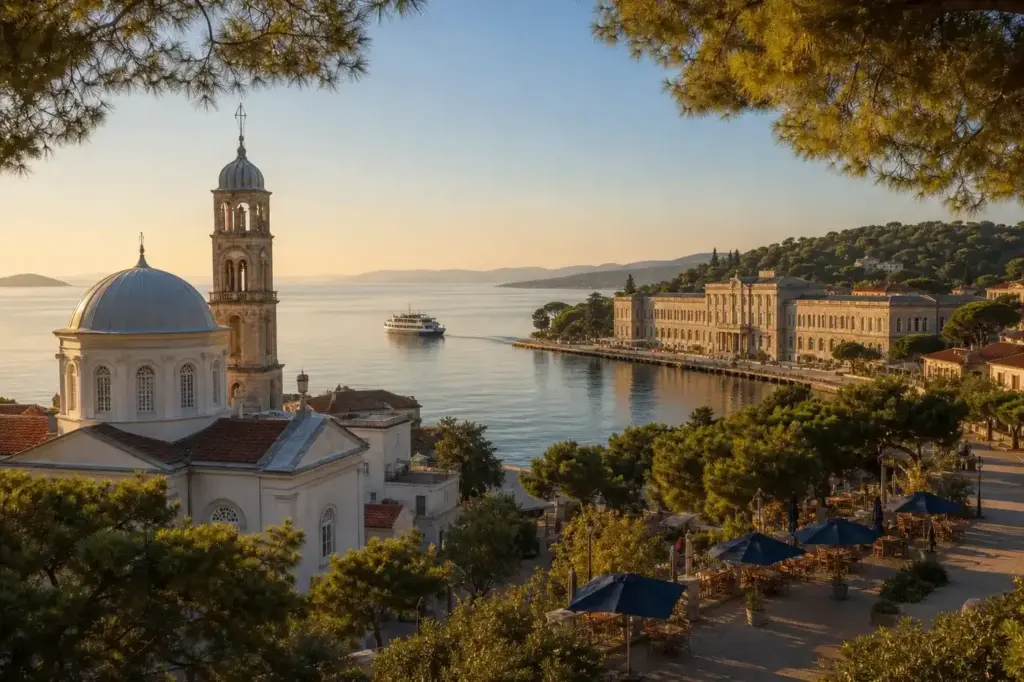
Heybeliada (known in Greek as Halki, meaning copper) is the second-largest of the Princes’ Islands, a car-free neighborhood in the Adalar district roughly 15 km southeast of central Istanbul. The name “Heybeliada” means Saddlebag Island in Turkish, referring to the saddle-shaped depression between its two main hills.
Unlike the busier Büyükada nearby, Heybeliada remains quieter and more village-like. The permanent population hovers around 4,500, though it swells to over 30,000 during summer months. The island’s defining feature is the absence of motor vehicles—transport is by foot, bicycle, or electric shuttle. This quiet, preserved character has made it a refuge for artists, writers, and anyone seeking relief from Istanbul’s urban intensity.
Quick Facts
| Address | Google MapsApple MapsYandex Maps |
|---|---|
| District | Adalar |
| Admission | Free |
| Best time to visit | Season: Spring (April–May) and autumn (September–October) are ideal: mild temperatures, fewer crowds than summer, and lush vegetation. Summer (June–August) is warm and swimmable but crowded on weekends; plan for early mornings and weekday visits. Winter (November–March) is quiet and atmospheric, with cooler weather and occasional rain; ferries still run, but some facilities close or reduce hours.
Days and times: Weekday mornings (Tuesday–Thursday, before 11 am) are the quietest; you will see locals and feel the true village character. Summer weekends are crowded with Istanbul day-trippers and families; ferries add extra sailings. Visiting on a weekday morning in May or September gives the best balance of comfortable weather and solitude. Crowds: The waterfront fills with day-trippers by noon on summer weekends. If you want to avoid crowds, arrive by 9 am or visit after 4 pm (not feasible on the same day). September mornings are particularly uncrowded and pleasant. |
| Recommended duration | Full day |
What Is (and Isn't) Part of a Visit to Heybeliada?
| Part | Status | Notes |
|---|---|---|
| Ferry ticket | Included in the standard ticket | Entry to the island is by ferry only; the ferry fare is your only cost to reach and walk the public areas. |
| Waterfront and walking streets | Included in the standard ticket | All public paths, streets, and the promenade are free to walk; no entry restrictions. |
| St. Nicholas Church interior | Separate ticket or institution | Open for worship and occasional visits; ask the caretaker. No charge, but modest dress required. Not reliably open to casual tourists. |
| Hagia Triada Monastery and Halki Theological Seminary | Separate ticket or institution | Access varies; sometimes open for limited public tours, sometimes closed. No established entry fee; donations accepted. Check with locals or call ahead; hours are irregular. |
| Naval Academy grounds | Not open to visitors | Active military institution; not open to visitors. The exterior is visible from the waterfront, but the grounds and buildings inside cannot be entered. |
| St. George Monastery (Aya Yorgi) | Not open to visitors | Closed to public. Located within Naval Academy grounds; visible from the promenade but not accessible. |
| Kamariotissa Byzantine Church | Not open to visitors | Historic Byzantine structure inside Naval Academy; not open to visitors. |
| Bicycle rental and horse-drawn carriage tours | Separate ticket or institution | Available at the waterfront for a fee; booking on the spot; standard tourist rates. |
| Büyükada (neighboring island) | Outside / not part of it | Larger and busier; requires a separate ferry leg; not part of a Heybeliada visit unless you make a day trip to both islands. |
Why Visit Heybeliada?
No cars mean silence. Thirty seconds off the ferry, the city’s traffic noise vanishes. You hear birdsong, wooden gates creaking, and pine needles underfoot—a rare urban escape.
Medieval and Ottoman layers. The Hagia Triada Monastery on Ümit Tepesi (Hope Hill) dates to the 9th century and was restored by Patriarch Photios. The Halki Theological Seminary, founded 1844, trained Eastern Orthodox clergy until 1971 and remains an active library and teaching site. St. Nicholas Church (1857) sits by the waterfront with a holy spring.
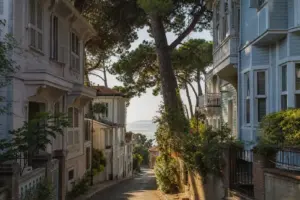
Walking and cycling architecture. Narrow streets lined with weathered wooden villas from the 1880s–1920s, when the island was a wealthy summer retreat for Constantinople’s Greek and Ottoman elite. Pine forests cover the hillsides; small beaches and a waterfront promenade frame the ferry jetty.
How Heybeliada Is Laid Out
Heybeliada is small—roughly 2.3 square kilometers, or about 1.2 km by 2.7 km—with four hills and a central waterfront village.
The waterfront is where the ferry arrives. This compact area holds restaurants, cafes, bicycle rentals, and St. Nicholas Church. It is the social and logistical heart; most day-trippers do not venture beyond this area.
Main hills and interior: Ümit Tepesi (Hope Hill) rises to the north, crowned by the Hagia Triada Monastery and Halki Seminary. Değirmentepe rises to the south and east (136 m high). Between and around them are residential streets with mansions and pine forests. Secondary attractions—the Naval Academy, monasteries, beaches—are scattered around the perimeter and require walking or cycling.
Getting oriented: Most visitors stay at the waterfront and take a bicycle or walking tour of one hill (a half-day activity). A full-day circuit explores both hills, beach coves, and monasteries. The island is compact enough that you cannot get truly lost; paths are narrow but marked.
Highlights of Heybeliada
Hagia Triada Monastery and Halki Theological Seminary
Perched on Ümit Tepesi (Hope Hill), this Orthodox monastery complex was founded in the 9th century by Patriarch Photios and rebuilt multiple times. The seminary opened in 1844 to train clergy from across the Orthodox world; it closed in 1971 but reopened for limited public visits. Visitors can walk through a library holding over 120,000 books, classrooms with original furnishings, and a biblical garden containing 82 plant species mentioned in Scripture. The current church (1844) features three naves and a dome. No regular entry fee, but hours and access vary; check locally before climbing the hill.
Tip: Go early morning or late afternoon to avoid heat and crowding; the climb takes 30–40 minutes on foot. Bring water. The views over the Sea of Marmara from the hill are best in afternoon light.
St. Nicholas Greek Orthodox Church
Located a few steps from the ferry terminal, this church was built in 1857 on the site of a Byzantine predecessor. Architect Stefani Gaitanakis designed it with a cruciform layout and independent bell tower; the bell was brought from Russia. A separate narthex building houses the St. Paraskevi holy spring (ayasma), revered for healing powers. The church was severely damaged in the 1894 earthquake but quickly repaired. It is now used by Armenian and Assyrian communities; the caretaker may allow visits around 16:30 in summer.
Tip: The church is easy to find and good for a quick visit. The holy spring is the real draw; if the door is open, ask permission to step inside the narthex. Modest dress is expected.
St. George Monastery (Aya Yorgi Manastırı)
This Orthodox monastery stands within the grounds of the Turkish Naval Academy (built 1773), which is why it is not fully open to the public. The current structure dates to 1758 and was rebuilt by Metropolitan Ioannikios Karatzas, who later became Ecumenical Patriarch. From the 18th century until the property passed to the Naval Academy in the mid-20th century, it served as a property of the Jerusalem Greek Orthodox Patriarchate. The monastery is closed to casual visitors, but its white stone exterior and dome are visible from the waterfront promenade.
Tip: Walk the waterfront promenade near the ferry dock to see the monastery's exterior. If you are interested in naval history, the academy grounds themselves are not open to tours, but the setting is photogenic.
Turkish Naval Academy (Deniz Harp Okulu)
Founded in 1773, the Naval Academy overlooks the main ferry jetty on the southern waterfront. Its neoclassical buildings and fortress-like walls dominate the harbor view. Within the academy grounds lies Kamariotissa, a small Byzantine church that is the last church built on the island before the conquest of Constantinople in 1453; it dates to around 1453 or slightly before. The academy moved inland to Mersin during World War II for security but returned to Heybeliada in 1946. The grounds are not open to visitors, and the grounds cannot be entered, but the building is an unmissable landmark and photo spot.
Tip: The best view of the academy is from a waterfront café or the promenade. Early mornings are quietest for photos. Do not attempt to enter; it remains an active military institution.
19th-Century Wooden Mansions
The residential streets inland from the waterfront—particularly along Lozan Zeferi and Refah Şehitler Streets—are lined with elegant wooden villas from the 1880s through early 1920s. These were built for wealthy Greek families, Ottoman officials, and later, summer residents. Most are still private homes, but their ornate balconies, shutters, and architectural details reflect the island's golden age as a summer retreat for Constantinople's elite. The wood construction is typical of Ottoman-era Istanbul neighborhoods, but the concentration and preservation here is exceptional. Trees and narrow lanes make them atmospheric for walking and photography.
Tip: Walk these streets in late afternoon when light is golden and fewer people are about. Many mansions sit behind locked gates, so respect privacy and photograph from the street. The architecture is best understood by wandering; no single mansion is more important than others.
Pine Forests and Walking Trails
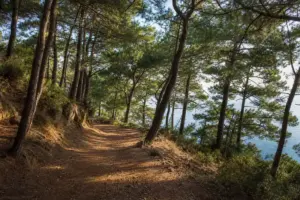
Heybeliada is the greenest of the Princes' Islands, covered in Aleppo pine, stone pine, and maritime pine. The forests provide shade, fragrance, and a sense of seclusion. Several waymarked trails loop through the interior and around the coast, connecting the two main hills, villages, and coves. The most popular is the southwest circuit (approximately 7 km), which passes the Çam Limanı (Pine Harbor) cove and the ruins of smaller monasteries. Trails are well-trodden but narrow; a full perimeter walk takes 2–3 hours depending on stops. The silence and forest smell are the main attractions—no significant geological or wildlife features.
Tip: Bring sturdy shoes; trails can be rocky and root-strewn. A bicycle is faster for covering the circuit. Start early to beat heat. The forest is densest on the eastern and southern slopes; the waterfront is more open.
Waterfront Promenade and Cafés
The narrow seafront strip around the ferry terminal hosts restaurants, cafes, and small shops. The atmosphere changes dramatically between seasons: quiet and local in winter and spring, crowded with day-trippers and summer residents in July and August. In summer evenings, grilled fish and seafood fill the air, and ferries glide past as the sun sets. Several small beaches and swimming spots are accessible from the promenade; the most popular is Akvaryum Cove on the western shore. Tables spill into the street; seating is casual and picturesque. No famous restaurants, but honest local lokantalar (casual eateries) serve meze and fish.
Tip: Go in the morning for breakfast or coffee and a quieter atmosphere. Evening dining is more touristy and requires reservations on weekends in summer. The waterfront is the only part of the island with substantial commercial infrastructure; everything else is residential.
Atmosphere
The first moment off the ferry, Heybeliada feels like stepping 50 years into the past. Bicycle bells, wooden gates, and the low murmur of conversation replace Istanbul’s relentless traffic. The scent of pine and salt air is constant. Narrow lanes slope upward between high wooden fences hiding villas; laundry hangs between shutters; cats sleep in doorways.
In early morning and off-season (autumn through spring), the island is genuinely quiet—the waterfront has a few fishermen and locals nursing tea. Summer transforms it: day-trippers arrive on noon ferries, the cafés fill, bicycles swarm the narrow streets, and families with small children take over the promenade. By late afternoon, ferries depart and calm returns.
The light is soft under the pines. The architecture—Ottoman wooden houses, stone churches with domes and belfries—creates an intimate, almost Mediterranean mood. Unlike Büyükada’s grandeur, Heybeliada feels lived-in and village-like. You encounter locals doing errands, elderly couples tending small gardens, children playing in squares. The waterfront restaurants in summer evenings, with lights reflecting on water and grilled fish aromas, are romantic but not slick.
History of Heybeliada
Ancient and Byzantine roots. The island was known in antiquity as Halki or Halkitis (from the Greek word for copper), a reference to copper mines that were worked in ancient times. During the Byzantine era, Heybeliada became a religious and cultural center. Monasteries and churches dotted the hills, drawing monks and pilgrims. The most significant is the Monastery of Hagia Triada (Holy Trinity), traditionally attributed to Patriarch Photios in the 9th century and later used as both a place of worship and, occasionally, as a place of exile for imperial figures. The monastery survives in continuous (though interrupted) operation to this day.
Ottoman period and refuge. After the conquest of Constantinople in 1453, the island remained home to a Greek Orthodox Christian population. Religious life continued, though under Ottoman authority. In the 16th century, during plague outbreaks on the mainland, the monasteries—particularly Hagios Georgios (St. George on the Cliff, founded late 1500s)—served as sanctuaries for the local Greek population. A list of island churches compiled by a German priest in the 16th century confirms the continuity of monastic life. The 1341 Virgin Mary Church and the 1758 St. George Monastery both belong to this period of Orthodox community survival.
19th-century transformation. Steam-powered ferry service began in 1846, connecting the island to mainland Istanbul and transforming it from a fishing village into a fashionable summer retreat. Wealthy Greek merchants, Ottoman officials (including Abbas Halim Pasha, who settled there around 1830 and built a beach pavilion), and later Turkish elites built villas and mansions. The island became an intellectual and artistic center, attracting writers and thinkers. Schools were established—the Ottoman Commercial School (a private institution) and, most notably, the Halki Theological Seminary, founded in 1844 by Patriarch Germanos IV with the support of Sultan Abdülmecit. The seminary trained Orthodox clergy from across the Ottoman world and beyond; roughly 1,000 students graduated during its 127 years of operation. The population and building stock expanded dramatically through the late 1800s.
20th century and decline. After the founding of the Turkish Republic in 1923, the island’s character shifted. A tuberculosis sanatorium was opened to serve the new state. The Naval Academy, established in 1773, consolidated its headquarters on the island and became its dominant institution. During World War II, the academy was relocated to Mersin for security, but returned in 1946. Many Greek families left for Greece over the 20th century, and the island’s cultural diversity began to narrow. The Halki Seminary, which had become a symbol of Orthodox education under Ottoman and Turkish rule, was closed by the Turkish government in 1971 under circumstances that remain diplomatically sensitive. The seminary building was converted to a museum and library, though it occasionally opens for worship and public tours. Today, the island remains quiet and architecturally preserved, its mansions and churches frozen in a late Ottoman aesthetic, and its waterfront has evolved into a summer retreat for Istanbul’s middle class and a tourist destination.
Legends and Myths about Heybeliada
Patriarch Photios and the monastery's founding
Disputed by historians. Local tradition credits Patriarch Photios I of Constantinople (9th century) with founding the Monastery of Hagia Triada on Ümit Tepesi. Photios is said to have been buried at the monastery after his death. Historians confirm that a monastery existed on the site and that Photios had connections to religious communities, but the exact founding date and Photios's direct role are disputed. Medieval sources mention the monastery, but no single source proves Photios himself established it.
Edward Barton's plague refuge and death
Legend – historically unreliable. In 1598, Edward Barton, ambassador to the Porte under Queen Elizabeth I of England, fled Constantinople when plague struck the mainland and sought refuge on Heybeliada. According to the legend, he brought the disease with him and died on the island. His grave was allegedly located on the Naval Academy grounds, though it was later moved to Üsküdar. The story is widely repeated in travel narratives and local accounts.
The bell from Russia
Legend – historically unreliable. St. Nicholas Church is said to possess a bell that was brought from Russia, installed when the church was rebuilt after the 1894 earthquake. The exact origin and journey of this bell are not documented, but the claim appears in multiple local sources and adds to the island's aura of historical mystery and international connection.
Tickets and Booking for Heybeliada
Heybeliada is accessed by ferry, not by ticketed entry to the island itself. The island is free to walk once you arrive; you pay only for the ferry.
Ferry operators and routes: City ferries (Şehir Hatları) depart from Eminönü, Beşiktaş, Kabataş, and Kadıköy on the European side, and Bostancı on the Asian side. Journey times range from 90 minutes (from Eminönü/Kabataş) to about 30 minutes (from Bostancı). Private fast-ferry operators—Mavi Marmara and Dentur Avrasya—also serve the route and are faster but run fewer trips. Schedules vary by season; more sailings operate in summer.
Booking and payment: Buy a ferry ticket at the terminal on the morning of travel, or use your Istanbulkart (Istanbul transit card) for a discount. Most travelers do not book in advance; ferries usually have space. Check the Şehir Hatları website for the current timetable the morning you travel; schedules change seasonally and with demand.
Monastery access: The Halki Seminary and Hagia Triada Monastery have irregular hours. No pre-booking system exists; visit on the day or ask your hotel to call ahead. No official website provides current hours; local cafés or your accommodation can advise.
Suggested itineraries Heybeliada
Half day (3–4 hours)
Arrive by morning ferry. Spend an hour at the waterfront café; walk the main street and visit St. Nicholas Church. Rent a bicycle and loop the waterfront coves, or climb Ümit Tepesi for monastery views (30–40 min walk uphill). Return to waterfront for lunch at a fish restaurant, then catch an afternoon ferry home. This covers the highlights without extreme walking.
Full day (6–8 hours)
Arrive early (8–9 am). Breakfast at waterfront café. Rent a bicycle and explore the southwest circuit (7 km, 2 hours with stops), visiting Çam Limanı cove and monastery ruins. Return to waterfront by early afternoon. Climb Ümit Tepesi to the Halki Seminary (with a guide if possible) or book a local tour. Lunch at a waterfront restaurant. Afternoon: swim at one of the coves or simply rest in a café. Sunset walk or ferry home late.
Overnight or two-day stay
If staying in a guesthouse, use the first day for the waterfront and one monastery (St. Nicholas or Halki). Second day: take the long forest circuits, visit Hagios Georgios and secondary coves, have evening dinner at a waterfront restaurant watching the sunset. This pace allows for conversation with locals, photography, and genuine rest from the city. Return by morning ferry on day three.
How to Get to Heybeliada
By ferry (only access method):
- From Eminönü (European side): Şehir Hatları (City Ferries) depart multiple times daily. Journey ~90 minutes; a scenic and budget-friendly option with open-deck seating. Most crowded at peak times (10 am–4 pm).
- From Kabataş/Beşiktaş (European side): City ferries and private operators (Dentur Avrasya, Mavi Marmara). Journey ~90 minutes by city ferry, ~45–60 minutes by private fast ferry. Kabataş is closer to central Istanbul (near Taksim) than Eminönü.
- From Kadıköy (Asian side): City ferries depart regularly. Journey ~60–75 minutes; convenient if staying on the Asian side. Less crowded than European routes.
- From Bostancı (Asian side): Both city and private ferries. Journey ~30 minutes; the fastest option. Bostancı is in a residential neighborhood on the east side; less touristy than the European terminals.
Ferry tickets and payment: Buy at the terminal ticket window on the day. Use your Istanbulkart (rechargeable transit card) for a small discount. No advance booking necessary for most sailings. Ferries fill quickly in summer; arrive 30 minutes before departure if traveling on a summer weekend.
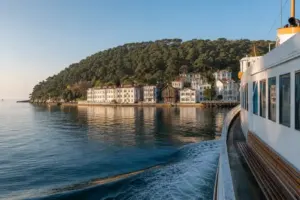
On the ferry: Bring a book or camera. The journey is part of the experience; sit on the open deck for views of the Bosphorus, the Golden Horn approach, and the islands as you approach. Onboard tea and simit (sesame bread rings) are sold.
Arrival at Heybeliada: The ferry docks at the central waterfront. Exit into the small square with restaurants and bicycle rental shops. This is the village center; orientation is immediate and easy. No shuttle or taxi; walking begins here.
Accessibility
Heybeliada is not fully wheelchair accessible. The ferry gangway is steep and requires balance; users with mobility aids should inform the ferry operator in advance. The waterfront promenade is flat and walkable, but interior streets rise steeply on narrow cobblestone and dirt paths. No curb cuts or ramps. The Halki Seminary requires a 30–40 minute uphill walk or bicycle ride; no vehicle access (cars are banned). Restaurants and some cafés are ground-level and accessible, but bathrooms are often upstairs or narrow. There are benches and resting spots throughout the waterfront. The island is best suited to able-bodied visitors comfortable with walking and uneven terrain.
Food Nearby
The waterfront has 10–15 small restaurants and cafés, all casual and family-run. Fish and seafood meze (appetizers) are the norm; grilled catch-of-the-day is standard. Turkish tea and coffee are always available. A few offer pasta or simple meat dishes. Restaurants do not take reservations (except on summer weekends, when you should call ahead). Prices are moderate; a fish meze plate and drink cost a few euros. No fine dining or international cuisine. Bakeries and small grocers stock bread, cheese, fruit, and drinks; useful for picnic supplies. The waterfront is the only area with commercial food; inland streets have no shops or restaurants. Summer evenings are romantic with grilled aromas and candlelit tables; avoid midday heat by eating breakfast early or lunch after 2 pm.
What to Bring
Bring sunscreen, a hat, and water (crucial in summer). Sturdy walking shoes or cycling shoes if you plan to explore hills or forest trails; paths are rocky and root-strewn. A light jacket for morning ferry rides and cooler evenings. Swimwear if you plan to use the coves (water is warmest June–September). Cash is helpful; not all waterfront cafés accept cards. Binoculars for bird-watching in the pine forests. Camera for architecture and light. Bag check: ferries and religious sites have no specific restrictions; small day packs are standard.
Best Views and Photo Spots of Heybeliada
Waterfront promenade at sunset
The ferry jetty, Naval Academy building, and church dome lit by golden hour light, reflected in calm water. Silhouettes of diners and ferries in the foreground create a romantic, layered composition. Best time: 30 minutes before sunset.
Best time: Late May through August; spring and autumn sunsets are 8 pm and 6 pm respectively.
St. Nicholas Church from the waterfront
The white stone church with its independent bell tower and dome, framed by weathered cafe chairs and umbrellas. The holy spring building in front adds architectural depth. Photograph from the adjacent café area for authentic street-scene framing.
Best time: Morning light (8–10 am), when the church facade is softly lit and the waterfront is less crowded.
Ümit Tepesi hilltop overlook
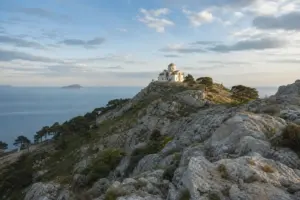
The entire waterfront, harbor, and Sea of Marmara beyond, with pine forest in the foreground and the Naval Academy building anchoring the composition. The monastery dome and seminary building sit on the horizon. Early morning mist (in cooler months) adds atmosphere.
Best time: Early morning (8–9 am) when light is clear and mist may linger. Afternoon provides dramatic cloud shadows.
Residential streets (Lozan Zeferi or Refah Şehitler)
Ornate wooden mansions with shutters, balconies, and peeling paint, framed by overhanging pines and narrow lane shadows. The weathered wood texture and architectural detail tell a story of Ottoman-era affluence and slow decay. No people and quiet light are key.
Best time: Morning or late afternoon when shadows are soft and streets are empty. Weekdays are preferable to weekends.
Çam Limanı (Pine Harbor) cove
Small tree-lined bay with calm water, a few moored boats, and rocky shore. The pine forest backdrop and lack of development create a timeless, secluded feel. Best for landscape and nature photography with a human-scale element.
Best time: Late afternoon (4–6 pm) when the sun is westward and the water is mirror-still. Summer mornings are also quiet.
Naval Academy from the promenade path
The neoclassical buildings and fortress-like stone walls of the academy, photographed from the public walking path that runs alongside. The perspective shows the grandeur of the institution and its dominance of the harbor landscape.
Best time: Morning light before the waterfront fills with people. The building's stone is best lit before noon.
Photography Rules
Photography is permitted on all public streets and outdoor areas. The waterfront, wooden mansions, and pine forests are highly photogenic. Drones are not mentioned in official guidance but are unusual on the island and likely discouraged by the Naval Academy. Tripods are fine for static shots. Flash is acceptable outdoors but avoid use inside churches and the seminary if you are allowed entry; ask first. Early morning and late afternoon light is best. The water and sunset reflection from the western shore are iconic shots.
Family Suitability
Heybeliada is family-friendly for children aged 5 and up who can walk and enjoy outdoor play. Older children enjoy bicycling, exploring forest trails, and swimming in the coves. The absence of cars means safe street play. Stroller access is limited; the waterfront promenade is flat, but interior streets are steep and cobblestone. Many families manage with a carrier for younger children. Restaurants are casual and children are welcome; simple pasta and grilled fish are standard kid-friendly options. Beach access is easy; the water is warm June–September. The main drawback is that toddlers and infants are difficult to manage on the uneven terrain and during long ferry rides. Older families, energetic children, and couples without young kids are the target audience.
Istanbul Vibes Tips
- Sit on the open deck of the ferry going out, not the enclosed cabin. The journey is the experience: watch Istanbul peel away, see the islands emerge, and breathe the sea air. This is not a commute; savor it.
- Rent a bicycle for the day rather than walking. The island is small but hilly; a bike saves time and energy and opens up the southwest circuit and coves that are hard to reach on foot in summer heat. Cost is modest; shops near the ferry are standard.
- Avoid the midday waterfront (11 am–3 pm in summer). Day-trippers flood in on the noon ferries; restaurants are packed and loud. Go early or go late. Alternatively, spend midday climbing Ümit Tepesi or swimming; return to the waterfront after 4 pm for a calmer experience.
- The Halki Seminary visits are not guaranteed. Opening hours are irregular, and no website lists them. Ask a waterfront café owner or your hotel to call ahead. If you do get in, the library and gardens alone are worth the visit; it is one of the island's most significant sites.
- Bring cash. Some waterfront cafés take cards, but smaller shops and some restaurants do not. There is no ATM in the main village; the nearest may be on a mainland ferry pier. Withdraw before you arrive or bring sufficient bills.
- Check the ferry schedule the morning you travel, not the day before. Seasonal schedules shift, and summer often adds extra sailings. Şehir Hatları has a live timetable on its website; use it to plan your day and avoid a missed return ferry.
Explore Nearby Heybeliada
Sights near Heybeliada
 Büyükada · typical visit: A full day, or one night
Main image: AI-generated illustration. It may not show the place exactly as it looks.
 Bosphorus Cruise · typical visit: 2–6 hours depending on cruise type
Main image: AI-generated illustration. It may not show the place exactly as it looks.
 Camlica Hill – about 19.7 km away · typical visit: 1–2 hoursOpen daily 10:00–21:30
Main image: AI-generated illustration. It may not show the place exactly as it looks.
 Hagia Triada Monasteryabout 500 m away (~8 min walk) · typical visit: 2–3 hours
Main image: AI-generated illustration. It may not show the place exactly as it looks.
Related guides
 Burgazada: The Car-Free Literary Island of the Princes
Main image: AI-generated illustration. It may not show the place exactly as it looks.
 Best Hiking Trails Near Istanbul: Forest, Island and Coast
Main image: AI-generated illustration. It may not show the place exactly as it looks.
 Beaches and Island Day Trips: Escape Istanbul by Ferry and Bus
Main image: AI-generated illustration. It may not show the place exactly as it looks.
 Kınalıada: Istanbul’s Quietest Island
Main image: AI-generated illustration. It may not show the place exactly as it looks.
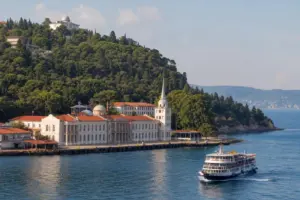 Heybeliada: The Calm Princes’ Island
Main image: AI-generated illustration. It may not show the place exactly as it looks.
Browse more: More in Adalar · All Hidden Istanbul · All Neighborhoods
FAQ: Heybeliada
How long is the ferry ride to Heybeliada?
From Eminönü, Kabataş, or Beşiktaş on the European side, expect about 90 minutes by city ferry (Şehir Hatları). From Bostancı on the Asian side, it is about 30 minutes. Private fast ferries (Dentur Avrasya, Mavi Marmara) reduce the time to 45–60 minutes from European piers but cost more and run fewer departures. Time also depends on how many stops the ferry makes; some routes call at other islands first.
Is Heybeliada a day trip or should I stay overnight?
Both work. A day trip from Istanbul (leaving at 8 am, returning by 6 pm) gives 8–10 hours on the island—enough to walk the waterfront, ride a bicycle loop, and have a leisurely meal. Staying overnight lets you enjoy morning quiet, climb to the seminary without rushing, and experience the island's slower rhythm. Budget guesthouses and simple hotels exist; book ahead in summer.
Are there cars on Heybeliada?
No. Motor vehicles are banned except for a few small emergency buses and service vehicles. You walk, rent a bicycle, or hire a horse-drawn carriage (fayton). This is what makes the island quiet and special. Bicycle rental is available at the waterfront; costs are standard and daily rates are modest.
Can I visit the Halki Seminary?
Sometimes. The seminary building and library are occasionally open for tours or worship, but there is no fixed schedule. Hours change seasonally and by closure for maintenance. Ask at a waterfront café or contact your hotel to call ahead. No official ticket; donations are welcome. The climb to Ümit Tepesi is steep (30–40 minutes), so plan accordingly.
What is the difference between Heybeliada and Büyükada?
Büyükada is the largest and busiest Princes' Island, known for grand 19th-century mansions and heavy summer tourism. Heybeliada is smaller, quieter, and more village-like, with more monasteries and Orthodox religious history. Heybeliada is better for a slower, more peaceful visit; Büyükada is better for grandeur and heritage mansions. Many visitors day-trip to both, but they require separate ferry legs.
Is swimming safe and where do I swim?
Yes, swimming is safe. The Sea of Marmara is warmer June–September (around 20–25°C). Small coves and beaches ring the island; the most popular is Akvaryum Cove (western shore). The waterfront near the ferry has no beach, but the promenade is lined with small rocky spots to enter. Water quality is monitored. Bring sandals; rocks are sharp. Lifeguards are not present; swim at your own judgment.
What should I eat on Heybeliada?
Fresh fish and seafood meze (appetizers). Grilled catch-of-the-day is the specialty at every waterfront restaurant. Expect standard Turkish fare—salatalar (salads), fried calamari, shrimp, and bread—rather than sophisticated cuisine. Restaurants are casual and inexpensive. Avoid the most tourist-fronting places; ask locals for recommendations. Afternoon tea at a small café is quintessential.
Is there an official website or phone number to get information about visiting?
The Adalar district municipality (adalar.bel.tr) is the official body, but it does not maintain tourist information or ferry schedules. Check Şehir Hatları (iett.gov.tr) for ferry timetables and payment options. For monastery hours, the Ecumenical Patriarchate or local café owners are more reliable than websites. English-language tourist information is sparse; ask your hotel to help.
Istanbul Vibes is a one-person project. A coffee keeps it going

Take this guide with you
Get a free PDF of this guide to print or read offline: key facts, tips and a map link on a few clean pages.
Report an issue on this page
How we research and update our guides
About this guide: AI assistance and accuracy
This guide is created with the help of AI and is based on official sources where available. Mistakes can still happen. Opening hours, prices, rules and other details are given to the best of our knowledge as of the date shown and can change without notice. It offers general recommendations only, not professional, legal or travel advice. Please confirm important details with the official source before you travel; you are responsible for your own plans and decisions.
* Affiliate link: as an Amazon Associate we earn from qualifying purchases at no extra cost to you.
