
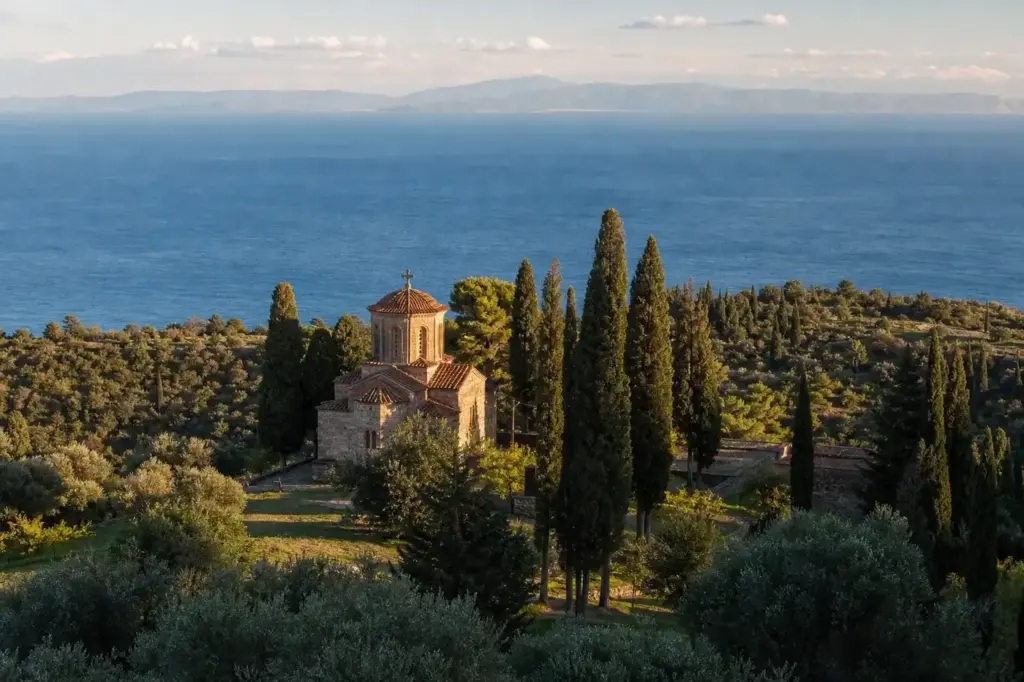
Hagia Triada monastery sits on Ümit Tepesi (Hope Hill) in the centre of Heybeliada island, one of the Princes’ Islands off Istanbul’s coast. Its origins are shrouded in mystery but it was restored by patriarch Photios I of Constantinople who was buried there in the 9th century; the monastery was destroyed in 1453 but rebuilt and given an extensive library in 1550.
The 1896 complex housed a Greek Orthodox theological school until 1971, when it was closed on the government’s orders. A small 17th-century church with an ornate altar stands on the site, as well as a library housing many old and rare manuscripts. Today it remains significant in Orthodox Christian history and a pilgrimage destination.
Current access notice: As of October 2026: The monastery complex is not regularly open to general tourists. The site is still used by the Orthodox community and access is restricted. The library requires special permission from the abbot. Visitors should check the official website or contact the institution directly before planning a visit.
Quick Facts
| Turkish name | Монастырь Святой Троицы |
|---|---|
| Built / opened | 9th century |
| Address | Ümit Tepesi 5, Heybeliada, Istanbul, Turkey Google MapsApple MapsYandex Maps |
| District | Princes' Islands |
| Best time to visit | Spring (April–May) and autumn (September–October) offer the most pleasant weather. Summers can be hot and crowded with day-trippers from Istanbul. Winter is quiet but can be grey and less inviting for the open-air journey. Avoid visiting during Orthodox religious holidays when the monastery may have restricted access. Weekday visits are generally quieter than weekends. |
| Recommended duration | 2–3 hours |
| Website | theologicalschoolhalki.com |
What Is (and Isn't) Part of a Visit to Hagia Triada Monastery?
| Part | Status | Notes |
|---|---|---|
| The 17th-century church and altar | Included in the standard ticket | The functioning Orthodox chapel on the grounds where services may be held; modest dress required. |
| Monastery grounds and cemetery | Included in the standard ticket | The outdoor areas including Hope Hill and burial sites are generally accessible when the site is open. |
| The library with manuscripts | Separate ticket or institution | Special permission from the abbot is required to access the library and view the rare manuscripts collection. |
| Theological School buildings | Not open to visitors | The 1896 educational complex remains closed to the public; reopening efforts by the Patriarchate are ongoing. |
| Halki Seminary (Theological School) | Outside / not part of it | This is a separate institution historically linked to the monastery site but is a distinct entity. |
Why Visit Hagia Triada Monastery?
The monastery housed some notable exiles in the Byzantine period, including Saint Theodore Studius, the head priest of the monastery of Saint John Studius in Constantinople, who was exiled here after he criticised Emperor Leon V for Iconoclasm. The island location provides a tranquil escape from Istanbul’s crowds. The library contains many old and rare manuscripts of historical importance to Orthodox Christianity, though viewing them requires special permission. The journey itself—by ferry and then traditionally by horse-drawn carriage—feels like stepping back in time.
Highlights of Hagia Triada Monastery
The 17th-Century Church
The small 17th-century church with an ornate altar sits on the monastery grounds. This is the functioning place of worship on the site. The interior features Orthodox religious iconography and decorative elements typical of the period. Visitors should dress modestly when entering, as it remains an active sacred space.
Tip: Arrive early in the morning for the quietest atmosphere and best light for viewing the altar and interior details.
Patriarch Photios I's Burial Site
Patriarch Photios I of Constantinople was buried at the monastery in the 9th century after restoring it. Photios was one of the most important figures in Orthodox Church history, a scholar and patriarch during the Byzantine golden age. His connection to this place makes it a pilgrimage site for Orthodox faithful.
Tip: Ask staff or guides about the location of his burial to understand the monastery's spiritual significance for visitors.
The Monastery Library
A library on the site houses many old and rare manuscripts, though visiting the library requires special permission from the abbot, Metropolitan Elpidoforos. The library contains numerous manuscripts and religious texts that document the development of Orthodox Christianity in the region over centuries. This is one of the most valuable collections of Orthodox manuscripts in existence.
Tip: Plan ahead if you wish to view the library collection; advance contact through the official website or phone is essential for access.
Byzantine History and Restoration
The monastery was destroyed in 1453 but rebuilt and given an extensive library in 1550. The current complex of buildings dates to 1896. The site thus spans continuous religious occupation for over 1,000 years, from its Byzantine foundation through Ottoman times to the present day. Visitors see layers of this history in the architecture and surroundings.
Tip: The hill location offers views back toward Istanbul; take time to appreciate the strategic and spiritual significance of this elevated position.
Hope Hill (Ümit Tepesi) Views
The monastery sits atop Ümit Tepesi, or Hope Hill, the highest point on Heybeliada. From this elevation, visitors see across the island and toward the Marmara Sea. The poplar trees and landscaping create a distinctive pastoral atmosphere quite different from urban Istanbul. The name itself—Hope Hill—reflects the spiritual refuge the island represented during Byzantine times.
Tip: Visit in late afternoon when light is softer and the views toward Istanbul across the water become more striking; fewer visitors are present at this time.
Saint Theodore Studius
Saint Theodore Studius, head priest of the monastery of Saint John Studius in Constantinople, was exiled here after he criticised Emperor Leon V for Iconoclasm. His grave is in the monastery cemetery. Theodore Studius is venerated as a saint in Orthodox Christianity for his principled resistance to imperial religious policies, making his presence here historically and spiritually significant.
Tip: The monastery cemetery contains graves of other religious figures; staff can point out notable burial locations and explain their historical roles.
Atmosphere
Heybeliada preserves a quiet, removed quality despite being only a short ferry ride from Istanbul. The monastery complex is perched above a picturesque line of poplar trees, creating a distinctly Mediterranean and peaceful setting. The air feels clearer, the pace slower than in the city. The theological school is located at the top of the island’s Hill of Hope, and the elevation provides contemplative views. Orthodox pilgrims and visitors move quietly through the grounds. The 17th-century church stands as a spiritual anchor, and the library evokes centuries of intellectual tradition. Unlike the bustle of tourist attractions on the European shore, this feels like a genuine place of continuing religious practice.
History of Hagia Triada Monastery
The monastery’s origins are shrouded in mystery but it was restored by patriarch Photios I of Constantinople who was buried there in the 9th century. Photios was a towering figure of Byzantine intellectual life and Orthodox theology, and his association with this monastery gave it prominence as a place of theological learning and monastic discipline.
In the Byzantine period, the monastery housed notable exiles, including Saint Theodore Studius, head priest of the monastery of Saint John Studius in Constantinople, who was exiled here after criticising Emperor Leon V for Iconoclasm. The island became a place of religious refuge, especially during periods of doctrinal conflict.
The monastery was destroyed in 1453 during the Ottoman conquest of Constantinople, but it was rebuilt and given an extensive library in 1550, showing the continuity of Orthodox religious life under Ottoman rule. The island communities preserved their traditions despite being subjects of the Muslim Ottoman state.
In 1844, Patriarch Germanos IV converted the monastery into a school of theology, which was inaugurated on 1 October 1844. The Theological School of Halki was founded on 1 October 1844 and was the main school of theology of the Ecumenical Patriarchate of Constantinople until it ceased teaching in 1971. The current 1896 complex of buildings housed this theological school until 1971, when it was closed on the government’s orders. The closure represented a significant loss for Orthodox theological education, and the Ecumenical Orthodox Patriarchate is waging an ongoing campaign to have it reopened.
Legends and Myths about Hagia Triada Monastery
Exiled to Hope Hill
Legend – historically unreliable. Saint Theodore Studius was exiled to the monastery after criticizing Emperor Leon V for Iconoclasm. Legend holds that his principled stance against imperial religious tyranny and his eventual sainthood were shaped by his time in contemplative exile on the island, making the place itself part of his spiritual transformation. The mountain's name—Hope Hill—is sometimes connected to the hope Theodore and other exiles found here.
Tickets and Booking for Hagia Triada Monastery
Access to Hagia Triada Monastery is not publicly available on a regular basis. The site is an active Orthodox religious site and spiritual center, not a museum or tourist attraction with standard visiting hours. Those wishing to visit should contact the institution directly at 0216-351 8563 or through the official website at www.theologicalschoolhalki.com to inquire about possibilities and requirements. Library access requires advance permission from the abbot. Visitors traveling from Istanbul should arrange ferry transport to Heybeliada island first, then use local transport (traditionally a horse-drawn carriage or taxi) to reach the monastery on Hope Hill. Dress modestly out of respect for the sacred setting. Check the official source for current access policies and any updates on the ongoing campaign to restore the theological school.
Suggested itineraries Hagia Triada Monastery
Half day
Take an early ferry from Eminönü to Heybeliada (45 minutes). Arrange transport to Hope Hill. Visit the 17th-century church, walk the monastery grounds, and view the cemetery. Return to the ferry pier for return journey to Istanbul. Contact ahead to confirm access and arrange any necessary permissions.
Full day
Spend the morning on Heybeliada visiting the monastery complex, cemetery, and hill views. After lunch at a local restaurant on the island, explore other parts of Heybeliada such as the waterfront areas. Return to Istanbul by late afternoon ferry. Bring comfortable walking shoes for the island's streets and the elevation to Hope Hill.
How to Get to Hagia Triada Monastery
By ferry: Take a ferry from Eminönü pier (near Galata Bridge) or other Istanbul ferry terminals directly to Heybeliada in the Princes’ Islands. The journey takes approximately 45 minutes to 1 hour depending on the ferry service and stops. Ferries run several times daily; check the Istanbul ferry operator’s schedule.
On Heybeliada: From the main ferry pier, the monastery on Hope Hill is uphill. Traditionally, horse-drawn carriages (fayton) provide transport from the pier to the monastery; ask the driver for ‘Papaz Okulu’ (Priest School) or ‘Hagia Triada.’ A fayton charges approximately 50 Turkish lira to bring you from the centre of town (prices may vary). Alternatively, walk uphill through residential streets, following signs toward Ümit Tepesi. The walk is steep but manageable in 15–20 minutes.
Ferry operators: Ferries are operated by Istanbul’s main public ferry service. Tickets are inexpensive; purchase at the pier ticket booth or with an istanbulkart transit card.
Accessibility
The monastery sits atop Hope Hill with steep elevation gain; those with mobility limitations may find access challenging. There is no information about wheelchair accessibility at the site. Sturdy, comfortable walking shoes are essential. The uphill terrain is not suitable for strollers. Those requiring assistance should contact the monastery in advance to discuss specific needs.
Food Nearby
Heybeliada has several small restaurants and cafés near the ferry pier and along the waterfront, serving Turkish home cooking, fresh fish, and light meals. Options are modest compared to Istanbul's dining scene but generally good quality. There are no food vendors on Hope Hill itself, so plan meals before or after visiting the monastery. Bring water if visiting during warm months.
What to Bring
Comfortable walking shoes with good grip for steep uphill paths. Light layers, as the hilltop elevation means cooler temperatures than the island's shore. Water and sun protection (hat, sunscreen) for the exposed hill. Modest clothing covering shoulders and knees for entering the sacred church. A small bag for carrying personal items; large backpacks should be avoided out of respect.
Best Views and Photo Spots of Hagia Triada Monastery
Hope Hill summit overlooking the island and sea
From the highest point near the monastery, views sweep across Heybeliada's tree-covered slopes toward the Sea of Marmara and other Princes' Islands. The poplar trees frame foreground views. Istanbul is visible across the water in clear weather, creating a sense of peaceful distance from the city.
Best time: Late afternoon when light is warm and soft, and when fewer day-trippers are present. Autumn and spring offer the clearest views.
Monastery entrance with poplar trees
The approach to the monastery complex with towering poplar trees creates a characteristic Mediterranean-Orthodox monastic aesthetic. The trees frame the buildings and create strong vertical lines and dappled shade.
Best time: Mid-morning when the light creates shadow patterns through the poplars, or late afternoon for golden-hour warmth.
17th-century church exterior
The small stone church with its characteristic Orthodox cross and bell tower details against the sky and surrounding trees. The architecture shows Byzantine and later Ottoman-period elements.
Best time: Morning light hitting the east-facing facade, or late afternoon for warm sidelighting that defines the stonework.
Cemetery with sea views beyond
Graves and monuments among trees with views toward the Marmara Sea in the background. The composition illustrates the monastic community's connection to both the spiritual life and the natural island landscape.
Best time: Late afternoon when the light is lower and the distant sea becomes more visible and prominent in the scene.
Photography Rules
Photography is generally permitted in the monastery grounds and outdoors, but discretion is required. Do not photograph inside the church without permission, especially during services. Respect the sacred nature of the site and the privacy of Orthodox worshippers. Drones are not permitted.
Family Suitability
The steep uphill walk to Hope Hill is challenging for young children and parents with strollers. Older children (10+) who enjoy hiking and history will find the visit meaningful. The quiet, reverent atmosphere is appropriate for teaching children about Orthodox Christian traditions. However, logistical challenges (limited ferry schedules, restricted access, uphill terrain) and the need to arrange permission in advance make this more suited to families with older children and those with genuine interest in religious history rather than casual sightseeing.
Istanbul Vibes Tips
- Contact the monastery or check the official website well before your visit to confirm current access policies. The site is not always open to casual tourists, so advance planning is essential to avoid a wasted trip.
- Don't confuse this monastery with the Hagia Triada Church in Beyoğlu's Taksim Square, which is a 1880 neo-baroque urban church. That is a separate, more easily accessible site near the city center.
- The ferry to Heybeliada can have limited schedules, especially in winter. Check the ferry timetable before leaving Istanbul to ensure you don't miss the last boat back.
- Hire a traditional horse-drawn carriage (fayton) from the pier rather than walking uphill if your fitness level is limited. The steep gradient and lack of shade make the walk uncomfortable in warm weather.
- Visit on a weekday if possible to avoid crowds of day-trippers and to have a quieter, more contemplative experience suitable to the site's spiritual nature.
- The Halki Seminary library contains extraordinary manuscripts, but viewing them requires permission from the abbot obtained weeks in advance. Don't assume you can simply visit the library upon arrival.
Explore Nearby Hagia Triada Monastery
Sights near Hagia Triada Monastery
 Büyükada · typical visit: A full day, or one night
Main image: AI-generated illustration. It may not show the place exactly as it looks.
Related guides
 Princes’ Islands: Ferry, Day Trip and What to See
Main image: AI-generated illustration. It may not show the place exactly as it looks.
 Kınalıada: Istanbul’s Quietest Island
Main image: AI-generated illustration. It may not show the place exactly as it looks.
 Burgazada: The Car-Free Literary Island of the Princes
Main image: AI-generated illustration. It may not show the place exactly as it looks.
Browse more: More in Princes' Islands · All Churches · All Sightseeing
FAQ: Hagia Triada Monastery
Is Hagia Triada Monastery open to tourists?
The monastery is not a standard tourist site with regular public hours. It is an active Orthodox religious site with restricted access. Visitors should contact the institution directly at 0216-351 8563 or through www.theologicalschoolhalki.com to inquire about visiting possibilities and to request permission in advance.
How do I get to Hagia Triada Monastery from Istanbul?
Take a public ferry from Eminönü to Heybeliada (approximately 45 minutes). From the ferry pier, use a traditional horse-drawn carriage or taxi to reach the monastery on Hope Hill, or walk uphill (steep, 15–20 minutes). Ferry schedules are available from Istanbul's public transport operator.
Can I visit the monastery library with its rare manuscripts?
The library is accessible only with special permission from the abbot, Metropolitan Elpidoforos. This requires advance contact and formal request. Ordinary visitors cannot simply walk in and view the collection.
Is this the same as the Hagia Triada Church in Taksim?
No. Hagia Triada Monastery on Heybeliada island is a Byzantine-era religious site that became a theological school. Hagia Triada Church in Beyoğlu (near Taksim Square) is a separate 1880 neo-baroque urban church. They are two different places.
What should I wear when visiting the monastery?
Dress modestly, with clothing that covers shoulders and knees, out of respect for the sacred site. The site's hill location can be breezy, so bring layers. Wear comfortable walking shoes with good grip for the steep paths on Hope Hill.
Why is the monastery special in Orthodox history?
It was home to the Monastery of the Holy Trinity, founded by Patriarch Photios I in the 9th century and housed notable exiles including Saint Theodore Studius. A theological school on the site was the main school of theology of the Ecumenical Patriarchate of Constantinople until 1971, making it one of Orthodoxy's most important educational institutions.
When was the current monastery complex built?
The current complex of buildings dates to 1896. However, the site has been continuously occupied by Orthodox monasteries since at least the 9th century, with medieval destruction and rebuilding in 1550.
Is photography allowed at the monastery?
Photography is generally permitted in outdoor areas and the monastery grounds. However, do not photograph inside the church without explicit permission, especially during services. Respect the sacred nature of the site and the privacy of Orthodox worshippers. Drones are not permitted.
Istanbul Vibes is a one-person project. A coffee keeps it going
Hotels near Hagia Triada Monastery
- Heybeliada Yali Guest House (450 m) Check prices (affiliate link, opens in a new tab)
- Pansiyon (550 m) Check prices (affiliate link, opens in a new tab)
- Özdemir Pansiyon (550 m) Check prices (affiliate link, opens in a new tab)
- Prenset Pansiyon (550 m) Check prices (affiliate link, opens in a new tab)
Affiliate link (opens the booking site): we may earn a commission at no extra cost to you.
Restaurants near Hagia Triada Monastery
Distances are straight-line, from OpenStreetMap data.

Take this guide with you
Get a free PDF of this guide to print or read offline: key facts, tips and a map link on a few clean pages.
Report an issue on this page
How we research and update our guides
About this guide: AI assistance and accuracy
This guide is created with the help of AI and is based on official sources where available. Mistakes can still happen. Opening hours, prices, rules and other details are given to the best of our knowledge as of the date shown and can change without notice. It offers general recommendations only, not professional, legal or travel advice. Please confirm important details with the official source before you travel; you are responsible for your own plans and decisions.
* Affiliate link: as an Amazon Associate we earn from qualifying purchases at no extra cost to you.
