
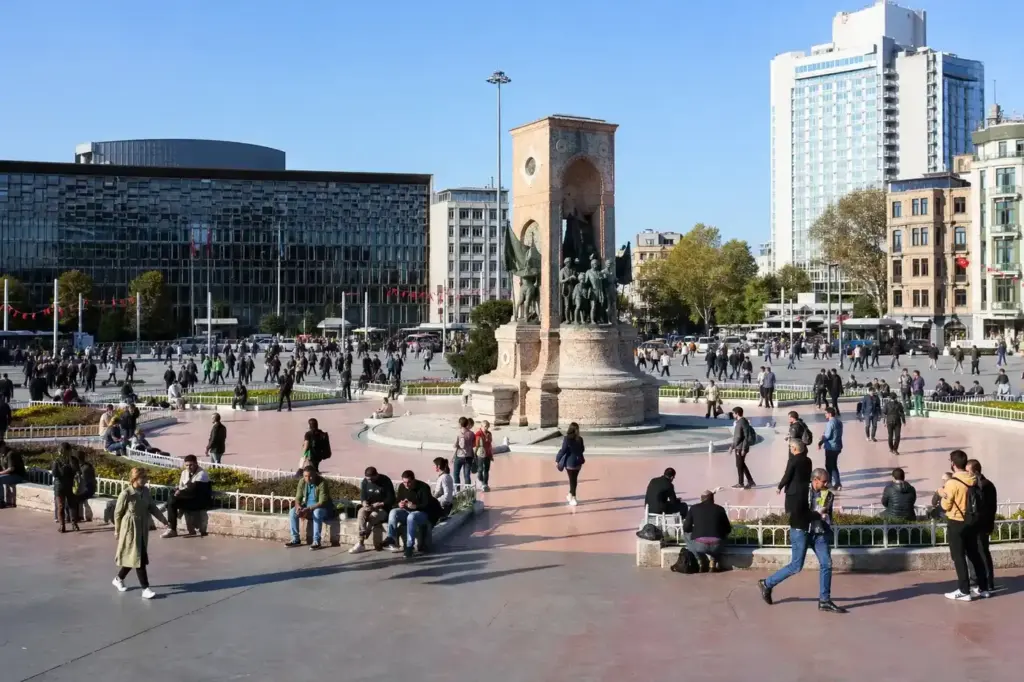
Taksim represents Istanbul’s cosmopolitan European face: a working city square full of taxi stands, Metro entrances, flower vendors, and crowds of locals meeting under the Republic Monument. Unlike the Ottoman grandeur of Sultanahmet across the Golden Horn, Taksim is modern in appearance, framed by glass hotels and the concrete bulk of the Atatürk Cultural Center.
The name itself traces to Ottoman times, when water collected here was distributed across the city—taksim means ‘division’ or ‘distribution’ in Turkish. Today the neighborhood branches outward from the square into the pedestrian boulevard of Istiklal Avenue, lined with bookshops, cinemas, bars and historic passages, and downhill into the intimate cafés and galleries of Cihangir. First-time visitors typically begin at Taksim before exploring the wider Beyoğlu district.
Quick Facts
| Address | Taksim, Beyoğlu, Istanbul, Turkey Google MapsApple MapsYandex Maps |
|---|---|
| District | Beyoğlu |
| Metro | Taksim (M2, Main exit to Taksim Square) Taksim (F1, Funicular from Kabataş) |
| Admission | Free access; Taksim Square is a public plaza |
| Best time to visit | Spring (April–May) and autumn (September–October) offer the most comfortable weather and moderate crowds. Summer (June–August) brings heat and peak tourism; December–February can be cold and rainy. Taksim Square itself is always busy, but early morning (before 09:00) or late evening (after 18:00) see lighter foot traffic in the square specifically. Istiklal Avenue is most pleasant midweek in the afternoon, when it is lively but less packed than weekends and evenings. |
What Is (and Isn't) Part of a Visit to Taksim?
| Part | Status | Notes |
|---|---|---|
| Taksim Square itself | Included in the standard ticket | The public plaza is open and free to enter at all times. It serves as the starting point for most visits to the neighborhood. |
| Istiklal Avenue | Included in the standard ticket | The pedestrian street is free to walk; individual shops, restaurants, and cafés inside charge their own fees. |
| Gezi Park | Included in the standard ticket | The park is free and open to the public during daylight hours, providing rest and green space. |
| Republic Monument | Included in the standard ticket | The monument stands in the open square and is always visible and accessible at no charge. |
| Hagia Triada Greek Orthodox Church | Included in the standard ticket | The church is free to enter outside prayer times; visitors should remove shoes and dress modestly. |
| Atatürk Cultural Center (AKM) | Separate ticket or institution | Exhibitions and performances have separate admission fees; check the official website for current programming. |
| Taksim Mosque | Included in the standard ticket | The mosque is free to visit outside prayer times; respect customs regarding shoes and dress. |
| Galata Tower | Outside / not part of it | Located at the bottom of Istiklal Avenue, Galata Tower is a separate attraction in the Karaköy neighborhood and requires its own ticket. |
| Museum of Innocence | Outside / not part of it | This museum is located near Cihangir but is a separate institution with its own admission fee. |
| Kabataş Tram Pier and Seabus Station | Outside / not part of it | The funicular (F1) descends to these transport hubs, which are outside Taksim itself but easily accessed. |
Why Visit Taksim?
Taksim Square functions as both a practical hub and an authentic observation post. You can spend an hour simply watching commuters, tourists, and locals pass through—a living cross-section of the city. The square leads directly to Istiklal Avenue, one of the world’s busiest pedestrian streets, where street performers, small galleries, and historic passages hide between international shops. A short funicular ride or downhill walk brings you to the Golden Horn and Galata Tower. The surrounding Beyoğlu neighborhood contains surviving Ottoman-era churches, live music venues, and some of Istanbul’s oldest bars and restaurants.
How Taksim Is Laid Out
Taksim is organized around the square itself, a broad open plaza roughly 120 meters across. The Republic Monument stands at the center. To the south, Istiklal Avenue descends steeply downhill for about 1.5 kilometers toward Tünel and Galata. The Atatürk Cultural Center occupies the eastern edge of the square. The Metro entrance lies on the square’s northern side; the funicular to Kabataş departs from within the Metro complex.
From the square, three main directions branch outward: west into Cihangir and Çukurcuma neighborhoods (narrow streets with galleries and cafés); south and downhill along Istiklal (the main pedestrian thoroughfare); and north toward parks and residential Beyoğlu. Most visitors spend their first hour in the square and on Istiklal Avenue, then either head down toward Galata Tower or explore the quieter side streets.
Highlights of Taksim
Republic Monument
Standing at the center of Taksim Square, this imposing stone and bronze structure was unveiled in 1928 to commemorate the founding of the Turkish Republic. The sculpture depicts Mustafa Kemal Atatürk and his companions in both military and civilian dress, symbolizing the transition from the War of Independence to the new republican state. The monument serves as an informal meeting point and the most photographed element of the square, especially when lit at dusk.
Tip: Visit in early evening when the monument is illuminated and commuters streaming out of the Metro create a lively atmosphere without excessive crowds.
Istiklal Avenue
This celebrated 1.5-kilometer pedestrian boulevard descends from Taksim Square toward Tünel in a long, slightly inclined walk. Originally known as Grande Rue de Pera during the 19th-century Ottoman Empire, it became a center for foreigners and Ottoman intellectuals and was renamed Istiklal (Independence) in 1923 after the War of Independence. Today it is lined with bookstores, independent boutiques, art galleries, cinemas, and restaurants alongside international brands, making it one of the world's most-walked streets.
Tip: The iconic red T2 heritage tram runs down the middle of the street. Ride it to save your legs, or walk to discover the hidden passages like Çiçek Pasajı (Flower Passage), where meyhanes (traditional taverns) and cafés occupy old arcade spaces.
Hagia Triada Greek Orthodox Church
This striking Neo-Byzantine church stands just off Taksim Square, easily recognizable by its ornate domes. The church reflects the multicultural communities that have long inhabited Beyoğlu, part of the district's diverse architectural heritage. It remains relatively overlooked by visitors rushing past, making it a quieter stop for those interested in Istanbul's religious architecture and Ottoman-era Christian communities.
Tip: The church is open to visitors outside prayer times. Its location just steps from the square makes it a natural pause between the busy square and the descent down Istiklal Avenue.
Gezi Park
Situated immediately adjacent to Taksim Square, this small green space provides a retreat from the constant motion of the square itself. The park offers shaded pathways, benches, and views across the district. It serves as a gathering place for both tourists and locals seeking a quiet moment, and in summer months hosts street musicians and impromptu performances.
Tip: Visit early morning or midweek for the quietest experience. The park connects the square to the neighborhoods downhill, making it a natural transition point for exploration.
Atatürk Cultural Center (AKM)
Occupying the eastern flank of Taksim Square, this boldly modern building is an important example of Turkish 1960s architecture. Originally built as an opera house and performing arts center, it hosted the Turkish State Opera and Ballet, Istanbul State Symphony Orchestra, and served as a venue for theater and dance. The building underwent renovation and remains a significant cultural institution hosting exhibitions, performances, and seasonal arts programming.
Tip: The building is particularly striking when illuminated at night. Check the official website for current exhibitions and performances, as programming and access vary.
Çiçek Pasajı (Flower Passage)
This ornate historical arcade opens onto Istiklal Avenue partway down from Taksim Square. Built in the late 19th century, the passage features an arched glass roof and is lined with meyhanes (traditional Turkish taverns), restaurants, and cafés. The passage maintains an Old Istanbul atmosphere with dim lighting, wood interiors, and the constant hum of conversation and clinking glasses. Street musicians often perform here in the evening.
Tip: The passage is most atmospheric in the evening, when it fills with diners and the smell of grilled fish and raki. Prices are moderate to upscale, reflecting the tourist location. Look for the entrance along Istiklal Avenue; it is easy to miss if you are walking quickly.
Taksim Mosque
This modern mosque overlooks Taksim Square from its eastern side, a contemporary addition to the district's religious architecture. Built in recent years, it offers a serene interior with traditional Islamic design elements updated for the 21st century. The mosque remains open to visitors outside of prayer times and serves both as a place of worship and a quiet refuge from the bustling square.
Tip: Visitors should remove shoes and dress modestly (covered shoulders and legs). It is free to enter outside prayer times, making it an affordable cultural pause.
Cihangir Neighborhood
Located west of Taksim Square, the Cihangir neighborhood descended from the Ottoman neighborhood surrounding the Cihangir Mosque, built in 1559 to commemorate the death of Şehzade Cihangir, son of Suleiman the Magnificent. The district evolved into Istanbul's most bohemian quarter, attracting artists, writers, and intellectuals. Today narrow streets wind through small galleries, independent cafés, vintage bookshops, and restored Ottoman buildings, offering a lived-in, artistic atmosphere distinct from the commercial Taksim Square.
Tip: Wander the side streets north and west of the square. The best cafés and galleries do not advertise heavily; ask locals or simply follow the sound of live music. This neighborhood rewards slow exploration.
Atmosphere
Taksim Square itself is perpetually in motion: a working transport hub where crowds of commuters pour out of the Metro, taxis honk, buses arrive and depart, and tourists and locals congregate under or around the Republic Monument. The square’s hard paving and surrounding commercial buildings create an urban canyon of constant activity and noise. Flower vendors work the periphery; fast-food chains and hotel lobbies line the edges.
The atmosphere shifts dramatically as you move downhill along Istiklal Avenue or into the side streets. Istiklal buzzes with shoppers, street performers, and the rattle of the red heritage tram. The passages and side streets of Cihangir and Çukurcuma are quieter, intimate, lined with café tables spilling onto narrow pavements. In the evening, the district transforms: neon signs flicker on along Istiklal, bars and meyhanes fill with diners, live musicians emerge, and rooftop terraces become gathering places.
History of Taksim
The name Taksim derives from the Ottoman-era water distribution system. In the 18th century, high ground in this area made it strategically important to Istanbul’s infrastructure. Under Sultan Mahmud I in 1723, a water collection and distribution point (maksem for taksim) was established here, dividing the city’s water supply across the neighborhoods below. This practical beginning gave the district its name and shaped its eventual development.
Until the 19th century, Taksim lay on the edge of the city, beyond the old walls. The Ottoman expansion northward transformed it. The street now known as Istiklal Avenue took shape as the main thoroughfare of a new district called Pera (from the Greek word for ‘beyond’). During the 19th-century Ottoman period, the avenue became known as Grande Rue de Pera and emerged as a center for foreign residents, merchants, Levantine communities, and Ottoman intellectuals drawn to Western culture and ideas. The district became distinctly cosmopolitan, attracting Armenian, Greek, and Jewish communities alongside European traders and diplomats.
The 1923 establishment of the Turkish Republic marked a transformation of symbolic importance. The street’s name changed from Grande Rue de Pera to Istiklal (Independence) to commemorate the War of Independence led by Atatürk. In 1928, the Republic Monument was erected at the center of Taksim Square, a bold statement of the new nation’s identity. By then, Taksim had become the commercial and cultural heart of modern Istanbul, distinct from the Ottoman and Islamic character of the old city across the Golden Horn.
The 20th century brought modernization and expansion. The Metro arrived in 2000 when the M2 line opened with Taksim as its southern terminus. In 2006, the F1 funicular connecting Taksim to Kabataş accelerated access from the waterfront. The Atatürk Cultural Center, built in the 1960s as an example of Turkish modernist architecture, anchors the square’s cultural life. The district absorbed waves of migration from rural Turkey, becoming increasingly diverse while retaining its bohemian character, particularly in the Cihangir quarter where artists and writers established themselves. Today Taksim remains a point of tension between tradition and modernity, commercial tourism and local identity, reflected in its architecture, street life, and cultural programming.
Legends and Myths about Taksim
The Hidden Churches of Istiklal
Legend – historically unreliable. Visitors often walk the entire length of Istiklal Avenue without realizing that historic churches stand hidden in courtyards and side passages, tucked away and difficult to spot from street level. Locals joke that you must look up and sideways to find them. The churches—including Hagia Triada and several Armenian and Catholic chapels—survive as remnants of the multinational Ottoman city. The story reflects how completely Beyoğlu's character changed after 1923, with many foreign and Christian institutions becoming less visible in the urban landscape.
Tickets and Booking for Taksim
Taksim Square and its immediate surroundings are free and open to the public 24 hours a day. No booking is required to explore the square, Gezi Park, or to walk along Istiklal Avenue.
If you plan to visit the Atatürk Cultural Center, check its official website for current exhibitions and performances, which may have separate admission fees and ticketing requirements. Most churches and the Taksim Mosque are free to enter but have specific hours and may have restricted access during prayer times; visiting respectfully outside these times is advised.
For shops, restaurants, and cafés along Istiklal Avenue and in the surrounding neighborhoods, payment is required at each establishment; prices and payment methods vary. International cards are widely accepted in tourist areas, but some smaller venues prefer cash or local cards.
Suggested itineraries Taksim
2 hours
Begin at Taksim Square; spend 15 minutes observing the monument and public activity. Descend Istiklal Avenue slowly, allowing 60–90 minutes to walk to Tünel, pausing for coffee or tea at a café. Visit Hagia Triada Church if time allows. Return via the T2 heritage tram or funicular to Kabataş for Bosphorus views.
3–4 hours
Start at Taksim Square; spend 20 minutes on the monument and Gezi Park. Walk Istiklal Avenue toward Galata, exploring Çiçek Pasajı and side passages (1.5 hours). Break for late lunch at a meyhane or café. Return uphill, then explore Cihangir's cafés and galleries (1 hour). End with sunset or early evening drinks at a rooftop bar or café.
Half day
Explore Taksim Square and nearby institutions (Taksim Mosque, Atatürk Cultural Center, Hagia Triada) in the morning (1 hour). Walk the length of Istiklal Avenue to Galata Tower, visiting museums or passages along the way (2–3 hours). Ride the funicular down to Kabataş, walk along the waterfront, and return to Taksim by tram or Metro (1 hour).
How to Get to Taksim
Metro: The M2 line serves Taksim Station directly. From Sultanahmet (Old City), take the M2 from Vezneciler station northbound for four stops to Taksim. The exit brings you directly to Taksim Square. From Istanbul Airport, take the M11 line to Gayrettepe, then transfer to the M2 southbound toward Taksim (journey time approximately 60–75 minutes total).
Funicular (F1): The Kabataş–Taksim funicular connects Taksim Metro station with Kabataş tram and seabus terminal on the waterfront. The journey takes about 2 minutes and climbs 110 meters. From the Old City, take the T1 tram to Kabataş, then ride the funicular up to Taksim.
On foot: From Galata Tower or lower Istiklal Avenue, the uphill walk to Taksim Square takes 15–25 minutes depending on fitness and stops.
Bus and dolmuş: Taksim Square is a major bus hub served by numerous municipal and minibus (dolmuş) routes connecting throughout the city.
Accessibility
Taksim Metro station is wheelchair accessible and equipped with lifts and accessible facilities. The public plaza itself is flat and broadly accessible. Gezi Park has some uneven terrain and is only partially suitable for wheelchair users. Istiklal Avenue is pedestrian-only, paved, and generally accessible, though crowded and with occasional steps at passage entrances. The T2 heritage tram has limited wheelchair accessibility; modern buses are equipped with ramps. Churches and the Taksim Mosque have steps at their entrances. For detailed accessibility information about specific venues or attractions, contact the Istanbul Metropolitan Municipality or check individual institution websites.
Food Nearby
Taksim and Istiklal Avenue are surrounded by eating options. Çiçek Pasajı (Flower Passage) houses traditional meyhanes serving mezze, grilled fish, and raki in a historic setting. Street vendors along Istiklal sell simit (sesame bread), roasted chestnuts, and stuffed mussels. Cihangir neighborhood offers independent cafés serving Turkish breakfast, brunch, and coffee. Modern restaurants and international chains occupy Istiklal and the square's perimeter. Nevizade Street (off Istiklal) is lined with fish restaurants and taverns. For quality coffee and pastries, look into the backstreets rather than main avenue branches. Taksim Square itself has fast-food outlets around its edges but few traditional restaurants.
What to Bring
Comfortable walking shoes are essential, as the neighborhood requires sustained walking on pavement and downhill slopes. A light layer or scarf is useful year-round, as wind can funnel through the square, and may be needed for visiting churches or the mosque. In summer, bring sun protection and water; the square has little shade. A small bag or daypack accommodates shopping and personal items. Security is good in the main areas, but keep bags secure in crowds and avoid displaying large amounts of cash.
Best Views and Photo Spots of Taksim
Taksim Square, facing the Republic Monument
The monument stands against the backdrop of the Atatürk Cultural Center and surrounding hotels. In daylight, the stone and bronze sculpture is clear and photogenic; at dusk, soft light illuminates it against the darkening sky and lit building facades. The square fills with people and activity, creating a vibrant, urban scene.
Best time: Golden hour (30 minutes before sunset) for warm light and a less-crowded moment; early morning for clearer skies and fewer tourists.
Looking down Istiklal Avenue from Taksim Square
The pedestrian street stretches downhill, lined with buildings, shops, and the red heritage tram running down the middle. The perspective captures the street's energy and architectural variety as it descends toward the Golden Horn and Galata Tower in the distance.
Best time: Late afternoon, when the sun is lower and casts longer shadows along the street, revealing architectural details and creating depth.
Inside Çiçek Pasajı (Flower Passage)
The ornate glass-roofed arcade glows with soft light filtering through the glass. Tables fill with diners; neon signs reflect off wet surfaces. The scene captures Old Istanbul's intimate atmosphere: narrow, atmospheric, busy with conversation and tradition.
Best time: Evening, when the passage is lit, full of diners, and alive with activity and street musicians.
Cihangir street corner at dusk
The narrow, sloped street with restored Ottoman-era buildings, small galleries, and café tables creates an intimate, bohemian scene. Warm light spills from cafés and galleries. The perspective captures the neighborhood's lived-in, artistic character away from the main tourist flow.
Best time: Early evening, when golden light hits the buildings, galleries display art, and cafés fill with locals.
Hagia Triada Greek Orthodox Church, exterior
The ornate Neo-Byzantine domes rise above surrounding modern buildings, creating a striking contrast. The church's intricate architecture and multiple domes are clearly visible, representing the multicultural heritage of Beyoğlu amid contemporary urban development.
Best time: Midday or early afternoon, when direct light reveals the building's ornamental details and colors.
Photography Rules
Photography is freely permitted in public areas, on Istiklal Avenue, and in Gezi Park. Tripods may be restricted during peak hours on narrow Istiklal Avenue to avoid blocking pedestrian flow; it is best to ask before setting one up. Inside churches, photography may be restricted or require permission; always check before shooting. Flash photography is generally discouraged inside religious buildings. Drone photography is regulated by Turkish aviation authorities and typically not permitted over urban areas without special approval.
Family Suitability
Taksim Square is suitable for families, though it is loud, crowded, and can feel chaotic. The flat public plaza is stroller-friendly, and Gezi Park provides a quiet retreat. Istiklal Avenue is pedestrian-only and popular with families, though crowds and street vendors can be overwhelming for young children during peak hours. Midweek mornings or early afternoons are quieter. The 1.5-kilometer downhill walk along Istiklal may be long for small children; consider the T2 heritage tram for part or all of the route. Churches and the Taksim Mosque are generally child-friendly if visited respectfully outside prayer times. Many cafés welcome families, and the neighborhood has ice cream shops and street food suitable for children. Avoid the district during evening and night hours if traveling with young children, as it becomes more adult-oriented with increased nightlife activity.
Istanbul Vibes Tips
- Do not try to drive through the square or Istiklal Avenue; both are pedestrian and public transport zones. Taksim works best on foot or by Metro and tram; taxis are difficult to navigate here.
- If you dislike crowds, visit early morning (before 08:30) or late evening (after 18:00). Midweek is quieter than weekends. Avoid religious holidays and national celebrations when the square fills with massive crowds for public events.
- Most useful is to treat Taksim as a starting point rather than a destination. The real charm of the neighborhood lies in the side streets: Cihangir, the passages off Istiklal, and the neighborhoods downhill toward Galata. Spend just 20–30 minutes in the square itself before exploring outward.
- The area is safe during daylight and evening hours, but use the same caution you would in any major city center. Keep bags secure and be aware of your surroundings. Avoid walking alone very late at night in isolated side streets.
- Istiklal Avenue closes to most traffic during the day but fills with street musicians, performers, and vendors. It is liveliest in the evening when people gather for drinks and dinner. Shop during daytime for the best light and choice; return in the evening for the atmosphere.
- Look up. The most interesting architectural details—ornate facades, historic plaques, hidden churches, and old building names—are above street level. Most visitors walking quickly miss the district's history because they are focused on ground-level shop windows.
Explore Nearby Taksim
Sights near Taksim
 Galata Tower – about 1.6 km away (~26 min walk) · typical visit: 1–2 hours4 min on foot from Şişhane metro, Open daily 08:30–23:00
Main image: AI-generated illustration. It may not show the place exactly as it looks.
 Golden Horn · typical visit: 1–3 hours (waterfront walk or boat tour)
Main image: AI-generated illustration. It may not show the place exactly as it looks.
 Galata Bridge – about 2.2 km away · typical visit: 30 minutes to 1 hour10 min on foot from Haliç metro, Open 24 hours
Main image: AI-generated illustration. It may not show the place exactly as it looks.
 Pera Museum – about 1.1 km away (~18 min walk) · typical visit: 2–3 hours6 min on foot from Tünel metro
Main image: AI-generated illustration. It may not show the place exactly as it looks.
 Galata Mevlevi Museum – about 150 m away (~3 min walk) · typical visit: 45 minutes to 1.5 hours13 min on foot from Kabataş metro, Open 09:00–18:30, closed Mon
Main image: AI-generated illustration. It may not show the place exactly as it looks.
 Atatürk Library – about 50 m away (~1 min walk) · typical visit: 2–3 hours11 min on foot from Kabataş metro, Open daily 09:00–21:00
Main image: AI-generated illustration. It may not show the place exactly as it looks.
Metro stations near Taksim
 Kabataş – about 600 m away (~10 min walk)Open daily 06:15–00:00
Main image: AI-generated illustration. It may not show the place exactly as it looks.
 Fındıklı-Mimar Sinan Üniversitesi – about 650 m away (~11 min walk)Open daily 06:00–00:00
Main image: AI-generated illustration. It may not show the place exactly as it looks.
 Tophaneabout 1.2 km away (~19 min walk)
Main image: AI-generated illustration. It may not show the place exactly as it looks.
Restaurants and cafes near Taksim
 Kızılkayalar – about 150 m away (~2 min walk)11 min on foot from Fındıklı-Mimar Sinan Üniversitesi metro, Open daily 08:00–05:00
Main image: AI-generated illustration. It may not show the place exactly as it looks.
 Tiflisi – about 200 m away (~3 min walk)10 min on foot from Kabataş metro
Main image: AI-generated illustration. It may not show the place exactly as it looks.
 Topaz – about 200 m away (~3 min walk)11 min on foot from Fındıklı-Mimar Sinan Üniversitesi metro, Open 18:00–00:00, closed Sun
Main image: AI-generated illustration. It may not show the place exactly as it looks.
 Ayaspaşa Russian Restaurant – about 300 m away (~5 min walk)5 min on foot from Kabataş metro, Open daily 12:30–23:30
Main image: AI-generated illustration. It may not show the place exactly as it looks.
Nightlife near Taksim
 Upperist – about 50 m away (~1 min walk)10 min on foot from Kabataş metro
Main image: AI-generated illustration. It may not show the place exactly as it looks.
 U2 Istanbul Irish Pub – about 350 m away (~6 min walk)14 min on foot from Fındıklı-Mimar Sinan Üniversitesi metro
Main image: AI-generated illustration. It may not show the place exactly as it looks.
Train stations and river piers near Taksim
 Kabataş Ferry Terminalabout 750 m away (~12 min walk)
Main image: AI-generated illustration. It may not show the place exactly as it looks.
 Beşiktaş Ferry Terminalabout 1.5 km away (~24 min walk)
Main image: AI-generated illustration. It may not show the place exactly as it looks.
Events and traditions near Taksim
 Istanbul Music Festivalabout 950 m away (~16 min walk)
Main image: AI-generated illustration. It may not show the place exactly as it looks.
 Istanbul Film Festivalabout 1.6 km away (~26 min walk)
Main image: AI-generated illustration. It may not show the place exactly as it looks.
Related guides
 Metrocity Shopping Mall: Modern Retail in Levent with Metro Access13 min on foot from Gayrettepe metro, Open daily 10:00–22:00
Main image: AI-generated illustration. It may not show the place exactly as it looks.
 Mimar Sinan Fine Arts University: History, Campus, and What to See2 min on foot from Fındıklı-Mimar Sinan Üniversitesi metro
Main image: AI-generated illustration. It may not show the place exactly as it looks.
 Kestane: Istanbul’s Winter Street Roasted Chestnuts
Main image: AI-generated illustration. It may not show the place exactly as it looks.
 Kanyon Shopping Mall: Architecture, Shopping and Istanbul Style13 min on foot from 4. Levent metro, Open daily 10:00–22:00
Main image: AI-generated illustration. It may not show the place exactly as it looks.
 Atatürk Cultural Center: Tickets, Hours and What to See8 min on foot from Kabataş metro, Open daily 10:00–18:00
Main image: AI-generated illustration. It may not show the place exactly as it looks.
Browse more: More in Beyoğlu · All Neighborhoods
FAQ: Taksim
Is Taksim Square open to visitors?
Yes, Taksim Square is a public plaza open 24 hours a day at no charge. Entry is free, and you can spend as much or as little time as you wish. It serves as a transport hub and gathering place, so it is always busy with activity.
How do I get to Taksim from the Old City (Sultanahmet)?
The easiest route is the Metro: take the M2 line from Vezneciler station (near the Basilica Cistern) northbound for four stops to Taksim. The journey takes about 10 minutes. Alternatively, take the T1 tram to Kabataş, then ride the F1 funicular uphill to Taksim (about 15 minutes total). Both are straightforward for first-time visitors.
What is there to do in Taksim for 2 hours?
Spend 15–20 minutes observing the square and Republic Monument. Walk down Istiklal Avenue for 60–90 minutes, exploring shops, passages, and cafés. Visit Hagia Triada Church if time allows. Alternatively, explore Cihangir's galleries and cafés, or rest in Gezi Park. Most visitors walk Istiklal Avenue as the main activity.
Are there toilets and facilities in the area?
Taksim Square has limited public toilets; most restaurants, cafés, and shopping centers offer facilities for customers. The Metro station has paid toilet facilities. Museums and cultural institutions also have visitor facilities. Overall, public restrooms are less abundant here than in modern shopping centers elsewhere in the city.
Is Taksim suitable for families with young children?
Taksim Square itself is stroller-friendly and free to visit, though it is loud and crowded. Gezi Park provides a quieter escape. Istiklal Avenue is pedestrian-only, but crowded and the 1.5-kilometer walk may be long for small children; the T2 heritage tram can reduce walking. Visit during quieter daytime hours and avoid evenings, when the area becomes more adult-oriented.
Can I visit churches in Taksim?
Yes. Hagia Triada Greek Orthodox Church is open to visitors outside prayer times. Visitors should remove shoes, dress modestly, and behave respectfully. Entry is free. There are other smaller chapels in passages off Istiklal Avenue, but Hagia Triada is the most prominent and most accessible to tourists.
What is the best time of day to visit Taksim?
Early morning (before 09:00) or late afternoon (after 16:00) are quieter. Midweek is less crowded than weekends. Early evening (17:00–18:00) is ideal for atmosphere: the square fills with energy, neon signs light up, and performers emerge. Avoid visiting between 12:00 and 15:00 on weekends, when crowds peak.
Do I need to book tickets to visit Taksim neighborhoods?
No booking is needed to visit the square, Gezi Park, Istiklal Avenue, or Cihangir. These are public areas. If you plan to visit museums, exhibitions, or performances at the Atatürk Cultural Center, check ahead for opening hours and any admission requirements. Entry to Hagia Triada Church is free.
Istanbul Vibes is a one-person project. A coffee keeps it going

Take this guide with you
Get a free PDF of this guide to print or read offline: key facts, tips and a map link on a few clean pages.
Report an issue on this page
How we research and update our guides
About this guide: AI assistance and accuracy
This guide is created with the help of AI and is based on official sources where available. Mistakes can still happen. Opening hours, prices, rules and other details are given to the best of our knowledge as of the date shown and can change without notice. It offers general recommendations only, not professional, legal or travel advice. Please confirm important details with the official source before you travel; you are responsible for your own plans and decisions.
* Affiliate link: as an Amazon Associate we earn from qualifying purchases at no extra cost to you.
