
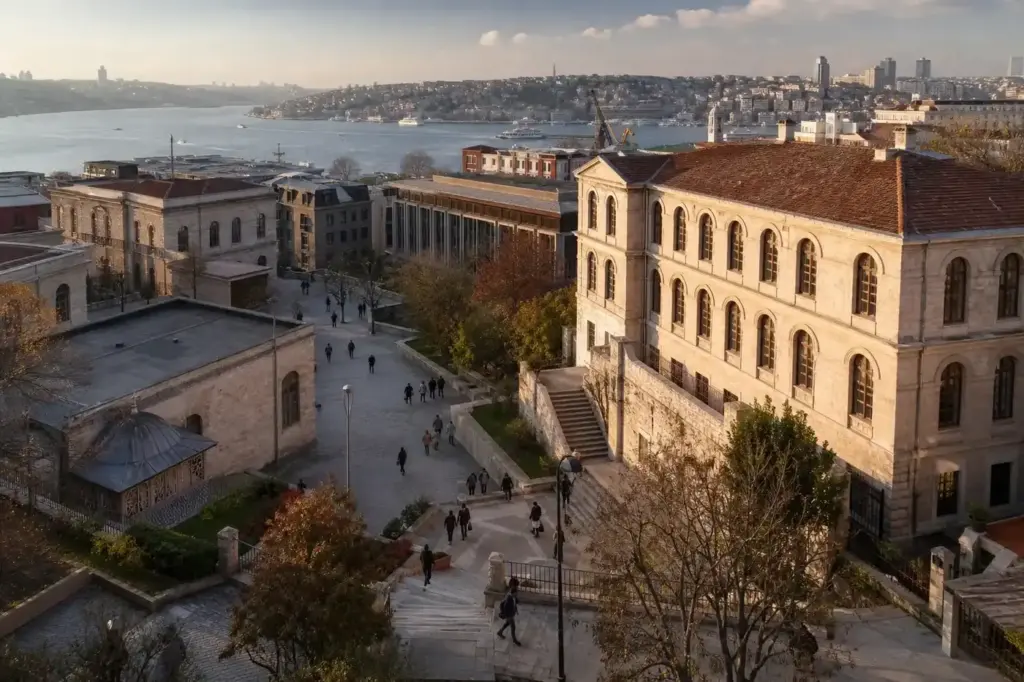
Mimar Sinan Fine Arts University is the oldest and most prestigious art academy in Turkey. Founded in 1882 by the Ottoman painter and archaeologist Osman Hamdi Bey, it was the Ottoman Empire’s first educational institution dedicated to fine arts and architecture. The campus, nestled in the Fındıklı neighborhood of Beyoğlu, is housed in a set of historic buildings that reflect the institution’s 140-year role in shaping Turkish art and design.
Although primarily a teaching university, parts of the campus are accessible to visitors interested in Turkish art education, contemporary galleries, and architectural heritage. The university hosts the Istanbul Painting and Sculpture Museum and the Tophane-i Amire Culture and Art Center, both open to the public.
Quick Facts
| Turkish name | Mimar Sinan Güzel Sanatlar Üniversitesi |
|---|---|
| Built / opened | 1882 |
| Architect(s) | Osman Hamdi Bey (founder) |
| Address | Meclis-i Mebusan Caddesi No: 24, Fındıklı, 34427 Beyoğlu, Istanbul, Turkey Google MapsApple MapsYandex Maps |
| District | Beyoğlu |
| Metro | Kabataş (T1, Toward Fındıklı; 10–12 min walk uphill) Taksim (M2, Exit toward Fındıklı; 15 min walk) |
| Admission | Free for visitors to public areas and courtyards; student-led tours may be offered; check the official website for visiting guidelines |
| Best time to visit | Visit on weekday mornings (08:00–12:00) during the academic year (September–June) to experience the campus with students and active studio life. Avoid July and August when most students are away. Afternoon light (14:00–17:00) is good for photography of courtyards and Golden Horn views. Weekends are quieter but some facilities may have reduced access. Winter (December–February) means rain and gray skies; spring (April–May) and autumn (September–October) offer clear light and mild temperatures. |
| Recommended duration | 1–2 hours |
| Website | msgsu.edu.tr |
What Is (and Isn't) Part of a Visit to Mimar Sinan Fine Arts University?
| Part | Status | Notes |
|---|---|---|
| Historic campus buildings and courtyards | Included in the standard ticket | Public access to courtyards, terraces, and outdoor areas is generally free during daylight hours on weekdays and selectively on weekends. Check at the main gate. |
| Istanbul Painting and Sculpture Museum | Separate ticket or institution | Requires separate admission and operates on its own schedule. Located within or near the university grounds. |
| Tophane-i Amire Culture and Art Center | Separate ticket or institution | Separate venue with independent programming, exhibitions, and hours. Free entry to some exhibitions; others may charge admission. |
| Student galleries and exhibition spaces | Included in the standard ticket | Many are free to view, but access depends on academic schedules and exhibition timings. Ask at the main gate. |
| Faculty studios and classrooms | Not open to visitors | Active teaching spaces; not open to general visitors. Access may be available during special open studio days. |
| Library and archives | Not open to visitors | University library and archival materials are restricted to affiliated students and researchers. |
| Kabataş Ferry Station | Outside / not part of it | Not part of the university; nearby T1 tram terminus used to reach the campus from European or Asian shores. |
| Istanbul State Conservatory | Separate ticket or institution | The conservatory operates within the university structure but is a distinct institution with separate admission and programming. |
Why Visit Mimar Sinan Fine Arts University?
This university is significant for anyone interested in the history of Turkish art, modern Turkish architecture, or the Ottoman influence on cultural institutions. The campus itself is worth visiting for its historic buildings and urban setting overlooking the Golden Horn from Beyoğlu’s heights. Visitors gain insight into how Ottoman and modern Turkey approached fine arts education. The public areas offer a glimpse into academic Istanbul life, and the affiliated museums provide concentrated views of contemporary Turkish visual art.
How Mimar Sinan Fine Arts University Is Laid Out
The main campus occupies several buildings around courtyards in Fındıklı, accessed from Meclis-i Mebusan Street. The central administrative buildings and faculties (Fine Arts, Architecture, Arts and Sciences, Communication) are spread across the slope. Student galleries and cultural spaces are distributed throughout the complex. Visitors typically enter from the street gate and can explore public courtyards and outdoor areas. The Tophane-i Amire Culture and Art Center is housed within the university grounds and operates separately for exhibitions and events. Navigate by following signs from the main gate; the sloped terrain means different facilities are at different elevations.
Highlights of Mimar Sinan Fine Arts University
Main Administrative Building
The 19th-century building at the heart of the campus reflects Ottoman and early modern architectural styles. Built during Osman Hamdi Bey's era, it retains period details and serves as the symbolic entrance to the university. The building's façade is visible from Meclis-i Mebusan Street and represents the transition from Ottoman education models to modern academies.
Tip: Arrive early in the morning (08:00–10:00) for quieter courtyards and better light for photography. Weekday mornings are calmer than afternoons.
Historic Courtyards
The university's courtyards, layered across the sloped terrain, preserve spaces used for over a century. They offer views toward the Golden Horn and Bosphorus on clear days. These open areas are freely accessible and provide a working snapshot of academic life in Istanbul.
Tip: Bring comfortable walking shoes—the campus is built on a steep slope with multiple levels connected by stairs and narrow paths.
Istanbul Painting and Sculpture Museum (Istanbul Resim ve Heykeltıraşlık Müzesi)
Located within the university grounds, this museum displays Turkish painting and sculpture from the 19th century to the present. It focuses on works by Turkish and Ottoman artists and offers a concentrated survey of visual art history. The collection includes both classical academic works and modern pieces, reflecting the university's educational mission.
Tip: Check the official university website for current museum hours and exhibition information; they may vary seasonally or during campus events.
Tophane-i Amire Culture and Art Center
This affiliated cultural center, housed in a separate building within or near the campus, hosts contemporary art exhibitions, performances, and educational workshops. Originally a military foundry in the Ottoman era, it was repurposed as an arts venue. It showcases emerging Turkish artists and experimental work.
Tip: The center often has evening events and exhibitions. Visit their website or social media for current programs; opening hours differ from the main university campus.
Faculty of Architecture Building
The Architecture Faculty occupies a dedicated structure that exemplifies how the university blends educational function with architectural significance. The building itself serves as a teaching tool, with studios and galleries that occasionally host student work exhibitions and design presentations visible during open studio days.
Tip: Look for posted announcements about open studio events (typically held once or twice yearly) when you can see student projects and meet faculty.
Views from the Campus Terraces
Scattered across the sloped campus are terraces and open areas offering sweeping views of the Golden Horn, the historic peninsula, and on clear days, the Asian shore. These vantage points are rarely crowded and offer perspective on Istanbul's geography and the university's strategic location in the city.
Tip: Late afternoon light (16:00–18:00) is best for photography; the western exposure catches the Golden Horn in warm tones.
Student Galleries and Exhibition Spaces
Several small gallery spaces throughout the campus display rotating student and faculty work, ranging from painting and sculpture to graphic design and experimental media. These provide unfiltered access to contemporary Turkish art education and emerging talent. Most are free to view.
Tip: Ask at the main gate if student galleries are open to visitors; access can depend on the academic calendar and exhibition schedules.
Atmosphere
The campus feels like a working art school, not a monument. During academic hours (mornings and early afternoons on weekdays), students move between studios and classes, carrying portfolios and art materials. The steep courtyards echo with voices and footsteps; you’ll hear Turkish being spoken alongside foreign languages from international exchange students. The architecture mixes 19th-century Ottoman elegance with brutalist 1960s–70s additions—a visual record of institutional evolution.
The air carries the scent of paint, plaster dust, and the vegetation on terraces overlooking the city. Walking through the campus feels like eavesdropping on Turkish intellectual life; unlike museums, there’s no hushed reverence—this is a place of active creation. The slope of the terrain means the campus is fragmented into intimate spaces; you rarely see the whole campus at once, which adds to the exploratory feel.
History of Mimar Sinan Fine Arts University
Foundation and Ottoman Era (1882–1914)
Osman Hamdi Bey, a polymathic Ottoman figure who trained in Paris, founded the School of Fine Arts (Mekteb-i Sanayi-i Nefise-i Şâhâne) on January 1, 1882, modeling it after the Beaux-Arts de Paris. When it opened on March 2, 1883, with eight instructors and 20 students, it was the Ottoman Empire’s first educational institution for fine arts and architecture. The school occupied a building in Fındıklı that reflected Ottoman and European architectural currents. Hamdi Bey, a painter, archaeologist, and museum curator himself, shaped the curriculum toward both academic training and national cultural identity.
Growth and Educational Reform (1914–1969)
In 1914, the school became co-educational, marking a shift in Ottoman social attitudes. After the founding of the Turkish Republic in 1923, the institution adapted to new state priorities, though it remained rooted in fine arts education. In 1928, it was elevated to academy status—the first academy in Turkey—and renamed the Academy of Fine Arts (Güzel Sanatlar Akademisi). This reflected both the institution’s maturity and the new nation’s investment in cultural education.
Mid-Twentieth Century Expansion (1969–1982)
In 1969, as educational modernization swept through Turkey, the academy was renamed the Istanbul State Academy of Fine Arts (İstanbul Devlet Güzel Sanatlar Akademisi) and expanded its facilities and programs. New faculty buildings and studios were added, reflecting both increased enrollment and shifting artistic movements—abstract art, modernism, and experimental media became part of the curriculum alongside traditional fine arts.
University Status and Contemporary Era (1982–Present)
On July 20, 1982, the academy formally became a university, renamed Mimar Sinan University after the great Ottoman architect Sinan, honoring Turkish architectural heritage. In December 2003, it adopted its current name: Mimar Sinan Fine Arts University. The name change cemented its role as a comprehensive institution for arts and design education, not merely painting and sculpture. In 2017, the Department of Architecture received validation from the UIA (International Union of Architects) and UNESCO. Today, the university operates four faculties (Fine Arts, Architecture, Arts and Sciences, Communication), five vocational schools, and maintains partnerships with more than 200 institutions across Europe and Asia through programs like Erasmus+.
Legends and Myths about Mimar Sinan Fine Arts University
Osman Hamdi Bey's Vision
Legend – historically unreliable. Osman Hamdi Bey is credited with single-handedly transplanting European art education into the Ottoman Empire against resistance from traditionalists who saw it as foreign corruption. Legend holds that he walked these streets after returning from Paris, envisioning a place where Turkish students could learn anatomy, perspective, and oil painting without leaving the empire. Whether embellished or not, his personal presence and reputation—he was respected as an artist, archaeologist, and intellectual—gave the young school credibility when it might otherwise have been dismissed as a European imitation.
The School of 20 Students
Legend – historically unreliable. The founding cohort of just 20 students on March 2, 1883, is sometimes mythologized as the seed of Turkish modern art. Stories suggest these students faced mockery from traditional Ottoman society for their 'foreign' training, yet many became the founders of Turkish painting and sculpture. The small number is real, but the narrative of their heroic struggle is often romanticized in Turkish art history.
Tickets and Booking for Mimar Sinan Fine Arts University
| Ticket | Price | Includes |
|---|---|---|
| Public campus access | Free | Access to courtyards, terraces, outdoor areas, and some public exhibition spaces during visiting hours. |
| Istanbul Painting and Sculpture Museum | ₺ | Entry to the museum's permanent collection and temporary exhibitions. Hours and admission structure vary; verify on the official website. |
| Tophane-i Amire exhibitions | Free | Many exhibitions are free; some special exhibitions or events may charge admission. Check the center's program for current details. |
₺ budget · ₺₺ moderate · ₺₺₺ upscale · ₺₺₺₺ splurge. Price levels are estimates compared with typical prices for visitors.
There is no ticket required for accessing the main campus courtyards and public areas. Simply arrive during daylight hours and enter through the main gate on Meclis-i Mebusan Street.
For the Istanbul Painting and Sculpture Museum, admission rates and hours vary. Consult the official university website (msgsu.edu.tr) for current ticket information, opening times, and any temporary closures.
The Tophane-i Amire Culture and Art Center operates independently with its own exhibitions and events schedule. Many shows are free; admission to special exhibitions should be confirmed in advance via their website or social media.
Student galleries and exhibitions are often accessible during academic hours on weekdays, but availability is seasonal. Ask staff at the main gate whether galleries are open on your visit date.
Turkish citizens, students, and various concession categories may qualify for reduced or free entry to the museum; rates differ from international visitor prices. Consult the official ticketing page on the university’s website for all categories.
Suggested itineraries Mimar Sinan Fine Arts University
1–1.5 hours
Enter through the main gate and explore the central courtyard and administrative buildings. Walk the upper terraces for Golden Horn views. If time allows, visit a student gallery or the main library courtyard. Suitable for a quick stop between other Beyoğlu activities.
2–3 hours
Tour the campus fully: courtyards, terraces, and multiple levels. Visit the Istanbul Painting and Sculpture Museum if open. Explore student exhibitions and spaces. Grab coffee in a nearby café on Istiklal or in Cihangir. Allows time to absorb the institutional atmosphere.
Half day
Spend 2–3 hours on campus, visiting the museum and galleries. Then explore neighboring Fındıklı with its Ottoman-era houses, or walk to nearby Tophane and Cihangir neighborhoods. Visit a Beyoğlu café or restaurant for lunch. Combine with visits to nearby art spaces or Istiklal Avenue.
How to Get to Mimar Sinan Fine Arts University
By Metro and Tram:
The nearest public transit is the T1 historic tram line to Kabataş station. Exit toward Fındıklı and walk uphill along small streets for 10–12 minutes to reach Meclis-i Mebusan Street and the main gate. The walk is steep but short; follow signs or ask locals for “Mimar Sinan Üniversitesi.”
Alternate route:
Take the M2 metro to Taksim and walk downhill through Fındıklı for approximately 15 minutes to the university.
By foot from Beyoğlu:
If staying in central Beyoğlu (Taksim, Istiklal), the university is 15–20 minutes downhill on foot. Head toward Fındıklı neighborhood.
By taxi or local transit:
Tell the driver “Meclis-i Mebusan Caddesi, Fındıklı” for direct drop-off. Taxis are readily available from Taksim or Kabataş areas.
Accessibility
The campus is built on a steep slope with multiple levels connected by stairs, narrow passages, and uneven terrain. Wheelchair accessibility is limited; the main gate and lower courtyard areas are reachable, but upper terraces and many studios are not accessible. The university can provide information about specific accessibility needs; contact +90 212 252 1600 to inquire before visiting. Benches are scattered throughout for rest. The main administrative buildings have interior stairs without elevators in some sections; inquire about accessible routes when you arrive.
Food Nearby
The university neighborhood of Fındıklı has traditional Turkish cafés and small eateries serving breakfast, tea, and simple lunch fare. Nearby Cihangir (5–10 min walk) offers more diverse options: independent cafés, bookstore cafés, and casual restaurants. Taksim and Istiklal Avenue are 10–15 minutes away by foot, with abundant dining from street food to sit-down restaurants. The university itself typically does not have a visitor café; bring water and snacks or plan a meal break in the neighborhood.
What to Bring
Comfortable walking shoes with good grip are essential—the campus is steep and paths can be slippery when wet. Bring water, as the climbing between levels is physically demanding. In summer (June–August), sunscreen and a hat help; in winter, a light rain jacket. A notebook and pen are useful for sketching or noting architectural details. A camera or smartphone for photography is welcome in public areas; ask before photographing people or private spaces.
Best Views and Photo Spots of Mimar Sinan Fine Arts University
Upper terraces overlooking Golden Horn
Panoramic views of the Golden Horn, historic peninsula, and Bosphorus beyond. The sloped campus means these terraces offer rare elevated perspectives from Beyoğlu. Best capture the curve of the waterfront and distant Asian shore.
Best time: Late afternoon (16:00–18:00) when warm western light catches the water and buildings. Clear autumn and spring days offer the sharpest visibility.
Central courtyard with administrative building
Ottoman-era architecture framed by modern academic buildings. The central courtyard captures the layering of historical periods and offers intimate architectural detail—arched windows, stonework, and period railings.
Best time: Morning light (09:00–11:00) rakes across façades; avoid harsh midday sun. Weekday mornings when student activity adds life to the scene.
Staircase between courtyards
The dramatic slopes and connecting stairs frame views both upward and downward across the campus. These narrow passages reveal the institutional landscape in miniature.
Best time: Morning or late afternoon when side lighting defines stairs and slopes. Dramatic after rain when surfaces reflect light.
Fındıklı neighborhood street view of campus entrance
Looking from Meclis-i Mebusan Street toward the main gate captures the campus nestled in its urban context—Ottoman houses and modern streets contrast with the institutional presence.
Best time: Morning or early afternoon before crowds; the street offers shifting urban perspectives of the campus façade.
Photography Rules
Photography is generally permitted in public courtyards, terraces, and common areas. Do not photograph people without permission. Drones, tripods used for commercial purposes, and flash photography inside buildings (if you gain access to interiors) may require advance permission from the university. Be respectful of students and classes in session. Social media sharing is acceptable for personal use; credit "Mimar Sinan Fine Arts University, Istanbul" if posting.
Family Suitability
The campus is moderately suitable for families with school-age children and teens interested in art, architecture, or history. The steep terrain and many stairs make it challenging for toddlers and those with mobility issues; strollers are impractical. Older children (10+) may enjoy exploring courtyards, viewing student art, and learning about Turkish education. The museums and galleries are age-appropriate for teens. However, the site is an active university, not a family attraction; expect academic atmosphere, not family-oriented facilities or activities. Allow short visits (1–2 hours) rather than extended stays.
Istanbul Vibes Tips
- Arrive before 11:00 on a weekday morning to see the campus at its liveliest—students in studios, classes in session, and courtyards busy with academic life. Late morning and afternoon are much quieter and may feel empty.
- Wear comfortable shoes with good grip. The campus is dramatically sloped; what looks like a short walk on a map requires climbing many stairs and navigating uneven paths. Plan 1.5–2 hours if you want to explore upper terraces and Golden Horn views.
- Ask at the main gate whether student galleries and exhibitions are open before wandering in search of them. Access is real but scattered; staff can point you to what's currently accessible and worth seeing.
- Visit the Istanbul Painting and Sculpture Museum on a separate trip if possible, or verify its hours before arriving on campus—museum hours do not always align with campus opening, and it closes for conservation and special exhibitions.
- Do not mistake the T1 tram terminus at Kabataş for the university. The walk from Kabataş is steeper and longer than it appears; the alternative route via Taksim and Fındıklı is often faster and less arduous if you're not coming from the ferry.
- Pack water and bring snacks. There is no visitor café on campus, and the nearest restaurants are a 5–10 minute walk away in Cihangir or Taksim. The steep climb between levels is dehydrating, especially in summer.
Explore Nearby Mimar Sinan Fine Arts University
Sights near Mimar Sinan Fine Arts University
 Istiklal Avenue – about 950 m away (~15 min walk) · typical visit: 2-3 hours12 min on foot from Tünel metro, Open 24 hours
Main image: AI-generated illustration. It may not show the place exactly as it looks.
 Istanbul Military Museumabout 1.6 km away (~26 min walk) · typical visit: 2–3 hours
Main image: AI-generated illustration. It may not show the place exactly as it looks.
 Istanbul Modern – about 550 m away (~9 min walk) · typical visit: 2–3 hours4 min on foot from Tophane metro
Main image: AI-generated illustration. It may not show the place exactly as it looks.
 Atatürk Cultural Center – about 700 m away (~12 min walk) · typical visit: 2–3 hours8 min on foot from Kabataş metro, Open daily 10:00–18:00
Main image: AI-generated illustration. It may not show the place exactly as it looks.
 Topane-i Amire Cultural and Art Center – about 750 m away (~12 min walk) · typical visit: 1–2 hours1 min on foot from Tophane metro, Open 10:00–18:00, closed Mon
Main image: AI-generated illustration. It may not show the place exactly as it looks.
 Museum of Innocence – about 800 m away (~13 min walk) · typical visit: 1.5–2.5 hours8 min on foot from Tophane metro
Main image: AI-generated illustration. It may not show the place exactly as it looks.
Metro stations near Mimar Sinan Fine Arts University
 Fındıklı-Mimar Sinan Üniversitesi – about 100 m away (~2 min walk)Open daily 06:00–00:00
Main image: AI-generated illustration. It may not show the place exactly as it looks.
 Kabataş – about 600 m away (~10 min walk)Open daily 06:15–00:00
Main image: AI-generated illustration. It may not show the place exactly as it looks.
 Tophaneabout 750 m away (~12 min walk)
Main image: AI-generated illustration. It may not show the place exactly as it looks.
Restaurants and cafes near Mimar Sinan Fine Arts University
 Jash Istanbul – about 250 m away (~4 min walk)4 min on foot from Fındıklı-Mimar Sinan Üniversitesi metro, Open daily 12:00–02:00
Main image: AI-generated illustration. It may not show the place exactly as it looks.
 Susam Cafe – about 350 m away (~5 min walk)6 min on foot from Fındıklı-Mimar Sinan Üniversitesi metro, Open daily 10:00–02:00
Main image: AI-generated illustration. It may not show the place exactly as it looks.
 Van Kahvalti Evi – about 450 m away (~7 min walk)6 min on foot from Fındıklı-Mimar Sinan Üniversitesi metro, Open daily 08:00–17:00
Main image: AI-generated illustration. It may not show the place exactly as it looks.
 Vegan Dükkan Lokanta – about 500 m away (~8 min walk)8 min on foot from Fındıklı-Mimar Sinan Üniversitesi metro, Open 12:00–20:30, closed Mon
Main image: AI-generated illustration. It may not show the place exactly as it looks.
Nightlife near Mimar Sinan Fine Arts University
 Monkey Istanbul – about 200 m away (~3 min walk)5 min on foot from Fındıklı-Mimar Sinan Üniversitesi metro
Main image: AI-generated illustration. It may not show the place exactly as it looks.
 Geyik Coffee Roastery and Cocktail Bar – about 450 m away (~7 min walk)7 min on foot from Tophane metro, Open daily 16:00–02:00
Main image: AI-generated illustration. It may not show the place exactly as it looks.
Train stations and river piers near Mimar Sinan Fine Arts University
 Kabataş Ferry Terminalabout 500 m away (~8 min walk)
Main image: AI-generated illustration. It may not show the place exactly as it looks.
 Karaköy Ferry Terminalabout 1.4 km away (~23 min walk)
Main image: AI-generated illustration. It may not show the place exactly as it looks.
Events and traditions near Mimar Sinan Fine Arts University
 Istanbul Music Festivalabout 1.5 km away (~24 min walk)
Main image: AI-generated illustration. It may not show the place exactly as it looks.
Related guides
 Taksim: Modern Heart of Istanbul and Gateway to Beyoğlu
Main image: AI-generated illustration. It may not show the place exactly as it looks.
 Cihangir: Istanbul’s Bohemian Neighborhood Beyond the Tourist Trail
Main image: AI-generated illustration. It may not show the place exactly as it looks.
 Ara Güler Museum: Free Photography and Istanbul History
Main image: AI-generated illustration. It may not show the place exactly as it looks.
 Süreyya Opera House: Art Deco Theatre and Performances in Kadıköy12 min on foot from Kadıköy-İDO metro, Open daily 10:00–18:00
Main image: AI-generated illustration. It may not show the place exactly as it looks.
 Yenisahra Metro Station: Transit Hub to Kadıköy and the Airport
Main image: AI-generated illustration. It may not show the place exactly as it looks.
Browse more: More in Beyoğlu · All Architecture · All Sightseeing
FAQ: Mimar Sinan Fine Arts University
Is Mimar Sinan Fine Arts University open to public visitors?
Yes, the main campus courtyards, terraces, and public areas are open to visitors during daylight hours on weekdays. Simply enter through the main gate on Meclis-i Mebusan Street. Some internal spaces, galleries, and exhibitions may have restricted access or require permission. Check with staff at the gate.
Do I need a ticket to walk around the campus?
No ticket is required for access to public courtyards and outdoor areas. The Istanbul Painting and Sculpture Museum and some exhibitions require separate admission; these are optional.
Is the Istanbul Painting and Sculpture Museum part of the university campus?
Yes, the museum is located within or affiliated with the university grounds, but it operates independently with its own admission, hours, and programming. Verify museum hours on the university website before visiting.
What is the best day and time to visit to see the campus at its liveliest?
Weekday mornings, especially 08:00–11:00, during the academic year (September–June) are busiest. Students are in classes and studios; courtyards are active. Afternoons and weekends are much quieter.
Is the campus accessible for visitors with mobility challenges?
Accessibility is limited due to steep terrain, multiple levels, and many stairs. Lower courtyards are reachable, but upper terraces and most studios are not wheelchair-accessible. Contact +90 212 252 1600 in advance to discuss your needs.
How long should I plan to spend on campus?
A quick visit exploring central courtyards and terraces takes 1–1.5 hours. A full tour visiting multiple buildings, student galleries, and Golden Horn viewpoints takes 2–3 hours. The steep terrain means even short distances require more time than expected.
Can I photograph the campus and share it on social media?
Yes, photography in public courtyards and terraces is generally permitted. Do not photograph people without permission. Ask before photographing interiors or restricted spaces. Commercial tripods and drones require advance permission.
What is Tophane-i Amire Culture and Art Center, and is it part of a university visit?
Tophane-i Amire is an affiliated cultural center near or within the university grounds that hosts contemporary art exhibitions and performances. It operates independently with separate hours and programming. Many exhibitions are free; check their website for current offerings.
Istanbul Vibes is a one-person project. A coffee keeps it going
Hotels near Mimar Sinan Fine Arts University
- Metropolitan Bosporus Hotel (50 m) Check prices (affiliate link, opens in a new tab)
- Azure the Bosporus (50 m) Check prices (affiliate link, opens in a new tab)
- Zimmer Hotel Bosphorus (100 m) Check prices (affiliate link, opens in a new tab)
- Loop Hotel Bosphorus Istanbul (200 m) Check prices (affiliate link, opens in a new tab)
Affiliate link (opens the booking site): we may earn a commission at no extra cost to you.
Restaurants near Mimar Sinan Fine Arts University
- Kaktüs Kahvesi (250 m) Google Maps
- 22 Restorant Bar (400 m) Google Maps
- 5. Kat (450 m) Google Maps
- 21 (450 m) Google Maps
Distances are straight-line, from OpenStreetMap data.

Take this guide with you
Get a free PDF of this guide to print or read offline: key facts, tips and a map link on a few clean pages.
Report an issue on this page
How we research and update our guides
About this guide: AI assistance and accuracy
This guide is created with the help of AI and is based on official sources where available. Mistakes can still happen. Opening hours, prices, rules and other details are given to the best of our knowledge as of the date shown and can change without notice. It offers general recommendations only, not professional, legal or travel advice. Please confirm important details with the official source before you travel; you are responsible for your own plans and decisions.
* Affiliate link: as an Amazon Associate we earn from qualifying purchases at no extra cost to you.
