
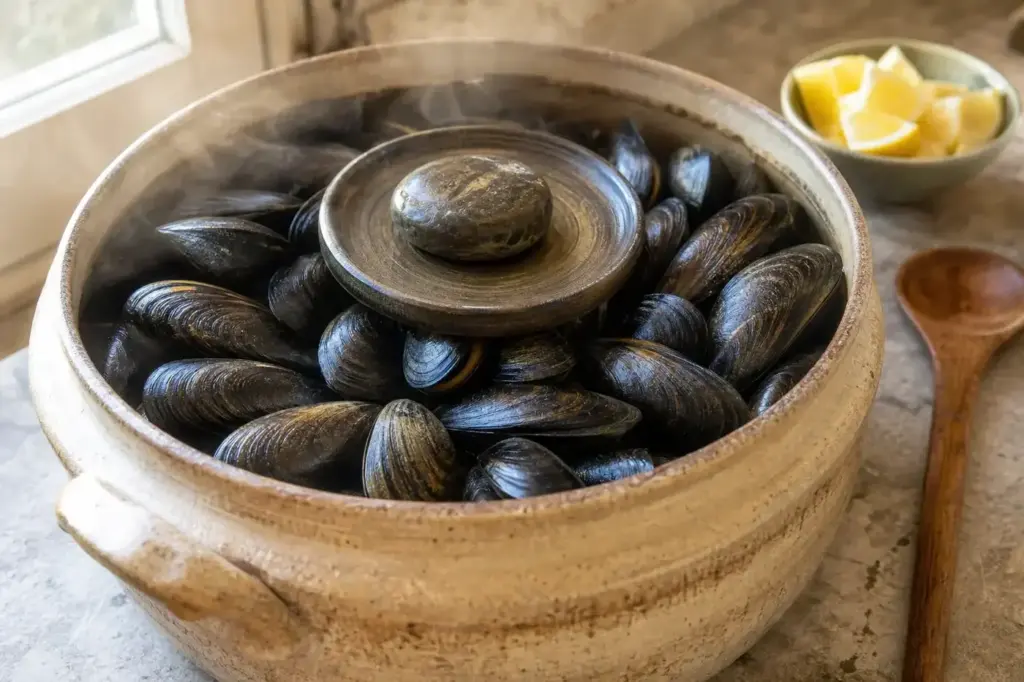
Midye dolma—stuffed mussels—is one of Istanbul’s most iconic street foods, available year-round from vendors with trays and carts. If you walk past Istiklal Avenue or the Eminönü waterfront after dusk, you’ll see them. This guide shows you how to make authentic midye dolma at home, from cleaning the mussels to steaming and serving.
The dish is easy to prepare but requires patience with the mussel-opening stage. Making midye dolma at home is worthwhile; most visitors who try it become fans. The best approach is to partially cook the rice filling beforehand, stuff and steam the mussels, then chill them for a few hours before serving.
Quick answer: Prepare spiced rice with onions, pine nuts and currants. Clean and carefully open raw mussels, fill each with a small spoonful of rice, pack tightly in a pot with a plate on top to keep them closed, and steam for 20–25 minutes. Cool and serve cold with lemon. Total time: about 75–90 minutes, including prep.
At a Glance
| Type | Street food & snacks |
|---|---|
| Origin | The origin of this dish is firmly linked to the coastal regions of Turkey and reflects the cosmopolitan history of the Ottoman Empire, where influences of Greek, Armenian, and Turkish cuisine mingled. As mussels required intricate preparation, midye dolma during the Ottoman times was a prized delicacy. The dish was often served at banquets, and its popularity continued to grow over the centuries. Historically, it was a way to feed people in ports cheaply and tastily by combining available protein from the sea and filling rice. |
| Servings | 2–4 servings (20–30 mussels) |
| Total time | 75–90 minutes (including cooling and chilling) |
| Difficulty | Medium |
History and Story of Midye Dolma
The name is literal—’midye’ means mussel and ‘dolma’ refers to anything stuffed, which is a technique typical for the entire region. Today, midye dolma is primarily a late-night food. Vendors with large round trays and folding stools stand on street corners and lure passersby, often late at night when people are leaving bars and need something to soak up the alcohol and fill their stomachs without having to sit at a table and wait for service. Most street vendors are found in Turkey’s coastal cities including Istanbul, İzmir and Bodrum. There are two specific locations in Istanbul which are known for their street food: Istiklal Avenue, an avenue in the European side of Istanbul and Eminönü a district near the Galata Bridge. Midye Dolma carts are frequently found in those two locations along with vendors of other Turkish street food.
Ingredients
- 250 g short-grain rice (Baldo or Osmancik), rinsed
- 400 g fresh mussels, live and tightly closed
- 90 ml olive oil
- 100 g onion, finely chopped
- 25 g pine nuts
- 20 g currants or small dark raisins
- 1 tbsp tomato paste
- 5 g ground allspice
- 2 g ground cinnamon
- 2 g ground black pepper
- 5 g dried mint or dill, chopped
- Salt to taste
- 120 ml hot water
- Lemon wedges for serving
How Midye Dolma Is Made
Step 1: Clean the mussels thoroughly
Clean the mussels thoroughly under cold running water, scrubbing the shells and pulling off any beards. Discard any mussels that are open and won't close when tapped, as they are not safe to eat. Place cleaned mussels in a bowl of cold water and set aside.
Tip: Soaking mussels in warm water for 15 minutes before opening helps relax them and makes opening easier.
Step 2: Make the spiced rice filling
Heat the olive oil in a wide pan over medium heat. Add the finely chopped onion and cook for 5 minutes until soft and golden, then add the pine nuts and toast lightly for another 2 minutes. Add the rinsed rice and stir constantly for 2–3 minutes until the grains are lightly coated and toasted. Stir in the tomato paste, allspice, cinnamon, black pepper, mint and salt. Pour in the hot water, bring to a simmer, cover, and cook for 10 minutes until the rice is partially cooked and most liquid is absorbed. Remove from heat, stir in the currants, and let cool to room temperature. The rice should still have some firmness; it will finish cooking inside the mussels.
Tip: Under-cooking the rice at this stage is key—it prevents a mushy filling when the mussels steam.
Step 3: Open the mussels carefully
Using a small sharp knife, insert the blade at the hinge where the two shell halves meet. Twist gently and run the blade around the edge of the shell, keeping the mussel meat attached to one half if possible. Open just wide enough to insert filling without breaking the shells. Keep the two halves hinged together.
Tip: Work slowly and carefully to avoid cutting yourself. If a mussel is difficult to open, return it to warm water for a few minutes and try again.
Step 4: Stuff the mussels
Once the rice has cooled, spoon about a teaspoon of filling into each opened mussel, distributing it evenly. Do not overstuff—the rice will expand during steaming and overstuffed shells will pop open and spill their filling. Close the shell around the filling by pressing the halves gently together.
Tip: Work quickly so the filling doesn't warm up too much. Arrange stuffed mussels on a clean surface as you go.
Step 5: Pack and steam the mussels
Arrange the stuffed mussels tightly in a wide pot, layering them with the seam side down (hinge pointing outward) so they do not open during cooking. Place a heavy plate upside down on top of them to keep them closed. Pour about 120 ml of water around the bottom of the pot and drizzle with a little olive oil. Cover the pot and place over low to medium heat.
Tip: Packing them tightly and keeping the seam side down is crucial; any space or tilting allows them to open and lose their filling.
Step 6: Steam until cooked
Cook covered for 20–25 minutes over low to medium heat. The water should simmer gently, not boil vigorously. You will see the mussel shells change color slightly and the meat inside become opaque. Once cooked, turn off the heat and leave the pot covered for a few minutes to cool.
Tip: Peek after 15 minutes to check liquid level; add a splash more water if the pot is drying out too quickly.
Step 7: Cool and serve
Remove the mussels from the pot carefully and arrange them on a platter. They can be served warm, at room temperature, or cold. Most vendors and restaurants serve them cold or at room temperature. Open the top shell to use as a spoon for scooping out the mussel and rice, squeeze fresh lemon juice over each one, and eat straight from the shell.
Tip: Chilling them for a few hours in the refrigerator deepens the flavor and makes them easier to eat. They keep for 3–4 days refrigerated.
Variants
- With dill instead of mint for a fresher herb note
- With raisins instead of currants for a sweeter filling
- With chopped almonds or walnuts substituted for pine nuts
- With a touch of paprika added to the rice for deeper color and flavor
- Cold midye dolma served with a yogurt-based sauce (less common in Istanbul but found in some restaurants)
Common Mistakes to Avoid
- Overcooking the rice before stuffing: This makes the filling mushy. Instead, cook the rice only until it is mostly tender but still has slight firmness; it finishes cooking inside the mussel during steaming.
- Overstuffing the mussels: If you pack too much rice into each shell, they will burst open during cooking and spill the filling. Use only about a teaspoon per mussel.
- Arranging mussels seam-side up or loosely: Mussels packed with their seam facing up or with gaps between them will open during steaming and lose their filling. Pack them tightly, seam-side down, with a plate weighted on top.
- Using mussels that are already open or broken: Open mussels may be dead and unsafe to eat. Also, broken shells cannot be stuffed or hold filling during cooking. Always select live, tightly closed mussels.
- Cooking at too high a temperature: Fast boiling can cause the mussels to open too quickly before the filling is cooked. Simmer gently over low to medium heat for even, controlled cooking.
- Not chilling before serving: While midye dolma can be served warm, chilling for a few hours allows the flavors to set and makes them easier to eat. Most Istanbul vendors and restaurants serve them cold.
How to Order and Eat It
In Istanbul we use one of the two shells of the mussel as a spoon to eat the filling. The vendor, called a midyeci, arranges the shells in a beautiful, fan-shaped pattern on a tray, and the customer picks them themselves, dipping each mussel in lemon juice before eating it straight from the shell. Pick up a mussel by its shell, gently pry the top half open slightly if needed, squeeze fresh lemon juice inside, and use the top shell as a small scoop to extract the mussel and rice filling. Eat it in one bite directly from the shell. The combination of tender mussel, spiced rice, and bright lemon should be balanced—not too much salt from the mussel should remain.
To order: Birer midye dolma, lütfen [Beer-er midyeh dol-mah, loo-tfen]
Where to Try Midye Dolma
 Eleos Restaurant Greek, Mediterranean Seafood
Main image: AI-generated illustration. It may not show the place exactly as it looks.
 The United Pub
Main image: AI-generated illustration. It may not show the place exactly as it looks.
 Seven Hills4 min on foot from Gülhane metro, Open daily 08:00–23:00
Main image: AI-generated illustration. It may not show the place exactly as it looks.
Istanbul Vibes Tips
- Buy mussels the same day you plan to cook them, or at most one day ahead. Store them in the coldest part of your refrigerator in a bowl covered with a damp cloth, never in a sealed plastic bag—they need to breathe.
- Find vendor carts most easily after dark near Eminönü (by the ferry terminal and along the Golden Horn waterfront) or Istiklal Avenue in Beyoğlu. Midyeci vendors typically set up around 9 pm and stay open until late.
- Many recipes add a small handful of chopped parsley or dill to the rice after cooking for brightness. Add it after removing from heat so it stays green and fresh-tasting.
- The balance of salt is tricky: the mussel itself is salty, so go light on salt in the filling. Taste a cooled mussel before serving and adjust seasoning if needed.
- Do not reopen a mussel to check if it is done—opening it releases steam and slows cooking. The color change from gray to more opaque and the softer feel are your signs that mussels are cooked.
Explore Nearby Midye Dolma
Related guides
 Eminönü: Istanbul’s Waterfront Heart and Ottoman Harbor
Main image: AI-generated illustration. It may not show the place exactly as it looks.
 Spice Bazaar and Grand Bazaar Route: Two Markets, Six Centuries
Main image: AI-generated illustration. It may not show the place exactly as it looks.
 Beyoğlu and Galata Walk: Modern Istanbul from Taksim to the Tower
Main image: AI-generated illustration. It may not show the place exactly as it looks.
 Best Street Food and Markets: Where Istanbul Eats
Main image: AI-generated illustration. It may not show the place exactly as it looks.
Browse more: All Food & Drink · All Other
FAQ
Is midye dolma made with raw or cooked mussels?
Raw mussels are stuffed and then steamed whole in their shells. The mussel meat cooks during steaming, which also finishes cooking the rice filling and creates a tender, juicy result.
Can I buy pre-made midye dolma and reheat them at home?
Yes. Street vendors in Istanbul sell them by the piece, packed in paper or small containers. You can eat them cold straight away or reheat them gently in a steamer for a few minutes. They are best served cold or at room temperature, though.
What does midye dolma typically contain for allergies?
Midye dolma contains shellfish (mussels) and tree nuts (pine nuts). It typically does not contain gluten, dairy or pork. Always check with a vendor or restaurant about specific ingredients and preparation if you have allergies.
How do I know if a mussel is dead or unsafe to eat?
Live mussels keep their shells tightly closed. Discard any mussel that is already open and does not close when you tap it, or any with a cracked or broken shell. These are dead and not safe to eat.
Can I make midye dolma a day or two ahead?
Yes. Midye dolma keeps in the refrigerator for 3–4 days in an airtight container. Chill them thoroughly after cooking, then serve cold or at room temperature. Do not leave them at room temperature for more than 2 hours.
What rice should I use for midye dolma?
Use short-grain rice, preferably Turkish varieties like Baldo or Osmancik. Short-grain rice absorbs liquid evenly and stays tender without becoming mushy. Long-grain rice tends to stay too firm.
Why does my filling come out mushy?
The rice was cooked too much before stuffing. Cook it only until it is about three-quarters done and still has a slight bite. It finishes cooking during the steaming stage inside the mussel.
Can I substitute other ingredients in the filling?
Yes. Use raisins instead of currants, almonds or walnuts instead of pine nuts, or fresh dill instead of mint. Some cooks add a pinch of paprika or use different herbs like parsley. The core technique remains the same.
Istanbul Vibes is a one-person project. A coffee keeps it going

Take this guide with you
Get a free PDF of this guide to print or read offline: key facts, tips and a map link on a few clean pages.
Report an issue on this page
How we research and update our guides
About this guide: AI assistance and accuracy
This guide is created with the help of AI and is based on official sources where available. Mistakes can still happen. Opening hours, prices, rules and other details are given to the best of our knowledge as of the date shown and can change without notice. It offers general recommendations only, not professional, legal or travel advice. Please confirm important details with the official source before you travel; you are responsible for your own plans and decisions.
* Affiliate link: as an Amazon Associate we earn from qualifying purchases at no extra cost to you.
