
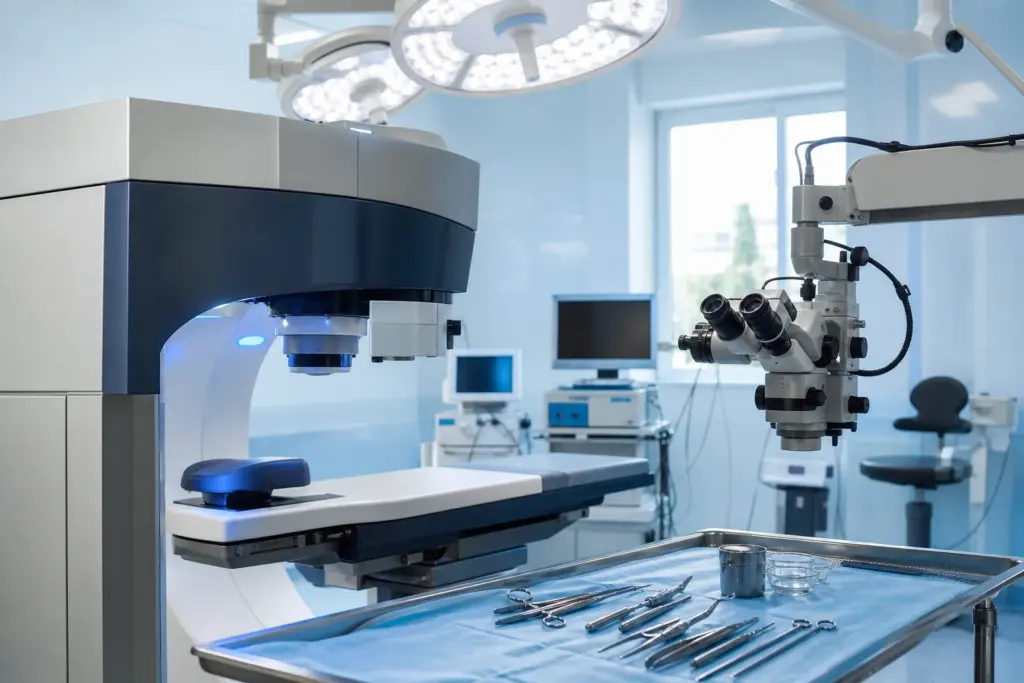
Information only. This article explains what a treatment is and how it is usually carried out. It is not medical advice, not an offer and not a recommendation to have any procedure. Whether it suits you can only be decided by a licensed doctor after an examination.
This article explains what photorefractive keratectomy (PRK) is, how the procedure works, what to expect during recovery, and key points to discuss with your eye doctor. PRK is one option among several for laser vision correction.
PRK is not the same as LASIK, the more widely known alternative; the main difference is that PRK removes the cornea’s outer layer entirely rather than creating a flap. The choice between procedures depends on your eye structure, lifestyle and the advice of a qualified eye surgeon.
Quick answer: PRK (Photorefractive keratectomy) is a laser vision correction procedure that reshapes the cornea to reduce or eliminate the need for glasses or contact lenses. Unlike LASIK, PRK doesn't involve creating a corneal flap. Instead, the outer layer of the cornea (the epithelium) is gently removed, and an excimer laser is used to precisely reshape the underlying tissue. The entire procedure takes between five and 15 minutes. The bandage contact lens facilitates healing of the outer cells of the cornea, a process that takes approximately four days. During this healing phase, the eye will be intermittently uncomfortable: scratchy, sandy, gritty, itchy, and light sensitive. Patients typically require one month to achieve excellent, stable vision.
At a Glance
| Total time | Procedure: 5–15 minutes per eye. Initial recovery (epithelial healing): 4 days to 1 week. Full recovery to stable vision: 3–4 weeks to 1–2 months. |
|---|
What You Need Before You Start
- Full eye examination including corneal thickness, refraction, corneal mapping and eye pressure measurement
- Stable vision for at least one year (prescription should not have changed significantly)
- No pregnancy or active breastfeeding
- No current infections or severe dry eye syndrome
- Contact lenses removed for a specified period before the procedure, as advised by your eye doctor
- Arrangement for someone to drive you home after the procedure
- Time for follow-up care with your surgeon for at least 3–4 weeks post-surgery
Compare Your Options
| Option | Duration | Price | Notes |
|---|---|---|---|
| Standard PRK (mechanical or chemical epithelial removal) | Procedure 5–15 minutes; recovery 3–4 weeks to clear vision | The outer layer (epithelium) is removed using a brush, blade, or alcohol solution before laser reshaping. Most commonly performed variant. | |
| TransPRK (laser-assisted epithelial removal and reshaping in one step) | Procedure 5–15 minutes; recovery 3–4 weeks | This technique combines the benefits of PRK with the precision of laser technology. In TransPRK, the laser removes the epithelium and reshapes the cornea in a single step, minimizing the risk of complications and enhancing recovery time. | |
| LASIK (laser-assisted in situ keratomileusis) | Procedure 10–15 minutes; recovery 1–2 days to functional vision | The main difference is that a flap is cut into the cornea during LASIK before using the laser. LASIK heals quicker, giving you clear vision within hours or days, while PRK takes a few weeks. PRK carries a slight edge for patients with thinner corneas because no flap is created, preserving more corneal tissue over time. | |
| LASEK (Laser Epithelial Keratomileusis) | Procedure 5–15 minutes; recovery 1–2 weeks | A variation of PRK, called LASEK, is also available. Instead of removing the outer epithelial layer of the cornea as with PRK, LASEK involves lifting the epithelial layer (using a surgical instrument called a trephine), preserving it during surgery and then replacing it on the eye's surface at the end of the procedure. A bandage contact lens is placed over it. This preserved epithelial layer acts as a human bandage contact lens. | |
| Contact lenses and eyeglasses | Ongoing, no procedure | Non-surgical alternatives that correct vision without permanent changes to the cornea. Require regular replacement and prescription updates. |
₺ budget · ₺₺ moderate · ₺₺₺ upscale · ₺₺₺₺ splurge. Price levels are estimates compared with typical prices for visitors.
Step-by-Step Instructions
Step 1: Schedule and prepare for pre-operative examination
Book an appointment with a qualified eye surgeon for a full evaluation. Your surgeon will measure your cornea, check your eye pressure, refraction and corneal shape. Discuss your medical history, any medications you take, and your lifestyle (sports, physical work). Bring all eye-related medical records if you have had previous eye surgery or conditions.
Tip: Ask about the surgeon's experience and qualifications. Request a written copy of your eye measurements and prescription to keep.
Step 2: Stop wearing contact lenses
Your eye surgeon will advise you when to stop wearing soft or rigid contact lenses before the procedure—typically 1–2 weeks or longer depending on the type. Contact lenses change the shape of your cornea, and your surgeon needs accurate measurements. Wear glasses during this period instead.
Tip: Plan ahead if you need vision correction for daily activities; arrange for glasses well in advance.
Step 3: Eat and take medications on the day of surgery
Eat a light meal before arriving. Take all your regularly prescribed medications unless your surgeon advises otherwise. Do not wear eye makeup, eyeshadow, eyeliner or mascara on the day of surgery, as these can interfere with the procedure. Avoid bulky hair accessories.
Tip: Wear comfortable, loose-fitting clothing so you can relax after surgery.
Step 4: Numbing and epithelial removal
Your eye is numbed with anesthetic eye drops. Your eye surgeon places an eyelid holder on your eye so you don't blink. The ophthalmologist removes the thin outer layer of cells on your cornea (the epithelium) using a special brush, blade, laser, or alcohol solution. You will feel slight pressure but no pain.
Tip: Stay as still as possible and keep your eyes focused on the target light the surgeon indicates.
Step 5: Laser reshaping
You'll be asked to stare at a target light to keep your eye steady. The ophthalmologist reshapes your cornea using a precisely programmed laser, customized for your individual eye measurements. The laser emits a cool ultraviolet light with a distinctive sound. The entire reshaping takes several minutes.
Tip: Listen for the surgeon's or assistant's instructions and follow them exactly. If your eye moves, the laser may pause automatically.
Step 6: Bandage contact lens placement
Your ophthalmologist will place a 'bandage' contact lens over your eye to help it heal. You do not need to remove this yourself. Your surgeon will take it out about five to seven days after surgery. The lens protects your eye and reduces discomfort as the outer layer of your cornea regrows.
Tip: Do not attempt to remove the bandage lens yourself, even if it feels uncomfortable.
Step 7: Immediate post-operative care
You shouldn't notice any pain until the numbing medications wear off. That usually lasts for less than an hour after your PRK procedure. Plan to rest for the remainder of the day. Arrange for someone to drive you home. Apply prescribed eye drops as directed by your surgeon. Wear sunglasses to reduce light sensitivity.
Tip: Do not rub your eyes, drive, or use screens for the rest of the day. Rest with your eyes closed.
Step 8: Days 2–4: Managing discomfort during healing
Most patients develop redness and tearing. There is often stinging and a gritty sensation that lasts 3 to 4 days. During this healing phase, the eye will be intermittently uncomfortable: scratchy, sandy, gritty, itchy, and light sensitive. Use prescribed pain relief medication and lubricating eye drops as directed. Wear sunglasses indoors and outdoors. Avoid screens, reading, and strenuous activity.
Tip: Discomfort is normal and expected during this phase. If pain is severe, fever develops, or vision suddenly worsens, contact your surgeon immediately.
Step 9: Days 4–7: Bandage lens removal and early recovery
Return to your surgeon's office about 5–7 days after surgery for removal of the bandage contact lens. Your surgeon will examine your eye and confirm that the epithelium has healed. Even after the lens is removed, you may feel some dryness, grittiness and mild light sensitivity for another week or two. Continue using prescribed eye drops (usually including antibiotics and anti-inflammatory drops) multiple times daily as directed.
Tip: Ask your surgeon for a written schedule of which drops to use, how often, and for how long.
Step 10: Weeks 2–4: Gradual vision improvement
Visual recovery takes 3 to 4 weeks. Your vision will gradually become clearer during this period, though it may be fluctuating or slightly blurry. Continue using prescribed drops, protect your eyes from dust and chlorine, and avoid swimming. Avoid strenuous exercise, contact sports, and heavy lifting. Attend all scheduled follow-up appointments.
Tip: Do not expect perfect vision during this phase. Vision continues to improve even after you feel comfortable.
Step 11: Weeks 4–12: Stabilisation and final follow-up
Patients typically require one month to achieve excellent, stable vision. However, the PRK healing process can take several days and up to three months for patients to achieve their best-corrected vision. Your surgeon may schedule a final examination around the 3-month mark. Most patients can gradually resume normal activities, including exercise and swimming, as cleared by your surgeon.
Tip: If your vision feels unstable or different at any point during the recovery, contact your surgeon for reassessment.
Common Mistakes to Avoid
- Assuming PRK is the same as LASIK. PRK has a much longer recovery period (weeks vs. days) because the outer layer must regrow naturally rather than being replaced as a flap. Discuss the differences with your surgeon to choose the right procedure for your eyes and lifestyle.
- Wearing contact lenses right up until surgery. Contact lenses change the shape of your cornea, leading to inaccurate measurements. Stop wearing them 1–2 weeks or longer before surgery as directed by your surgeon.
- Expecting clear vision within days. PRK vision improvement is gradual over 3–4 weeks, with some improvement continuing for up to 3 months. LASIK heals faster; if you need quick vision recovery, discuss alternatives with your surgeon.
- Ignoring post-operative discomfort as a warning sign. Mild discomfort (grittiness, redness, light sensitivity) for 3–4 days is normal, but severe pain, sudden vision changes, fever, or heavy discharge require immediate medical attention.
- Rubbing your eyes or using water in them during the healing period. The bandage lens and healing epithelium are fragile. Avoid touching or splashing water on your eyes until cleared by your surgeon.
- Returning to exercise or contact sports too quickly. Impact or eye trauma during recovery can compromise healing. Follow your surgeon's timeline for returning to physical activity; usually 2–4 weeks minimum.
- Assuming all eye surgeons and clinics offer the same quality and techniques. Eye surgery is a medical procedure with significant results for your vision. Choose a surgeon who is licensed and experienced, and ask about their training, complication rates, and follow-up protocols.
Tickets, Payment and Booking
Book a consultation directly with an eye surgeon or ophthalmology clinic. When contacting a clinic in Istanbul, confirm:
- Whether the surgeon holds a valid licence from the Turkish Ministry of Health
- What pre-operative tests are included in the initial consultation
- The exact procedure technique (standard PRK, TransPRK, or another variant) to be used
- The cost of the procedure and what is included (consultation, surgery, post-operative drops, follow-up visits)
- Payment methods accepted (cash, credit card, international transfers) and whether they accept your country’s health insurance or payment cards (subject to your own country’s sanctions rules)
- Whether the clinic provides written consent forms in English describing the procedure, risks, and expected recovery
- What happens if complications arise during recovery, and whether follow-up care is included in writing
Do not book based on reviews or advertisements alone. Verify the surgeon’s credentials through the Turkish Ministry of Health or the professional body that regulates eye doctors in Turkey.
Good to know
- If you wear glasses or contacts for daily life, arrange for backup eyeglasses well in advance, as you will not be able to wear contacts for 1–2 weeks before surgery and will have blurred vision for 3–4 weeks after. Have a pair of strong sunglasses ready for the recovery period.
- If you are considering PRK while travelling in Istanbul, plan to stay in the city for at least 1–2 weeks after surgery. Your surgeon will need to examine your eye multiple times, and you should not fly or undertake long journeys during the critical 4–7 day healing period when the bandage lens is in place.
- PRK may be less suitable if you have a dry-eye tendency. Discuss your eye moisture and tear production with your surgeon, as PRK can temporarily worsen dry eye symptoms during the healing phase.
- If you engage in contact sports, swimming, or high-impact work (construction, military, martial arts), PRK's lack of a corneal flap makes it inherently more stable than LASIK during the healing phase and beyond. Confirm your timeline for safely returning to these activities.
- Medical tourism for eye surgery carries risks. Ensure your home-country doctor is willing to provide follow-up care if complications arise, and ask the Istanbul clinic for detailed written documentation (surgical record, prescription change, post-operative protocol) to send to your doctor.
- If you are pregnant or breastfeeding, postpone PRK. Hormonal fluctuations during pregnancy and breastfeeding can make your vision unstable, leading to inaccurate surgery outcomes. Your surgeon will advise you to wait until after breastfeeding is complete.
Explore Nearby PRK Eye Surgery
Sights near PRK Eye Surgery
 Hagia Sophia · typical visit: 1–1.5 hours8 min on foot from Gülhane metro, Open daily 09:00–19:30
Main image: AI-generated illustration. It may not show the place exactly as it looks.
 Blue Mosque · typical visit: 45–75 minutes3 min on foot from Gülhane metro
Main image: AI-generated illustration. It may not show the place exactly as it looks.
 Topkapi Palace · typical visit: 3–4 hours without Harem; 4–5 hours with Harem15 min on foot from Gülhane metro, Open 09:00–18:30, closed Tue
Main image: AI-generated illustration. It may not show the place exactly as it looks.
 Istanbul Archaeological Museums · typical visit: 2–3 hours13 min on foot from Gülhane metro, Open daily 09:00–18:30
Main image: AI-generated illustration. It may not show the place exactly as it looks.
Browse more: All Other · All Treatments
FAQ
How long before I can see clearly after PRK?
The bandage contact lens facilitates healing of the outer cells of the cornea, a process that takes approximately four days. During this healing phase, the eye will be intermittently uncomfortable. Patients typically require one month to achieve excellent, stable vision. Some patients notice gradual improvement within days 2–3, but clear, stable vision usually arrives after 3–4 weeks.
Is PRK more painful than LASIK?
PRK is associated with minimal to mild discomfort while it is being performed. When the topical anesthesia wears off, however, the level of discomfort increases significantly. Most patients develop redness and tearing. There is often stinging and a gritty sensation that lasts 3 to 4 days. LASIK typically involves less post-operative discomfort because the corneal flap protects the healing layer underneath.
Can I wear contact lenses after PRK?
Yes, but not immediately. You must stop wearing contact lenses 1–2 weeks or longer before surgery (as your surgeon directs) to allow accurate measurements. After surgery, you will wear a bandage contact lens for 5–7 days. After that lens is removed and your eye is fully healed (typically 4–8 weeks), you can resume wearing regular contact lenses if you wish, or switch to glasses.
What if my vision is not perfect after PRK?
There is a risk of complications with PRK, including the possibility of an under correction or over correction. If your vision is undercorrected (not corrected enough), a 'retreatment' or second PRK procedure may be possible after full healing (3–6 months). Discuss this possibility and any relevant costs with your surgeon before surgery.
Can I have PRK if I have a thin cornea?
PRK carries a slight edge for patients with thinner corneas because no flap is created, preserving more corneal tissue over time. Patients with thin corneas, higher prescriptions, or active lifestyles that carry a risk of eye trauma are often steered toward PRK as the safer, equally effective alternative. Your surgeon will measure your corneal thickness and advise whether PRK or another procedure is safer for you.
How long after PRK can I go back to work or exercise?
Return to light desk work is usually possible after 1–2 weeks, once vision is clear enough and discomfort has subsided. Strenuous exercise, heavy lifting, contact sports and swimming should be avoided for 2–4 weeks minimum, depending on your surgeon's advice. Your eye is at risk of injury during healing; even minor trauma can affect the outcome. Ask your surgeon for a specific timeline based on your job and activities.
Who should not have PRK?
Patients with fluctuating vision or those whose prescription has changed significantly in the past year may not be ideal candidates. Individuals suffering from chronic dry eye may experience exacerbated symptoms post-surgery. Patients with autoimmune diseases, such as lupus or rheumatoid arthritis, may have a higher risk of complications during healing. It is generally recommended to wait until after nursing to consider PRK. A licensed eye surgeon can determine your suitability after a full examination.
What should I do if I have severe pain, fever, or vision loss after PRK?
Contact your surgeon immediately. Severe pain, fever, discharge, or sudden vision loss may indicate infection or another complication requiring urgent treatment. Do not wait for your next scheduled appointment. If you are in Istanbul and cannot reach your surgeon, seek emergency eye care at a hospital.
Before you decide anything
Risks and possible complications
- Stinging and a gritty sensation that lasts 3 to 4 days.
- Eye irritation, dry eye, eye pain, blurry vision, glare, visual halos, and light sensitivity are common in the week after surgery.
- There is a risk of complications with PRK, including the possibility of an under correction or over correction.
- Glare or ghost-like effects from lights. Cloudiness in your cornea (corneal haze). Corneal scarring that affects your vision.
- Complications such as bruising, corneal scarring, infection, bleeding, loss of vision, double vision, and severe dry eye are rare but possible.
- Because PRK requires removing the outer layer of the cornea which serves as a natural protective barrier, your eyes are slightly more vulnerable to infection post-PRK.
- Regression: your vision may shift slightly months or years after surgery, requiring retreatment in some cases.
Alternatives to talk about with a doctor
- LASIK is a laser eye surgery similar to PRK. Unlike LASIK, which involves opening a flap in your cornea, PRK removes your cornea so that it grows back naturally. That makes it a better laser eye surgery choice for some people who can't undergo LASIK.
- LASEK: a variation of PRK that lifts and preserves the epithelial layer rather than removing it, potentially offering slightly faster recovery than PRK.
- Implantable contact lenses (ICL): a reversible surgical option that places a corrective lens inside the eye without removing or reshaping corneal tissue.
- Eyeglasses and contact lenses: non-surgical alternatives that remain fully reversible but require ongoing use and replacement.
Questions to ask a licensed doctor
- Am I a suitable candidate for PRK, or would another procedure be safer and more effective for my eyes and prescription?
- What is your experience and training with PRK? How many procedures have you performed, and what are your complication rates?
- What technique will you use (standard PRK, TransPRK, or other), and why is that best for my eyes?
- What should I expect during the healing period, and what level of discomfort is normal?
- What are the specific risks for my eyes based on my prescription, corneal thickness, and any existing eye conditions?
- What medications will I need after surgery, and for how long?
- What is your protocol if I develop complications or if my vision does not improve as expected?
- Can you provide follow-up care by videoconference if I return home to another country, and for how long?
- Will you provide a written treatment plan and a summary of your post-operative instructions in English?
- This page is information. It is not medical advice and not a recommendation to have any treatment or to choose any clinic, doctor or country.
- Every medical procedure has risks, and results and healing differ from person to person. A licensed doctor who has examined you decides whether a treatment is suitable.
- Talk to a doctor in your home country before you decide, and plan follow-up care at home: problems can appear after you return.
- Check that the clinic and the doctor are licensed in the official register of the Türkiye Cumhuriyeti Sağlık Bakanlığı, and ask for a written treatment plan and a consent form you understand.
- After a procedure, get urgent medical help for severe pain, fever, heavy bleeding or breathing problems. In an emergency call the local emergency number.
Kontrendikasyonlar olabilir. Bir uzmana danışmak gerekir.

Take this guide with you
Get a free PDF of this guide to print or read offline: key facts, tips and a map link on a few clean pages.
Report an issue on this page
How we research and update our guides
About this page: AI assistance and accuracy
This page was prepared with the help of AI and checked by automatic rules. It is general information only, not medical advice and not a recommendation to have any treatment or to choose any clinic. Mistakes can still happen and details can change without notice. Please check important details with the official source and talk to a licensed doctor before you decide anything.
