

The Great Palace Mosaics Museum holds one of the world’s finest collections of late antique Byzantine mosaics, displayed where they were discovered: on the ground floor beneath the Arasta Bazaar near Sultanahmet Square. The mosaics date to around 450–550 AD and once covered a vast courtyard of the Great Palace of Constantinople, the imperial residence that dominated the historic peninsula for over 800 years.
What makes these mosaics extraordinary is their subject matter. Unlike contemporary religious art, they depict entirely secular life: children herding geese, hunters fighting tigers, mythological beasts, foals nursing, and scenes of everyday activity. Approximately 180 square metres of the estimated original 1,872 square metres survive on display, rendered in tens of thousands of small limestone, terracotta and marble stones.
Current access notice: As of October 2026: The Great Palace Mosaics Museum is temporarily closed for restoration work. There is currently no official reopening date announced. Please check the official museum website (muze.gov.tr) for updates before planning your visit.
Quick Facts
| Built / opened | 1953 |
|---|---|
| Address | Arasta Çarşısı Sok. No. 53, Sultanahmet, 34122 Fatih, Istanbul Google MapsApple MapsYandex Maps |
| District | Fatih |
| Admission | ₺ |
| Best time to visit | Visit on weekday mornings (Tuesday to Friday, 09:00–11:00) to avoid crowds and enjoy optimal lighting for photography. Summer (April–October) is peak season with more visitors but extended hours (until 19:30). Winter (November–March) is quieter and cooler but closes earlier (18:30). Avoid weekends and public holidays when nearby attractions draw large groups. |
| Website | muze.gov.tr/muze-detay?SectionId=MOZ01&DistId=MOZ |
What Is (and Isn't) Part of a Visit to Great Palace Mosaics Museum?
| Part | Status | Notes |
|---|---|---|
| Surviving Byzantine mosaics from the Great Palace courtyard | Included in the standard ticket | Approximately 180 square metres of the original 1,872-square-metre courtyard floor on display. |
| Arasta Bazaar | Outside / not part of it | The Ottoman-era market above and around the museum remains open; the museum sits beneath it. |
| Great Palace of Constantinople (full site) | Outside / not part of it | Only this one courtyard section is preserved and open. The vast palace complex is buried or destroyed; other parts remain sealed or inaccessible. |
| Blue Mosque complex | Outside / not part of it | A separate institution with its own hours and entrance; museum is only accessed through the Arasta Bazaar, not the mosque. |
| Audio guides | Separate ticket or institution | Available for rent (when museum reopens); provides additional context on Byzantine history and individual mosaic scenes. |
Why Visit Great Palace Mosaics Museum?
These mosaics offer a rare window into daily Byzantine imperial life, showing what emperors and their court saw underfoot. The artistic detail is exceptional—each square metre contains over 40,000 individual pieces. The scenes are vivid and naturalistic, depicting movement and character rather than formal religious iconography, which was uncommon for Byzantine art.
The museum is intimate and undercrowded compared to nearby Hagia Sophia and the Blue Mosque. Most visitors finish in under an hour, making it easy to add to a morning itinerary around Sultanahmet. The preserved mosaics represent one of the largest surviving in-situ collections of floor mosaics from this period anywhere in the world.
Highlights of Great Palace Mosaics Museum
Hunting and Animal Scenes
The most dramatic mosaic panels show hunting action and wild animals in vivid detail. A hunter grapples with a tiger; elsewhere, a mare nurses her foal. Lions, griffins, birds and sphinxes populate the floor. These scenes reflect the Byzantine court's interest in nature and the hunt—central to imperial leisure and displays of power.
Tip: Look for the movement in the animals' poses—the artists conveyed action and emotion with remarkable skill for the period.
Children at Play
Unlike grand imperial portraiture, these mosaics show ordinary childhood. A boy with a dog, children herding geese, and boys feeding donkeys. These domestic scenes are historically valuable because they reveal how children were depicted in an empire where childhood was often absent from formal art.
Tip: Examine the faces and details carefully; the mosaic workers rendered individual features with surprising sensitivity.
Mythological Figures
Greek and Roman mythology appears throughout the floor—a continuation of pagan cultural memory in imperial Byzantine spaces. The scenes include fantastic creatures and legendary scenes woven seamlessly among everyday activities, suggesting the palace's library and intellectual culture.
Tip: Ask the museum staff to identify specific mythological scenes; labels are minimal and detailed context enriches the experience.
Original Courtyard Context
These mosaics paved a peristyle (colonnaded) courtyard in the northeast section of the Great Palace. The museum is built directly over the site, so the mosaics have never been moved—you walk above the very floor where Byzantine emperors and courtiers walked. This in-situ preservation is rare and archaeologically significant.
Tip: The museum entrance sits within the Arasta Bazaar itself; this market was built on top of the palace's buried remains after the empire fell.
Exceptional Craftsmanship
Each square metre contains approximately 40,000 tiny stone pieces in countless colors and shades. The technical skill required to compose these detailed scenes at such scale, over 1,800 square metres originally, demonstrates the Byzantine empire's resources and artistic mastery during its height under or soon after Justinian I.
Tip: Bring reading glasses or use your phone's camera zoom to examine individual mosaic tesserae (pieces) up close—the gradations of color create shading effects.
Secular Imperial Art
What distinguishes these mosaics is the total absence of Christian religious content. In a Christian empire, the imperial palace's private courtyard was decorated with pagan hunting, nature, and mythological themes. This reveals the complexity of Byzantine culture—pagan classical traditions coexisted with Christian identity.
Tip: Compare this secular aesthetic to the religious mosaics in Hagia Sophia and the Kariye Mosque to understand the range of Byzantine artistic expression.
Atmosphere
The museum is small and deliberately quiet. Visitors descend into a climate-controlled underground space lit by professional lighting systems that highlight the mosaics’ colors. The setting is cool and intimate—very different from the bustling Sultanahmet Square above or the market sounds in the Arasta Bazaar surrounding it.
The experience is contemplative rather than crowded. Most visitors spend 30–45 minutes absorbed in details. The stone underfoot, the smell of old stone and preservation materials, and the reduced light create a sense of discovery—as if stepping back into the palace courtyard itself. Weekday mornings are the quietest times.
History of Great Palace Mosaics Museum
The Great Palace of Constantinople was built beginning in the 4th century under Constantine I as the imperial residence of the Eastern Roman (Byzantine) Empire. Over centuries it grew into an enormous complex covering the slopes from the Hippodrome down to the Sea of Marmara, with hundreds of buildings, courtyards, and gardens. It remained the seat of imperial power for over 800 years.
The floor mosaics in this museum decorated a peristyle courtyard in the palace’s northeast section. Based on style and archaeological context, they date to around 450–550 AD, possibly commissioned during the reign of Byzantine Emperor Justinian I (527–565) or shortly after under Heraclius (610–641). The scenes suggest they were made by multiple master mosaic artists collaborating under the direction of a leading master.
After the Ottoman conquest of Constantinople in 1453, the Great Palace fell into disuse and decay. Eventually the Arasta Bazaar—a market built during the Ottoman period—was constructed on the site, burying the palace remains. The mosaics lay hidden for centuries.
In 1935, archaeologists from the University of St Andrews in Scotland, led by excavations that continued through the 1950s (with later campaigns in 1952–1954 led by David Talbot Rice), systematically dug beneath the bazaar and discovered these extraordinary mosaics. The find was remarkable both for its scale and its artistic quality. Between 1982 and 1997, a restoration and preservation project led by Prof. Dr. Werner Jobst of the Austrian Academy of Sciences carefully conserved the mosaics. The museum opened to the public in 1953 and has operated since, preserving one of the world’s finest collections of late antique floor mosaics in their original location.
Tickets and Booking for Great Palace Mosaics Museum
| Ticket | Price | Includes |
|---|---|---|
| Single adult admission | ₺ | Access to all mosaics and exhibits; multilingual explanatory panels; climate-controlled viewing space. |
| Istanbul Museum Pass | Free | Entry included with pass; pass provides access to multiple Istanbul museums. |
₺ budget · ₺₺ moderate · ₺₺₺ upscale · ₺₺₺₺ splurge. Price levels are estimates compared with typical prices for visitors.
Tickets are purchased at the entrance kiosk inside the Arasta Bazaar. The ticket office typically closes about one hour before the museum’s closing time. No advance online booking is currently available; same-day purchase is standard.
Entry is included in the Istanbul Museum Pass and Museum Pass Türkiye. Turkish citizens and eligible concession holders (students, senior citizens) receive discounted rates; consult the official website at muze.gov.tr for current pricing and eligibility. The museum is currently closed for restoration—check the official website for reopening information before your visit.
Suggested itineraries Great Palace Mosaics Museum
45 minutes
Enter through Arasta Bazaar. Spend 10 minutes with the introductory panels and orientation. Then move through the main mosaic chambers, pausing on the hunting scenes, animal figures, and children at play. Exit and return to the bazaar.
1 hour
Take the slower route: study each major scene carefully, use close-up views of individual mosaic pieces, examine the explanatory panels in full, and note the courtyard's original layout. Read about the excavation history and restoration work.
Half day (Sultanahmet area)
Start at the museum (45 min). Walk through Arasta Bazaar to view Ottoman-era shops and crafts. Continue to the Blue Mosque (separate ticket, 30 min). Walk to Hagia Sophia (30 min). Lunch at a nearby restaurant overlooking the Hippodrome or Golden Horn.
How to Get to Great Palace Mosaics Museum
By tram: Take the T1 tram toward Kabataş or Bağcılar and get off at Sultanahmet station. Walk south toward Sultanahmet Square and the Blue Mosque (5 minutes). The museum entrance is inside the Arasta Bazaar on the eastern side of the Blue Mosque complex.
By ferry: From Eminönü, Üsküdar, or Kadıköy ferry terminals, reach Sultanahmet by walking or taking a connecting tram. Head to Sultanahmet Square.
Walking from the Blue Mosque: If arriving at the Blue Mosque itself, look for the Arasta Bazaar entrance on the mosque’s eastern side (behind the building). The museum is accessed through the bazaar’s covered market passage.
By taxi or private transfer: Ask the driver for “Arasta Bazaar” or “Mosaic Museum” (Büyük Saray Mozaikleri Müzesi). Sultanahmet is traffic-heavy during peak hours; early morning is advisable.
Accessibility
The museum is accessed via stairs descending from the Arasta Bazaar level—no wheelchair access at present. The space is underground with a single narrow entry passage. The viewing areas are compact. Visitors with mobility limitations, claustrophobia, or difficulty with stairs may find access challenging. No accessible toilets or lifts are available. Contact the museum directly at +90 (212) 518 12 05 or via muze.gov.tr for specific accessibility requirements.
Food Nearby
The Arasta Bazaar surrounding the museum has small cafés and snack vendors selling Turkish coffee, tea, pastries, and sandwiches. Sultanahmet Square, a 5-minute walk away, has numerous restaurants ranging from budget kebab stands to upscale venues with Bosphorus views. Near the Blue Mosque and Hagia Sophia, international chains and traditional Turkish restaurants serve lunch and dinner. Street-food vendors throughout the area sell corn, roasted chestnuts, and simit (sesame bread).
What to Bring
Bring a light jacket or sweater—the underground museum is cool year-round. Water and snacks are recommended; few vendors are directly inside. Comfortable walking shoes are essential for navigating the bazaar and stairs. If photographing, a phone with good zoom capability or camera with macro lens helps capture mosaic detail. Standard bag security rules apply; keep valuables close.
Photography Rules
Photography is permitted throughout the museum without flash, tripod, or drone. Indoor professional lighting is already optimized; use natural phone light or camera settings without artificial flash to avoid glare on the stone surfaces. Publication of high-resolution photos may require permission; check the official site for commercial use guidelines.
Family Suitability
The museum is family-friendly for older children (ages 10+) with patience for historical detail. Younger children often lose interest after 20–30 minutes due to the abstract nature of mosaics and minimal interactive elements. Strollers are impractical due to narrow stairs and tight passages. The cool, enclosed space is suitable for hot weather. Educational value is highest for history-focused families and school groups.
Istanbul Vibes Tips
- Visit early in the morning on a weekday to have the mosaics almost to yourself. The museum rarely draws crowds compared to Hagia Sophia or Topkapi Palace.
- Combine this with a morning at the Arasta Bazaar itself—the market is a functioning Ottoman-era shopping street with craft vendors, not a tourist-only bazaar. Spend 20 minutes browsing before or after the museum.
- The mosaics are best appreciated slowly. Resist the urge to rush through in 15 minutes. Sit on the museum's benches and study a few scenes in detail—the narrative and artistry become apparent with time.
- Use your phone's camera zoom or magnifying glass to examine individual mosaic tesserae (stones). The color gradations and precision reveal the craftsmanship more fully than viewing from standing distance.
- If you read Turkish, request a free brochure in Turkish at the desk—it contains more detailed information than some English-language labels inside.
- Do not confuse this museum with Hagia Sophia's gallery mosaics or the Kariye Mosque's mosaics. Each site has different Byzantine periods, artistic styles, and religious versus secular themes worth comparing.
Explore Nearby Great Palace Mosaics Museum
Sights near Great Palace Mosaics Museum
 Blue Mosque – about 200 m away (~4 min walk) · typical visit: 45–75 minutes3 min on foot from Gülhane metro
Main image: AI-generated illustration. It may not show the place exactly as it looks.
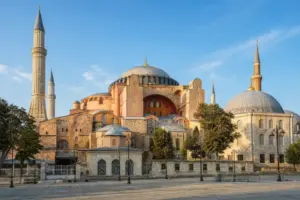 Hagia Sophia – about 500 m away (~8 min walk) · typical visit: 1–1.5 hours8 min on foot from Gülhane metro, Open daily 09:00–19:30
Main image: AI-generated illustration. It may not show the place exactly as it looks.
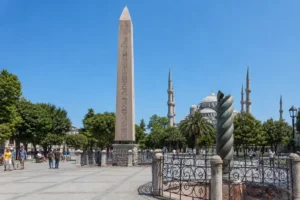 Byzantine Hippodrome – about 350 m away (~6 min walk) · typical visit: 1-2 hours5 min on foot from Gülhane metro, Open 24 hours
Main image: AI-generated illustration. It may not show the place exactly as it looks.
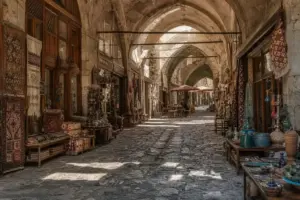 Arasta Bazaar – about 100 m away (~2 min walk) · typical visit: 1–2 hours1 min on foot from Gülhane metro, Open daily 09:00–19:00
Main image: AI-generated illustration. It may not show the place exactly as it looks.
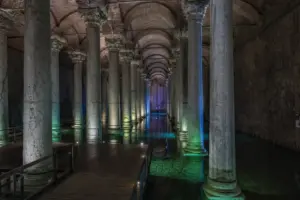 Basilica Cistern – about 250 m away (~4 min walk) · typical visit: 1 hour4 min on foot from Gülhane metro, Open daily 09:00–18:30
Main image: AI-generated illustration. It may not show the place exactly as it looks.
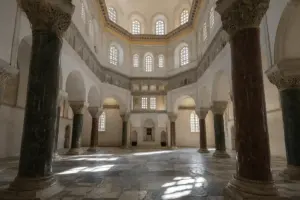 Little Hagia Sophia – about 250 m away (~4 min walk) · typical visit: 45 minutes – 1 hour4 min on foot from Gülhane metro, Open daily 08:00–20:00
Main image: AI-generated illustration. It may not show the place exactly as it looks.
Metro stations near Great Palace Mosaics Museum
 Gülhane – about 50 m away (~1 min walk)Open daily 06:00–00:00
Main image: AI-generated illustration. It may not show the place exactly as it looks.
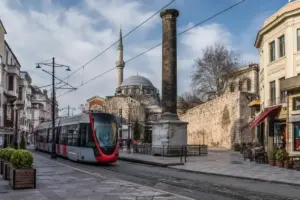 Çemberlitaşabout 800 m away (~13 min walk)
Main image: AI-generated illustration. It may not show the place exactly as it looks.
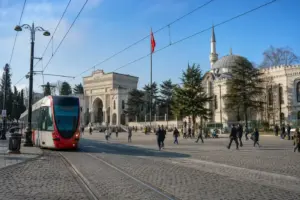 Beyazıt-Kapalıçarşı – about 1.1 km away (~19 min walk)Open daily 06:00–00:00
Main image: AI-generated illustration. It may not show the place exactly as it looks.
Restaurants and cafes near Great Palace Mosaics Museum
 Giritli Restaurant – about 200 m away (~3 min walk)3 min on foot from Gülhane metro, Open daily 12:00–00:00
Main image: AI-generated illustration. It may not show the place exactly as it looks.
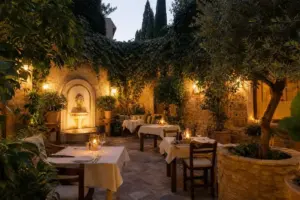 Hidden Garden – about 300 m away (~5 min walk)4 min on foot from Gülhane metro, Open daily 11:00–00:00
Main image: AI-generated illustration. It may not show the place exactly as it looks.
 Tarihi Sultanahmet Koftecisi – about 450 m away (~8 min walk)7 min on foot from Gülhane metro, Open daily 11:00–23:00
Main image: AI-generated illustration. It may not show the place exactly as it looks.
 Balık Ekmek at Eminönü – about 500 m away (~8 min walk)7 min on foot from Gülhane metro, Open daily 09:00–22:30
Main image: AI-generated illustration. It may not show the place exactly as it looks.
Nightlife near Great Palace Mosaics Museum
 Seven Hills – about 300 m away (~5 min walk)4 min on foot from Gülhane metro, Open daily 08:00–23:00
Main image: AI-generated illustration. It may not show the place exactly as it looks.
 Roxy – about 500 m away (~8 min walk)7 min on foot from Gülhane metro
Main image: AI-generated illustration. It may not show the place exactly as it looks.
Train stations and river piers near Great Palace Mosaics Museum
 Eminönü Ferry Terminalabout 1.6 km away (~26 min walk)
Main image: AI-generated illustration. It may not show the place exactly as it looks.
 Karaköy Ferry Terminalabout 2.0 km away (~32 min walk)
Main image: AI-generated illustration. It may not show the place exactly as it looks.
Events and traditions near Great Palace Mosaics Museum
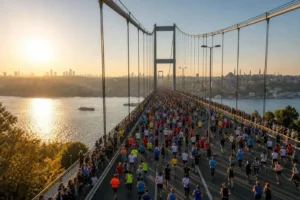 Istanbul Marathonabout 250 m away (~4 min walk)
Main image: AI-generated illustration. It may not show the place exactly as it looks.
Related guides
 Best Underground Cisterns in Istanbul: Three Sites Compared
Main image: AI-generated illustration. It may not show the place exactly as it looks.
 The Red School in Fener: A Castle above the Golden Horn
Main image: AI-generated illustration. It may not show the place exactly as it looks.
 Orient Occident Hotel: Green and Brass in Sirkeci
Main image: AI-generated illustration. It may not show the place exactly as it looks.
 AJWA Sultanahmet: Ottoman Luxury Near the Blue Mosque
Main image: AI-generated illustration. It may not show the place exactly as it looks.
 My Terrace: Rooftop Breakfast by Little Hagia Sophia
Main image: AI-generated illustration. It may not show the place exactly as it looks.
Browse more: More in Fatih · All Museums · All Sightseeing
FAQ: Great Palace Mosaics Museum
Is this museum included in the Istanbul Museum Pass?
Yes. Entry is free with the Istanbul Museum Pass or Museum Pass Türkiye. If visiting more than three museums, the pass usually pays for itself and saves time at ticket queues.
How long does it take to visit?
Most visitors spend 30–45 minutes to 1 hour. A rushed visit takes 20 minutes; a detailed study can extend to 90 minutes if you examine mosaics closely and read all panels.
Is this different from Hagia Sophia's mosaics?
Yes. This museum displays secular, naturalistic floor mosaics from a courtyard (450–550 AD). Hagia Sophia has religious ceiling and dome mosaics from a later period (mostly 9th–13th centuries). The styles, subjects, and contexts are entirely different.
Can I take photos?
Photography without flash, tripods, or drones is permitted. Flash can cause glare. Use your phone's camera or professional equipment on 'natural light' settings. Commercial publication may require permission—check with the museum.
Is the museum accessible for wheelchairs?
No. The museum is accessed via stairs descending into an underground space. Wheelchair accessibility is not currently available. Contact the museum directly at +90 (212) 518 12 05 to discuss specific needs.
What is inside the Arasta Bazaar?
The Arasta is a functioning Ottoman-era market with small shops selling Turkish souvenirs, crafts, textiles, and snacks. The museum entrance is within this bazaar. You pass through the market to reach the museum door.
Is it crowded like the Blue Mosque?
No. This museum is one of Istanbul's least crowded cultural sites. Most visitors are tourists specifically seeking Byzantine history. Weekdays are nearly empty.
Do I need a guide?
Not required, but helpful. Audio guides are available for rent (when the museum reopens). English-language explanatory panels are on-site. For deep historical context, a private guide enriches the experience.
Istanbul Vibes is a one-person project. A coffee keeps it going
Hotels near Great Palace Mosaics Museum
- Darussaade Istambul Hotel (50 m) Check prices (affiliate link, opens in a new tab)
- best point hotel old sity (50 m) Check prices (affiliate link, opens in a new tab)
- Anzac Woodenhouse (50 m) Check prices (affiliate link, opens in a new tab)
- best2 (50 m) Check prices (affiliate link, opens in a new tab)
Affiliate link (opens the booking site): we may earn a commission at no extra cost to you.
Restaurants near Great Palace Mosaics Museum
- West Town Cafe & Restaurant (150 m) Google Maps
- Akbıyık Balık Evi (150 m) Google Maps
- The Cozy Garden (150 m) Google Maps
- Suleyman (150 m) Google Maps
Distances are straight-line, from OpenStreetMap data.

Take this guide with you
Get a free PDF of this guide to print or read offline: key facts, tips and a map link on a few clean pages.
Report an issue on this page
How we research and update our guides
About this guide: AI assistance and accuracy
This guide is created with the help of AI and is based on official sources where available. Mistakes can still happen. Opening hours, prices, rules and other details are given to the best of our knowledge as of the date shown and can change without notice. It offers general recommendations only, not professional, legal or travel advice. Please confirm important details with the official source before you travel; you are responsible for your own plans and decisions.
* Affiliate link: as an Amazon Associate we earn from qualifying purchases at no extra cost to you.
