
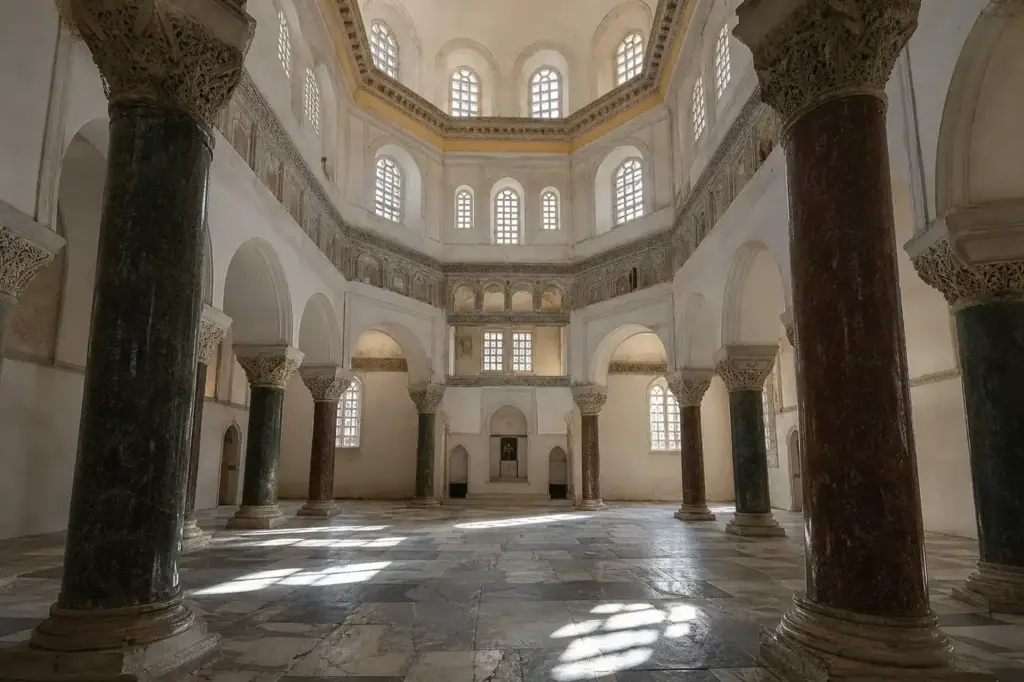
Little Hagia Sophia, a 10-minute walk southwest from the Blue Mosque, was built in the 530s as the Church of Saints Sergius and Bacchus by the Byzantine Emperor Justinian and his wife Theodora. Originally built as the Church of Saints Sergius and Bacchus in the early 6th century, it was later converted into a mosque following the Ottoman conquest, earning its present-day title, the Little Hagia Sophia, a name stemming from its striking architectural resemblance to the larger Hagia Sophia.
Unlike its famous namesake, this intimate former church remains calm and relatively uncrowded. There is no admission fee (though donations are accepted), and you can simply walk in to see the elegant Byzantine geometry and marble columns that have survived thirteen centuries. Extensive restoration work—interior, exterior and structural—was completed in November 2007.
Quick Facts
| Turkish name | Küçük Ayasofya Camii |
|---|---|
| Built / opened | 536 |
| Address | Küçük Ayasofya Mahallesi, Küçük Ayasofya Camii Sokağı No. 20, 34122 Fatih, Istanbul Google MapsApple MapsYandex Maps |
| District | Fatih |
| Metro | Sultanahmet (T1 Tram, 5–8 min walk southwest) Sirkeci (M1 Metro / Marmaray, 10 min walk south) |
| Admission | Free (donations welcome) |
| Best time to visit | Early morning (08:00–10:00) offers the quietest, coolest conditions and softest light for seeing the marble details. Weekday mornings are less crowded than weekends. Spring (April–May) and autumn (September–October) provide comfortable temperatures without summer heat. Avoid midday in summer when the city is hottest and mid-afternoon when tour groups often pass through. Check prayer times before visiting; the building closes temporarily for each prayer. |
What Is (and Isn't) Part of a Visit to Little Hagia Sophia?
| Part | Status | Notes |
|---|---|---|
| Interior of the church/mosque | Included in the standard ticket | Ground floor and second-floor gallery accessible during opening hours (outside prayer times). |
| Marble columns and capitals | Included in the standard ticket | Byzantine-era columns with carved capitals and Greek inscriptions are visible on the ground floor. |
| Octagonal dome | Included in the standard ticket | Can be viewed from the ground floor and second gallery. |
| Hagia Sophia (the larger structure) | Separate ticket or institution | A different building uphill requiring a separate paid ticket; often confused with Little Hagia Sophia. |
| Blue Mosque (Sultanahmet Camii) | Separate ticket or institution | Located about 10 minutes' walk to the north; a separate visit with its own access rules. |
| Basilica Cistern | Separate ticket or institution | Underground water structure nearby with a paid entrance ticket. |
| Boukoleon Palace ruins | Outside / not part of it | Byzantine palace ruins south of Little Hagia Sophia near the sea; not part of the mosque visit. |
Why Visit Little Hagia Sophia?
The remarkable geometric construction consists of a central octagonal dome, which is placed into an irregular quadrangle with inner corner niches. The irregular octagonal floor plan features beautiful red- and green-marble breccia columns topped by intricately-carved Byzantine marble capitals, and above the capitals, a band of marble with Greek letters in relief offers evidence of the building’s first use.
The building provides an opportunity to admire Byzantine architecture without the crowds, and offers views of gorgeous marble columns on the ground floor and the second-floor gallery. Commissioned by Emperor Justinian I and Empress Theodora between 527 and 536 AD, it was originally intended as a church dedicated to Saints Sergius and Bacchus, two prominent Roman soldiers and Christian martyrs.
Highlights of Little Hagia Sophia
Octagonal Dome and Byzantine Geometry
The central octagonal dome is placed into an irregular quadrangle with inner corner niches, creating a distinctive geometric design. The structure was commissioned between 527 and 536 AD during the reign of Emperor Justinian I. Look up to see how the dome light filters through windows onto the marble surfaces, and note the geometric precision of the octagonal floor plan—a Byzantine engineering signature that influenced later Ottoman architecture.
Tip: The dome's proportions are best appreciated from the centre of the ground floor; step back from the columns to see the full spatial effect.
Byzantine Marble Columns and Capitals
Beautiful red- and green-marble breccia columns are topped by intricately-carved Byzantine marble capitals. Above the capitals, a band of marble with Greek letters in relief offers evidence of the building's first use as a church. These columns are among the finest surviving examples of 6th-century craftsmanship and show how Byzantine builders combined structural function with decorative richness.
Tip: The marble is fragile and darkened by age; close inspection reveals the carved details better in morning light from the east-facing windows.
Greek Inscription Band
A band of marble with Greek letters in relief appears above the Byzantine marble capitals, preserving the original dedication from the 6th-century church. These carved letters, though weathered, are an irreplaceable link to Justinian's court. The inscription documents the building's religious purpose at a moment when the Eastern Roman Empire stood at its height of power and culture.
Tip: Use a camera's zoom or zoom function to read the Greek letters from a distance; direct handling could damage this irreplaceable surface.
Architectural Influence on Hagia Sophia
Of the same architectural period and with a broad dome, it looked like a study for Justinian's great Church of Hagia Sophia, hence its name. This structure is often seen as the forerunner to the grand Hagia Sophia, which Justinian completed later, serving as a testing ground for design elements. Architects likely experimented with dome engineering and spatial planning here before tackling the larger structure across the city.
Tip: After visiting, walk uphill to see Hagia Sophia itself (a separate paid ticket required); the architectural comparison becomes clear when you see how similar ideas were scaled up and refined.
Ground-Floor Gallery and Second-Story Balcony
The building features gorgeous marble columns on the ground floor and a second-floor gallery. The gallery was originally used for female worshippers in the Byzantine period and later adapted for Ottoman use. The upper level provides a different perspective on the dome and allows visitors to see into the structure's spatial logic from a height.
Tip: The stairs to the gallery may be steep and narrow; wear non-slip shoes and go slowly to take in the views as you climb.
Whitewashed Interior and Ottoman Adaptations
Küçük Ayasofya underwent extensive repairs and restoration and has only reopened in the last seven or eight years, with whitewashed walls and warm blue intricate paintwork. Islamic features, such as minarets and a mihrab, were added to the structure when the Ottomans converted it to a mosque in the 16th century. The simple whitewash conceals the original Byzantine decorative schemes but gives the space a peaceful, uncluttered feeling.
Tip: The whitewash actually protects the underlying Byzantine masonry; the simplicity of the interior enhances the architectural geometry rather than distracting from it.
Atmosphere
Inside, the air is cool and quiet. Sunlight filters through high windows onto pale marble, creating soft geometric patterns on the floor. The octagonal dome draws the eye upward, and the space feels intimate despite the architectural ambition—a prayer hall rather than a grand cathedral. Few tourists venture here, so you may find yourself nearly alone, hearing only the soft shuffle of footsteps and occasional pigeons cooing outside.
The smell of dust and old stone is faint but present. In summer mornings it is coolest; afternoons bring stronger light that highlights the carved marble details. During prayer times the space becomes active and public—worshippers enter, prayers sound, then it empties again. The atmosphere respects both its past as a church and its present as a mosque.
History of Little Hagia Sophia
The Little Hagia Sophia was commissioned by Emperor Justinian I and his wife Empress Theodora between 527 and 536 AD. By establishing this church, Justinian demonstrated his reverence for Christianity and his ambition to leave an architectural legacy.
Being of the same architectural period, and with a broad dome, it looked like a study for Justinian’s great Church of Hagia Sophia, hence its name. Construction on the Little Hagia Sophia began in 527 AD and was completed in 536, predating the Hagia Sophia, which was built from 532 to 537, by just a few years. Though it is sometimes called a prototype or trial run for the larger structure, the two buildings differ significantly in their engineering and scale—they simply share a common architectural vision and design team.
It was most likely once adorned with magnificent gold mosaics. Like other Byzantine churches, it originally displayed the rich decorative programs typical of Justinian’s artistic patronage, though these were lost or covered over the centuries.
Küçük Ayasofya was converted into a mosque during the reign of Beyazid II in 1497 by Hüseyin Ağa, the Chief Eunuch of Topkapı Palace. Islamic features, such as minarets and a mihrab, were added to the structure. The conversion marked the building’s shift from Christian to Islamic worship following the Ottoman conquest of Constantinople in 1453.
The building suffered major damage in the earthquakes of 1648 and 1763, underwent comprehensive repairs in 1831, and was damaged again in the 19th century by the railway line passing nearby. After extensive restoration work between 2002 and 2006, the Little Hagia Sophia was reopened to the public as a mosque. Modern conservation efforts have preserved its medieval masonry and allowed visitors to experience the space much as it stood in the 6th century.
Legends and Myths about Little Hagia Sophia
Saints Sergius and Bacchus and the Imperial Dream
Legend – historically unreliable. Sergius and Bacchus were of Syrian origin and had converted to Christianity, but died in the religious war. According to legend, the church was built because of the Emperor's debt of gratitude to the two saints. According to later legend, during the reign of Justin I, his nephew Justinian had been accused of plotting against the throne. Some versions of the legend claim that Sergius and Bacchus appeared to Justinian in a dream while he was imprisoned in the palace dungeon, protecting him and eventually leading to his vindication and rise to power. The church was built as thanks for their intercession.
The Dome That Could Have Fallen
Legend – historically unreliable. Byzantine historians describe the octagonal dome as a daring experiment in weight distribution that nearly collapsed during construction. Workers had to stop work multiple times, and legend claims that Justinian himself came to see the unfinished building to reassure the engineers of his confidence. The dome was eventually stabilized and became one of the engineering marvels of its age. Later versions of the story suggest that divine intervention—the saints' favor—kept the dome standing.
Tickets and Booking for Little Hagia Sophia
| Ticket | Price | Includes |
|---|---|---|
| Entry to mosque | Free | Access to the interior, ground floor, and second-floor gallery during opening hours outside prayer times. Donations are welcome but not required. |
₺ budget · ₺₺ moderate · ₺₺₺ upscale · ₺₺₺₺ splurge. Price levels are estimates compared with typical prices for visitors.
Little Hagia Sophia is free to enter and does not require advance booking. Simply arrive during opening hours outside prayer times and walk in. As a working mosque, visiting hours are 08:00–20:00 daily, but the building closes during the five daily Islamic prayer times. Morning hours tend to be quieter than afternoons.
Photography is permitted but follow mosque etiquette: remove shoes or wear non-slip socks, dress modestly (shoulders and knees covered, women should cover hair with a scarf), and do not stand in front of worshippers during prayer. If you arrive during prayer times, wait outside in the surrounding streets until prayers conclude.
For the most current visiting information and any updates, check the Istanbul Culture and Tourism Authority or ask at your hotel.
Suggested itineraries Little Hagia Sophia
45 minutes
Enter through the main door on Küçük Ayasofya Camii Sokağı. Spend 10 minutes orienting yourself to the octagonal geometry from the centre of the ground floor. Study the Byzantine marble columns and capitals (10 minutes), then climb to the second-floor gallery for an elevated view of the dome (10 minutes). Exit and sit in the courtyard or on nearby steps to absorb the atmosphere (10 minutes).
1–1.5 hours
Visit the interior as above (45 minutes). Then explore the narrow streets immediately surrounding the mosque—Demirci Reşit Sokak and the pedestrian lanes to the south—to see the neighbourhood's old wooden houses, small cafés, and artisan shops (30–40 minutes). Return to the mosque for a final look at the dome before moving on.
Half day (2–3 hours)
Start at Little Hagia Sophia in early morning (1 hour). Walk uphill to Hagia Sophia (15 min walk; requires separate paid ticket). Spend 1–1.5 hours there. Walk south to the Basilica Cistern (10 min walk; separate paid ticket; 45 min inside). Return downhill to Sultanahmet Square and the Blue Mosque if time permits. This route covers three major Byzantine/Ottoman sites in sequence.
How to Get to Little Hagia Sophia
By tram (T1): Exit at Sultanahmet station. Walk southwest downhill through the narrow streets toward the sea for 5–8 minutes, following signs for Demirci Reşit Sokak or asking locals for “Küçük Ayasofya Camii.” The mosque is at the end of Küçük Ayasofya Camii Sokağı.
By metro (M1) or Marmaray: Exit at Sirkeci station. Walk south toward the sea for about 10 minutes, descending steadily. Follow Demirci Reşit Sokak downhill toward the historic neighbourhoods.
On foot: If coming from the Blue Mosque or Hagia Sophia, Little Hagia Sophia is about 10 minutes southwest on foot. Head downhill toward the shoreline; the mosque sits in a neighbourhood of old wooden houses near Kennedy Avenue (the coastal road). Parking is limited nearby; walking or public transport are recommended.
Accessibility
The mosque is located at street level, and the main entrance is a single step up from the street. No ramp is present, so wheelchair access is not feasible for the interior. The interior floor is uneven stone; stroller access is not practical. The staircase to the second-floor gallery is narrow and steep with no handrails. There are no lifts or accessible toilet facilities. Visitors with limited mobility may find the interior challenging; the ground floor only is possible for those unable to climb stairs.
Food Nearby
The streets around Little Hagia Sophia (especially Demirci Reşit Sokak and the narrow lanes to the south) have several small local cafés and tea gardens catering to residents rather than tourists. Surrounding it is a labyrinth of ancient wooden houses, many in a state of disrepair, narrow climbing alleyways and artisan shops. These cafés typically serve Turkish tea, coffee, and simple pastries. Restaurants with international menus are limited in this quiet neighbourhood; the main dining and café zone is uphill toward the Blue Mosque and Sultanahmet Square (10–15 min walk north), where numerous restaurants and casual eateries line the streets.
What to Bring
Wear comfortable non-slip shoes or carry socks—shoes must be removed before entering the mosque interior. Bring a light headscarf (women) to cover hair respectfully. In summer, bring a light cardigan or shawl to cover shoulders and arms if your main clothes are sleeveless. The interior can be cool even in warm seasons. Bring water, as the area has few shops. A camera is welcome for personal photography, but be respectful during prayer times. Bags and large backpacks are generally acceptable but security may ask you to open them.
Best Views and Photo Spots of Little Hagia Sophia
Centre of ground floor, looking up at the octagonal dome
The dome fills the frame directly above, with light from upper windows creating geometric shadows on the walls. The Byzantine marble columns frame the composition at the edges. This shot captures the building's spatial essence.
Best time: Midmorning (08:30–10:30) when sunlight from east-facing windows is soft and illuminates the upper walls without harsh contrast.
Close-up of a Byzantine marble column base and carved capital
Red and green marble veining becomes visible at close range, and the hand-carved details of the capital stand out. The Greek letters above are legible if shot from the right angle. This emphasizes the craftsmanship of the 6th century.
Best time: Morning light (08:00–11:00) is best for bringing out the marble's colour and carving details without glare.
Second-floor gallery, framed view of the dome from above
From the gallery, the dome's octagonal geometry becomes clear, and you can see the wooden beams and structural elements. The floor and lower columns create layers of depth. This perspective is unique to the elevated vantage point.
Best time: Early morning or late afternoon, when side light through high windows creates definition without washing out the stone's texture.
Outer courtyard or surrounding street (Küçük Ayasofya Camii Sokağı), showing the building's exterior
The mosque's simple exterior stonework and minaret are visible. Old wooden houses and narrow streets in the background show the historic neighbourhood setting. This captures the building in its urban context rather than in isolation.
Best time: Golden hour (early morning or late afternoon) softens the harsh walls and adds warmth to the stone and wooden buildings around it.
Photography Rules
Photography is permitted inside the mosque for personal use. Avoid using flash, which can be disruptive and damages the historic surfaces. Avoid photographing worshippers during prayer times. Wide-angle or standard lenses work best in the enclosed space. Tripods are not recommended due to space constraints and mosque etiquette. Drone photography outside the building requires permission from local authorities and is not practical in this dense urban neighbourhood.
Family Suitability
Little Hagia Sophia is suitable for children ages 5 and up who can walk and follow mosque etiquette (quiet, respectful behaviour). The scale is manageable for young children—no overwhelming crowds or excessive walking. The second-floor gallery may challenge toddlers due to steep stairs without handrails, so consider your child's mobility. Strollers are not practical on the uneven stone floor or narrow stairs. Older children (10+) are often fascinated by the geometry and history. The mosque is not airconditioned, so summer visits can be uncomfortable for small children unaccustomed to heat. Toilet facilities are limited; plan accordingly.
Istanbul Vibes Tips
- Arrive at opening time (08:00) before tour groups and tourists discover the place. At this hour, the space feels meditative and the light is softest for appreciating marble details and geometry.
- Don't expect elaborate decoration. The whitewashed walls and simple interior initially disappoint visitors expecting Byzantine mosaics. Shift your focus to the architecture and marble craftsmanship—the elegance lies in form and materials, not ornament.
- Check prayer times before you go (five daily prayers, longest closure at midday Friday). Arriving just after a prayer has ended means you enter a space being prepared for worship; arriving just before means you'll see worshippers. Either offers an authentic glimpse of the building's living role.
- The narrow street approach (Küçük Ayasofya Camii Sokağı) feels like entering an Old Istanbul backstreet, which it is. This setting—wooden houses, tea gardens, quiet streets—is as much the experience as the building itself. Allow time to wander.
- If visiting Hagia Sophia on the same day, go to Little Hagia Sophia first in early morning, then walk uphill to the larger mosque later. This avoids the crowds and lets you compare the two buildings' designs while they're fresh in mind. Hagia Sophia is much busier and requires a paid ticket.
- Photography during prayer times is disrespectful and may be asked to stop. Even when prayer is not happening, some visitors pray alone or in small groups; stay quiet and give them space. Observe before raising your camera.
Explore Nearby Little Hagia Sophia
Sights near Little Hagia Sophia
 Hagia Sophia – about 500 m away (~8 min walk) · typical visit: 1–1.5 hours8 min on foot from Gülhane metro, Open daily 09:00–19:30
Main image: AI-generated illustration. It may not show the place exactly as it looks.
 Blue Mosque – about 50 m away (~1 min walk) · typical visit: 45–75 minutes3 min on foot from Gülhane metro
Main image: AI-generated illustration. It may not show the place exactly as it looks.
 Basilica Cistern – about 150 m away (~2 min walk) · typical visit: 1 hour4 min on foot from Gülhane metro, Open daily 09:00–18:30
Main image: AI-generated illustration. It may not show the place exactly as it looks.
 Hippodrome – about 150 m away (~2 min walk) · typical visit: 1–2 hours5 min on foot from Gülhane metro, Open 24 hours
Main image: AI-generated illustration. It may not show the place exactly as it looks.
 Topkapi Palace – about 950 m away (~15 min walk) · typical visit: 3–4 hours without Harem; 4–5 hours with Harem15 min on foot from Gülhane metro, Open 09:00–18:30, closed Tue
Main image: AI-generated illustration. It may not show the place exactly as it looks.
 Sokollu Mehmet Pasha Mosque – about 50 m away (~1 min walk) · typical visit: 20–30 minutes5 min on foot from Gülhane metro
Main image: AI-generated illustration. It may not show the place exactly as it looks.
Metro stations near Little Hagia Sophia
 Gülhane – about 200 m away (~4 min walk)Open daily 06:00–00:00
Main image: AI-generated illustration. It may not show the place exactly as it looks.
 Çemberlitaşabout 550 m away (~9 min walk)
Main image: AI-generated illustration. It may not show the place exactly as it looks.
 Beyazıt-Kapalıçarşı – about 900 m away (~14 min walk)Open daily 06:00–00:00
Main image: AI-generated illustration. It may not show the place exactly as it looks.
Restaurants and cafes near Little Hagia Sophia
 Hidden Garden – about 50 m away (~1 min walk)4 min on foot from Gülhane metro, Open daily 11:00–00:00
Main image: AI-generated illustration. It may not show the place exactly as it looks.
 Tarihi Sultanahmet Koftecisi – about 350 m away (~5 min walk)7 min on foot from Gülhane metro, Open daily 11:00–23:00
Main image: AI-generated illustration. It may not show the place exactly as it looks.
 Balık Ekmek at Eminönü – about 400 m away (~6 min walk)7 min on foot from Gülhane metro, Open daily 09:00–22:30
Main image: AI-generated illustration. It may not show the place exactly as it looks.
 Giritli Restaurant – about 450 m away (~7 min walk)3 min on foot from Gülhane metro, Open daily 12:00–00:00
Main image: AI-generated illustration. It may not show the place exactly as it looks.
Nightlife near Little Hagia Sophia
 Seven Hills – about 350 m away (~5 min walk)4 min on foot from Gülhane metro, Open daily 08:00–23:00
Main image: AI-generated illustration. It may not show the place exactly as it looks.
 Roxy – about 400 m away (~6 min walk)7 min on foot from Gülhane metro
Main image: AI-generated illustration. It may not show the place exactly as it looks.
Train stations and river piers near Little Hagia Sophia
 Eminönü Ferry Terminalabout 1.4 km away (~23 min walk)
Main image: AI-generated illustration. It may not show the place exactly as it looks.
 Karaköy Ferry Terminalabout 1.8 km away (~30 min walk)
Main image: AI-generated illustration. It may not show the place exactly as it looks.
Events and traditions near Little Hagia Sophia
 Istanbul Marathonabout 50 m away (~1 min walk)
Main image: AI-generated illustration. It may not show the place exactly as it looks.
Related guides
 My Terrace: Rooftop Breakfast by Little Hagia Sophia
Main image: AI-generated illustration. It may not show the place exactly as it looks.
 Seven Hills Restaurant: Rooftop Breakfast in Sultanahmet
Main image: AI-generated illustration. It may not show the place exactly as it looks.
 Balıkçı Sabahattin: Fish in a Sultanahmet Mansion
Main image: AI-generated illustration. It may not show the place exactly as it looks.
 Turkish Delight: How to Make Lokum at Home
Main image: AI-generated illustration. It may not show the place exactly as it looks.
 Hagia Irene: Istanbul’s Oldest Church and Minimalist Byzantine Masterpiece10 min on foot from Gülhane metro, Open 09:00–18:00, closed Tue
Main image: AI-generated illustration. It may not show the place exactly as it looks.
Browse more: More in Fatih · All Churches · All Sightseeing
FAQ: Little Hagia Sophia
Is there an admission fee?
No. Little Hagia Sophia is free to enter. Donations are welcome but never required. This is a working mosque, not a museum.
Is Little Hagia Sophia the same as Hagia Sophia?
No, they are two separate buildings. The larger Hagia Sophia is uphill (about 10 min walk) and requires a paid ticket. Little Hagia Sophia is smaller, older (built 527–536 vs. 532–537), and free to enter. Both date to Emperor Justinian's reign.
When is the best time to visit?
Early morning (08:00–10:00) is quietest. Avoid midday in summer when it's hot and busiest. Friday midday should be avoided entirely due to congregational prayers. Weekday mornings in spring or autumn offer the best combination of quiet, comfortable weather, and good light.
Can I visit during prayer times?
The mosque closes to visitors during the five daily Islamic prayer times, each lasting 20–45 minutes. Friday prayer (roughly 12:00–14:00) is the longest closure. If you arrive during prayers, wait outside until prayers end. Check prayer times before visiting.
What should I wear?
Wear modest clothing: shoulders and knees covered. Remove your shoes or wear clean socks before entering. Women should bring or use a headscarf to cover their hair respectfully. Men should remove hats. This is a place of worship, not a sightseeing attraction.
Do I need a guide?
A guide is not necessary. The interior is small and easy to explore independently. Audio guides are not available. If you want historical context, read about Justinian I and Byzantine architecture beforehand, or hire a private guide from your hotel.
How long does a visit take?
Plan 45 minutes to 1 hour. This allows time to examine the marble columns, look up at the dome, climb to the gallery, and sit quietly. You can spend longer if exploring the surrounding neighbourhood.
Can I take photographs inside?
Yes, photography is permitted for personal use. Do not use flash, which damages historic surfaces and is disruptive. Avoid photographing worshippers. Respect the space as a functioning mosque first, tourist site second.
Istanbul Vibes is a one-person project. A coffee keeps it going
Hotels near Little Hagia Sophia
- Blue Ottoman Hotel (50 m) Check prices (affiliate link, opens in a new tab)
- Hotel Sultan Hill (50 m) Check prices (affiliate link, opens in a new tab)
- Yunus Emre Hotel & Hostel (100 m) Check prices (affiliate link, opens in a new tab)
- Optimist hotel (150 m) Check prices (affiliate link, opens in a new tab)
Affiliate link (opens the booking site): we may earn a commission at no extra cost to you.
Restaurants near Little Hagia Sophia
- Mom's Garden (100 m) Google Maps
- Serbethane Cafe & Restaurant (100 m) Google Maps
- Sultan Köşesi (100 m) Google Maps
- Tamara (150 m) Google Maps
Distances are straight-line, from OpenStreetMap data.

Take this guide with you
Get a free PDF of this guide to print or read offline: key facts, tips and a map link on a few clean pages.
Report an issue on this page
How we research and update our guides
About this guide: AI assistance and accuracy
This guide is created with the help of AI and is based on official sources where available. Mistakes can still happen. Opening hours, prices, rules and other details are given to the best of our knowledge as of the date shown and can change without notice. It offers general recommendations only, not professional, legal or travel advice. Please confirm important details with the official source before you travel; you are responsible for your own plans and decisions.
* Affiliate link: as an Amazon Associate we earn from qualifying purchases at no extra cost to you.
