
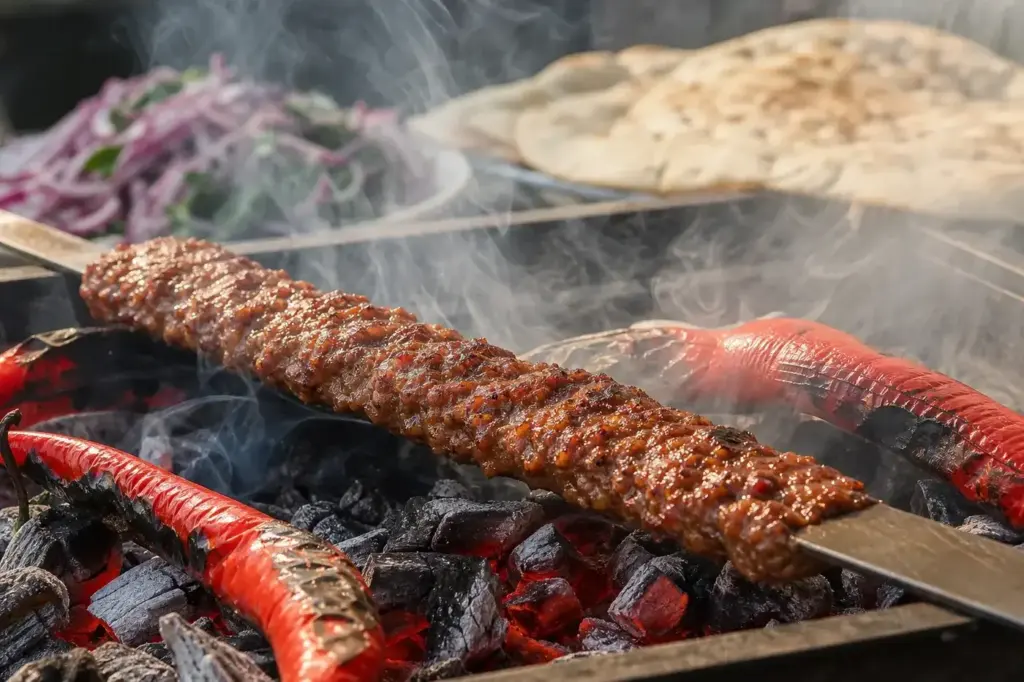
Adana kebab is not just something you order at a restaurant—it’s one of the defining dishes of Turkish cuisine, and if you’re in Istanbul, learning how to cook it at home is a worthwhile kitchen project. This guide shows you the authentic way to make Adana kebab, from mixing the meat to achieving that charred, smoky finish that makes it so memorable.
The traditional recipe is surprisingly simple: hand-minced lamb, red pepper, salt, and heat are the only essentials. But the technique matters far more than a long ingredient list. You’ll learn the right way to prepare the meat, shape it onto the skewer, and grill it until the fat renders and the surface crisps. The recommended approach here keeps to the essentials and respects the dish’s regional identity.
Quick answer: Mix hand-minced or coarsely ground lamb with red pepper, onion, salt and spices; knead until sticky; shape onto flat skewers; grill over high charcoal heat, turning frequently. Total time: about 30 minutes, plus chilling. Cost: budget to moderate per serving.
At a Glance
| Type | Dishes |
|---|---|
| Local name | Адана кебаб |
| Origin | Named after the city of Adana in southern Turkey, where this dish originated. It emerged in the second half of the 19th century in Adana's historical bazaar, Kazancılar Bazaar. It is believed that this version was born from a Turkish-Arabic culinary fusion. The dish received protected designation of origin status in 2005, with Adana recognized as its mother city. |
| Servings | 2–4 servings |
| Total time | 30–40 minutes plus 30 minutes refrigeration |
| Difficulty | Medium |
History and Story of Adana Kebab
Adana kebab emerged in the second half of the 19th century in Adana’s historical bazaar. The dish is believed to have been influenced by diverse culinary traditions, including Arabic, Mediterranean, and Turkish flavors. In 2005, after legal proceedings, it received protected designation of origin status. According to Turkish patent law, authentic Adana kebab is now made only by certified vendors in Adana who have passed inspection by the Adana Chamber of Commerce. Today the dish is eaten throughout Turkey and the eastern Mediterranean, but Istanbul’s street food vendors and restaurants offer their own versions, often adapted to local taste preferences.
Ingredients
- 500 g ground lamb (or beef, or a mix), with 20% fat minimum
- 1 large red bell pepper, finely chopped
- ½ small onion, grated
- 2 g salt
- 1 g red pepper flakes or Aleppo pepper
- 1 g ground cumin
- ½ g smoked paprika
- 1 g sumac (optional)
- Flat metal skewers
How Adana Kebab Is Made
Step 1: Prepare the pepper
Finely chop the red bell pepper. Place it in a sieve or clean kitchen towel and squeeze firmly to remove as much liquid as possible. This step prevents the meat mixture from becoming soggy during cooking.
Tip: Drained pepper juice can be reserved as a basting liquid for the cooked kebab.
Step 2: Mix the meat and seasonings
In a large bowl, combine the ground lamb, drained pepper, grated onion, salt, red pepper flakes, cumin, paprika and sumac (if using). Mix thoroughly with your hands, pressing and folding the mixture until all ingredients are evenly distributed.
Tip: If your meat is very lean (under 20% fat), add a small amount of melted butter to help keep the kebab moist during grilling.
Step 3: Knead until tacky
Continue working the mixture with your hands for 2–3 minutes. The goal is for the meat to become sticky and hold together firmly. It should feel slightly tacky to your fingers, not crumbly. This binding is essential for the kebab to stay intact on the skewer.
Tip: A coarse double grind of meat works better at home than a fine grind, which turns to paste and loses texture. Hand-mincing with a knife is ideal but not essential for home cooking.
Step 4: Refrigerate
Cover the bowl and refrigerate for at least 30 minutes, preferably up to 1 hour. This resting period helps the mixture firm up and allows the flavors to meld.
Tip: You can prepare the mixture up to 24 hours ahead and store it covered in the refrigerator.
Step 5: Shape onto skewers
Wet your hands lightly with cold water. Divide the meat into 4 equal portions (for 4 kebabs). Take one portion and form it into a ball, then press it onto the center of a flat metal skewer. Using both hands, spread and compress the meat along the length of the skewer to form a thin, even layer with no gaps or air pockets.
Tip: Wet your hands periodically to prevent sticking. The traditional indented ridges along the kebab's length can be created by pressing with your thumb and forefinger every 2–3 centimeters; these are decorative but also create more surface area for even cooking.
Step 6: Prepare the grill
Heat a charcoal grill until the coals glow and are covered with a light ash. You need strong, even heat but not active flames. Alternatively, heat a cast-iron grill pan to high on the stovetop, or use a broiler oven set to high.
Tip: Charcoal grilling delivers the authentic smoky flavor, but the kebab can be cooked indoors using a grill pan or under a broiler.
Step 7: Grill the kebab
Place the skewers directly over the heat. Cook for 5–10 minutes total, turning every 1–2 minutes to cook evenly on all sides. The meat should be browned and slightly charred at the edges, with fat dripping and rendering as it cooks. The kebab is done when the meat feels slightly firm and has a golden-brown crust.
Tip: Turn frequently to prevent burning and to manage flare-ups. If fat drips and flames spike, move the skewer away for a moment. The meat should sizzle steadily but never blacken. The whole process is quick—overcooking makes it dry.
Variants
- Urfa kebab: a milder, non-spicy version made without red peppers or hot spices, favoring sumac and cumin for flavor
- Beyti kebab: ground lamb shaped around a skewer and wrapped in flatbread, topped with yogurt and tomato sauce
- Chicken Adana: the same technique applied to minced chicken thighs instead of lamb, producing a lighter kebab with similar spices
- Beef Adana: made with ground beef instead of lamb, often in a lamb-and-beef blend, a common variation in Istanbul and other cities
- Dürüm Adana: the kebab wrapped in lavash flatbread, turning it into a portable street food
Common Mistakes to Avoid
- Using meat that is too lean: Adana kebab needs at least 20% fat to stay juicy. Leaner meat becomes dry during grilling. If using very lean meat, mix in a small amount of melted butter or use fattier cuts.
- Over-mincing or using a fine grind: This breaks down the muscle fibers too much and creates a paste that loses texture. A coarse double grind or hand-mincing with a knife is far better. You should see small flecks of fat throughout, not a uniform paste.
- Skipping the pepper drainage step: Excess moisture in the pepper mixture causes the kebab to steam rather than grill properly, resulting in a pale, soggy texture instead of a charred exterior.
- Mixing the meat too little or too much: Too little mixing leaves ingredients uneven. Too much mixing overdevelops gluten and makes the kebab dense and tough. Knead just until the mixture becomes tacky and holds together, usually 2–3 minutes.
- Grilling over insufficient heat: Weak heat cooks the inside before crisping the outside, leaving a pale, dry kebab. The heat should be strong and the cooking fast—5 to 10 minutes total.
- Not keeping the mixture cold before shaping: Warm meat is harder to shape and more likely to fall apart on the skewer. Keep the bowl in the fridge and wet your hands with cold water.
How to Order and Eat It
Serve hot, immediately after grilling. Traditionally it comes wrapped in lavash flatbread or pita, with charred peppers and tomatoes, and an onion salad dressed with sumac. Tear off pieces of the kebab and eat with bread, wrapping it with the salad and vegetables. The meat should be juicy and smoky inside with a crisp, charred crust. The rendered fat and the rendered fat from the meat drippings soak into the bread, making it essential for eating. Squeeze fresh lemon juice over everything just before eating for brightness.
To order: Adana kebap lütfen [Adana kebap lütfen]
Where to Try Adana Kebab
 Zübeyir Ocakbaşı Turkish kebab and grilled meats
Main image: AI-generated illustration. It may not show the place exactly as it looks.
 Vegan Dükkan Lokanta Turkish (vegan)
Main image: AI-generated illustration. It may not show the place exactly as it looks.
 Mahsun Usta Turkish
Main image: AI-generated illustration. It may not show the place exactly as it looks.
Istanbul Vibes Tips
- In Istanbul, Adana kebab is often served as a street food at ocakbaşı (charcoal grill) restaurants, particularly in workers' neighborhoods and bazaars. The best versions are cooked to order over visible charcoal, not kept warm in a steam tray.
- The difference between Adana and Urfa kebab: both are minced kebabs, but Adana is distinctly spicy with red peppers and pepper flakes, while Urfa is milder and relies on sumac for sourness. In Istanbul restaurants, both are usually available on the same menu.
- Don't buy pre-packaged kebab meat if making this at home. Visit a butcher and ask for a coarse grind of lamb or a lamb-beef blend with good fat content. Freshly ground meat makes an enormous difference in texture and flavor.
- Shaping the kebab onto the skewer is the trickiest part for beginners. Practice with one test kebab first; keep your hands wet and cold, and don't press so hard that the meat tears. The motion should be smooth and firm, not rushed.
- If cooking in Istanbul during warmer months, seek out Adana kebab at street stands during lunch (noon to 2 p.m.), when the meat is freshest and the grills are at peak temperature. Late dinner service often means meat that has been held for hours.
- The onion salad that accompanies Adana kebab is not a garnish—it cuts through the richness of the lamb fat and provides essential acid and freshness. Always ask for it or make your own by mixing sliced red onion with sumac, lemon juice, salt and a little parsley.
Explore Nearby Adana Kebab
Related guides
 Spice Bazaar and Grand Bazaar Route: Two Markets, Six Centuries
Main image: AI-generated illustration. It may not show the place exactly as it looks.
 Istanbul Markets and Bazaars: A Three-Day Shopping and Exploration Itinerary
Main image: AI-generated illustration. It may not show the place exactly as it looks.
 Street Food Tour Route: A 3-Day Walking Guide to Istanbul’s Best Eats
Main image: AI-generated illustration. It may not show the place exactly as it looks.
 Best Street Food and Markets: Where Istanbul Eats
Main image: AI-generated illustration. It may not show the place exactly as it looks.
 Tantuni: How to Make Turkish Mersin Street Food at Home
Main image: AI-generated illustration. It may not show the place exactly as it looks.
Browse more: All Food & Drink · All Other
FAQ
What's the difference between Adana kebab and ground lamb kebab?
Not all minced meat kebabs are Adana kebab. The name 'Adana' specifically refers to kebab made in the style of Adana, Turkey—traditionally with lamb hand-minced with red pepper and minimal other seasonings, then grilled on a flat skewer. Generic ground lamb kebabs may skip the specific pepper, skip the hand-mincing, or use different spices. In Istanbul, the terms are often used loosely, but authentic Adana should taste primarily of lamb, red pepper, salt, and smoke.
Can I use beef instead of lamb?
Yes. Lamb is the most traditional meat, but a mix of beef and lamb is common, and all-beef versions are also made. Beef kebabs are popular in Istanbul, especially at street food vendors. The cooking time may vary slightly since beef is leaner; add extra fat if needed.
Do I need special Turkish spices to make Adana kebab?
Not strictly necessary at home. The traditional recipe in Adana uses mainly salt and red pepper. For an Istanbul version, most recipes add paprika, cumin, and sumac. Aleppo pepper and Urfa pepper add authentic Turkish depth but can be hard to find outside specialty shops. Red pepper flakes and smoked paprika are acceptable substitutes and are widely available.
Why does my kebab fall off the skewer while grilling?
The meat mixture is not tacky enough or not kneaded long enough. It must be sticky and hold together as one mass before shaping. Also, make sure there are no air gaps inside when you press it onto the skewer—air pockets cause the meat to separate. Finally, ensure the meat is cold before grilling and handle it minimally after shaping.
What heat should I use to grill?
Strong, consistent heat—not very hot flames, but glowing hot coals or a high grill setting. If you're using a grill pan indoors, set it to high. The cooking should be fast (5–10 minutes total) with frequent turning. Weak heat cooks it through but doesn't char the outside.
Is Adana kebab typically spicy?
In Istanbul, Adana kebabi refers to the spicy minced kebab version, while Urfa kebabi is the non-spicy version. Adana is moderately to notably spicy, with red pepper providing the heat. You can reduce the spice level by using less red pepper flakes or swapping in milder paprika, but it won't taste like traditional Adana.
How long can I store the meat mixture before cooking?
Up to 24 hours, refrigerated and covered. The mixture should be cold when you shape it onto the skewer. Do not freeze; freezing and thawing affects the meat's binding texture.
What side dishes go with Adana kebab?
Traditionally served with warm lavash flatbread, charred peppers and tomatoes, a sumac-and-onion salad, and possibly bulgur pilaf or yogurt. The flatbread and salad are essential—they balance the rich, smoky meat and add freshness and texture.
Istanbul Vibes is a one-person project. A coffee keeps it going

Take this guide with you
Get a free PDF of this guide to print or read offline: key facts, tips and a map link on a few clean pages.
Report an issue on this page
How we research and update our guides
About this guide: AI assistance and accuracy
This guide is created with the help of AI and is based on official sources where available. Mistakes can still happen. Opening hours, prices, rules and other details are given to the best of our knowledge as of the date shown and can change without notice. It offers general recommendations only, not professional, legal or travel advice. Please confirm important details with the official source before you travel; you are responsible for your own plans and decisions.
* Affiliate link: as an Amazon Associate we earn from qualifying purchases at no extra cost to you.
