
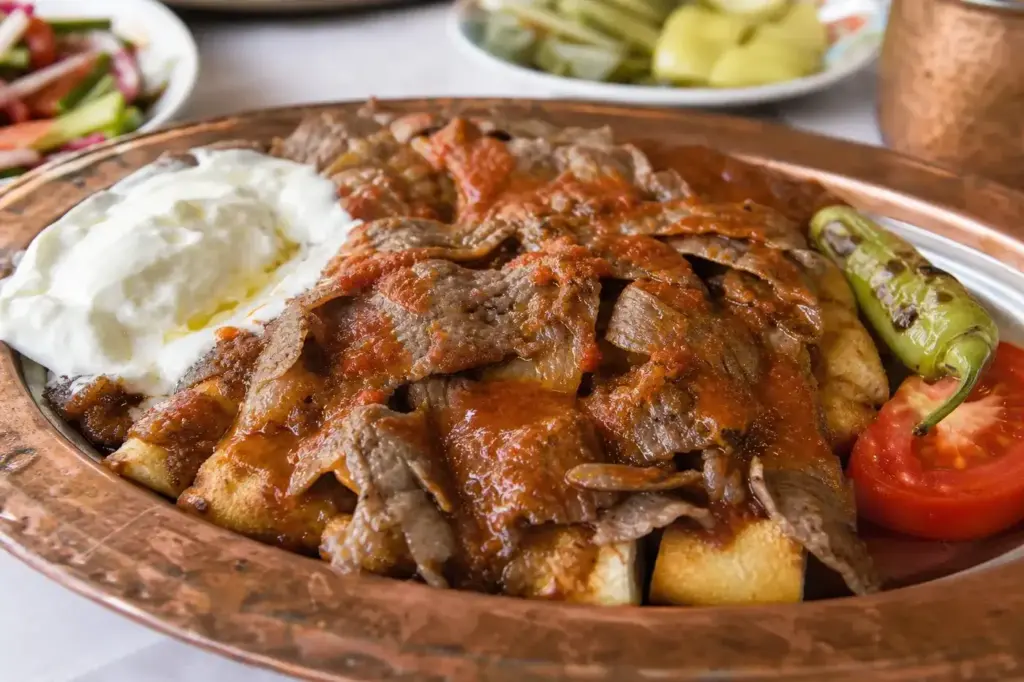
Iskender Kebab is one of Turkey’s most celebrated dishes, transforming döner meat into an elaborate plate meal that goes far beyond street food. This guide shows you how to make authentic Iskender Kebab at home, with verified ingredients and techniques used by restaurants across Istanbul and Bursa.
The recommended approach uses ground lamb or beef, which you’ll season, form into a log, freeze, and slice thinly. You’ll layer these slices over toasted bread with tomato sauce, then finish with melted butter and yogurt at the table—the theatrical final step that defines the dish.
Quick answer: Make Iskender Kebab by seasoning ground lamb or beef, freezing the mixture, slicing it thinly, pan-frying the slices, and layering them over bread with tomato sauce, butter, and yogurt. Total time: 50–60 minutes plus overnight refrigeration.
At a Glance
| Type | Dishes |
|---|---|
| Origin | Created by İskender, who lived in Bursa in the late 19th century Ottoman Empire. The story started in 1867 in Mehmet's son Iskender Efendi's shop in Kayhan, Bursa. "Kebapçı İskender" is trademarked by the İskenderoğlu family, who still run the restaurant in Bursa. |
| Servings | 2–4 servings |
| Total time | 50–60 minutes (plus overnight refrigeration and freezing) |
| Difficulty | Medium |
History and Story of Iskender Kebab
The story started in 1867 in Iskender Efendi’s shop in Bursa. He developed a method to solve cooking problems: after separating lamb meat from its bones, he placed it on a stick and started cooking it on the stove, turning the meat to cook it evenly on all sides. This is how the doner kebab, which plays an essential role in Turkish taste culture, was invented. The story goes that in 1867, a butcher’s son named İskender Efendi devised a novel way to present döner-style meat. His approach ensured that meat juices and melted butter would ooze over the meat and bread below, amplifying flavour. “Kebapçı İskender” is trademarked by the İskenderoğlu family, who still run the restaurant in Bursa.
Ingredients
- 500 g ground lamb or beef
- 1 medium onion, grated and juiced
- 2 tablespoons plain yogurt
- 1 teaspoon salt
- ½ teaspoon black pepper
- 1 teaspoon paprika
- 4 pieces pita or pide bread
- 3 tablespoons butter (for sauce) plus 3 tablespoons butter (for serving)
- 2 tablespoons tomato paste
- 2 cups water
- ½ cup plain yogurt (for serving)
- 2 Turkish green peppers (for grilling)
- 1 tomato (for serving)
How Iskender Kebab Is Made
Step 1: Extract onion juice and prepare seasoning
Grate the onion finely, then place the grated onion in a fine sieve and press with a spoon to extract the juice. In a mixing bowl, combine the salt, black pepper, paprika, and set aside. You'll add this to the meat next.
Tip: Extracting the juice rather than using whole grated onion prevents excess moisture in the meat log.
Step 2: Mix and form the meat
Add the ground lamb or beef to the bowl with the spices. Pour in the extracted onion juice and the 2 tablespoons of yogurt. Mix by hand for 8–10 minutes until the mixture becomes very firm and all ingredients are thoroughly incorporated. The mixture should hold together.
Tip: Mix by hand rather than with a mixer to avoid damaging the meat texture.
Step 3: Refrigerate and freeze the meat log
Shape the seasoned mixture into a compact log about 4–5 cm in diameter. Wrap it tightly in plastic wrap or cling film. Refrigerate for at least 2 hours or overnight, then transfer to the freezer for at least 8 hours. The frozen meat is much easier to slice thinly.
Tip: A properly frozen log will slice cleanly without crumbling or falling apart.
Step 4: Prepare the tomato sauce
Melt 3 tablespoons of butter in a saucepan over medium heat. Add the tomato paste and cook for 1–2 minutes, stirring constantly until it becomes fragrant. Pour in the 2 cups of water, then add salt and black pepper to taste. Bring to a simmer and cook for 10 minutes, stirring occasionally, until the sauce thickens slightly.
Tip: Let the tomato paste cook briefly in the butter to develop deeper flavor.
Step 5: Slice and cook the meat
Remove the frozen meat log from the freezer. Slice it very thinly using a sharp knife—each slice should be about 3–4 mm thick. Heat 1–2 tablespoons of oil in a large skillet over medium-high heat. Working in batches, pan-fry the meat slices for 1–2 minutes per side until they brown at the edges.
Tip: Slice against the grain for the most tender results. Keep the meat cold until you're ready to cook it.
Step 6: Toast and cube the bread
Cut the pita or pide bread into bite-sized pieces about 2–3 cm square. Toast them lightly in a dry skillet or oven at 180°C (350°F) for 3–5 minutes until they're warm and slightly crispy but still soft inside.
Tip: Toasting the bread prevents it from becoming soggy when the sauce is added.
Step 7: Assemble and finish at the table
Place the warm toasted bread pieces on a serving plate. Drizzle a small amount of warm tomato sauce over the bread. Layer the cooked meat slices on top. Pour more warm tomato sauce generously over the meat. Add a dollop of plain yogurt to the side of the plate. Heat 3 tablespoons of butter in a small skillet until it's bubbling and sizzling, then pour it over the entire plate just before serving. Garnish with the grilled green peppers and sliced tomato on the side.
Tip: The sizzling butter poured tableside is the signature finishing touch—it should be very hot and smell of toasted butter.
Variants
- Some restaurants prepare it with chicken instead of lamb or beef
- Bursa Kebabı and Uludağ Kebabı are local variations with slightly different preparations
- Some versions include grilled eggplant alongside the traditional grilled peppers and tomatoes
- Modern adaptations sometimes use different bread types or add additional vegetables
Common Mistakes to Avoid
- Using warm or room-temperature meat: The meat must be thoroughly frozen before slicing. Warm meat will fall apart and won't slice thinly.
- Skipping the juice extraction: Using whole grated onion instead of extracted juice makes the meat mixture too wet, resulting in a paste rather than a firm log that holds together during cooking.
- Mixing the meat too briefly: Mixing for less than 8 minutes doesn't bind the ingredients properly, and the meat won't form a cohesive log.
- Not toasting the bread: Untoasted bread soaks up the sauce and becomes mushy. Brief toasting keeps it structurally sound.
- Pouring cold butter over the dish: The butter must be hot and sizzling to be authentic. Room-temperature or warm butter won't have the same flavor or texture.
- Using thin yogurt: Turkish iskender requires thick, strained yogurt (like Greek yogurt). Thin yogurt runs across the plate instead of sitting as a creamy dollop.
How to Order and Eat It
Melted butter is generally poured over the dish at the table, for the customer’s amusement. Cut through the layers of bread, meat, and sauce with your fork and spoon. The yogurt is typically eaten as a cool counterpoint to the hot, rich elements. Start from the edges where the ingredients are still warm and well-combined. In Istanbul, you’ll find iskender served on shallow copper or ceramic plates that keep the food warm. The dish is meant to be eaten immediately after assembly, while the butter is still sizzling and hot.
To order: Iskender Kebab alacak mısınız? [Iskender Kebab alack mısınız?]
Diet and Allergens
- Contains lamb or beef
- Typically contains gluten (bread)
- Contains dairy (yogurt, butter)
Where to Try Iskender Kebab
 Kebapçı İskender İskender kebab (döner on pide with tomato sauce, butter and yoghurt)
Main image: AI-generated illustration. It may not show the place exactly as it looks.
 Hamdi Restaurant Southeast Turkish, kebabs, meze
Main image: AI-generated illustration. It may not show the place exactly as it looks.
 Mivan Restaurant Turkish
Main image: AI-generated illustration. It may not show the place exactly as it looks.
Istanbul Vibes Tips
- In Istanbul, iskender is not street food—it's a sit-down dish served at dedicated restaurants. Most menus list it simply as 'Iskender' or 'Bursa Kebabı' because the name is trademarked. Budget restaurants and mid-range establishments serve authentic versions; you don't need to visit a luxury venue.
- The bread layer matters more than you'd expect. Avoid restaurants that use thin, flimsy pita that disintegrates when the sauce touches it. Good iskender restaurants toast their bread lightly just before assembly so it stays structurally sound while soaking up the sauce.
- The butter temperature is a quality indicator. If the butter is merely warm or barely melted, the restaurant hasn't prepared it correctly. Authentic iskender arrives with actively sizzling, brown butter that fills the plate with rich aroma.
- Yogurt quality varies dramatically. Thin, plain yogurt served at casual places tastes sour and acidic. Creamy, full-fat Turkish yogurt is thick and tangy in a balanced way. If a restaurant uses low-quality yogurt, you'll taste the difference immediately.
- Iskender is filling—a full plate easily serves two people as a main course or one person as a heavy meal. Share one plate or order it with a simple salad and light drink rather than multiple courses.
- Many Istanbul restaurants now offer 'Iskender for two' or 'half portions.' If you're unsure about appetite, ask for this option rather than ordering two full plates.
Explore Nearby Iskender Kebab
Related guides
 Spice Bazaar and Grand Bazaar Route: Two Markets, Six Centuries
Main image: AI-generated illustration. It may not show the place exactly as it looks.
 Istanbul Food Itinerary: Three Days Through Markets, Street Food and Neighborhoods
Main image: AI-generated illustration. It may not show the place exactly as it looks.
 Street Food Tour Route: A 3-Day Walking Guide to Istanbul’s Best Eats
Main image: AI-generated illustration. It may not show the place exactly as it looks.
 Best Street Food and Markets: Where Istanbul Eats
Main image: AI-generated illustration. It may not show the place exactly as it looks.
 Grape Juice (Şıra): Recipe and How to Make Turkish Fermented Grape Juice
Main image: AI-generated illustration. It may not show the place exactly as it looks.
Browse more: All Food & Drink · All Other
FAQ
Is iskender kebab the same as döner kebab?
The term 'döner' refers to meat cooked on a vertical rotisserie; İskender is a way of serving that meat with signature accompaniments. So if you have any leftover döner meat next time you make döner kebabs at home, you could use it to make Iskender Kebabs. The meat is the same, it's just the presentation and sauces that are different.
Can I make iskender with chicken instead of lamb?
It can be prepared from thinly cut grilled lamb or chicken. Chicken iskender has a lighter flavor and is slightly less rich than lamb. Both are served the same way with sauce, bread, and butter.
What's the difference between iskender and Bursa kebabı?
Across Turkey, you may also see similar dishes served as Bursa kebabı, Uludağ kebabı, or under other local restaurant names. These are essentially the same dish prepared slightly differently by various restaurants. The name 'Iskender' is trademarked, so many restaurants use alternative names.
Why is the butter poured at the table?
Melted butter is generally poured over the dish at the table, for the customer's amusement. This theatrical presentation keeps the butter hot and allows it to absorb into the warm bread and meat at the moment of eating, ensuring maximum flavor.
What type of yogurt should I use?
Plain, full-fat yogurt is essential. Turkish yogurt or Greek yogurt works best because they're thick and creamy rather than thin and runny. Avoid low-fat or flavored yogurts, which change the taste significantly.
How do I store leftover iskender?
Iskender is best eaten immediately after assembly. If you have leftovers, store the components separately in the refrigerator: keep the meat, bread, sauce, and yogurt in separate containers. Do not combine them, as the bread will become soggy. Reheat the meat and sauce gently before reassembling, but avoid reheating the yogurt.
Is there a vegetarian version of iskender?
Traditionally, iskender is a meat dish and there is no authentic vegetarian version. However, some modern restaurants experiment with eggplant, mushrooms, or lentil-based fillings served in the same style with bread, sauce, and yogurt, though these are not considered true iskender.
Where was iskender kebab invented?
It takes its name from its inventor, İskender, who lived in Bursa in the late 19th century Ottoman Empire. It comes from Bursa in north-west Turkey, and it is the dish that turns döner from street food into something you sit down for.
Istanbul Vibes is a one-person project. A coffee keeps it going

Take this guide with you
Get a free PDF of this guide to print or read offline: key facts, tips and a map link on a few clean pages.
Report an issue on this page
How we research and update our guides
About this guide: AI assistance and accuracy
This guide is created with the help of AI and is based on official sources where available. Mistakes can still happen. Opening hours, prices, rules and other details are given to the best of our knowledge as of the date shown and can change without notice. It offers general recommendations only, not professional, legal or travel advice. Please confirm important details with the official source before you travel; you are responsible for your own plans and decisions.
* Affiliate link: as an Amazon Associate we earn from qualifying purchases at no extra cost to you.
