
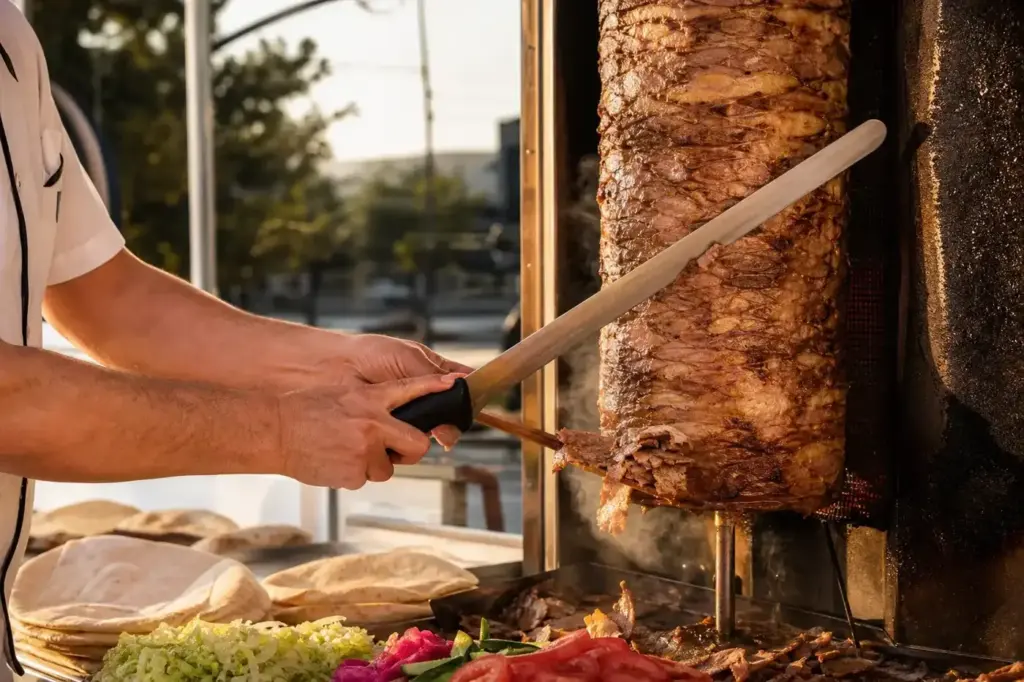
Doner kebab is Turkey’s most recognizable dish worldwide, but what you’ll eat in Istanbul is often different from what you buy in Berlin or London. This guide explains what doner kebab actually is, how it’s traditionally made, and gives you a simple home recipe so you can recreate it in your own kitchen.
The word “döner” comes from Turkish and means “turning” or “rotating”—the reference is to the vertical rotisserie on which the meat cooks. In Istanbul and across Turkey, doner kebab is either sliced from a spit and stuffed into flatbread, wrapped in lavash, or plated with rice and salad. The home-friendly recipe below uses ground meat instead of a spit, but captures the seasoning and texture.
Quick answer: Mix ground lamb or beef with yogurt, onion, garlic and warm spices. Roll it flat between parchment sheets, bake at 400°F (200°C) until cooked through, then slice thin and pan-fry the slices until edges crisp. Serve in warm pita or lavash with tomatoes, onion, lettuce and yogurt sauce. Total time: about 50 minutes plus resting.
At a Glance
| Type | Dishes |
|---|---|
| Origin | The vertical rotisserie was invented in the 19th-century Ottoman Empire. The term "döner kebap" was not documented in written form until 1908, though depictions appear in miniature paintings by an Istanbul artist dating from 1616 to 1620. In Istanbul, the vertical rotating kebab was most famously popularised by Beyti Güler, whose restaurant served döner from 1945 onward to kings, prime ministers and celebrities. The modern sandwich variant of doner kebab originated and was popularized in the 1970s in West Berlin by Turkish immigrants. |
| Servings | 2–4 servings |
| Total time | 50 minutes plus 15 minutes resting |
| Difficulty | Medium |
History and Story of Doner Kebab
The term ‘döner kebap’ was not documented in written form until 1908, though as far back as the 17th century people in the Ottoman Empire cooked stacked meat on a horizontal rotisserie, and around the mid-19th century a vertical method was developed so fat would run down the meat instead of dripping into the fire. These original döner kebabs were typically served on a plate with rice and vegetable accompaniments. The first döner kebab in sandwich form is said to have appeared in Istanbul in the mid-1960s, but it was in Germany in the 1970s that it was developed into the sandwich version we know today. Today it remains one of Turkey’s most iconic exports.
Ingredients
- 500 g ground beef or lamb (80/20 lean-to-fat ratio)
- 1 medium onion
- 3 cloves garlic
- 60 ml Greek yogurt, full-fat
- 30 ml olive oil
- 5 ml ground cumin
- 5 ml paprika
- 5 ml dried oregano
- Salt and black pepper to taste
- Parchment paper for rolling
- Fresh tomatoes, lettuce and pita or lavash bread for serving
How Doner Kebab Is Made
Step 1: Puree the aromatics
Peel and roughly chop the onion and garlic. Place them in a food processor with 15 ml olive oil and pulse until you have a smooth, thick paste. This step makes the meat tender and flavourful.
Tip: Refrigerate the onion for 30 minutes before chopping to reduce tears.
Step 2: Mix the meat
Transfer the onion-garlic paste to a large bowl. Add the ground meat, yogurt, remaining 15 ml olive oil, all the spices (cumin, paprika, oregano, salt and pepper). Using your hands, mix thoroughly for 1–2 minutes until the mixture is sticky and fully combined. The stickiness helps the meat hold together.
Tip: Do not overmix, but ensure spices are evenly distributed—you want flavour in every bite.
Step 3: Roll between parchment
Divide the mixture into two equal portions. Place a sheet of parchment paper on your work surface and lightly oil one side. Put one portion on the oiled side, then cover with another sheet. Using a rolling pin, roll the meat into a thin, even rectangle (about 5 mm thick). Peel off the top sheet carefully.
Tip: Keep the meat between parchment to prevent sticking. Work gently so the meat stays together.
Step 4: Bake the meat
Preheat your oven to 200°C (400°F). Slide the meat (still on parchment) onto a baking sheet. Bake for 20–25 minutes until the meat is fully cooked through and the surface begins to brown at the edges. Remove from the oven and let rest for 10 minutes.
Tip: The meat will firm up as it cools, making it easier to slice.
Step 5: Slice and crisp
Once cool enough to handle, peel away the parchment and slice the meat as thinly as possible using a sharp knife (about 3 mm). Heat a large pan over medium-high heat with a little olive oil. Working in batches, lay the slices flat and cook until the edges brown and crisp, about 1–2 minutes per side. Do not overcrowd the pan.
Tip: High heat creates caramelised edges that mimic the spit-roasted texture. Avoid steaming by leaving space between slices.
Step 6: Assemble the wrap or plate
Doner can be rolled in thin lavash bread with vegetables and sauce (dürüm), served in pide bread, or plated with rice, salad and sauce. Warm your bread, spread with yogurt sauce, add a handful of meat, then layer with fresh tomatoes, lettuce, sliced red onion and pickles. Roll tightly or eat with a fork if plated.
Tip: Warm the bread in a dry pan for 30 seconds before assembling so it's pliable.
Variants
- İskender kebab: meat served on pide bread, topped with tomato sauce, yogurt and melted butter—eaten with a fork
- Durum: meat wrapped tightly in thin lavash bread with vegetables and sauce, eaten by hand
- Plate (porsiyon): meat served over rice or fries with salad, sauce and yogurt on the side
- With chicken: commonly made with ground chicken in place of or mixed with lamb and beef
- With pork: available in some Western countries but not traditional or common in Turkey
Common Mistakes to Avoid
- Using lean meat (less than 80/20): the final result will be dry and crumbly. Fat keeps the meat moist and helps it hold together when sliced.
- Adding onion pulp instead of juice: excess moisture makes the mixture wet and prevents it from holding together. Strain the onion to use only the juice.
- Overseasoning: doner should taste like meat first, spices second. A light hand on paprika and cumin lets the other flavours shine.
- Cooking slices at low temperature: they will steam and become tough instead of crisp at the edges. Use high heat and cook in single layers.
- Letting cooked doner sit before eating: the meat and sauce are best when served immediately while warm. Delay cools the dish and dulls the contrast of temperatures.
- Forgetting to mix the meat thoroughly: insufficient mixing leads to patches of unmixed spices and yogurt, making some bites flavourless.
- Rolling the meat too thick: it will take longer to cook and the texture will be dense instead of tender. Aim for 5 mm thickness.
How to Order and Eat It
The meat is thinly shaved and either served on a plate or in flatbread along with lettuce, tomatoes, red onions, cucumber and either chili sauce or garlic yogurt sauce. In a dürüm it is rolled in thin lavash bread with vegetables and sauce, in pide bread, or on a plate with rice or fries and salad. When served in bread or wrap, hold it with both hands and eat it while it is still warm—the warmth and the texture contrast between the soft bread and the crisped meat edges are essential to the experience. If served on a plate as a hot dish, eat it immediately with a fork while the meat is warm and the yogurt sauce is still cool.
To order: Bir döner, lütfen [beer doner, lutfen]
Diet and Allergens
- Contains gluten (in bread/wraps)
- Contains dairy (yogurt, yogurt sauce)
Where to Try Doner Kebab
 Kızılkayalar Turkish street food
Main image: AI-generated illustration. It may not show the place exactly as it looks.
 Pandeli Ottoman-Turkish
Main image: AI-generated illustration. It may not show the place exactly as it looks.
Istanbul Vibes Tips
- Watch for "rotating meat" on the street: many Istanbul döner shops cook meat on a vertical spit continuously. If you see the spit and the operator shaving fresh meat, that's a sign of a busy, fresh shop. Avoid places where meat appears old or discoloured.
- Order by cooking method: ask for meat from the spit (spit-roasted) rather than pan-fried if available. In Istanbul, traditional shops will have the spit visible and will slice to order.
- Dress it yourself if offered: in some casual döner stands, especially in neighbourhood areas like Beyoğlu, you choose your vegetables and sauce from a line. Pick fresh tomatoes and crisp lettuce, not wilted greens.
- Avoid tourist-heavy streets: Istiklal Avenue and main squares near mosques have many döner stands, but they attract crowds and may use lower-quality meat. Side streets and worker-focused areas often have better versions at lower prices.
- Ask for "sumac onions" (sumak soğan): red onion sliced and mixed with sumac powder is a classic side that brightens the rich, heavy meat. It costs little and transforms the dish.
- Try it as a plate (porsiyon): while wraps are convenient, eating doner on a plate with rice, grilled peppers and fresh salad is how Turks often enjoy it at sit-down restaurants and shows the true craft of the meat.
Explore Nearby Doner Kebab
Related guides
 Spice Bazaar and Grand Bazaar Route: Two Markets, Six Centuries
Main image: AI-generated illustration. It may not show the place exactly as it looks.
 Istanbul Markets and Bazaars: A Three-Day Shopping and Exploration Itinerary
Main image: AI-generated illustration. It may not show the place exactly as it looks.
 Street Food Tour Route: A 3-Day Walking Guide to Istanbul’s Best Eats
Main image: AI-generated illustration. It may not show the place exactly as it looks.
 Istanbul Food Itinerary: Three Days Through Markets, Street Food and Neighborhoods
Main image: AI-generated illustration. It may not show the place exactly as it looks.
 Best Street Food and Markets: Where Istanbul Eats
Main image: AI-generated illustration. It may not show the place exactly as it looks.
Browse more: All Food & Drink · All Other
FAQ
Is doner kebab the same as shawarma or gyros?
The vertical rotisserie technique was invented in the 19th-century Ottoman Empire, and dishes such as Arab shawarma, Greek gyros and Mexican al pastor are derived from this rotisserie technique. All three are made on a vertical spit, but each has different seasoning and regional origins. Doner is Turkish, shawarma is Arab, and gyros is Greek.
Can I buy doner kebab at Istanbul street stalls, or only at restaurants?
Both. In Istanbul, doner is sold everywhere—from small street stands that serve only döner to sit-down restaurants that offer it alongside other kebabs and grilled dishes. Street vendors often have better, fresher meat because of high turnover. Look for a line of local workers at lunch time.
What is the difference between a dürüm and a plate?
Dürüm is meat rolled in thin lavash bread with vegetables and sauce, pide bread is served in a soft bread roll, and a plate consists of rice or fries, salad and sauce. Choose dürüm if you want to eat on the go. Choose a plate if you want to sit down and taste the meat with rice and fresh salad.
Does doner kebab contain pork?
Traditional doner kebab in Istanbul is made with lamb, beef or chicken. Pork is not used in Turkey and is not halal. If you have religious or dietary restrictions, ask the vendor which meat is in the spit.
Is doner kebab expensive in Istanbul?
No. Doner is budget street food in Turkey. A wrap or plate costs around a third to half of what you would pay in Western Europe. Even at a sit-down restaurant, it is moderately priced.
Can I make doner kebab at home without a rotisserie spit?
Yes. The home recipe above uses ground meat, rolled flat, baked and pan-fried to slice. It captures the flavour and texture surprisingly well, though a true spit-roasted version creates a different, more caramelised exterior. Most home cooks have success with the baked method.
What is the best sauce for doner kebab?
Doner is served with either chili sauce or garlic yogurt sauce. Garlic yogurt (made with yogurt, garlic and lemon) is the classic choice and pairs well with the rich meat. Chili sauce adds heat. Most stands offer both—ask for your preference or get both.
How long does homemade doner kebab keep?
Cooked doner meat keeps refrigerated for 3–4 days. Uncooked meat mixture can be refrigerated for up to 2 days. Freeze the raw mixture for up to a month. Always reheat slices in a hot pan to restore the crispy edges before serving.
Istanbul Vibes is a one-person project. A coffee keeps it going

Take this guide with you
Get a free PDF of this guide to print or read offline: key facts, tips and a map link on a few clean pages.
Report an issue on this page
How we research and update our guides
About this guide: AI assistance and accuracy
This guide is created with the help of AI and is based on official sources where available. Mistakes can still happen. Opening hours, prices, rules and other details are given to the best of our knowledge as of the date shown and can change without notice. It offers general recommendations only, not professional, legal or travel advice. Please confirm important details with the official source before you travel; you are responsible for your own plans and decisions.
* Affiliate link: as an Amazon Associate we earn from qualifying purchases at no extra cost to you.
