
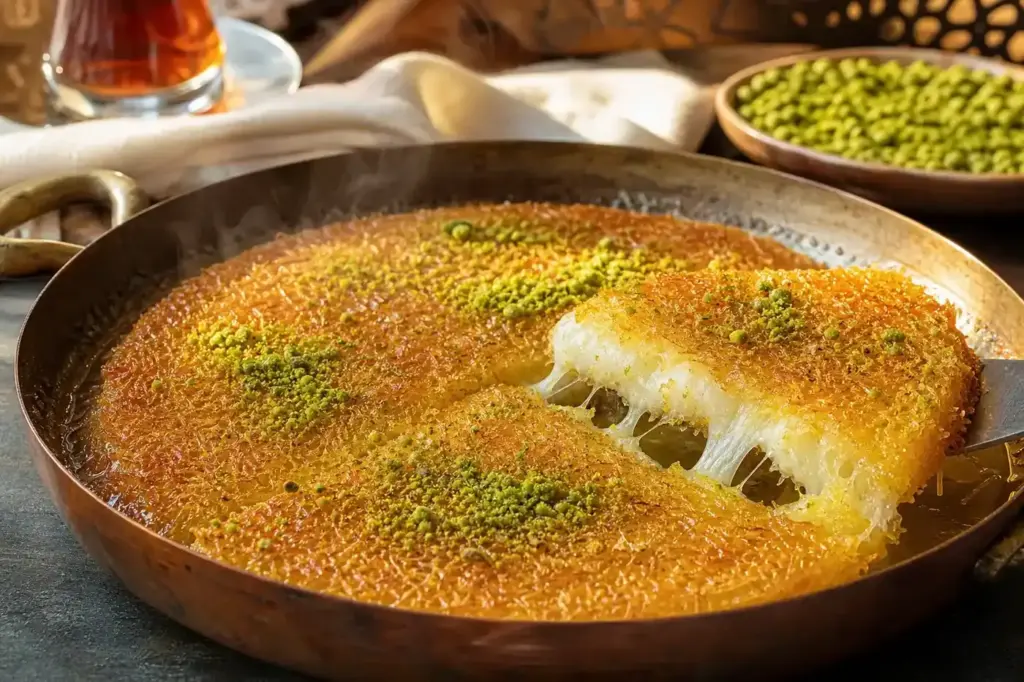
Kunefe is a beloved Turkish dessert that combines crispy shredded pastry, gooey melted cheese, and fragrant syrup in one unforgettable bite. If you’re curious about how to make kunefe Turkish dessert, this guide walks you through each step of the traditional method, from preparing the syrup to achieving the perfect golden crust. The recommended approach is to cook it stovetop in a heavy skillet or copper pan, which creates the signature crispiness that oven baking cannot match.
This dessert works best when served immediately while the cheese still pulls. First-time makers should know that the temperature contrast between hot pastry and cool syrup is what keeps the crust crisp, and that pressing the layers firmly is essential for a cohesive, sliceable result.
Quick answer: Cook kunefe by layering buttered shredded pastry with unsalted cheese, frying both sides in a pan until golden, then soaking with cooled sugar syrup and pistachio garnish. Total time is about 45 minutes.
At a Glance
| Type | Desserts & sweets |
|---|---|
| Origin | Kunefe originates from the city of Antakya, located in southeastern Turkey. Early versions of sweet cheese pastries appear in medieval Arab cookbooks like the 13th-century Kitab al-Tabikh, involving soft cheeses and sweet syrups flavored with rosewater or honey. During the Ottoman Empire, kunefe underwent further development when the Ottomans introduced a thinner pastry called kadayif, combined with cheese and a richer sweet syrup. In Turkey today, Antakya remains the city most synonymous with kunefe, and Antakya's kunefe has been awarded Protected Geographical Indication status by the European Union. |
| Servings | 2–4 |
| Total time | 45 minutes (15 minutes prep, 20 minutes cooking) |
| Difficulty | Medium |
History and Story of Kunefe
The origins of kunefe reach back to the medieval Arab world, with some historical accounts tracing early versions to the 10th century during the Fatimid or Umayyad Caliphates. Food historians suggest the dessert may have been created to provide nourishment during the long fasting hours of Ramadan, with its combination of cheese, pastry, and sweet syrup providing sustained energy through the night. As the Ottoman Empire expanded southward and eastward, absorbing the Levant, Egypt, and the Arab world into its vast territory, kunefe traveled with it, adapted and refined by Ottoman palace cooks into the sophisticated confection enjoyed today, eventually spreading to every corner of the empire.
Ingredients
- 250 g kataifi (shredded phyllo pastry)
- 170 g unsalted butter, melted
- 250 g unsalted melting cheese (mozzarella, Hatay künefe cheese, or similar)
- 250 g granulated sugar
- 240 ml water
- 5 ml lemon juice
- 30 g raw pistachios, ground or finely chopped
How Kunefe Is Made
Step 1: Make the sugar syrup
Combine 250 g sugar and 240 ml water in a small saucepan. Bring to a boil over medium-high heat, stirring for 30 seconds to dissolve the sugar completely. Reduce heat to medium and simmer for 8 minutes until slightly thickened but still pourable. Stir in 5 ml lemon juice. Remove from heat and let cool to room temperature. This cooling is essential: when hot pastry meets cool syrup, the temperature difference keeps the crust crisp.
Tip: Prepare the syrup first so it cools while you work on the pastry.
Step 2: Prepare the pastry
Pull the kataifi strands apart in a bowl with your fingers so there are no clumps. Roughly chop the strands into 1 cm pieces so they lie flat. Pour the 170 g melted butter over the pastry and mix thoroughly with your fingers, working it through every strand until evenly coated. Every piece should glisten with butter.
Tip: Spend a couple of minutes on this step to ensure complete, even coating.
Step 3: Butter the pan and build the base layer
Use a 22–24 cm heavy skillet or copper kunefe pan. Generously butter the bottom and sides. Press half the buttered kataifi firmly across the base and up the edges, packing it tight and even with your palms. The goal is a flat, compact layer so it crisps evenly on the first side.
Tip: A heavy or copper pan conducts heat more evenly than thin skillets, creating better crispiness.
Step 4: Add the cheese layer
Spread the grated or sliced unsalted cheese evenly over the pastry base, leaving a small border (about 1 cm) around the edges so it does not leak and burn. Cover with the remaining buttered kataifi and press down very hard with your palms. This pressing fuses the layers together and prevents loose strands from burning.
Tip: If your cheese is salty, soak it in cold water for 20 minutes, then drain and pat dry before using.
Step 5: Cook the first side
Place the pan over low to medium heat and cook slowly for 8–12 minutes, rotating the pan occasionally for even browning. Check progress by lifting the edge with a spatula; the underside should turn deep golden brown and crisp. Do not rush this stage—slow cooking ensures the interior cheese melts while the pastry crisps.
Tip: If the bottom is browning too fast, lower the heat further.
Step 6: Flip and cook the second side
Carefully invert the kunefe onto a flat plate or another pan and return it to the heat. Cook the second side for 8–12 minutes over the same low to medium heat, rotating for even color, until that side is also deep golden and crisp. The cheese should be fully melted inside.
Tip: Invert decisively and confidently; hesitation can cause sticking. If small bits stick to the original pan, scrape them out and place them back on top—no one will notice.
Step 7: Soak with syrup and finish
Remove the kunefe from heat and immediately pour the cooled syrup all over the hot dessert. The hot pastry will absorb the sweet syrup and stay crisp because of the temperature contrast. Garnish generously with ground pistachios. Serve right away while the cheese is still pulling and warm.
Tip: Never pour hot syrup over hot kunefe—this will make it soggy instead of crispy.
Variants
- Antakya kunefe: uses a specific local unsalted white cheese and is traditionally topped with kaymak (clotted cream)
- Regional variations across the Levant include versions with mastic flavoring in Aleppo and different local cheeses in Palestine
- Some versions incorporate rose water or orange blossom water in the syrup
- Gaziantep Antep künefe: made with crushed pistachios and kaymak from buffalo
Common Mistakes to Avoid
- Using hot syrup instead of cooled syrup: this makes the pastry soggy rather than keeping it crisp. Always let the syrup cool to room temperature before pouring.
- Not pressing the layers firmly enough: loose, unpressed pastry will burn in spots or not hold together. Press hard with your palms after adding each layer.
- Using salted cheese: traditional kunefe requires unsalted cheese that does not compete with the syrup. If only salted cheese is available, soak it in cold water first to reduce salt.
- Skipping the butter coating on the pastry: every strand must be evenly coated so it fries evenly and crisps uniformly. Spend time mixing.
- Cooking too fast over high heat: high heat browns the outside before the cheese inside melts. Use low to medium heat and give it time.
- Using an oven instead of stovetop: oven baking does not create the same deep, even crispiness as cooking in a heavy pan over direct heat.
How to Order and Eat It
Kunefe should be eaten immediately while hot and the cheese is still stretchy. Serve on a plate, scoop with a spoon, and enjoy the contrast between the crisp pastry shell and the molten, pulling cheese inside. The pistachio garnish adds crunch and balances the richness. Kunefe is often paired with strong Turkish tea or coffee. Many people eat it by breaking off pieces and letting the syrup drip onto the plate, then scooping up pieces of cheese. Some diners enjoy adding a dollop of kaymak (Turkish clotted cream) on top or on the side.
To order: Bir porsiyon kunefe lütfen [Bir porsiyon kunefe lütfen] / One portion of kunefe, please
Diet and Allergens
- Contains dairy
- Contains tree nuts (pistachios)
- Typically contains gluten
Where to Try Kunefe
 Antakya Mutfağı Hatay (Antakya) home cooking: mezes, kebabs and desserts
Main image: AI-generated illustration. It may not show the place exactly as it looks.
 CZN Burak Etiler Hatay-style grills, sharing platters and künefe
Main image: AI-generated illustration. It may not show the place exactly as it looks.
 Develi Samatya Gaziantep (Antep) kebab and Turkish dishes
Main image: AI-generated illustration. It may not show the place exactly as it looks.
 Hünkar Ottoman and Turkish home cooking
Main image: AI-generated illustration. It may not show the place exactly as it looks.
 Antiochia Hatay (Antakya) meze, grills and desserts
Main image: AI-generated illustration. It may not show the place exactly as it looks.
 Hatay Medeniyetler Sofrası Hatay (Antakya) cuisine: meze, kebab and clay-pot dishes
Main image: AI-generated illustration. It may not show the place exactly as it looks.
 Hamdi Restaurant Southeast Turkish, kebabs, meze
Main image: AI-generated illustration. It may not show the place exactly as it looks.
Istanbul Vibes Tips
- The copper pan tradition is not just aesthetic: copper conducts and distributes heat far more evenly than stainless steel or aluminum, which is why professional pastry chefs in Antakya have used it for generations. If you do not have a copper pan, a heavy cast-iron or enameled cast-iron skillet works well as a second choice.
- Timing the syrup pour is everything. The hot pastry must meet cold syrup, never hot syrup. If your syrup has cooled to room temperature, that is perfect. This temperature shock is what keeps the exterior crisp while the interior absorbs sweetness.
- Do not flip the kunefe gently or hesitantly. A confident, swift inversion is less likely to cause sticking or breakage. Some cooks place a plate directly over the pan and flip as one motion, keeping the heat underneath during the flip to ensure clean separation.
- Kataifi pastry is fragile and dries out quickly once thawed. If your package has been open for a while, loosely cover unused portions with plastic wrap and keep them in the coldest part of your refrigerator. Dried-out pastry will not crisp properly when fried.
- Pressing hard and often—after the base layer, after the cheese, and before cooking—is what keeps kunefe from falling apart when you eat it and what creates a flat, even crust. Loose pastry will burn in some spots and stay pale in others.
- If making kunefe for the first time, start with a smaller 15–18 cm pan and a single portion (75 g pastry, 60 g cheese). It is easier to manage, and success builds confidence for larger batches.
Explore Nearby Kunefe
Browse more: All Food & Drink · All Other
FAQ
Can you make kunefe in the oven instead of on the stovetop?
Oven baking is possible and produces a softer result, but it does not create the same deep, even golden crispiness that makes traditional kunefe special. Stovetop cooking in a heavy or copper pan over direct heat is the authentic method and gives superior texture. If you must use an oven, bake at high temperature (around 200°C) until the top and bottom are golden, then pour syrup immediately, but expect less crispiness.
What cheese works best if I cannot find Hatay künefe cheese?
You want a cheese that melts into a stretch without turning greasy or watery, and that is mild rather than sharp. The traditional choice is fresh unsalted künefe cheese from Hatay, a soft white cheese with almost no salt. Low-moisture mozzarella, Akkawi cheese, or Nabulsi cheese are good substitutes. Avoid aged hard cheeses—they will not melt properly. If your only option is salted cheese, soak it in cold water for 20 minutes and pat dry.
How far in advance can I prepare kunefe?
You can prepare the syrup up to 3 days ahead and refrigerate it, bringing it to room temperature before using. You can butter and separate the kataifi 6 hours ahead, cover it tightly, and keep it chilled until assembly. However, kunefe must be assembled and cooked fresh—it does not keep well once made. Serve immediately while hot.
Why does my kunefe stay soggy instead of crisp?
Three common causes: first, you poured hot or warm syrup over hot pastry instead of cold syrup, which makes it absorb too much liquid and become soggy. Second, you did not cook the pastry long enough for it to crisp through. Third, the pastry strands were not evenly coated with butter, so some parts crisped and others steamed. Ensure the syrup is cool, cook over low to medium heat for the full time, and mix the butter through every strand.
Can you make kunefe without dairy?
Traditional kunefe requires both butter and cheese, both dairy products. There is no traditional dairy-free version of this dessert. The cheese is essential to the structure and taste, and the butter creates the crispy pastry. Attempting a dairy-free version would be a modern adaptation that departs significantly from the original.
Is kunefe always topped with pistachios?
Pistachio garnish is traditional and typical, especially in Antakya künefe and across Turkey, but not universal across all regional variations. Some versions use almonds, and some use only kaymak (clotted cream) on the side or top. However, when serving kunefe in Turkey, pistachio is the standard topping, so plan for at least 30 g ground or finely chopped pistachios per batch.
How many people does one kunefe serve?
A standard kunefe made in a 22–24 cm pan with 250 g pastry and 250 g cheese serves 2–4 people, depending on portion size and whether it is the only dessert. For a richer meal or if it is the main dessert, it typically serves 2–3. A smaller 15 cm pan serves 1–2.
What should I do if the kunefe breaks when I flip it?
Do not worry—a few breaks are normal and almost never noticed by diners. If the kunefe cracks or separates during the flip, simply reassemble the pieces on your serving plate or back in the pan and continue cooking. Once you pour the syrup over it, the pieces will hold together, and the pistachio garnish will cover any seams. Confidence and a swift flip minimize breakage, so practice the motion before your first attempt.
Istanbul Vibes is a one-person project. A coffee keeps it going

Take this guide with you
Get a free PDF of this guide to print or read offline: key facts, tips and a map link on a few clean pages.
Report an issue on this page
How we research and update our guides
About this guide: AI assistance and accuracy
This guide is created with the help of AI and is based on official sources where available. Mistakes can still happen. Opening hours, prices, rules and other details are given to the best of our knowledge as of the date shown and can change without notice. It offers general recommendations only, not professional, legal or travel advice. Please confirm important details with the official source before you travel; you are responsible for your own plans and decisions.
* Affiliate link: as an Amazon Associate we earn from qualifying purchases at no extra cost to you.
