
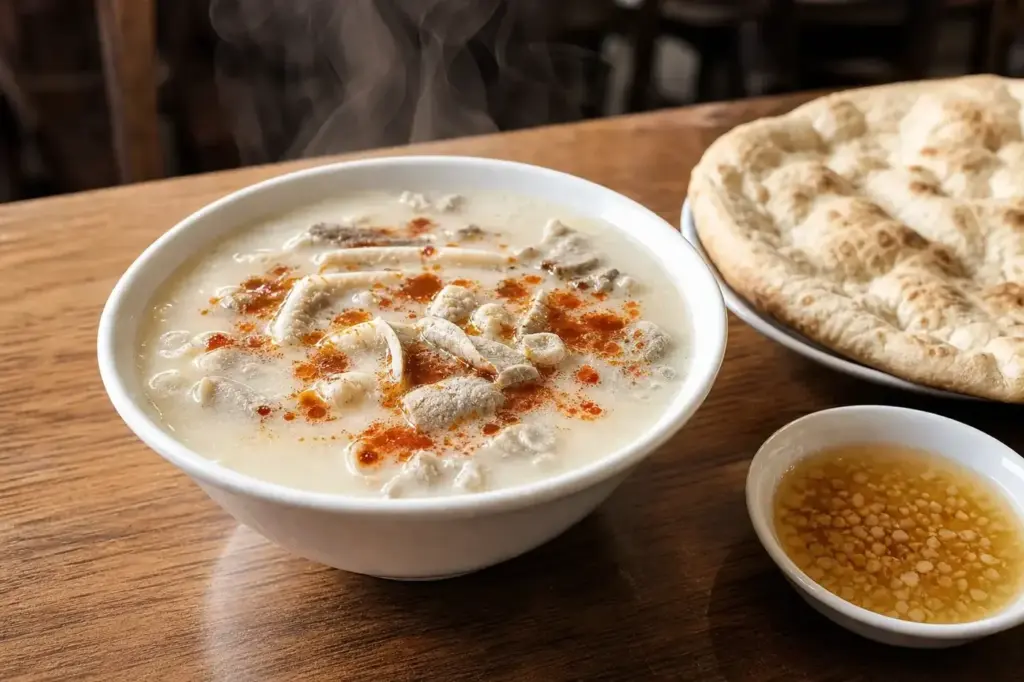
Tripe soup, known as işkembe çorbası, is one of Istanbul’s most iconic late-night dishes—a creamy, warming bowl that appears on menus of dedicated soup houses (işkembeci) open around the clock. This article shows you how to make an authentic version at home, with the proper technique for tender tripe and the traditional garlic-vinegar finishing sauce that cuts through the richness. The recommended method follows the Istanbul style: a long, gentle simmer followed by a flour-egg thickening (called terbiye) and table-side condiments.
Whether you are curious about Turkish food culture or want to understand what you’ll encounter in Istanbul’s night-time food scene, this recipe teaches you the real thing—not the vegetable-laden versions found online. You will achieve a pale, silky broth with soft pieces of tripe, ready for the sharp, pungent garlic-vinegar sauce that each diner controls to taste.
Quick answer: The tripe simmers for 1.5 to 2 hours until tender, then the soup is thickened and finished with a flour roux and egg-lemon mixture. Total time is approximately 2–2.5 hours. Cost is budget (₺), as tripe is an inexpensive ingredient traditionally valued in Turkish cuisine.
At a Glance
| Type | Dishes |
|---|---|
| Origin | Turkish tripe soup has deep roots in Ottoman cuisine, dating back centuries when resourceful cooks transformed humble ingredients into extraordinary dishes. Tripe, the edible lining of a cow's stomach, was valued for its affordability, nutritional benefits and unique texture that could absorb the flavors of aromatic broths. The tradition of consuming this dish after heavy drinking began in the 18th century among the Ottoman Turks when they drank large amounts of alcoholic drinks like rakı. Street vendors and specialized soup kitchens called işkembeci have served this warming soup to late-night diners and early morning workers for generations. |
| Servings | 2–4 servings |
| Total time | Approximately 2–2.5 hours, including 1.5–2 hours simmering time for the tripe |
| Difficulty | Medium |
History and Story of Tripe Soup
Turkish tripe soup has deep roots in Ottoman cuisine, dating back centuries when resourceful cooks transformed humble ingredients into extraordinary dishes. The tradition of consuming this dish after heavy drinking began in the 18th century among the Ottoman Turks when they drank large amounts of alcoholic drinks like rakı. As in several other countries, it is seen as a “hangover remedy” and finds itself a place in almost all New Year’s Eve menus, served right after midnight.
Ingredients
- 500 g beef tripe, cleaned
- 6 cups water
- 1 small onion, peeled
- 1 bay leaf
- 2 tablespoons butter
- 2 tablespoons all-purpose flour
- 1 cup milk
- 1 egg yolk
- Salt and black pepper
- 4 cloves garlic, for sauce
- ½ cup white vinegar, for sauce
How Tripe Soup Is Made
Step 1: Rinse and blanch the tripe
Place the tripe in a colander and rinse thoroughly under cold running water, rubbing gently to remove any surface residue. Boil for 10 minutes, then drain and rinse again. This step removes any remaining odor and prepares the tripe for cooking.
Tip: Pre-cleaned tripe from the butcher saves considerable time; if using raw tripe, allow extra rinsing.
Step 2: Simmer the tripe until tender
Return the tripe to the pot with 6 cups of fresh water, the halved onion and the bay leaf. Bring to a gentle boil, then drop the heat and simmer, partly covered, for 1.5 to 2 hours, until the tripe is genuinely tender (it should give easily when you bite a piece). Skim off the grey foam every so often during the first half hour. Do not rush this step; the texture depends on proper cooking.
Tip: A pressure cooker can reduce simmering time to 30–45 minutes, but gentle simmering is traditional.
Step 3: Strain and cut the tripe
Remove the tripe from the broth and discard the onion and bay leaf. Reserve the broth. Allow the tripe to cool slightly, then cut into small bite-sized pieces (approximately 1–1.5 cm). The pieces should be small so they contribute texture to the broth rather than dominating it.
Tip: Cutting while still warm makes the tripe easier to slice cleanly; do not let it cool completely.
Step 4: Make the flour-butter roux
In a separate small saucepan, melt the butter over medium heat. Add the flour and stir constantly for 1–2 minutes to combine, creating a smooth paste. Slowly whisk in the warmed milk in a thin stream, keeping the mixture smooth and lump-free. This creates the creamy base that will thicken the broth.
Tip: Warm the milk slightly before whisking in to prevent lumps; stir continuously to avoid a grainy texture.
Step 5: Combine roux and broth
Ladle 250 ml of hot tripe broth into the roux mixture while whisking continuously to temper and loosen it. Then slowly pour this thinned roux back into the pot containing the reserved broth and the cut tripe, stirring well. Bring to a gentle simmer and cook for 5–10 minutes, stirring occasionally, until the broth thickens slightly.
Tip: Tempering the roux with broth before combining prevents curdling; keep heat moderate to avoid scrambling the mixture.
Step 6: Finish with egg-lemon thickening (terbiye)
In a bowl, whisk together the egg yolk with a little fresh lemon juice. Ladle a spoonful of hot broth into the egg mixture and whisk well. Slowly pour this tempered egg mixture into the soup while stirring gently. Cook for 2–3 minutes over very low heat (do not boil) to set the egg without scrambling it. The soup should now be creamy and pale.
Tip: This step is crucial to authenticity; always temper the egg yolk with broth first, then stir continuously as you add it to prevent lumps.
Step 7: Prepare the garlic-vinegar sauce
Pound or finely mince the garlic cloves with a pinch of salt until completely soft. Mix the garlic with the vinegar in a small bowl. The garlic-vinegar-red pepper mixture goes on at the table, not in the pot, so each person controls the kick. Set aside in a serving bowl.
Tip: Crush the garlic just before serving to preserve its sharp, pungent flavor; do not prepare it ahead of time.
Variants
- Offal of cow and sheep and kelle (sheep head meat, especially cheeks, baked) are also offered at traditional restaurants dedicated to this soup.
- A dish can be ordered and made from the various parts of the stomach: "Tuzlama, işkembe, şırdan and damar".
- Some versions include a small amount of crushed garlic stirred directly into the pot before serving, though the Istanbul style keeps it on the side.
- In some regions, the soup is thickened more heavily with extra flour for a denser, spoon-coating consistency rather than the lighter, silkier Istanbul version.
Common Mistakes to Avoid
- Undercooking the tripe so it remains chewy instead of tender. The tripe must simmer long enough to become soft and melt-in-mouth; this cannot be rushed. A minimum of 1.5 hours at a gentle bubble is essential.
- Adding the thickening mixture (roux or egg) without tempering it first with hot broth. This causes curdling and lumps. Always whisk a spoonful of hot soup into cold mixtures before pouring them into the pot.
- Allowing the soup to boil after adding the egg yolk. The heat must be very low during the final 2–3 minutes, or the egg will scramble into small curds instead of creating a smooth, creamy broth.
- Forgetting that the garlic-vinegar sauce is served on the side, not stirred into the entire pot during cooking. Each diner should control their own level of sharpness by adding sauce to taste.
- Using store-bought pre-minced garlic for the sauce instead of crushing fresh garlic. The pungent, fresh flavor of crushed garlic is essential to the authentic taste.
- Making the soup too thick with flour or egg. It should be creamy and pourable, not stiff; if it thickens too much as it cools, thin it with a little hot broth or milk when reheating.
How to Order and Eat It
A real işkembe çorbası is white, not red. Just tripe, a roux, milk, egg, garlic and vinegar. Turkish Tripe Soup is traditionally served hot in deep bowls, allowing diners to customize their portion with various condiments. The classic accompaniments include freshly crushed garlic, lemon juice or white vinegar, and paprika-infused oil. Start with a spoonful of the creamy broth, then taste it plain. Add garlic-vinegar sauce to the remaining soup according to your preference—a little for a mild version, more for a sharp, pungent bite. The soup pairs well with plain pide bread for dipping. Serve immediately while hot, as the soup thickens as it cools.
To order: İşkembe çorbası lütfen [ish-KEM-be chor-BAH-suh LOOT-fen]
Istanbul Vibes Tips
- Visit an işkembeci (tripe soup house) late at night or very early morning to see the true Istanbul food culture. These specialized restaurants are busiest between midnight and dawn, when locals drop in after nights out or before work. The atmosphere is unpretentious and often crowded.
- When ordering in Turkish, the staff will ask how much garlic-vinegar sauce you want added. Say "biraz" (a little) or "çok" (a lot) depending on your tolerance for sharp, pungent flavors. The soup itself is mild; the sauce provides the kick.
- Do not assume this soup is only for hangovers. In Istanbul, işkembeci serve it as comfort food at all hours, to construction workers, night-shift hospital staff, and anyone seeking a warming, nourishing meal. It is as much part of the food scene as lentil soup.
- If you buy tripe from a Turkish butcher, ask if they can blanch it first to save time at home. Pre-blanched or pre-cooked tripe cuts simmering time significantly and is widely available in Istanbul markets.
- The pale, creamy color is correct. Do not add tomato paste, carrots, or potatoes—common online "Turkish" tripe soup recipes often include these, but the Istanbul original is simple: just tripe, milk, egg, and broth. Those additions are not authentic to what you will encounter in the city.
- Reheat leftover soup gently over low heat or in a water bath. Never boil it, as this can cause the egg-thickened broth to separate. If the soup has thickened too much overnight, stir in a little hot milk or broth to restore a pourable consistency.
Explore Nearby Tripe Soup
Related guides
 Sultanahmet: Istanbul’s Historic Heart and Essential First Stop
Main image: AI-generated illustration. It may not show the place exactly as it looks.
 Beyazit: Ottoman Mosque, University, and the Gateway to History
Main image: AI-generated illustration. It may not show the place exactly as it looks.
 Eminönü: Istanbul’s Waterfront Heart and Ottoman Harbor
Main image: AI-generated illustration. It may not show the place exactly as it looks.
Browse more: All Food & Drink · All Other
FAQ
What is tripe, and is it safe to eat?
Tripe is made from the lining of a cow's stomach, simmered for hours until it turns soft and almost gelatinous. When properly cleaned and cooked, it is entirely safe. The cleaning step is important to remove any odor; most butchers sell pre-cleaned tripe, which significantly simplifies home cooking.
Why is it served so late at night in Istanbul?
The soup became particularly associated with nightlife culture, as it was believed to help counteract the effects of alcohol and provide much-needed nourishment. Specialized soup kitchens called işkembeci have served this warming soup to late-night diners and early morning workers for generations. Today it is simply part of Istanbul's food culture at all hours.
Is the soup vegetarian?
No. Tripe soup is made entirely from beef tripe and beef broth. It is not suitable for vegetarians or vegans. A vegetarian alternative would be lentil soup or tomato soup, commonly served at the same soup houses.
What does it taste like?
The base is creamy yet light, thanks to a carefully prepared roux and broth enriched with collagen from the tripe. The finishing touches—sharp vinegar, pungent garlic, and a squeeze of lemon—cut through the richness, creating a harmony that feels surprisingly refined.
Can I make it in a pressure cooker?
Yes. A pressure cooker reduces the simmering time for tripe from 1.5–2 hours to approximately 30–45 minutes, depending on the machine. The final broth quality is similar, though some believe the traditional long simmer produces a richer texture. Follow your pressure cooker's instructions for cooking tough cuts of meat.
How is terbiye different from just adding an egg to soup?
Terbiye is a specific technique: the egg yolk is first whisked with lemon juice and flour, then tempered with hot broth before being stirred back into the soup. This creates a smooth, silky thickening rather than scrambled egg. It is essential to the authentic Istanbul style.
What if I cannot find beef tripe?
Ask at a Turkish or Middle Eastern butcher; they stock it regularly. In Istanbul, any neighborhood butcher will have it. If absolutely unavailable, lamb or mutton tripe can be used, though beef is traditional. Some restaurants offer soup made from other offal, such as sheep's head (kelle) or sheep's feet (paça), which are cooked in a similar style.
Does the soup keep well?
Yes. The soup can be refrigerated in an airtight container for up to 3 days. It will thicken as it cools due to the natural gelatin and flour. When reheating, warm gently over low heat and stir in a little hot milk or broth if it has become too thick.
Istanbul Vibes is a one-person project. A coffee keeps it going

Take this guide with you
Get a free PDF of this guide to print or read offline: key facts, tips and a map link on a few clean pages.
Report an issue on this page
How we research and update our guides
About this guide: AI assistance and accuracy
This guide is created with the help of AI and is based on official sources where available. Mistakes can still happen. Opening hours, prices, rules and other details are given to the best of our knowledge as of the date shown and can change without notice. It offers general recommendations only, not professional, legal or travel advice. Please confirm important details with the official source before you travel; you are responsible for your own plans and decisions.
* Affiliate link: as an Amazon Associate we earn from qualifying purchases at no extra cost to you.
