
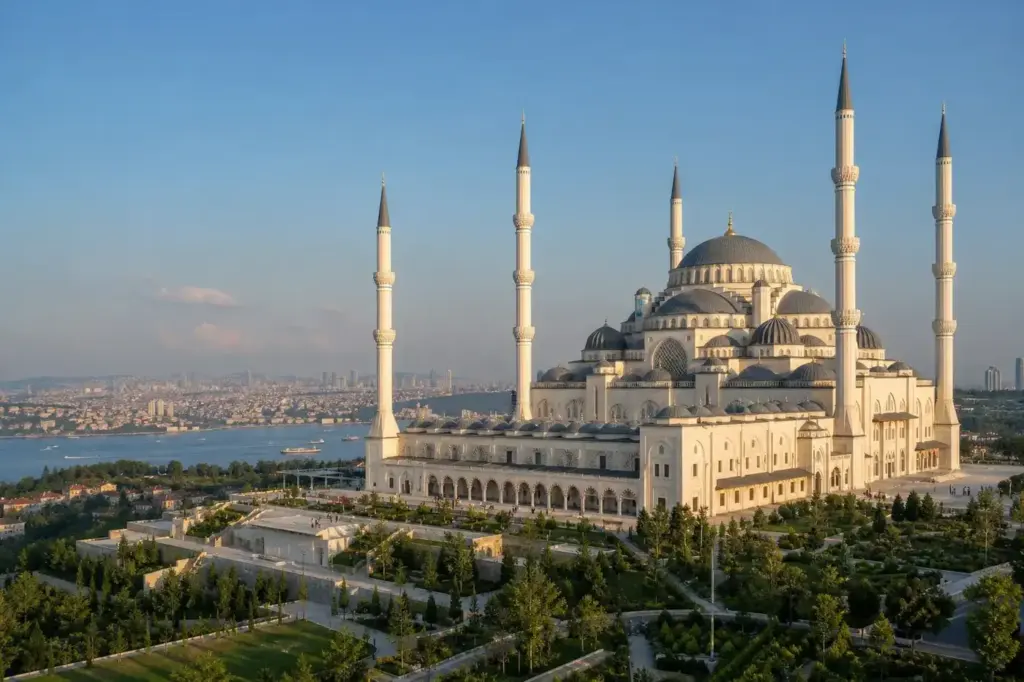
The Camlica Mosque is the largest mosque in Turkey, located on Çamlıca Hill overlooking the Bosphorus on Istanbul’s Asian side. This modern architectural landmark opened for worship on 7 March 2019, after six years of construction beginning in 2013, and was officially inaugurated by President Erdoğan in May that year.
Designed by architects Bahar Mızrak and Hayriye Gül Totu to evoke classical Ottoman style while employing contemporary materials and engineering, the complex occupies 57,500 square metres and accommodates up to 63,000 worshippers. The six minarets stand 107.1 metres tall, and the central dome reaches 72 metres—a height that symbolises the 72 ethnic groups represented in Istanbul’s history. Six smaller supporting domes and 64 additional smaller domes complete the structure.
Quick Facts
| Turkish name | Çamlıca Camii |
|---|---|
| Built / opened | 2019 |
| Architect(s) | Bahar Mızrak and Hayriye Gül Totu |
| Address | Ferah Yolu Sk. No:6 D:3, 34692 Üsküdar, Istanbul Google MapsApple MapsYandex Maps |
| District | Üsküdar |
| Metro | Üsküdar (M4, From Üsküdar Ferry Terminal, take bus 1, 14F, 14FD, or C118) |
| Opening hours | Open daily 24 hours
Visitor access restricted approximately 20–30 minutes before and after the five daily prayer times (Fajr, Dhuhr, Asr, Maghrib, Isha). Museum of Islamic Civilisations: Tue–Sun 09:00–18:30; closed Mondays. Library: Mon–Sat 09:00–18:00; shared working areas open until midnight daily. |
| Admission | Free entry to mosque and complex; separate ticket for Museum of Islamic Civilisations |
| Best time to visit | Visit on weekdays (Monday to Thursday) to avoid large crowds, especially Friday, when congregational prayers draw thousands. Morning hours (08:00–11:00) are quieter than afternoons. Avoid the five daily prayer times, particularly Dhuhr (midday) and Asr (afternoon), when access is restricted and crowds increase. Spring (April–May) and autumn (September–October) offer comfortable temperatures and clear air, making the Bosphorus views sharper and photography easier. Summer (June–August) brings heat and haze; bring water and sun protection. Winter (November–February) can be rainy and overcast, though fewer tourists visit. For light conditions, visit late afternoon (after 15:00) for golden-hour light across the courtyards, or early morning for cool blue tones in the prayer hall. |
| Website | camlicacami.com |
What Is (and Isn't) Part of a Visit to Camlica Mosque?
| Part | Status | Notes |
|---|---|---|
| Main prayer hall and courtyard | Included in the standard ticket | Free entry to all visitors. Non-worshippers may visit outside the five daily prayer times. |
| Museum of Islamic Civilisations | Separate ticket or institution | Separate ticket required; located in the underground level of the complex. Open Tue–Sun 09:00–18:30, closed Mondays. |
| Art gallery and library | Included in the standard ticket | Both are part of the complex but not all areas may be open during all visiting hours. Library: Mon–Sat 09:00–18:00, extended hours for shared working areas. |
| Conference hall | Included in the standard ticket | Part of the complex but typically reserved for events. Not available for casual visitor exploration. |
| Underground parking | Outside / not part of it | Visitor parking is available but is a separate facility, not part of the mosque visit itself. |
| Camlica Hill and surrounding park | Outside / not part of it | The broader Çamlıca Hill area includes public parks and the Çamlıca Tower (a separate television and observation tower). The mosque is located on the hill but is distinct from other sites nearby. |
Why Visit Camlica Mosque?
Unlike the historic mosques of Sultanahmet, Camlica Mosque offers a chance to experience 21st-century Islamic architecture at a monumental scale. The prayer hall’s dimensions—uninterrupted floor space beneath the soaring central dome—create an unusual sense of space and light. The hilltop location provides 360-degree views of Istanbul and the Bosphorus, and the landscaped courtyards and gardens are open to visitors outside prayer times.
The complex also houses the Museum of Islamic Civilisations with a significant collection, an art gallery, library and conference facilities. Non-Muslim visitors are welcome and the mosque respects its spiritual purpose: women’s headscarves and protective clothing are available free at the entrance if needed.
How Camlica Mosque Is Laid Out
The complex is large and spread across multiple levels. The main prayer hall occupies the central structure. The Museum of Islamic Civilisations is located in the underground level, accessed from the lower terrace. The colonnaded courtyard surrounds the prayer hall on the eastern and northern sides, and the landscaped gardens extend toward the edges of the hill. Shoe racks and bag storage are provided near the main entrances to the prayer hall; visitors remove shoes before entering the carpeted prayer space.
Approach the mosque from the main entrance on the Ferah Yolu side, which leads to the courtyard. Signs direct you to the museum, library, and art gallery. Allow extra time to navigate the complex if you plan to visit multiple facilities, as corridors and staircases connect the different areas.
Highlights of Camlica Mosque
The Main Prayer Hall
The interior prayer space is vast and unified beneath the 72-metre central dome. The entire floor is carpeted, and the qibla wall—the wall indicating the direction of Mecca—features intricate marble carvings and calligraphic panels in Iznik tilework style. Four semi-domes and numerous smaller domes create changing light and shadow patterns throughout the day. The mihrab (prayer niche) is carved from marble; the minbar (pulpit) rises 21 metres and operates via electric lift. No single focal point dominates; instead, the scale itself draws the eye.
Tip: Visit early morning (before Fajr prayers) or in late afternoon for the best light through the eastern and southern windows. The quality of natural illumination changes the entire feeling of the space.
The Museum of Islamic Civilisations
Located underground beneath the mosque complex, this museum features artifacts and displays on Islamic history, culture and art. The museum is housed in its own dedicated space with climate control and professional presentation. Hours differ from the mosque: open Tuesday to Sunday 09:00–18:30, closed Mondays. A separate ticket may be required.
Tip: Plan your museum visit after prayers, as the underground entry can become crowded during visitor rush hours. Purchase tickets in advance if the queue is long.
The Six Minarets
Four of the six minarets reach 107.1 metres tall, symbolising the 1071 Battle of Manzikert—a defining moment in Ottoman history. The other two stand at 90 metres. All six are positioned around the complex's perimeter. The minarets serve double duty: two on the Qibla side incorporate fresh-air ventilation shafts that naturally cool the prayer hall. They are viewable from outside the prayer hall and from the courtyards.
Tip: Photograph the minarets from the courtyard or the surrounding grounds for the best perspective. Early morning light casts dramatic shadows that emphasise their height and scale.
The Courtyard and Gardens
The colonnaded courtyard is surrounded by covered walkways and opens toward views of the Bosphorus and European Istanbul. Landscaped gardens with seating areas line the outer edges of the complex. The courtyard floor uses locally sourced stone. The openness of the space contrasts sharply with the enclosed prayer hall, allowing visitors to pause and enjoy the views without entering the mosque itself.
Tip: Spend time in the courtyard regardless of whether you enter the prayer hall. The gardens are less crowded in early morning and weekday afternoons, offering a peaceful vantage point for photographs.
Panoramic Views from Çamlıca Hill
At approximately 270 metres above sea level, Çamlıca Hill is the highest point on Istanbul's Asian side. From the mosque complex and surrounding grounds, you can see across the Golden Horn to the European side, the Galata Tower, and the historic peninsula. On clear days, the Bosphorus strait opens to the Black Sea. This view is not a separate attraction but something available freely from the complex's outdoor areas.
Tip: Arrive before sunset to catch the light across the Bosphorus and towards the European shore. Weekday afternoons offer fewer crowds for photography. Bring water if visiting during summer months.
The Art Gallery
A dedicated art gallery within the complex showcases contemporary Islamic art and cultural works. The gallery is integrated into the main complex but maintains its own entrance and operating hours. The space covers 3,500 square metres and hosts rotating exhibitions alongside permanent displays. Like the museum, it supports the complex's role as a cultural and educational hub beyond prayer.
Tip: Check current exhibitions online or at the entrance. The gallery is less crowded on weekdays and offers a quieter alternative to the prayer hall during prayer times.
Atmosphere
The atmosphere inside the main prayer hall is one of vast, hushed space. The carpet muffles footsteps; the enormous scale makes individual visitors feel small. Natural light moves gradually across the floor throughout the day, from cool blue tones in early morning to warmer golden light in afternoon. During prayer times, the space fills with worshippers, their voices rising in unison during recitation, creating a powerful sensory moment; non-worshippers are typically not present during these periods.
Outside the prayer hall, the courtyards feel more open and contemplative. Families sit in gardens, children play quietly on the stone platforms, and visitors circulate slowly. The Bosphorus visible in the distance anchors the experience to Istanbul’s geography. On weekdays, the complex is quieter; weekends and Fridays attract larger crowds. The overall feeling is modern, clean and well-maintained, with little of the aged patina of Istanbul’s historic mosques.
History of Camlica Mosque
Planning for a mosque on Çamlıca Hill began in the year 2000, when the Turkish government identified the hilltop as an ideal location for a major contemporary religious and cultural landmark. The project was commissioned as a symbol of modern Turkey’s economic strength and connection to its Islamic heritage. A nationwide architectural competition was held to select the design.
Architects Bahar Mızrak and Hayriye Gül Totu won the competition with a design that bridged Ottoman classical aesthetics with 21st-century engineering. Their proposal was notably led by two women architects, marking a historic first for a major mosque design in Turkey. The design drew explicit inspiration from the work of Mimar Sinan, the renowned Ottoman architect of the 16th century, though it expressed this inspiration through modern materials and spatial organisation.
Groundbreaking and foundation work began on 6 August 2013 (some sources cite 29 March 2013). Construction continued for six years, employing more than 5,000 artisans and workers. Specialised concrete formulations and natural stone sourced from across Anatolia were used for structural and decorative elements. The project incorporated advanced earthquake-resistant engineering, reflecting Istanbul’s geological vulnerability.
The mosque opened for worship on 7 March 2019, during Fajr (morning) prayers on the night of Regaib Kandili, a significant date in the Islamic calendar. The official inauguration ceremony took place on 3 May 2019, attended by President Recep Tayyip Erdoğan and international dignitaries. The inauguration speech condemned violent attacks on places of worship globally, framing the mosque as a symbol of peace and interfaith respect.
Since opening, the Camlica Mosque has become one of Istanbul’s most recognisable landmarks, visible from across the city and the Bosphorus. In 2022, work was underway to extend the M5 Metro line to include a dedicated station at the mosque, which would significantly increase public transport accessibility.
Tickets and Booking for Camlica Mosque
| Ticket | Price | Includes |
|---|---|---|
| Mosque and complex | Free | Access to main prayer hall, courtyards, gardens, art gallery, library (during operating hours), and all outdoor areas. |
| Museum of Islamic Civilisations | ₺ | Access to the underground museum featuring Islamic artifacts, cultural displays and exhibitions. Separate from the mosque. |
₺ budget · ₺₺ moderate · ₺₺₺ upscale · ₺₺₺₺ splurge. Price levels are estimates compared with typical prices for visitors.
Entry to the mosque and complex is free. No advance booking is needed for the mosque itself. The Museum of Islamic Civilisations requires a ticket; these can be purchased at the ticket counter located at the museum entrance (underground level) on the day of your visit. Online purchase options and advance booking for the museum are not clearly published; visitors should check at the entrance or contact the complex directly for current arrangements.
Plan your visit to avoid the five daily prayer times: Fajr (dawn), Dhuhr (midday), Asr (afternoon), Maghrib (sunset), and Isha (evening). Each prayer period restricts visitor access for approximately 20–30 minutes. A prayer schedule is typically posted near the main entrances. Weekdays are less crowded than Fridays, when congregational prayers attract thousands of worshippers.
The mosque is a functioning place of worship, not a museum. Appropriate dress is required: men should wear long trousers and avoid sleeveless clothing; women must cover their hair, arms, and legs. Free headscarves, abayas and coverings are available to borrow at the entrance. All visitors must remove shoes before entering the carpeted prayer hall; plastic bags are provided to carry them.
For all current ticket prices, categories, group discounts and detailed visiting rules, consult the official website or contact the mosque directly, as rates and policies may change seasonally.
Suggested itineraries Camlica Mosque
1 hour
Enter the prayer hall, explore the courtyard and enjoy the views. This is the minimum for a meaningful visit. Walk around the main dome to observe the tilework and calligraphy, then exit via the courtyard to photograph the structure and Bosphorus views.
2–3 hours
Begin with the prayer hall and courtyard (45 minutes). Visit the Museum of Islamic Civilisations (60 minutes). Browse the art gallery (30 minutes). Spend remaining time in the gardens and on the courtyards with views. This is the recommended timeframe for a comprehensive visit.
Half day
Allow 2–3 hours in the mosque complex itself. Combine with a visit to the Çamlıca Tower observation deck (additional 45 minutes, adjacent to the mosque site). Eat at the on-site café or nearby restaurants in Üsküdar. Return to the mosque for sunset views from the courtyard.
How to Get to Camlica Mosque
By metro and bus: Take the M4 metro line to Üsküdar station. Exit and walk to the Üsküdar Ferry Terminal (approximately 5 minutes). From the ferry terminal, board bus 1, 14F, 14FD, or C118 headed toward Büyük Çamlıca Camii. Journey time on the bus is approximately 15–20 minutes depending on traffic. Exit at the “Büyük Çamlıca Camii” stop. The mosque entrance is a short walk uphill from the bus stop.
By taxi or private car: Taxis are available from anywhere in Istanbul. Provide the address “Ferah Yolu Sk. No:6, Üsküdar” to the driver. Travel time from central areas (Sultanahmet, Taksim) is 20–40 minutes depending on traffic, plus parking time. The complex has underground parking for 3,500 vehicles.
Walking: Once at the bus stop or parking area, the final ascent to the mosque involves some uphill walking (5–10 minutes) along landscaped paths. The route is clearly signposted.
Accessibility
The mosque complex has limited formal accessibility information published. Wheelchair access to the main prayer hall exists but involves some navigating of levels and transitions. The museum entrance is at underground level; accessibility for visitors with mobility limitations may be affected by staircases and architectural design. Visitors using wheelchairs or with mobility restrictions should contact the complex in advance to arrange assistance or confirm specific access routes.
There are benches throughout the courtyards and gardens for rest. The prayer hall itself has no internal barriers, allowing visitors to sit or stand throughout the space. Free companions may accompany visitors with disabilities.
Food Nearby
An on-site café called Beltur serves drinks and light meals within the complex. For more substantial dining, the Üsküdar neighbourhood immediately below the hill has numerous restaurants, kebab houses, cafés and bakeries. Walk downhill from the mosque toward the main shopping district and waterfront area to find options ranging from casual street food to sit-down restaurants serving Turkish cuisine. The area is popular with locals, so dining options are reliable and reasonably priced.
What to Bring
Bring water, especially in summer. Sun protection (hat, sunscreen) is useful for the courtyards and outdoor areas. Comfortable walking shoes are essential for the uphill approach and navigating the complex. A headscarf or light shawl is optional if you prefer your own covering; free ones are available at the entrance. Bring a small bag if you wish to carry items; larger bags may require checking (policies are consistent with standard mosque protocols).
Best Views and Photo Spots of Camlica Mosque
Courtyard looking toward the main dome
The central dome rises above the colonnade with the Bosphorus visible beyond. This perspective captures the mosque's scale against the broader Istanbul landscape.
Best time: Late afternoon for golden light; early morning for crisp, cool tones with clearer Bosphorus views.
Gardens on the eastern side of the complex
The six minarets are framed against the sky, with the European shore and Golden Horn visible in the distance. The landscaped garden provides foreground interest.
Best time: Morning light from the east; photograph facing west toward the minarets and European side for silhouetting effects at sunset.
Approach path to the main entrance
The mosque appears gradually as you ascend the landscaped path, with Bosphorus and city views widening behind it. This captures the experience of arrival.
Best time: Any time, but late afternoon walking upward places the dome in warm light while the Bosphorus remains visible.
Underside of the main dome from within the prayer hall
Looking straight up reveals the geometric complexity of the domes and semi-domes, with light filtering through windows creating a pattern of illumination.
Best time: Mid-morning or mid-afternoon when direct sunlight creates contrast; avoid during prayers when interior photography may not be permitted.
Photography Rules
Photography is permitted in the courtyards, gardens, and some areas of the complex. Interior photography of the main prayer hall may be restricted during prayer times or may require permission; ask staff before photographing worshippers. Tripods and professional filming equipment may require advance permission. Drones are not permitted. No flash photography inside the prayer hall to respect worshippers and preserve the mood.
Family Suitability
The mosque is suitable for families with children of all ages. The vast, quiet space can feel calming for young visitors, though some children may find it overwhelming due to the scale. There are no stairs or obstacles on the main prayer hall floor, and children can walk or sit freely without restriction. The courtyards and gardens offer open space for older children to move about, though supervision is important on the landscaped paths with various levels.
Stroller access to the prayer hall itself is not typically permitted, as the carpeted floor and removal of shoes are required. However, strollers can be left at the entrance or in designated areas. Bathrooms are available throughout the complex. The on-site café offers refreshments. Quieter, less-crowded periods (weekday mornings) are best for families with small children.
Istanbul Vibes Tips
- Avoid arriving during the Dhuhr (midday) prayer, which is the busiest time for congregational worship. Instead, visit late afternoon or early morning when the space is quieter and light conditions are optimal for photography.
- Bring your own light cover-up (a scarf or cardigan) if you prefer not to borrow free headscarves at the entrance, though clean coverings are readily available and free.
- Check the prayer schedule displayed near entrances to plan your visit. The timing shifts daily with the Islamic lunar calendar and seasonal daylight changes; what was prayer time yesterday may not be today.
- Walk the perimeter of the complex (especially the eastern gardens) to see how the six minarets frame the landscape differently from various angles. Many first-time visitors miss these views by staying only in the main courtyard.
- If visiting the Museum of Islamic Civilisations, allow at least 60 minutes; it is not a quick stop. Go in the late morning or early afternoon to avoid queues that can form late in the day.
- The bus journey from Üsküdar Ferry Terminal takes 15–20 minutes; if you arrive late in the afternoon, allow extra time so you don't rush the visit or miss the last convenient bus back down the hill.
Explore Nearby Camlica Mosque
Sights near Camlica Mosque
 Blue Mosque – about 8.5 km away · typical visit: 45–75 minutes3 min on foot from Gülhane metro
Main image: AI-generated illustration. It may not show the place exactly as it looks.
 Hagia Sophia – about 8.2 km away · typical visit: 1–1.5 hours8 min on foot from Gülhane metro, Open daily 09:00–19:30
Main image: AI-generated illustration. It may not show the place exactly as it looks.
 Camlica Tower – about 2.5 km away · typical visit: 1–2 hours2 min on foot from Altunizade metro, Open daily 10:00–22:00
Main image: AI-generated illustration. It may not show the place exactly as it looks.
 Kadıköy · typical visit: Half a day to a full day
Main image: AI-generated illustration. It may not show the place exactly as it looks.
 Khedive's Grove – about 2.6 km away · typical visit: 2–3 hoursOpen 24 hours
Main image: AI-generated illustration. It may not show the place exactly as it looks.
 Beylerbeyi Palace – about 2.7 km away · typical visit: 1–1.5 hoursOpen 09:00–17:00, closed Mon
Main image: AI-generated illustration. It may not show the place exactly as it looks.
Related guides
 Üsküdar: The Asian Shore’s Authentic Neighborhoods and Bosphorus Views
Main image: AI-generated illustration. It may not show the place exactly as it looks.
 Best Views in Istanbul: 10 Viewpoints from Towers to Waterfront
Main image: AI-generated illustration. It may not show the place exactly as it looks.
 Emaar Square Mall: Turkey’s Largest Shopping Center with Aquarium and Entertainment
Main image: AI-generated illustration. It may not show the place exactly as it looks.
 Mall of Istanbul: Shopping, Entertainment and Dining Guide
Main image: AI-generated illustration. It may not show the place exactly as it looks.
 Bosphorus Brewing Company: Istanbul’s Craft Brewery and Gastropub15 min on foot from Gayrettepe metro, Open daily 11:00–02:00
Main image: AI-generated illustration. It may not show the place exactly as it looks.
Browse more: More in Üsküdar · All Landmarks · All Sightseeing
FAQ: Camlica Mosque
Is Camlica Mosque free to enter?
Yes, entry to the main mosque and complex is completely free. The Museum of Islamic Civilisations, located in the underground level, requires a separate ticket at a budget price level.
Can non-Muslims visit the mosque?
Yes. The mosque welcomes non-Muslim visitors outside of the five daily prayer times. Visitors of all faiths are invited to explore the prayer hall, courtyards, and gardens. Appropriate dress is required (covered shoulders, legs, and headscarves for women); free coverings are available at the entrance.
What are the prayer times when I cannot visit?
Visitor access is restricted approximately 20–30 minutes before and after each of the five daily prayers: Fajr (dawn), Dhuhr (midday), Asr (afternoon), Maghrib (sunset), and Isha (evening). A prayer schedule is posted at the entrances and shifts daily. During Ramadan, additional restrictions may apply.
Is there a dress code?
Yes. Men should wear long trousers and avoid sleeveless tops. Women must cover their hair, arms, and legs; headscarves, abayas and protective shawls are available free at the entrance. Everyone must remove shoes before entering the carpeted prayer hall.
How long should I plan to spend there?
A basic visit (prayer hall and courtyard only) takes 45 minutes to 1 hour. A full visit including the museum and galleries takes 2–3 hours. Plan accordingly based on your interests.
What is the difference between the mosque and the Museum of Islamic Civilisations?
The mosque is the main prayer space and complex (free entry). The Museum of Islamic Civilisations is a separate underground museum with its own admission fee and different hours (Tue–Sun 09:00–18:30, closed Mondays). You can visit one without the other.
How do I get there by public transport?
Take the M4 metro to Üsküdar station. From Üsküdar Ferry Terminal (a 5-minute walk away), board bus 1, 14F, 14FD, or C118 toward Büyük Çamlıca Camii. The bus ride is 15–20 minutes. Exit at the mosque stop and walk uphill to the entrance.
Is a guide necessary?
No, the complex is well-signposted and easy to navigate independently. Free guides are available upon request if you contact the mosque in advance (except Tuesdays). Audio guides or printed materials for purchase may also be available at the entrance.
Istanbul Vibes is a one-person project. A coffee keeps it going
Hotels near Camlica Mosque
Restaurants near Camlica Mosque
Distances are straight-line, from OpenStreetMap data.

Take this guide with you
Get a free PDF of this guide to print or read offline: key facts, tips and a map link on a few clean pages.
Report an issue on this page
How we research and update our guides
About this guide: AI assistance and accuracy
This guide is created with the help of AI and is based on official sources where available. Mistakes can still happen. Opening hours, prices, rules and other details are given to the best of our knowledge as of the date shown and can change without notice. It offers general recommendations only, not professional, legal or travel advice. Please confirm important details with the official source before you travel; you are responsible for your own plans and decisions.
* Affiliate link: as an Amazon Associate we earn from qualifying purchases at no extra cost to you.
