
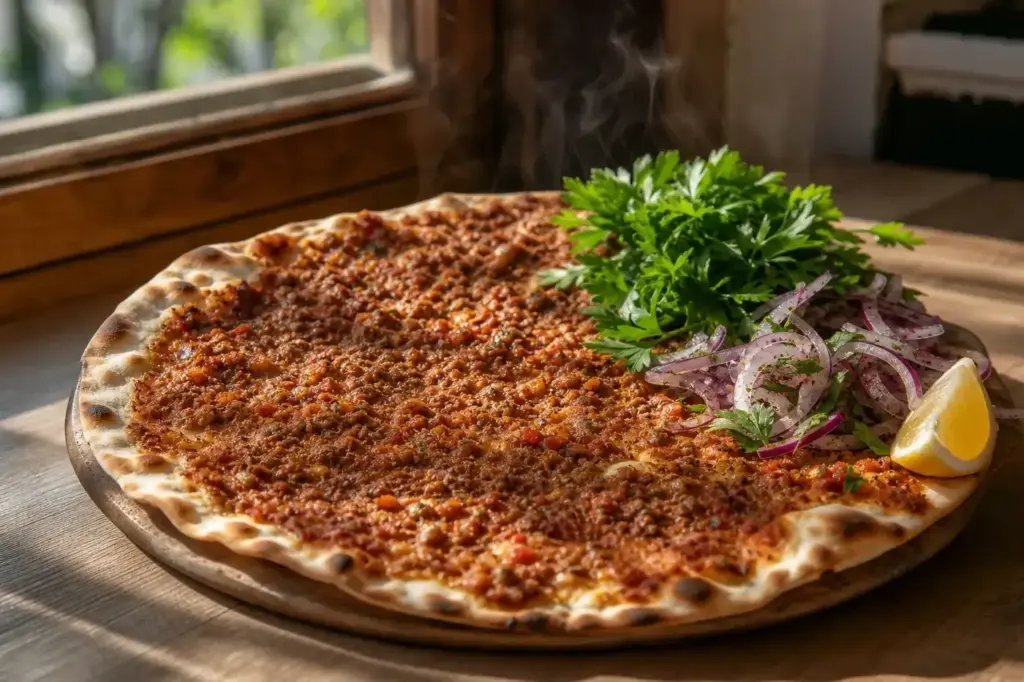
Lahmacun is one of Istanbul’s quickest and most affordable street foods, perfect when you’re hungry between sightseeing. Often called “Turkish pizza,” it is nothing like pizza: instead of cheese and sauce, a whisper-thin crust carries a layer of seasoned minced meat mixed with fresh vegetables and spices.
This guide teaches you how to make authentic lahmacun at home. The key is rolling the dough tissue-thin and baking it in a very hot oven until the edges crisp and blister. The result is soft in the middle with a crackle at the edges—exactly what a good lahmacun should be.
Quick answer: Lahmacun's heartland is southeastern Turkey, but it is eaten throughout the country and across the Eastern Mediterranean. The dish is a flatbread topped with minced meat (most commonly beef or lamb), minced vegetables, and herbs such as onions, garlic, tomatoes, red peppers, and parsley, flavored with spices such as chili pepper and paprika, then baked. Total time: 1 hour (mostly rising time). Cost: budget.
At a Glance
| Type | Street food & snacks |
|---|---|
| Local name | лахмаджун |
| Origin | The dish originated in the Levant region of West Asia and the earliest known written evidence of its existence comes from medieval Syria where it is traditionally known by its Arabic name lahm bi ʿajīn ("meat with dough"). Variants of lahmacun are also common in Armenia and Turkey, where the dish became popular in local cuisines. Lahmacun's heartland is southeastern Turkey—cities like Gaziantep and Şanlıurfa (Urfa), where Ottoman trade routes, Aleppo pepper, and stone ovens shaped the food culture for centuries. |
| Servings | 2–4 servings (makes 4–5 lahmacun) |
| Total time | About 1 hour, including 30 minutes dough rest and 10–15 minutes baking |
| Difficulty | Medium |
History and Story of Lahmacun
The earliest known written evidence of lahmacun’s existence comes from medieval Syria, where it is traditionally known by its Arabic name lahm bi ʿajīn (“meat with dough”). The 17th-century Ottoman traveler Evliya Çelebi also notices the dish for the first time in Syria, Damascus, listing lahm-ı acîn among the notable foods of Damascus. Lahmacun’s heartland is southeastern Turkey—cities like Gaziantep and Şanlıurfa (Urfa), where Ottoman trade routes, Aleppo pepper, and stone ovens shaped the food culture for centuries. It spread from the eastern regions of Turkey to the whole country after the 1960s.
Ingredients
- 250–300 g ground beef or lamb (or mixture of both)
- 2 cups all-purpose flour
- ¾ cup warm water
- ¼ teaspoon instant dry yeast
- ½ teaspoon salt
- 1 medium onion
- 1 tomato
- 1 green pepper
- 2 garlic cloves
- ¼ cup fresh parsley
- 1 tablespoon tomato paste
- 1 teaspoon paprika
- ½ teaspoon ground cumin
- Black pepper to taste
- 1 tablespoon olive oil
How Lahmacun Is Made
Step 1: Mix the dough
In a large bowl, combine flour, salt, yeast and sugar (if using). Make a well in the center, pour in warm water and olive oil. Stir until the mixture comes together into a rough dough.
Tip: Warm water (not hot) helps the yeast activate without killing it.
Step 2: Knead until smooth
Turn the dough onto a clean surface and knead for 5 minutes until it becomes smooth, elastic and stops sticking to your hands. Add a little more water if too dry, a pinch of flour if too sticky.
Tip: You can also knead in a mixer with a dough hook for 3–4 minutes.
Step 3: Let dough rest
Shape the dough into a ball. Place it in a clean bowl, cover with a damp cloth, and let it rest for 30 minutes at room temperature. Unlike bread dough, lahmacun dough does not need to rise dramatically.
Tip: If your kitchen is cold, place the bowl in a warm spot near a window or oven.
Step 4: Prepare the topping
Finely chop onion, tomato, pepper and garlic, or pulse them together in a food processor. Add the minced meat, parsley, tomato paste, paprika, cumin, salt and black pepper. Mix everything thoroughly with a fork or by hand until combined. The mixture should be finely textured, not chunky.
Tip: A food processor makes this quick, but chop by hand if you prefer a coarser texture.
Step 5: Divide and shape dough
Divide the rested dough into 4–5 equal pieces. On a lightly floured surface, roll each piece into a very thin circle, about the size of a dinner plate. The dough should be so thin you can almost see light through it.
Tip: Use a rolling pin and work slowly; if the dough resists, let it rest for a minute before continuing.
Step 6: Spread the topping
Place a rolled dough circle on a baking sheet or pizza peel. Spread 2–3 tablespoons of the meat mixture over the dough in a thin, even layer, leaving a small border at the edge. Do not overload; the filling should be a thin coat, not thick.
Tip: Wet hands help you spread the mixture evenly without tearing the delicate dough.
Step 7: Bake until crisp
Preheat your oven as hot as it will go (450–480°F / 230–250°C). Slide the lahmacun onto the hot baking sheet and bake for 10–15 minutes until the edges are golden brown and slightly blistered, and the meat is cooked through. The bottom should be crispy and speckled with brown.
Tip: For crispier results, preheat a pizza stone in the oven and bake on it; reduce time to 6–8 minutes.
Variants
- Minced lamb instead of beef, or a mixture of both
- Addition of finely chopped eggplant or zucchini to the topping
- Different spice blends: some regions use more cumin or add sumac and allspice instead of paprika
- Toppings that include pickled peppers, radishes or a small amount of pine nuts
- Baked on a wood-fired oven stone (traditional in Turkey) versus a home oven
Common Mistakes to Avoid
- Rolling the dough too thick: Lahmacun should be tissue-thin so the crust stays light and crispy. If too thick, it becomes doughy and heavy. Roll it until you can see light through it.
- Using too much topping: A heavy, thick layer of meat makes the flatbread soggy and difficult to eat. The filling should be a thin coat, barely covering the dough.
- Not heating the oven hot enough: A cool oven will not crisp the edges or cook the meat quickly. The oven must be as hot as possible; lahmacun is meant to bake fast and hard.
- Letting the dough rest too long: If the dough sits longer than an hour before baking, it will over-rise and become puffy instead of thin and flat. Keep the timeline tight.
- Pressing the meat into the dough too hard: Gentle spreading prevents tearing the thin dough. Use your fingers or the back of a spoon; do not knead or crush the topping into the base.
- Overcooking the meat topping: The meat should be just cooked through, not dried out. Watch the oven carefully after 10 minutes; baking times vary by oven.
- Forgetting the squeeze of lemon: Lahmacun is traditionally served with fresh lemon juice, which cuts the richness of the meat and brightens the entire dish. Lemon is not optional—it is essential to how it tastes.
How to Order and Eat It
Lahmacun is often wrapped around vegetables, including pickled vegetables, tomatoes, peppers, onions, lettuce, parsley, and roasted eggplant. Lahmacun is rolled very thin, open-faced, and eaten rolled with herbs and lemon. The traditional way to eat it is hot off the pan: squeeze fresh lemon juice over the top, scatter chopped parsley, raw onion slices and tomato, then roll it up like a wrap and eat it by hand. In Istanbul, street vendors serve lahmacun this way, and you stand at the counter or sit at a small table with Turkish tea. The fresh vegetables and lemon cut through the richness of the meat and make each bite bright and satisfying.
To order: Bir lahmacun, lütfen [Beer lah-mah-JOON, LÜ-fen]
Diet and Allergens
- Contains gluten
Where to Try Lahmacun
 Mahir Lokantası Anatolian home cooking, lahmacun and daily lokanta dishes
Main image: AI-generated illustration. It may not show the place exactly as it looks.
 Çiya Kebap Regional Anatolian kebab, lahmacun and pide
Main image: AI-generated illustration. It may not show the place exactly as it looks.
 Develi Samatya Gaziantep (Antep) kebab and Turkish dishes
Main image: AI-generated illustration. It may not show the place exactly as it looks.
 Tatbak Gaziantep-style kebab and lahmacun
Main image: AI-generated illustration. It may not show the place exactly as it looks.
 Hamdi Restaurant Southeast Turkish, kebabs, meze
Main image: AI-generated illustration. It may not show the place exactly as it looks.
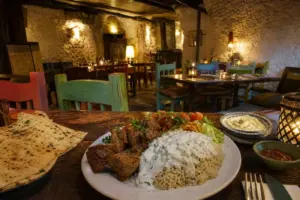 Vegan Community Kitchen Turkish Vegan
Main image: AI-generated illustration. It may not show the place exactly as it looks.
 Ritim12 min on foot from Tünel metro, Open daily 10:00–04:30
Main image: AI-generated illustration. It may not show the place exactly as it looks.
 Balkon2 min on foot from Tünel metro, Open daily 13:00–02:00
Main image: AI-generated illustration. It may not show the place exactly as it looks.
Istanbul Vibes Tips
- Buy a pizza stone or baking steel if you make lahmacun often. Preheating it inside the oven gives a much crisper, more authentic result than a standard baking sheet.
- Do not let the dough rest longer than 1 hour. Over-rested dough becomes puffy and loses the thin, delicate texture that makes lahmacun special.
- If you cannot roll the dough thin enough by hand, divide it into smaller pieces (6–8 instead of 4–5). Smaller circles are easier to stretch paper-thin.
- The traditional garnish is very important: squeeze lemon over the hot lahmacun immediately after it comes out of the oven. The heat releases the lemon aroma and flavor into the meat.
- Lahmacun is best eaten within minutes of baking, while the edges are still crispy and warm. If you must reheat leftovers, wrap them loosely in foil and warm gently in a 300°F oven for 5–10 minutes to avoid drying out the filling.
- If the meat topping is too loose or watery, drain excess liquid after mixing. Wet topping will make the dough soggy during baking.
Explore Nearby Lahmacun
Sights near Lahmacun
 Istiklal Avenue · typical visit: 2-3 hours12 min on foot from Tünel metro, Open 24 hours
Main image: AI-generated illustration. It may not show the place exactly as it looks.
Related guides
 Spice Bazaar and Grand Bazaar Route: Two Markets, Six Centuries
Main image: AI-generated illustration. It may not show the place exactly as it looks.
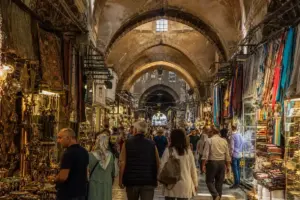 Istanbul Markets and Bazaars: A Three-Day Shopping and Exploration Itinerary
Main image: AI-generated illustration. It may not show the place exactly as it looks.
 Turkish Pide: Recipe, Filling Ideas and How to Shape the Boat
Main image: AI-generated illustration. It may not show the place exactly as it looks.
Browse more: All Food & Drink · All Other
FAQ
Is lahmacun the same as Turkish pizza?
Unlike pizza, lahmacun has no cheese and no tomato-sauce base — the meat mixture is the topping, and it is applied sparingly so the bread stays light. The crust is also much thinner and crispier than pizza dough. It has no cheese, a much thinner crust, and is usually rolled with parsley, onion, and lemon and eaten by hand. The term "Turkish pizza" is used by tourists and restaurants, but locals simply call it lahmacun.
What is the difference between lahmacun and pide?
Lahmacun is very thin and is often eaten like a wrap whereas pide is boat-shaped and has a thicker crust. Pide is also usually filled or folded, while lahmacun is open-faced and topped. Both are Turkish, but they are distinct dishes.
Can I use store-bought pizza dough?
Yes, though homemade dough is better. If using store-bought, thaw it fully, divide into smaller portions, and roll as thinly as possible. The dough will be slightly thicker than traditional lahmacun but still acceptable. Watch the baking time carefully, as store-bought dough may brown faster.
What if my dough keeps shrinking when I roll it?
This is normal. Let the dough rest on the work surface for 2–3 minutes after rolling, then stretch it gently by hand to the desired size. Do not force it; gentle handling prevents tearing. If it resists, rest it again.
Can I make lahmacun in a regular home oven?
Yes. Set your oven as hot as it will go, usually 450–480°F (230–250°C). Baking will take 10–15 minutes instead of 3–5 minutes in a wood-fired oven, and the results will not be quite as crispy, but it will still taste very good. Preheating a pizza stone helps.
What type of meat is best?
Minced meat is most commonly beef or lamb. Lamb is more traditional in southeastern Turkey but beef is more common in Istanbul. A mixture of both gives rich flavor. Ground lamb tends to be fattier and more flavorful; beef is leaner. Either works well.
Can I freeze lahmacun?
If you want to enjoy lahmacun in advance, you can easily freeze the flatbreads and bake them again when needed. Freeze the uncooked topped dough on a baking sheet, then transfer to bags. Bake from frozen, adding 2–3 minutes to the baking time.
What should I drink with lahmacun?
In Turkey, it is common street food eaten standing at the counter or shared at a table with Turkish tea. Ayran (a salty yogurt drink) and Turkish coffee also pair well. The slight saltiness of these drinks complements the savory, spiced meat.
Istanbul Vibes is a one-person project. A coffee keeps it going

Take this guide with you
Get a free PDF of this guide to print or read offline: key facts, tips and a map link on a few clean pages.
Report an issue on this page
How we research and update our guides
About this guide: AI assistance and accuracy
This guide is created with the help of AI and is based on official sources where available. Mistakes can still happen. Opening hours, prices, rules and other details are given to the best of our knowledge as of the date shown and can change without notice. It offers general recommendations only, not professional, legal or travel advice. Please confirm important details with the official source before you travel; you are responsible for your own plans and decisions.
* Affiliate link: as an Amazon Associate we earn from qualifying purchases at no extra cost to you.
