
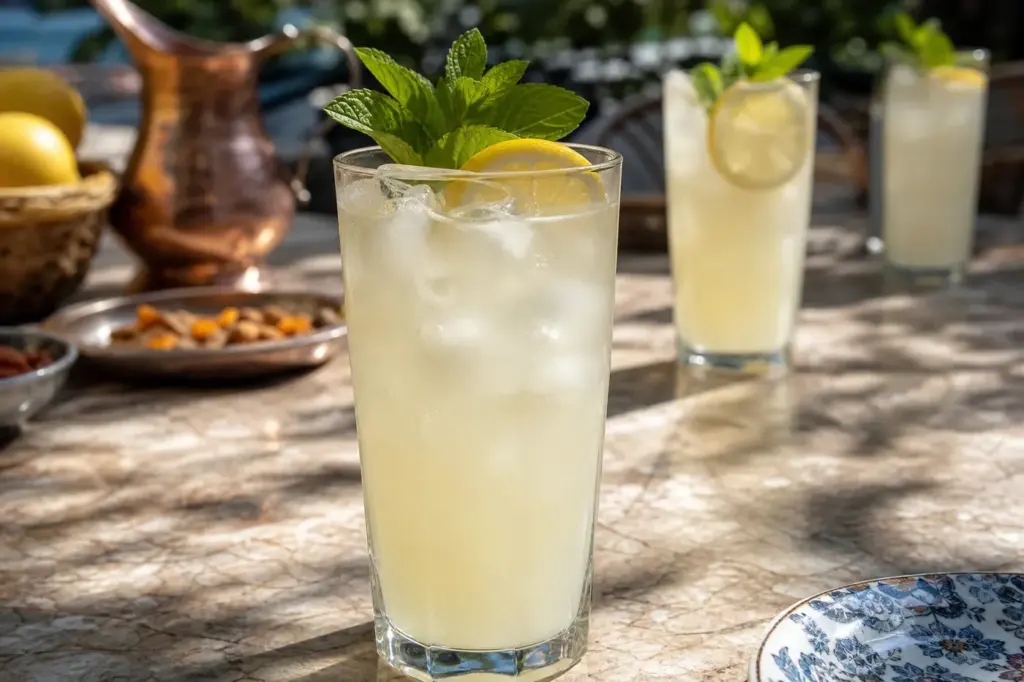
Turkish Lemonade (Limonata) is not the sour, sharp drink you might expect from the name. Instead, it is smooth, pale and fragrant—closer to the aroma of a freshly cut lemon than to ordinary lemonade. Turkish limonata is a whole-fruit drink. Lemon chunks go into the blender with the peel still on, sugar pulls the oils out of the zest, and a short rest lets everything mingle before you strain.
This guide shows you how to make limonata at home using simple ingredients and basic kitchen equipment. The whole process takes about 30 minutes of hands-on work, plus resting time, and produces a concentrate you can keep in the refrigerator all week.
Quick answer: Turkish limonata blends whole lemons, peel and all, so the zest oils flavor the drink. Rest the blitzed mix 10–15 minutes, then strain. Total time: 30 minutes of work plus 2–4 hours chilling.
At a Glance
| Type | Drinks |
|---|---|
| Origin | There is some debate on the exact origins of limonata. Some argue that it originated in Turkey, while others argue Syria. Limonata is one of every Turk's favorite homemade drinks. |
| Servings | Serves 2–4 glasses |
| Total time | 30 minutes hands-on; 2–4 hours chilling |
| Difficulty | Easy |
History and Story of Turkish Lemonade (Limonata)
There is some debate on the exact origins of limonata. Some argue that it originated in Turkey, while others argue Syria. Today it is popular across the Levantine region from Lebanon and Israel to Cyprus and Egypt. In Turkey, limonata is deeply rooted in everyday culture and has been a popular summer refreshment for generations. The drink is so central to Turkish life that when bottled limonata was introduced in 2007, it was marketed with the slogan ‘tastes like homemade’ and became a product for millions of people who want to freshen with a refreshing beverage.
Ingredients
- 4 large fresh lemons, scrubbed
- 150 g sugar
- 500 ml cold water
- Optional: fresh mint leaves
How Turkish Lemonade (Limonata) Is Made
Step 1: Wash and prepare the lemons
Rinse the lemons under cool running water and scrub lightly to remove any dirt. Pat them dry. Cut each lemon into 4–5 chunks, leaving the peel on. You do not need to remove seeds before blending, but you may discard any visible ones.
Tip: At Istanbul fruit markets (pazar), ask for lemons marked 'bol sulu' (very juicy) to get maximum juice yield.
Step 2: Blend the whole lemons with sugar
Add lemon chunks to the blender with the peel still on; sugar pulls the oils out of the zest. Pour in all the sugar and blend on high speed for 1–2 minutes until the mixture breaks down and becomes cloudy. Stop before the pith begins to turn the drink bitter.
Tip: Work quickly to avoid over-blending, which can make the pith release bitterness.
Step 3: Rest the mixture
Rest the blitzed mix 10–15 minutes, then strain. Let the blended mixture sit undisturbed in a bowl or jug at room temperature for 10–15 minutes to allow the sugar to dissolve and flavors to mingle.
Tip: Do not leave the mixture longer than 30 minutes before straining, as the pith will turn it bitter.
Step 4: Strain the concentrate
Pour the rested mixture through a fine mesh sieve or cheesecloth into a clean pitcher or jar. Press gently on the solids to extract all the liquid, then discard the pulp. The result is a pale, cloudy concentrate.
Tip: For a smoother drink, strain a second time through fresh cheesecloth.
Step 5: Chill and dilute to serve
Refrigerate the concentrate for at least 2–4 hours or overnight. To serve, pour 1 part concentrate into a glass and add 2–3 parts cold water, depending on how strong you prefer it. Serve it ice-cold, often with fresh mint or topped with sparkling maden suyu (Turkish mineral water).
Tip: A strained concentrate keeps about 4 days in the fridge, so you can mix a glass at a time all week.
Variants
- With mint: Add a sprig of fresh mint leaves to the blender at the same time as the lemon and sugar for a minty version.
- With orange: Blend 2–3 lemons with 1 orange for a slightly sweeter, more aromatic drink.
- Sparkling limonata: Top a glass of chilled concentrate mixed with cold water with sparkling mineral water or soda water instead of still water.
- Syrup concentrate: Store the strained concentrate at full strength in a bottle and serve as a table syrup to mix into hot or cold water throughout the week.
Common Mistakes to Avoid
- Over-blending the mixture: Blending past the point where the peel breaks down releases bitter compounds from the pith. Keep blending time short and stop as soon as the mixture is cloudy.
- Straining too late: Rest the blitzed mix 10–15 minutes, then strain. Much past 30 minutes, the pith turns it bitter.
- Using bottled or old lemon juice: Fresh-squeezed juice is essential for authentic limonata. The peel oils, which give limonata its distinctive fragrance, are lost if you use pre-squeezed juice.
- Adding ice directly to the concentrate: Ice dilutes the drink too quickly as it melts. Chill the concentrate first, then add ice to cold water mixed with concentrate.
- Not straining properly: Leaving pulp and fine pith particles in the finished drink can make it cloudy and slightly bitter. Use a fine sieve or line your strainer with cheesecloth.
- Storing in the heat: Keep the concentrate in the refrigerator, not at room temperature. A strained concentrate keeps about 4 days in the fridge.
How to Order and Eat It
Turkish lemonade is always served very cold, usually over ice. Sip it slowly on hot days to refresh without chilling yourself too quickly. It is often served with fresh mint leaves or topped with sparkling maden suyu (Turkish mineral water). The drink is commonly enjoyed at home, in cafes and restaurants, or from street stalls during summer months. Some people prefer the concentrated syrup mixed into still water for a lighter refreshment; others like it stronger with less water. There is no strict rule—adjust the ratio of concentrate to water to suit your taste.
To order: Limonata lütfen [Limonata please]
Istanbul Vibes Tips
- At Istanbul's street food stalls and open-air restaurants (lokanta), freshly made limonata is often poured over ice from a large glass jug. If you order one, the vendor will usually fill it generously and sometimes add a sprig of mint without asking. Watch vendors prepare it—you'll often see the whole-lemon method used.
- Turkish lemons and sugar are available at any neighborhood fruit and vegetable market (pazar) or supermarket. Markets often have better prices than tourist areas. Mint is typically sold at the same market stalls. For the best results, buy your ingredients from a market on the morning you plan to make limonata.
- Many Istanbul households keep a jug of limonata concentrate in the refrigerator during summer. This habit lets you offer fresh limonata to guests at any moment. If you're staying in a rented flat or hotel with kitchen access, making your own batch is cheaper than buying it elsewhere.
- Do not confuse limonata with limonana—the mint-heavy version—or with commercially bottled drinks. Homemade limonata has a pale, cloudy appearance and subtle flavor. If it looks clear or tastes overly sour, it has not been made using the traditional whole-lemon method.
- On very hot Istanbul days (above 35°C), chill your glasses and pitcher before serving to keep the drink cold longer. Some Turks also serve limonata over crushed ice rather than cubes, which slows melting and prevents excessive dilution.
- If you are traveling during summer and staying in a hostel or guesthouse without kitchen access, ask staff if they can make you a glass. Many places keep limonata in the fridge for guests. It is often free or costs a small amount.
Where to Find Turkish Lemonade (Limonata) in Istanbul
Related guides
 Ayran: How to make Turkish yogurt drink at home
Main image: AI-generated illustration. It may not show the place exactly as it looks.
 Turkish Tea: How to Brew and Serve It Like Istanbul Locals
Main image: AI-generated illustration. It may not show the place exactly as it looks.
 Turkish Coffee: How to Make It, Its History and Ritual
Main image: AI-generated illustration. It may not show the place exactly as it looks.
 Dolma: How to Make Turkish Stuffed Grape Leaves
Main image: AI-generated illustration. It may not show the place exactly as it looks.
Browse more: All Food & Drink · All Other
FAQ
Is Turkish limonata the same as regular lemonade?
American lemonade is a juice drink: squeeze, sweeten, dilute. Turkish limonata is a whole-fruit drink. Lemon chunks go into the blender with the peel still on, sugar pulls the oils out of the zest, and a short rest lets everything mingle before you strain. What comes out is cloudy, pale, and fragrant—closer to the smell of a just-cut lemon than to sour sugar water.
Why is Turkish limonata not as sour as American lemonade?
Turkish lemonade has a refreshing lemon taste without the sourness. The lemon rinds and sugar are either rubbed together or cooked before they are mixed with the lemon juice. This leaves you with a smooth, sweet lemonade minus the bite.
How long does homemade limonata keep?
A strained concentrate keeps about 4 days in the fridge, so you can mix a glass at a time all week. Once diluted with water, drink it within 24 hours for the best flavor.
Can I add orange or other flavors to limonata?
Yes. Some regional variations include orange juice or zest. Some Turks add fresh ginger or other citrus fruits. You can experiment by blending 2–3 lemons with 1 orange using the same method. However, the classic version uses only lemons, sugar, water and optional mint.
What is the best way to store limonata concentrate?
Store the strained concentrate in a clean glass bottle or jar in the refrigerator. Cover tightly to prevent it from absorbing odors from other foods. It will keep for about 4 days. Do not store at room temperature, as the concentrate can spoil.
Can I make limonata without a blender?
Yes, but the result will be different. Traditional Turkish cooks sometimes squeeze the juice and finely grate the zest, then mix both with sugar and let them sit for several hours. This method takes longer but produces a similar fragrant concentrate. Blending is faster and extracts more of the peel oils.
Is limonata suitable for all diets?
Basic homemade limonata contains only lemons, sugar, and water, so it is vegan and naturally dairy-free. However, always check the ingredient list if you buy bottled limonata, as some brands may contain additives. If you want to reduce sugar, adjust the ratio to your taste.
Can I serve limonata to guests at a Turkish dinner?
Yes. Offering cold limonata alongside tea or coffee is a common Turkish hospitality gesture in summer. Guests often appreciate the homemade version more than bottled drinks. Prepare the concentrate in advance and chill it, then offer guests a choice of concentrate mixed with water or sparkling water.
Istanbul Vibes is a one-person project. A coffee keeps it going

Take this guide with you
Get a free PDF of this guide to print or read offline: key facts, tips and a map link on a few clean pages.
Report an issue on this page
How we research and update our guides
About this guide: AI assistance and accuracy
This guide is created with the help of AI and is based on official sources where available. Mistakes can still happen. Opening hours, prices, rules and other details are given to the best of our knowledge as of the date shown and can change without notice. It offers general recommendations only, not professional, legal or travel advice. Please confirm important details with the official source before you travel; you are responsible for your own plans and decisions.
* Affiliate link: as an Amazon Associate we earn from qualifying purchases at no extra cost to you.
